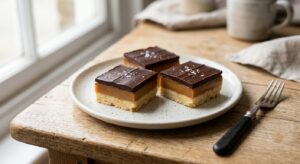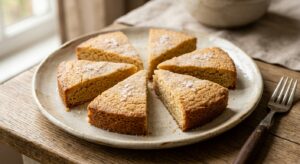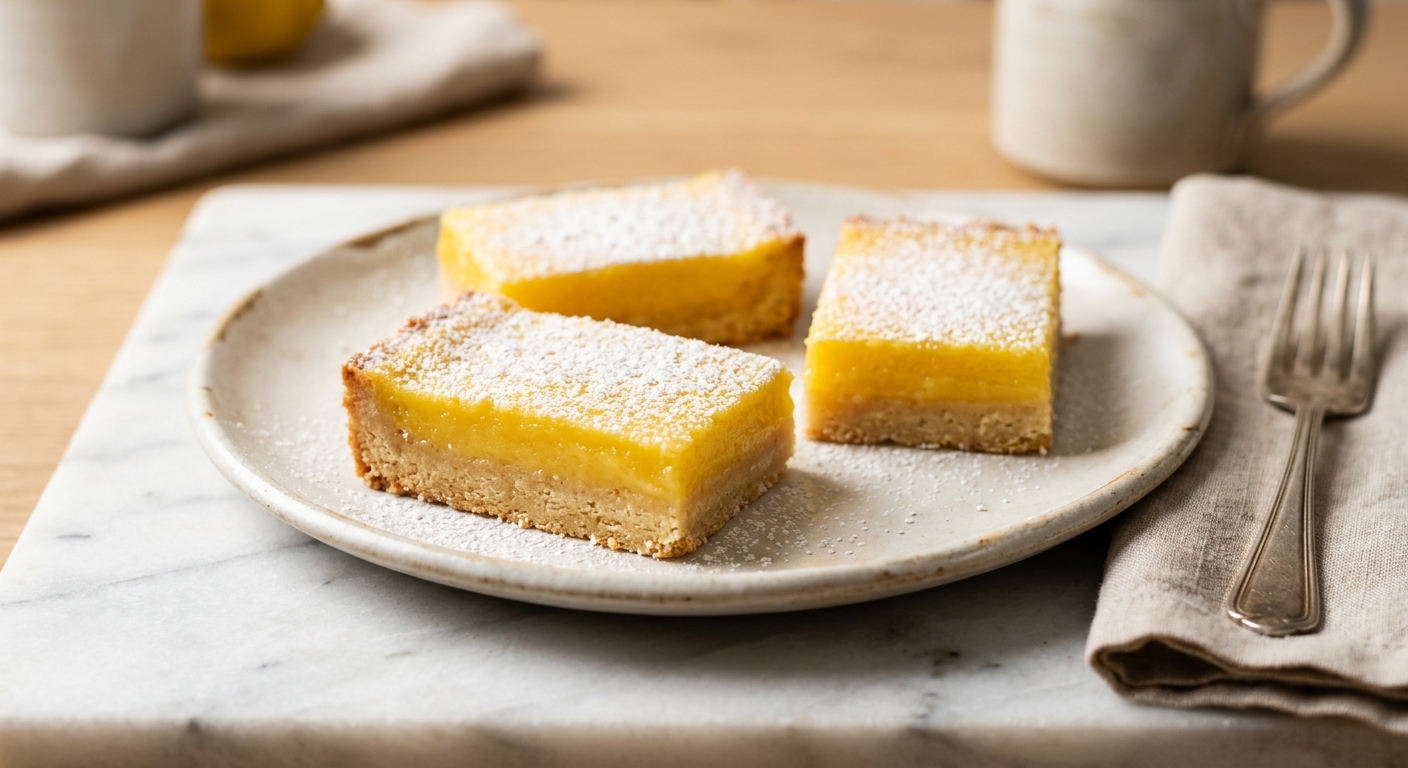
There is something almost magical about a great lemon bar. The moment you bite through that snowy dusting of powdered sugar into the silky, trembling lemon curd and then hit that crumbly, buttery shortbread beneath, everything about it just feels right. Sunny and bright, a little tart, a little sweet, and completely satisfying. These are the bars that disappear from a baking dish before they have had a proper chance to cool, the ones guests ask you to bring to every gathering, the ones you sneak from the fridge at midnight just because you know they are there.
What sets this version apart is a two-stage approach to both layers. The shortbread crust is pressed in and par-baked before the filling ever touches the pan, which guarantees it stays crisp and distinct rather than soggy or underbaked. The lemon curd filling uses a higher ratio of egg yolks to whole eggs, which gives it a deeply golden color, a richer flavor, and a smooth, creamy set that slices cleanly without cracking. Fresh lemon juice and zest are non-negotiable here: the zest carries the essential oils that give lemon its floral, aromatic punch, something bottled juice simply cannot replicate.
These lemon bars are a medium-difficulty bake, mostly because the curd requires a watchful eye during the final stretch in the oven, but there is nothing technically demanding about the process. They are perfect for anyone who loves a classic, crowd-pleasing dessert with genuine homemade flavor. Whether you are baking for a spring brunch, a potluck, or just a quiet Tuesday afternoon when you need something cheerful, this recipe will not let you down.
Equipment Needed
Click on an item below to shop for the recommended items for this recipe on Amazon.
As an Amazon Associate, we earn from qualifying purchases.
16
Ingredients
- Crust
- 240 gall-purpose flour (about 2 cups, spooned and leveled)
- 60 gpowdered sugar, sifted (about 1/2 cup), for the crust, plus extra for dusting
- 30 gcornstarch (about 3 tablespoons)
- 0.5 tspColima Sea SaltMicroplastic Free Salt, divided (1/4 tsp for crust, 1/4 tsp for filling)
- 225 gunsalted butter, cold and cut into 1/2-inch cubes (1 cup or 2 sticks)
- 1 tsppure vanilla extract
- Filling
- 400 ggranulated sugar (about 2 cups)
- 4 wholelarge eggs, at room temperature
- 4 wholelarge egg yolks, at room temperature
- 180 mlfreshly squeezed lemon juice (from about 6 to 8 lemons, approximately 3/4 cup)
- 2 tbspfinely grated lemon zest (from about 4 lemons)
- 30 gall-purpose flour (about 3 tablespoons)
Ingredient Substitutions
Instructions
- Preheat your oven to 350°F (175°C). Line a 9×13-inch baking pan with parchment paper, leaving an overhang on the two long sides so you can lift the bars out cleanly. Lightly grease any exposed pan corners.
- Make the shortbread crust: In a food processor, pulse together the 240g flour, sifted powdered sugar, cornstarch, and 1/4 teaspoon salt until combined, about 5 pulses. Add the cold butter cubes and vanilla extract, then pulse 15 to 20 times until the mixture resembles coarse, damp sand with no large butter chunks remaining. It should hold together when you squeeze a small handful. If you do not have a food processor, grate the cold butter on a box grater into the flour mixture and rub together with your fingertips until sandy.
- Press the crust firmly and evenly into the prepared pan using the flat bottom of a measuring cup or a straight-sided glass. Aim for an even, compact layer reaching all four corners. Par-bake for 15 minutes, until the edges are just barely golden and the center looks set and dry. Remove from the oven and let it rest while you make the filling. Do not turn the oven off.
- Make the lemon filling: In a large bowl, whisk together the granulated sugar, 30g flour, and 1/4 teaspoon salt. Add the 4 whole eggs and 4 egg yolks and whisk vigorously until smooth and fully combined, about 1 minute. Whisk in the fresh lemon juice and lemon zest until the mixture is uniform. The filling will be quite fluid at this stage.
- Pour the lemon filling directly over the still-warm shortbread crust. Return the pan to the oven and bake for 28 to 32 minutes, until the filling is set around the edges with just a slight, gentle wobble in the very center when you nudge the pan. It should no longer look wet or glossy in the center. If the edges are browning too quickly, tent loosely with foil.
- Remove from the oven and cool completely in the pan on a wire rack, about 1 hour at room temperature. Then refrigerate for at least 1 hour (or up to overnight) before cutting, as chilling fully firms the curd and gives you clean, neat slices.
- When ready to serve, use the parchment overhang to lift the entire slab out of the pan and onto a cutting board. Dust generously with powdered sugar through a fine-mesh sieve. Cut into 16 bars using a sharp knife wiped clean between cuts. Serve chilled or at cool room temperature.
- Halve all ingredient quantities. Line a 7-inch or 8×8-inch square metal pan (confirmed to fit inside your air fryer basket) with parchment paper and grease lightly. Prepare the shortbread crust as described in the oven method, using a food processor or fingertip method.
- Press the halved crust mixture firmly and evenly into the prepared pan. Place the pan in the air fryer basket. Air fry at 325°F (160°C) for 12 minutes, until the crust looks pale golden and set. Remove the pan carefully using tongs or oven mitts.
- Prepare the halved lemon filling as described in the oven method, whisking together sugar, flour, salt, eggs, yolks, lemon juice, and zest until smooth. Pour directly over the warm crust.
- Return the pan to the air fryer basket. Air fry at 300°F (150°C) for 20 to 24 minutes, checking at 20 minutes. The filling should be set at the edges with a very slight tremble in the center and should not look wet or shiny. If the top is browning too quickly, lay a small piece of foil loosely over the top of the pan without sealing it (to allow airflow).
- Remove and cool in the pan for 30 minutes at room temperature, then refrigerate for at least 45 minutes before lifting out, dusting with powdered sugar, and cutting into 8 bars. Wipe the knife between cuts for clean edges.
- Make the no-bake crust: Blitz 250g (about 9 oz) of shortbread cookies or vanilla wafers in a food processor until fine crumbs form. Add 75g (5 tablespoons) melted unsalted butter and a pinch of salt, then pulse just until the crumbs are evenly moistened. Press firmly into a parchment-lined 9×13-inch pan using a flat-bottomed measuring cup. Refrigerate while you make the curd.
- Make the stovetop curd: In a medium heavy-bottomed saucepan (not aluminum, which can react with lemon), whisk together 400g granulated sugar, 50g cornstarch (replacing both the filling flour and adding extra for a no-bake set), and 1/4 teaspoon fine sea salt. Whisk in 360ml (1.5 cups) cold water until smooth, then whisk in 180ml fresh lemon juice and 2 tablespoons lemon zest.
- Whisk in 4 whole eggs and 4 egg yolks until fully combined. Place the saucepan over medium heat and cook, whisking constantly, for 8 to 12 minutes until the mixture thickens noticeably, begins to bubble in the center, and coats the back of a spoon. Once bubbling, cook for exactly 1 additional minute while whisking to ensure the cornstarch is fully cooked out.
- Remove from heat and whisk in 60g (4 tablespoons) cold unsalted butter, one cube at a time, until fully melted and glossy. This enriches the curd and makes it silky. Strain the curd through a fine-mesh sieve directly over the chilled crumb crust to catch any cooked egg bits and remove the zest for a smoother texture.
- Press a sheet of plastic wrap directly onto the surface of the curd (this prevents a skin from forming). Refrigerate for at least 3 hours, or until fully set and firm enough to slice cleanly. Dust with powdered sugar and cut into bars as directed. Store covered in the refrigerator; these bars do not hold well at room temperature due to the softer curd.
Nutrition Per Serving
Per 1 serving (makes one 9×13-inch pan, cut into 16 bars)
Why This Recipe Works
The cornstarch in the shortbread crust is the quiet hero here. Standard shortbread uses only butter, flour, and sugar, which produces a good cookie but can turn slightly tough if overworked. Cornstarch disrupts the formation of long gluten chains, keeping the crust impossibly tender and creating that signature melt-on-the-tongue texture. Par-baking the crust before adding the filling is also essential: it sets and crisps the base so it does not become a soggy, underbaked layer under the weight of the wet curd. A soft or underbaked crust is the most common textural flaw in lemon bars, and this step is the direct fix.
In the lemon curd filling, the balance between whole eggs and extra yolks is deliberate and meaningful. Egg whites contain mostly water and protein; they set firmly and can make a curd rubbery or slightly grainy if overdone. Egg yolks are rich in fat and lecithin, a natural emulsifier, which gives the curd its smooth, creamy, voluptuous texture and that deep, beautiful golden color. The small amount of flour whisked into the filling acts as a gentle stabilizer, helping the curd hold its structure when sliced and preventing it from weeping liquid over time. It is not enough to make the filling taste cakey; it is purely functional.
If your filling ever cracks on top, it almost always means the oven temperature was too high or the bars baked too long, causing the egg proteins to tighten and contract. The goal is a low, gentle bake that barely sets the curd. Likewise, if your bars look perfect in the oven but the filling weeps a puddle of liquid after chilling, the curd was underbaked and the proteins did not fully set. A reliable test: the filling should be completely opaque, not glossy or translucent in the center, and a gentle nudge of the pan should produce only the faintest jiggle, similar to a just-set panna cotta.
Baker’s Tips
- Use a microplane or fine rasp grater for the lemon zest and stop grating when you reach the white pith, which is bitter. Zest before juicing, as it is much easier on a whole lemon.
- Whisk the filling thoroughly before pouring to fully dissolve the sugar and distribute the eggs evenly. Lumps of undissolved sugar can cause uneven spots in the baked curd.
- Always strain the finished baked bars before cutting (or strain the no-bake curd before pouring) if a perfectly smooth surface matters to you.
- Pour the filling over the warm crust while the crust is still in the oven, pulling the rack out slightly and pouring on the rack to minimize the distance you carry a full pan of liquid filling.
- For perfectly neat square cuts, use a sharp chef’s knife dipped in hot water and wiped dry between every single cut. Cold bars from the refrigerator cut far more cleanly than room-temperature bars.
- Do not dust with powdered sugar until right before serving. Powdered sugar is hygroscopic and will absorb moisture from the curd surface, turning invisible within an hour or two.
- If your lemons are not yielding enough juice, microwave each whole lemon for 15 seconds before rolling firmly on the counter. This softens the membranes and dramatically increases juice output.
Variations
- Meyer Lemon Bars: Substitute Meyer lemon juice and zest for regular lemon. Meyer lemons are sweeter and more floral, so reduce the granulated sugar in the filling to 340g (1 3/4 cups) to keep the balance.
- Lemon Lavender Bars: Add 1 teaspoon of finely ground culinary dried lavender to the shortbread crust along with the dry ingredients. The floral note pairs beautifully with the bright lemon curd.
- Lime Bars: Replace lemon juice with fresh lime juice and lemon zest with lime zest for a slightly more tropical, sharper flavor profile. Works one-to-one with no other changes needed.
- Lemon Coconut Bars: Press 60g (about 2/3 cup) toasted sweetened shredded coconut into the par-baked crust immediately after it comes out of the oven, before adding the filling. It toasts further during the second bake and adds a lovely chew.
- Brown Butter Shortbread Crust: Brown the butter before using it in the crust for a nutty, toasty depth. Cool the browned butter in the freezer until just firm (about 45 minutes) before using in the recipe.
Troubleshooting & FAQ
My lemon filling is still liquid or jiggly in the center after the full bake time. What happened?
My shortbread crust is soggy or soft underneath the filling. How do I fix this?
There are small white or brown flecks in my baked lemon filling. Did something go wrong?
My bars look perfect but are weeping liquid after I cut them. Why?
The powdered sugar dusting disappeared into the bars almost immediately. How do I get it to stay?
Storage & Make-Ahead
- Storage: Store cut bars in an airtight container in the refrigerator for up to 5 days. Layer them between sheets of parchment or wax paper to prevent sticking. For room temperature serving, remove bars 20 minutes before serving. Uncut bars (whole slab) can be refrigerated in the pan covered with plastic wrap for the same duration. Freeze fully cooled, undusted bars in an airtight container with parchment between layers for up to 2 months. Thaw overnight in the refrigerator and dust with fresh powdered sugar before serving.
- Make-Ahead: The shortbread crust can be par-baked up to 1 day ahead and stored covered at room temperature. The entire assembled, baked slab can be made up to 2 days ahead and refrigerated uncut, which actually improves the texture as the curd firms further. Dust with powdered sugar only just before serving, as powdered sugar will absorb into the moist curd surface if applied too far in advance.