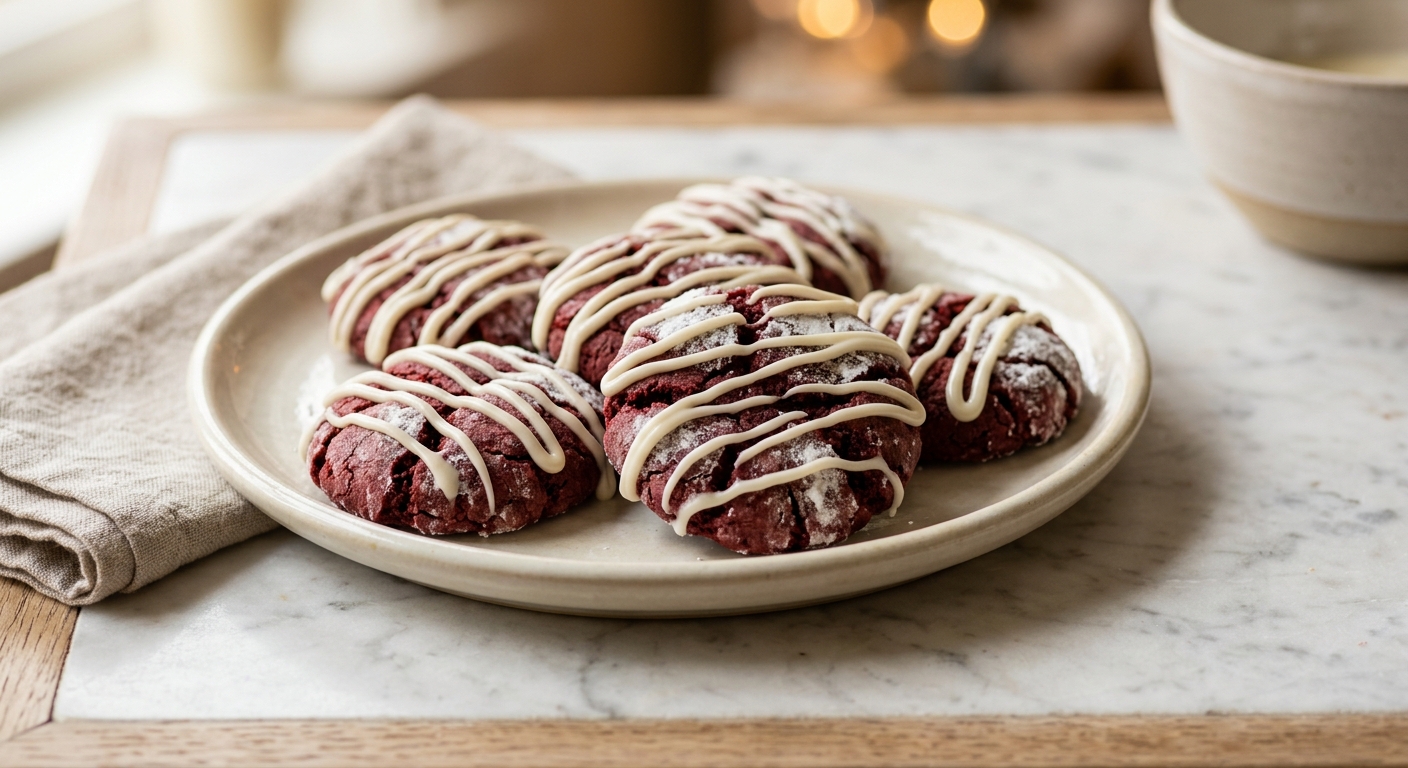
There is something undeniably theatrical about a crinkle cookie. One moment it is a smooth, glossy ball rolled in snowy powdered sugar, and the next, the oven transforms it into a cracked, jewel-toned beauty with a fudgy center that practically begs to be bitten into. Now imagine that same magic in deep crimson red velvet, with a subtle cocoa warmth, a slight tang from buttermilk, and a cream cheese drizzle that zigzags across the top like the finishing stroke on a pastry chef’s canvas. These cookies are absolutely showstopping.
What sets this version apart is a combination of chilling the dough thoroughly before baking and using both butter and cream cheese directly in the cookie dough. The fat from the cream cheese keeps the centers impossibly tender while the butter provides spread and flavor. A measured amount of Dutch-process cocoa gives depth without overpowering the vanilla-forward red velvet character, and the double-sugar coating, first granulated then powdered, ensures that signature crackled exterior that crinkle cookies are famous for.
These cookies sit comfortably at a medium difficulty level. There is nothing technically intimidating here, but you do need to plan ahead for the chilling step, which is non-negotiable for proper crinkle formation. They are ideal for holiday cookie trays, Valentine’s Day gifts, bake sales, or any occasion where you want to hand someone something that looks completely impressive with a reasonable amount of effort.
Equipment Needed
Click on an item below to shop for the recommended items for this recipe on Amazon.
As an Amazon Associate, we earn from qualifying purchases.
24
Ingredients
- Drizzle, About 1/2 Cup
- 215 gall-purpose flour (about 1 3/4 cups, spooned and leveled)
- 25 gDutch-process cocoa powder (about 3 tablespoons)
- 1 tspbaking powder
- 0.5 tspbaking soda
- 0.5 tspColima Sea SaltMicroplastic Free Salt
- 115 gunsalted butter, softened to room temperature (1 stick or 1/2 cup)
- 60 gfull-fat cream cheese, softened to room temperature (about 1/4 cup)
- 200 ggranulated sugar (1 cup)
- 50 gpacked light brown sugar (about 1/4 cup)
- 2 largeeggs, at room temperature
- 2 tsppure vanilla extract
- 1.5 tspwhite wine vinegar or distilled white vinegar
- 15 mlred gel food coloring (1 tablespoon, adjust to desired depth)
- 30 mlbuttermilk, at room temperature (2 tablespoons)
- 100 ggranulated sugar for rolling (about 1/2 cup)
- 120 gpowdered sugar for rolling, sifted (about 1 cup)
- 115 gfull-fat cream cheese, softened
- Drizzle, About 1 Cup
- 120 gpowdered sugar, sifted
- Drizzle, 2 Tablespoons, Plus More As Needed
- 30 mlwhole milk or heavy cream
- Drizzle
- 0.5 tsppure vanilla extract
Ingredient Substitutions
Instructions
- Make the dough: Whisk together the flour, cocoa powder, baking powder, baking soda, and salt in a medium bowl. Set aside.
- In the bowl of a stand mixer fitted with the paddle attachment (or using a hand mixer), beat the softened butter and cream cheese together on medium speed for 2 minutes until smooth and well combined. Add the granulated sugar and brown sugar and beat on medium-high for 3 full minutes until light and fluffy, scraping down the sides once.
- Add the eggs one at a time, beating for 30 seconds after each addition. Mix in the vanilla extract, white vinegar, and red gel food coloring until evenly combined. Add the buttermilk and mix briefly on low.
- Add the dry ingredients all at once and mix on low just until no streaks of flour remain. Do not overmix. The dough will be soft and slightly sticky. Cover the bowl tightly with plastic wrap and refrigerate for at least 2 hours, or overnight for best results.
- When ready to bake, preheat your oven to 350°F (175°C). Line two baking sheets with parchment paper. Set up a rolling station: place the granulated sugar in one shallow bowl and the sifted powdered sugar in another.
- Scoop the chilled dough into balls approximately 1.5 tablespoons each (about 35g). Roll each ball first in the granulated sugar until lightly coated, then roll generously in the powdered sugar until fully white and opaque. Place on the prepared baking sheets about 2 inches apart.
- Bake for 11 to 13 minutes, until the edges are set and the tops are cracked but the centers still look slightly underdone. They will firm up significantly as they cool. Do not overbake. Cool on the baking sheet for 5 minutes, then transfer to a wire rack to cool completely.
- Make the cream cheese drizzle: Beat the softened cream cheese with a hand mixer or whisk until smooth. Sift in the powdered sugar and mix until combined. Add the vanilla and milk one tablespoon at a time until you reach a thick but pourable consistency (it should fall from a spoon in a slow ribbon). Transfer to a small zip-lock bag or piping bag, snip a tiny corner, and drizzle over the completely cooled cookies. Let the drizzle set for 15 minutes before serving or stacking.
- Prepare the dough following the full dough recipe through the chilling step (at least 2 hours refrigerator time is still required for proper crinkle formation in the air fryer).
- Preheat your air fryer to 325°F (163°C) for 3 minutes. Cut a piece of parchment paper to fit the air fryer basket, leaving the outer inch uncovered so air can circulate around the edges.
- Scoop and roll the chilled dough in granulated sugar first, then powdered sugar, exactly as described in the oven method. Place 4 to 5 cookies in the air fryer basket with at least 1.5 inches of space between each one. The smaller batch size is important as overcrowding prevents even airflow and the cookies will not crinkle properly.
- Air fry at 325°F (163°C) for 8 to 9 minutes. The cookies are done when the edges are set and the tops show distinct cracks, but the centers still appear slightly soft. They will firm up as they cool. Resist the urge to add extra time, as air fryers run hot and overbaking happens quickly.
- Carefully lift the parchment from the basket and slide it onto a flat surface. Cool cookies on the parchment for 5 minutes before transferring to a wire rack. Repeat with remaining dough, re-rolling the powdered sugar coating if it has absorbed moisture between batches. Finish with the cream cheese drizzle once all cookies are fully cooled.
- Prepare the full dough recipe and chill it for 2 hours as directed. Line a baking sheet that will fit in your freezer with parchment paper.
- Scoop the chilled dough into 35g balls. Roll each ball in granulated sugar only at this stage. Do not coat in powdered sugar yet, as it will absorb moisture and turn transparent during freezing, eliminating the crinkle effect.
- Arrange the granulated-sugar-coated dough balls in a single layer on the prepared baking sheet and freeze uncovered for 1 to 2 hours until completely solid. Once frozen, transfer the dough balls to a zip-lock freezer bag and store for up to 3 months.
- When ready to bake, do not thaw. Preheat your oven to 350°F (175°C) and line a baking sheet with parchment. Remove the frozen dough balls directly from the freezer and roll them in sifted powdered sugar immediately (the slight condensation from the frozen dough actually helps the powdered sugar adhere beautifully). Place 2 inches apart on the prepared sheet.
- Bake frozen cookies at 350°F (175°C) for 13 to 15 minutes, 2 to 3 minutes longer than the fresh-dough method. The centers should look just set and crackled on top. Cool on the pan for 5 minutes, transfer to a wire rack, and finish with cream cheese drizzle once fully cooled. The drizzle is best made fresh each time.
Nutrition Per Serving
Per 1 serving (makes about 24 cookies)
Why This Recipe Works
The crinkle effect is a direct result of the tension between the dry, powdered-sugar exterior and the moist, expanding dough underneath. As the cookie bakes, steam and gas from the leavening push the dough upward and outward, cracking through the set sugar crust and creating those beautiful fissures. This is exactly why chilling the dough is non-negotiable: cold dough spreads more slowly in the oven, giving the powdered sugar coating enough time to dry and set before the interior expands. Skipping the chill results in flat, spread-out cookies where the powdered sugar melts right in without cracking. The double-coating method (granulated sugar first, then powdered) reinforces this further. The granulated sugar creates a moisture barrier that prevents the powdered sugar from absorbing into the raw dough before baking, preserving that bright white, cracked-contrast finish.
Cream cheese in the dough is the secret to the bakery-soft, fudgy texture. Fat from cream cheese coats the gluten strands more thoroughly than butter alone, resulting in a more tender, dense crumb rather than a cakey one. The slight acidity of cream cheese also plays nicely with the baking soda (an alkaline leavener), helping control the rise so the cookies stay thick rather than puffing up into a dome. The white vinegar serves a dual purpose: it reacts with the baking soda for lift, and in the tradition of classic red velvet batter, it helps the cocoa pigments shift slightly more toward red in the right pH environment, though gel food coloring does the heavy lifting for color here.
If your cookies are spreading too flat, the dough was not cold enough or your butter was too soft before creaming. If the powdered sugar coating disappears entirely and the surface looks glossy rather than cracked, your dough balls may have been too warm when coated, causing the sugar to dissolve before baking. Always work with cold dough and coat quickly. If the drizzle is too thick to flow, add milk half a teaspoon at a time until it reaches a slow-ribbon consistency.
Baker’s Tips
- Chilling for the full 2 hours (or overnight) is the single most important step in this recipe. Do not skip or shorten it.
- Use a kitchen scale to portion uniform dough balls. Cookies of the same size bake evenly in the same time, which matters a lot with a recipe where underbaking is a feature, not a bug.
- Gel food coloring gives far more vibrant, consistent red color than liquid food coloring without adding excess moisture to the dough. Americolor Super Red or Wilton No-Taste Red are excellent choices.
- Sift the powdered sugar before rolling. Lumps in the sugar coating lead to uneven coverage and patchy crinkles.
- Pull the cookies from the oven when they still look slightly underdone in the center. The residual heat from the pan will continue cooking them for several minutes after you remove them.
- Let cookies cool completely before drizzling. Warm cookies will cause the cream cheese drizzle to melt and run off completely.
- If baking in multiple batches, keep the uncoated dough balls in the refrigerator between batches so the dough stays cold throughout.
Variations
- Peppermint Red Velvet: Add 1/2 teaspoon peppermint extract to the dough and sprinkle crushed candy canes over the cream cheese drizzle before it sets. Perfect for Christmas cookie trays.
- Brown Butter Red Velvet: Brown the butter before using it in the dough (cool it back to room temperature first). The nutty, caramel notes add extraordinary depth to the cocoa flavor.
- Espresso Cream Cheese Drizzle: Add 1 teaspoon of instant espresso powder dissolved in 1 teaspoon of hot water to the drizzle mixture for a mocha-tinged finish that pairs beautifully with the cocoa base.
- Stuffed Version: Freeze teaspoon-sized balls of cream cheese mixed with 2 tablespoons powdered sugar until firm, then wrap each chilled dough ball around a cream cheese center before rolling in sugar.
Troubleshooting & FAQ
My cookies spread completely flat and the powdered sugar coating disappeared. What went wrong?
The crinkles are barely visible and the cookies look smooth on top. How do I get more dramatic cracks?
My cream cheese drizzle is lumpy. How do I fix it?
The cookies taste more like chocolate than red velvet. Did I add too much cocoa?
My cookies came out cakey and soft rather than fudgy and chewy. What happened?
Storage & Make-Ahead
- Storage: Store cookies in a single layer or with parchment between layers in an airtight container at room temperature for up to 3 days. Because of the cream cheese drizzle, refrigerate after day 3 for up to 6 days. Bring to room temperature before serving for the best fudgy texture. Undrizzled cookies freeze well for up to 2 months.
- Make-Ahead: The cookie dough can be made and refrigerated up to 48 hours ahead. Shaped, uncoated dough balls can be frozen for up to 3 months (see Freeze-Ahead Method above). The cream cheese drizzle is best made fresh but can be refrigerated in a sealed bag for up to 3 days. Snip the corner and drizzle straight from the fridge, adding a few drops of milk if it has thickened.