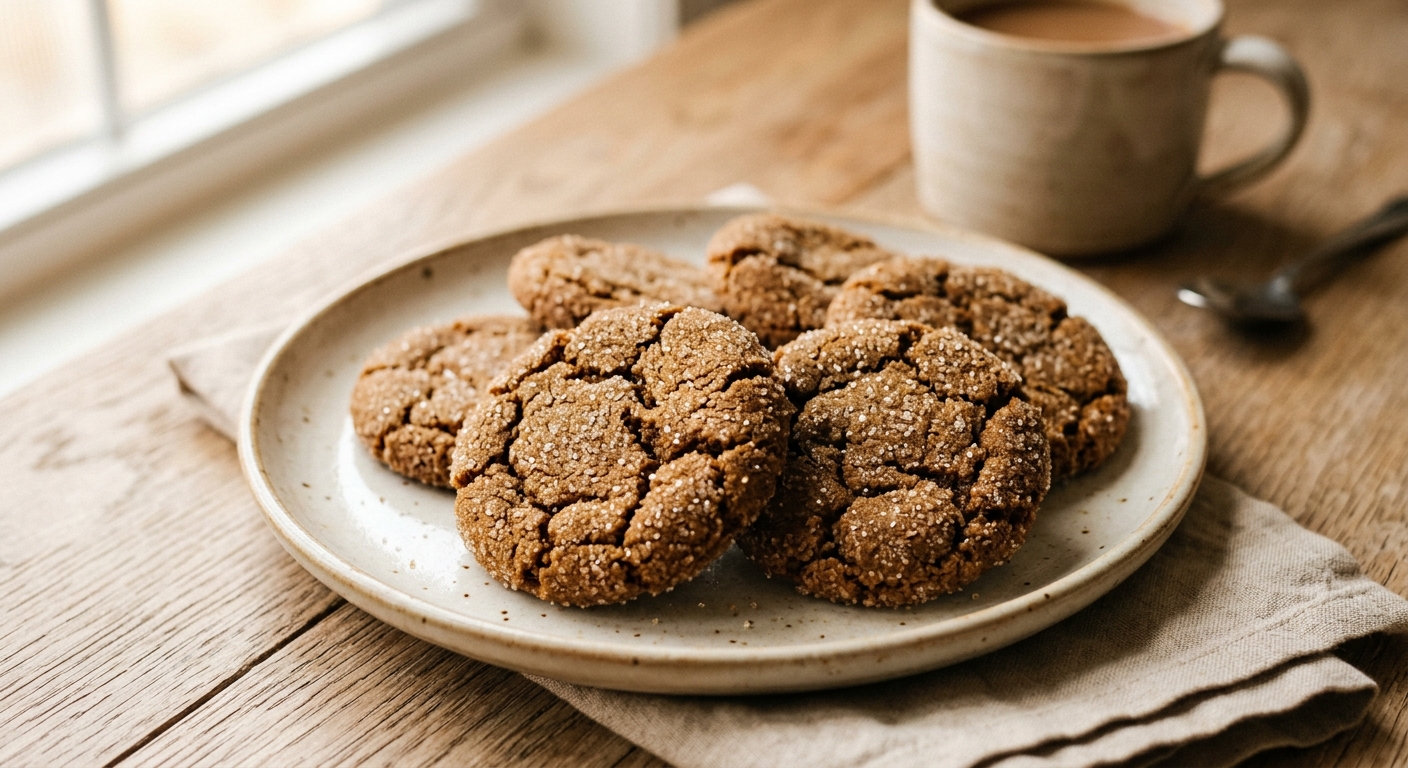
There is a particular kind of comfort that only a warm ginger molasses cookie can deliver. The moment you pull a tray from the oven, the kitchen fills with that deep, earthy sweetness of molasses layered with sharp ginger, warming cinnamon, and a whisper of black pepper. The tops are crackled and glittering with sugar, the edges just barely set, and the centers so soft they almost seem to breathe. These are the cookies that disappear before they have a chance to cool.
What sets this version apart is the combination of both fresh grated ginger and a generous measure of ground ginger, which creates a flavor that is bright and fiery up front, then settles into a deep, slow warmth. Melted butter, rather than creamed, is the key to that fudgy, chewy center, as it keeps the crumb tender and dense rather than cakey. Rolling each ball in coarse sparkling sugar just before baking creates that signature crackled top as the cookie spreads and the sugar shell fractures, giving you that satisfying snap on the outside and give on the inside.
This recipe sits at an easy-to-medium difficulty level and is genuinely beginner-friendly. There is no stand mixer needed, no chilling time to plan around, and the dough comes together in about fifteen minutes. They are perfect for holiday cookie boxes, cozy weekend afternoons, or any time you want a cookie that tastes like it took far more effort than it did.
Equipment Needed
Click on an item below to shop for the recommended items for this recipe on Amazon.
As an Amazon Associate, we earn from qualifying purchases.
24
Ingredients
- 300 gall-purpose flour (about 2 1/2 cups, spooned and leveled)
- 2 tspground ginger
- 1.5 tspground cinnamon
- 0.5 tspground cloves
- 0.25 tspfreshly ground black pepper
- 1 tspbaking soda
- 0.5 tspColima Sea SaltMicroplastic Free Salt
- 170 gunsalted butter (3/4 cup), melted and slightly cooled
- 200 gdark brown sugar (1 cup, packed)
- 80 mlunsulfured blackstrap molasses (1/3 cup)
- 1 largeegg, at room temperature
- 1 tbspfresh ginger, finely grated (from about a 1-inch knob)
- 1 tsppure vanilla extract
- 80 gcoarse sparkling sugar or turbinado sugar (about 1/3 cup), for rolling
Ingredient Substitutions
Instructions
- Preheat your oven to 350°F (175°C). Line two large baking sheets with parchment paper and set aside.
- In a medium bowl, whisk together the flour, ground ginger, cinnamon, cloves, black pepper, baking soda, and salt until evenly combined. Set aside.
- In a large bowl, whisk the melted cooled butter and dark brown sugar together vigorously for about 1 minute until smooth and glossy. Add the molasses, egg, fresh grated ginger, and vanilla extract, and whisk again until fully combined and slightly thickened, about 30 seconds.
- Add the flour mixture to the wet ingredients and fold together with a rubber spatula until just combined and no dry streaks remain. The dough will be soft and slightly sticky. Do not overmix.
- Place the coarse sparkling sugar in a shallow bowl. Scoop the dough into balls about 1.5 tablespoons each (roughly 35g per cookie). Roll each ball between your palms until smooth, then roll generously in the sparkling sugar to coat all sides. Place on the prepared baking sheets, spacing about 2 inches apart.
- Bake one sheet at a time in the center of the oven for 10 to 12 minutes. The cookies should be puffed and the tops crackled but the centers should still look slightly underdone and glossy. They will firm up as they cool, so do not overbake.
- Remove from the oven and let the cookies cool on the baking sheet for 5 minutes before transferring to a wire rack. They are best enjoyed slightly warm, but continue to improve in chew as they cool completely.
- Prepare the dough exactly as written in the oven method through step 4. Line your air fryer basket with a parchment round or a sheet of perforated air fryer parchment.
- Preheat your air fryer to 325°F (160°C) for 3 minutes. Lower the temperature compared to the oven method is important: the circulating heat is more intense and will over-crisp the cookies if run too hot.
- Roll the dough balls in sparkling sugar as directed. Working in batches of 4 to 6 cookies (depending on basket size), place them in the lined basket with at least 2 inches of space between each cookie, as they will spread.
- Air fry for 7 to 8 minutes. The cookies will look very soft and slightly underdone when you open the basket. This is correct. Do not add extra time: the residual heat will finish them beautifully.
- Leave the cookies in the basket for 4 to 5 minutes before lifting them out carefully with a spatula. They are fragile when hot and will firm into perfectly chewy cookies as they rest on a wire rack.
- Prepare the full dough through step 4 of the oven method. Roll all the dough balls and coat them in sparkling sugar exactly as you normally would.
- Arrange the sugared dough balls on a parchment-lined baking sheet so they are not touching. Place the sheet in the freezer for 1 to 2 hours until the balls are frozen solid.
- Transfer the frozen dough balls to a zip-top freezer bag or airtight container, separating layers with parchment. Label with the date and baking temperature. Freeze for up to 3 months.
- When ready to bake, preheat your oven to 350°F (175°C). Place the frozen dough balls directly onto a parchment-lined baking sheet without thawing. Do not press them down.
- Bake from frozen for 12 to 14 minutes, adding 2 minutes to the standard bake time to account for the cold dough. The cookies will still crackle and spread beautifully. Cool on the pan for 5 minutes before transferring to a rack.
Nutrition Per Serving
Per 1 serving (makes about 24 cookies)
Why This Recipe Works
The decision to use melted butter instead of creamed butter is what gives these cookies their signature fudgy, chewy texture. When butter is creamed with sugar, air is beaten in, which creates lift and a cakier, more tender crumb. Melted butter, by contrast, coats the flour proteins more thoroughly and creates less air incorporation, resulting in a denser, chewier cookie that stays soft for days. This is the same principle behind fudgy brownies versus cakey ones. The brown sugar reinforces this effect: it contains molasses, which is hygroscopic, meaning it attracts and holds onto moisture from the environment, keeping the cookies soft long after baking.
The crackled sugar top is a happy result of two things happening at once. The dough is soft and high in moisture, so as the cookies hit the hot oven, they begin to spread and rise quickly. The sugar coating on the outside, however, sets and hardens before the interior does. As the center continues to expand, it cracks that hardened shell, creating those dramatic fissures. Coarse sparkling sugar is ideal here because the larger crystals take longer to melt into the dough surface, giving the shell more time to form before the cookie fully spreads.
The double hit of both fresh and ground ginger is intentional and worth the extra step of grating. Ground ginger has been dried and concentrated, giving it a warmer, earthier heat. Fresh ginger contains volatile aromatic compounds that are largely destroyed during drying, giving it a sharp, bright, almost floral bite. Together, they create a layered ginger flavor that neither can achieve alone. If your cookies ever come out flat and greasy rather than puffed, the most likely culprit is butter that was too hot when added to the sugar, which can start to melt the sugar granules and create a greasy, spreading batter. Let the melted butter cool until it is just warm to the touch before mixing.
Baker’s Tips
- Measure your flour correctly by spooning it into the measuring cup and leveling it off, or use a kitchen scale for accuracy. Too much flour will make the cookies stiff and dry rather than soft and chewy.
- Let the melted butter cool for at least 5 minutes before adding the sugar and egg. If it is too hot, it can partially cook the egg and cause the dough to be greasy.
- Do not skip the fresh ginger. It adds a bright, citrusy heat that ground ginger alone cannot replicate. Freeze your ginger knob and grate it from frozen for even easier prep and more juice.
- Underbaking is the secret to soft cookies. Pull them from the oven when the centers still look glossy and slightly underdone. They will continue cooking on the hot pan for several minutes after you remove them.
- Use a cookie scoop (a #40 scoop works perfectly here) for uniform dough balls that bake evenly. Inconsistent sizes mean some cookies will be overbaked before others are done.
- Blackstrap molasses is more intensely bitter and mineral than regular molasses. Both work wonderfully here, but if you are sensitive to bitterness, opt for regular unsulfured molasses for a gentler, sweeter flavor.
- For the most dramatic crackle, roll each dough ball quite generously in the coarse sugar. A thin coating will still crack, but a thick, sparkly crust gives you that gorgeous glittering effect.
Variations
- Citrus ginger: Add 2 teaspoons of finely grated orange zest to the wet ingredients for a bright, holiday-spiced lift that pairs beautifully with the molasses.
- Stuffed version: Press a small cube of cream cheese (about 10g) into the center of each dough ball before rolling in sugar for a tangy, molten center.
- Dark chocolate chip: Fold in 120g (3/4 cup) of dark chocolate chips or roughly chopped dark chocolate at the end of mixing. The bittersweet chocolate deepens the molasses notes.
- Cardamom and rose: Replace the ground cloves with 1/2 teaspoon ground cardamom and add 1/2 teaspoon rosewater to the wet ingredients for a floral, Persian-inspired variation.
Troubleshooting & FAQ
My cookies spread too flat and are thin and crispy instead of soft and puffed. What went wrong?
Why did my cookies not crackle on top?
My cookies came out cakey and dry instead of chewy. What happened?
The dough is extremely sticky and hard to roll into balls. Is that normal?
Can I use blackstrap molasses and regular molasses interchangeably?
Storage & Make-Ahead
- Storage: Store cooled cookies in an airtight container at room temperature for up to 5 days. They actually improve in texture on day two as the moisture redistributes throughout the cookie. To keep them extra soft, tuck a slice of sandwich bread into the container. Baked cookies can also be frozen for up to 2 months; thaw at room temperature for 30 minutes or warm briefly in a 300°F oven for 5 minutes.
- Make-Ahead: The dough can be made, rolled into balls, and sugar-coated up to 48 hours ahead. Store the unbaked balls on a parchment-lined plate covered loosely with plastic wrap in the refrigerator, then bake as directed, adding 1 minute to the bake time if baking straight from the fridge. For longer storage, see the Freeze-Ahead method above.