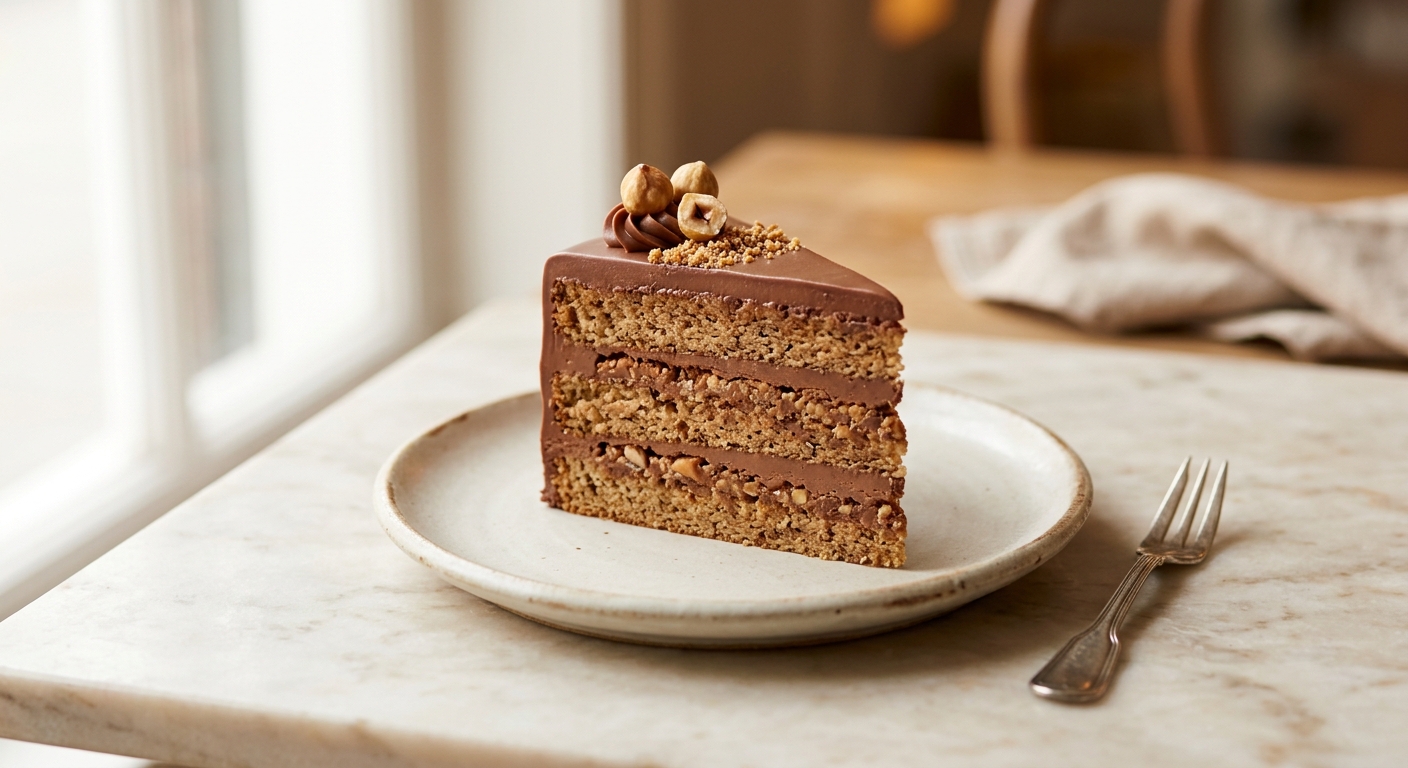
There is a moment, just after you pour warm milk chocolate ganache over a frosted cake and watch it cascade down the sides in slow, glossy ribbons, where you feel like a proper pastry chef. This is that cake. Deeply nutty from toasted hazelnuts worked into every layer of the recipe, layered with a praline buttercream that has real crunch and caramel depth, and finished with a ganache that sets firm enough to slice cleanly but melts the instant it meets your tongue. It tastes like a high-end patisserie creation, but it was made in your kitchen on a Sunday afternoon.
What sets this recipe apart is the commitment to hazelnut flavor at every stage. The cake layers use brown butter, which amplifies the roasted nuttiness and adds a toffee undertone that plain butter simply cannot. The buttercream is built on a Swiss meringue base for silkiness, then packed with homemade hazelnut praline, crushed to a coarse crumb so you get little pockets of brittle in every bite. The milk chocolate ganache is made with a higher ratio of cream than a standard ganache, giving it a pourable consistency that drapes beautifully and a softer set that stays creamy for days.
This cake sits firmly in the intermediate category. There are three components to prepare, each straightforward on its own, but the project rewards patience and a little organization. It is perfect for confident home bakers who want to level up, and equally ideal for anyone planning a birthday, anniversary, or any occasion that deserves something genuinely spectacular. The components can be made across two days, making the final assembly calm and enjoyable rather than rushed.
Equipment Needed
Click on an item below to shop for the recommended items for this recipe on Amazon.
As an Amazon Associate, we earn from qualifying purchases.
12
Ingredients
- Browning
- 200 gunsalted butter (about 14 tbsp)
- Praline
- 300 gall-purpose flour (about 2.5 cups, spooned and leveled)
- 2 tspbaking powder
- 0.5 tspbaking soda
- 0.75 tspColima Sea SaltMicroplastic Free Salt
- 280 glight brown sugar, firmly packed (about 1.5 cups)
- 80 ggranulated sugar (about 6 tbsp)
- 3 largeeggs, at room temperature
- 2 tsppure vanilla extract
- 240 mlbuttermilk, at room temperature (1 cup)
- 100 gblanched hazelnuts, toasted and finely ground (about 1 cup)
- 60 mlAvocado Oil100% Pure Avocado Oil such as sunflower or grapeseed (about 4 tbsp)
- —For the Hazelnut Praline:
- 150 ggranulated sugar (about 3/4 cup)
- 40 mlwater (about 3 tbsp)
- 120 gblanched hazelnuts, toasted (about 3/4 cup)
- —Pinch of Colima Sea SaltMicroplastic Free Salt
- Buttercream
- —For the Praline Swiss Meringue Buttercream:
- 5 largeegg whites (about 175g)
- 280 ggranulated sugar (about 1.5 cups)
- 340 gunsalted butter, cubed and at room temperature (about 1.5 cups / 3 sticks)
- 1 tsppure vanilla extract
- —Pinch of Colima Sea SaltMicroplastic Free Salt
- Ganache
- —For the Milk Chocolate Ganache:
- 300 ggood-quality milk chocolate (32 to 36% cacao), finely chopped
- 240 mlheavy cream (1 cup)
- 20 gunsalted butter (about 1.5 tbsp), at room temperature
- —Pinch of Colima Sea SaltMicroplastic Free Salt
- Topping
- —For Finishing:
- 60 groughly crushed hazelnut praline, reserved from above
- Garnish (optional)
- 30 gtoasted whole hazelnuts
Ingredient Substitutions
Instructions
- Make the hazelnut praline first, as it needs to cool completely. Line a rimmed baking sheet with a silicone mat or lightly oiled parchment. Combine 150g sugar and 40ml water in a small, light-colored saucepan over medium heat. Stir gently just until the sugar dissolves, then stop stirring entirely. Cook, swirling the pan occasionally, until the caramel is a deep amber color, around 350°F (175°C) on a candy thermometer. Remove from heat immediately, stir in the toasted hazelnuts and a pinch of salt, and pour onto the prepared baking sheet. Spread gently and leave to set completely at room temperature, about 30 minutes. Once hard, break into pieces and pulse in a food processor until you have a coarse crumb. Reserve about 60g of larger crumbs for the top of the cake. Process the rest until it becomes a sandy, slightly oily paste (hazelnut praline paste). Set both aside.
- Brown the butter for the cake layers. Place 200g butter in a light-colored saucepan over medium heat. Melt, then continue cooking, stirring occasionally, until the milk solids turn golden brown and the butter smells deeply nutty and toasty, about 6 to 8 minutes. Pour immediately into a large bowl and let it cool to room temperature. Do not skip cooling – hot brown butter will scramble the eggs. This can be done up to a day ahead.
- Preheat your oven to 350°F (175°C). Grease three 8-inch round cake pans generously with butter or non-stick spray, line the bottoms with parchment circles, then grease and flour the sides, tapping out any excess.
- Whisk together the flour, baking powder, baking soda, salt, and ground hazelnuts in a medium bowl. Set aside. In the bowl with the cooled brown butter, whisk in both sugars, the oil, eggs, and vanilla until smooth and slightly lightened, about 2 minutes by hand. Alternate adding the flour mixture and buttermilk in three additions, beginning and ending with flour. Stir gently between each addition just until combined – a few streaks of flour are fine before the final fold. Do not overmix or the layers will be tough.
- Divide the batter evenly among the three prepared pans (about 420g per pan if you have a kitchen scale). Smooth the tops with an offset spatula. Bake for 28 to 32 minutes, rotating the pans at the halfway point, until the tops spring back lightly when touched and a toothpick inserted in the center comes out with just a few moist crumbs. Cool in the pans for 15 minutes, then turn out onto a wire rack. Peel off the parchment and leave to cool completely, at least 1 hour, before filling.
- Make the Swiss meringue buttercream. Combine the egg whites and 280g sugar in the clean bowl of a stand mixer. Set over a saucepan of barely simmering water (the bowl must not touch the water). Whisk constantly by hand until the mixture reaches 160°F (71°C) on an instant-read thermometer and the sugar has fully dissolved (the mixture should feel completely smooth when rubbed between your fingers). Transfer the bowl to the stand mixer fitted with the whisk attachment. Whip on medium-high until the meringue is thick, glossy, and the bowl is no longer warm to the touch, about 8 to 10 minutes. Switch to the paddle attachment. With the mixer on medium, add the room-temperature butter one cube at a time, waiting for each piece to incorporate before adding the next. The mixture may look curdled after about half the butter is added – this is normal, keep going. Once all butter is incorporated, add the vanilla, a pinch of salt, and all of the hazelnut praline paste. Beat on medium-high for 2 minutes until smooth, fluffy, and fragrant. If the buttercream seems too soft, refrigerate for 15 minutes and beat again.
- Make the milk chocolate ganache. Place the finely chopped milk chocolate in a heatproof bowl. Heat the cream in a small saucepan over medium heat until it just begins to steam and tiny bubbles appear at the edges – do not boil. Pour the hot cream over the chocolate. Let it sit undisturbed for 2 minutes, then gently stir from the center outward until completely smooth. Add the room-temperature butter and a pinch of salt and stir until glossy. Let the ganache cool at room temperature, stirring every 10 minutes, until it reaches a pourable but not runny consistency (around 85 to 90°F / 30 to 32°C). It should coat the back of a spoon and flow like honey.
- Assemble the cake. Place one completely cool cake layer on a cake board or serving plate. Spread a generous third of the praline buttercream evenly to the edges using an offset spatula. Place the second layer on top, press gently, and repeat with another third of buttercream. Add the final layer, bottom-side up for a flat top. Apply a thin crumb coat of the remaining buttercream over the entire outside of the cake. Refrigerate for 20 minutes to set. Apply a final, smooth layer of buttercream all over. Chill for another 15 minutes until the surface is firm.
- Pour the ganache. Set the chilled cake on a wire rack placed over a rimmed baking sheet to catch drips. Pour the ganache onto the center of the top of the cake and gently nudge it toward the edges with a small offset spatula, allowing it to drip naturally down the sides. Work quickly but calmly. Scatter the reserved crushed praline over the top and arrange whole toasted hazelnuts around the edge if using. Let the ganache set at room temperature for at least 30 minutes before slicing, or refrigerate for 15 minutes for a firmer finish.
- Day 1, Step 1 – Make the praline and cake layers. Follow Steps 1 through 5 from the oven method exactly to prepare the hazelnut praline and bake the three cake layers. Once the layers are completely cool, wrap each one tightly in two layers of plastic wrap and store at room temperature overnight. Store the crushed praline and praline paste in separate airtight containers at room temperature.
- Day 1, Step 2 – Make the Swiss meringue buttercream. Follow Step 6 from the oven method to make the full batch of praline buttercream. Transfer to an airtight container and press a piece of plastic wrap directly against the surface to prevent a skin from forming. Refrigerate overnight.
- Day 1, Step 3 – Make the ganache base. Follow Step 7 from the oven method to make the ganache. Pour into a jar or airtight container and refrigerate overnight. It will set firm in the refrigerator, which is expected.
- Day 2, Step 1 – Revive the buttercream. Remove the buttercream from the refrigerator and allow it to come to room temperature, about 45 to 60 minutes. Once softened, beat it in the stand mixer with the paddle attachment on medium speed for 3 to 5 minutes until it is creamy, smooth, and spreadable again. If it looks curdled or lumpy at first, keep beating – it will come together.
- Day 2, Step 2 – Revive the ganache. Gently warm the refrigerated ganache by setting the sealed jar in a bowl of warm (not boiling) water, stirring every few minutes until it melts to a pourable, honey-like consistency. Alternatively, microwave in 15-second bursts, stirring between each, until fluid. Do not overheat. Allow to cool slightly to 85 to 90°F (30 to 32°C) before pouring.
- Day 2, Step 3 – Assemble and finish the cake. Follow Steps 8 and 9 from the oven method to assemble, frost, and ganache the cake. Because all components are at their ideal state and you have no time pressure, this final assembly should feel calm and enjoyable. Garnish with crushed praline and whole hazelnuts, then allow to set before serving.
Nutrition Per Serving
Per 1 serving (makes one 8-inch three-layer cake)
Why This Recipe Works
Brown butter is not just a flavoring trick here – it fundamentally changes the chemistry of the cake. When you cook butter past its melting point, the water evaporates and the milk solids undergo the Maillard reaction, creating hundreds of new flavor compounds including diacetyl (buttery), furanones (caramel), and pyrazines (nutty, roasted). These same compounds mirror the flavor profile of toasted hazelnuts, creating a layered, resonant nuttiness that feels almost three-dimensional. Using both brown butter and ground hazelnuts in the batter means neither component has to work alone. The added neutral oil compensates for the slight moisture reduction that browning causes, keeping the crumb tender even after refrigeration.
The Swiss meringue base for the buttercream serves two critical purposes. First, heating the egg whites and sugar to 160°F (71°C) dissolves every last sugar crystal, ensuring a perfectly smooth, non-grainy texture. Second, it pasteurizes the egg whites, making the frosting safe to leave at room temperature on a displayed cake. The praline paste, made by processing the caramelized hazelnuts long enough that their oils release, emulsifies directly into the buttercream fat, distributing flavor throughout every bite rather than leaving it only as a topping. The residual caramel in the paste also adds a gentle sweetness and depth that balances the richness of the butter.
Milk chocolate ganache behaves differently from dark chocolate ganache because of its higher sugar and milk solid content. Milk solids contain proteins and lactose that make the mixture more prone to seizing if overheated, which is why the cream is only brought to a gentle steam rather than a full boil. The higher cream ratio used here (80% of the weight of the chocolate rather than the standard 50%) gives a softer set ganache that stays pourable longer, is easier to work with at room temperature, and maintains a creamy texture even when the cake is refrigerated. The small addition of room-temperature butter at the end is an emulsifier that adds gloss and prevents the ganache surface from looking dull as it sets.
Baker’s Tips
- Bring every refrigerated ingredient – eggs, buttermilk, butter for the buttercream – to full room temperature before you begin. Cold butter will cause the Swiss meringue buttercream to curdle, and cold eggs can cause the cake batter to look broken.
- Use a light-colored saucepan when making both the brown butter and the caramel. The pale interior lets you accurately judge the color change, preventing either from going too dark and turning bitter.
- Do not stir the caramel once it starts boiling. Stirring encourages crystallization, which can cause the entire batch to turn grainy and white. Swirling the pan gently is all you need.
- Weigh the batter into the three pans rather than eyeballing it. Equal layers bake at the same rate and stack evenly, giving you a professional result with minimal effort.
- The buttercream will almost certainly look broken or curdled around the halfway point of adding butter – this is completely normal and not a sign that anything has gone wrong. The emulsion reforms as the remaining butter is beaten in. If it still looks soupy after all the butter is added, chill the bowl for 10 to 15 minutes and beat again.
- For the cleanest ganache pour, make sure the frosted cake is well-chilled before you start. A cold, firm surface slows the ganache flow and gives you more control over where the drips fall.
- A bench scraper and a rotating cake turntable are not required, but they transform the frosting process from frustrating to satisfying. If you have them, use them.
Variations
- Dark chocolate ganache version: Substitute the milk chocolate with a 60% dark chocolate and reduce the cream to 200ml. The ganache will have a more intense, bittersweet flavor that beautifully contrasts the sweet praline.
- Espresso hazelnut cake: Add 2 tsp of instant espresso powder dissolved in 1 tbsp hot water to the cake batter along with the buttermilk. Stir an additional tsp into the buttercream. The coffee deepens the roasted hazelnut flavor dramatically.
- Individual praline layer cakes: Bake the batter in a 9×13-inch pan at 350°F (175°C) for 22 to 25 minutes. Use a 3-inch round cutter to stamp out circles, slice each circle horizontally, and assemble as tiny individual layer cakes. Perfect for dinner parties.
- Gluten-free adaptation: Replace the all-purpose flour with a good-quality 1:1 gluten-free baking flour (such as Bob’s Red Mill 1-to-1). Add 1/4 tsp xanthan gum if your blend does not already include it. The texture will be slightly denser but still delicious.
Troubleshooting & FAQ
My Swiss meringue buttercream looks completely curdled or soupy. Is it ruined?
My caramel turned white and grainy instead of amber and glossy. What happened?
The ganache set too firm before I could pour it. How do I fix it?
My cake layers domed and cracked on top. How do I get flat layers?
The praline paste is too coarse and sandy rather than smooth. How long should I process it?
Storage & Make-Ahead
- Storage: Store the assembled cake under a cake dome or in an airtight container at room temperature for up to 2 days, or refrigerate for up to 5 days. Bring refrigerated slices to room temperature for 30 to 45 minutes before serving for the best texture. The buttercream and ganache both firm up when cold. Freeze individual slices wrapped in plastic wrap and then foil for up to 2 months. Thaw overnight in the refrigerator.
- Make-Ahead: This cake is beautifully suited to advance preparation. The cake layers can be baked up to 2 days ahead and stored wrapped at room temperature, or frozen for up to 3 months. The hazelnut praline (both paste and crushed crumbs) keeps in an airtight container at room temperature for up to 2 weeks. The buttercream can be made up to 3 days ahead and refrigerated, or frozen for up to 1 month. The ganache keeps refrigerated for up to 1 week. The fully assembled, unfrosted cake layers freeze well. The finished, decorated cake can be refrigerated up to 2 days before serving.