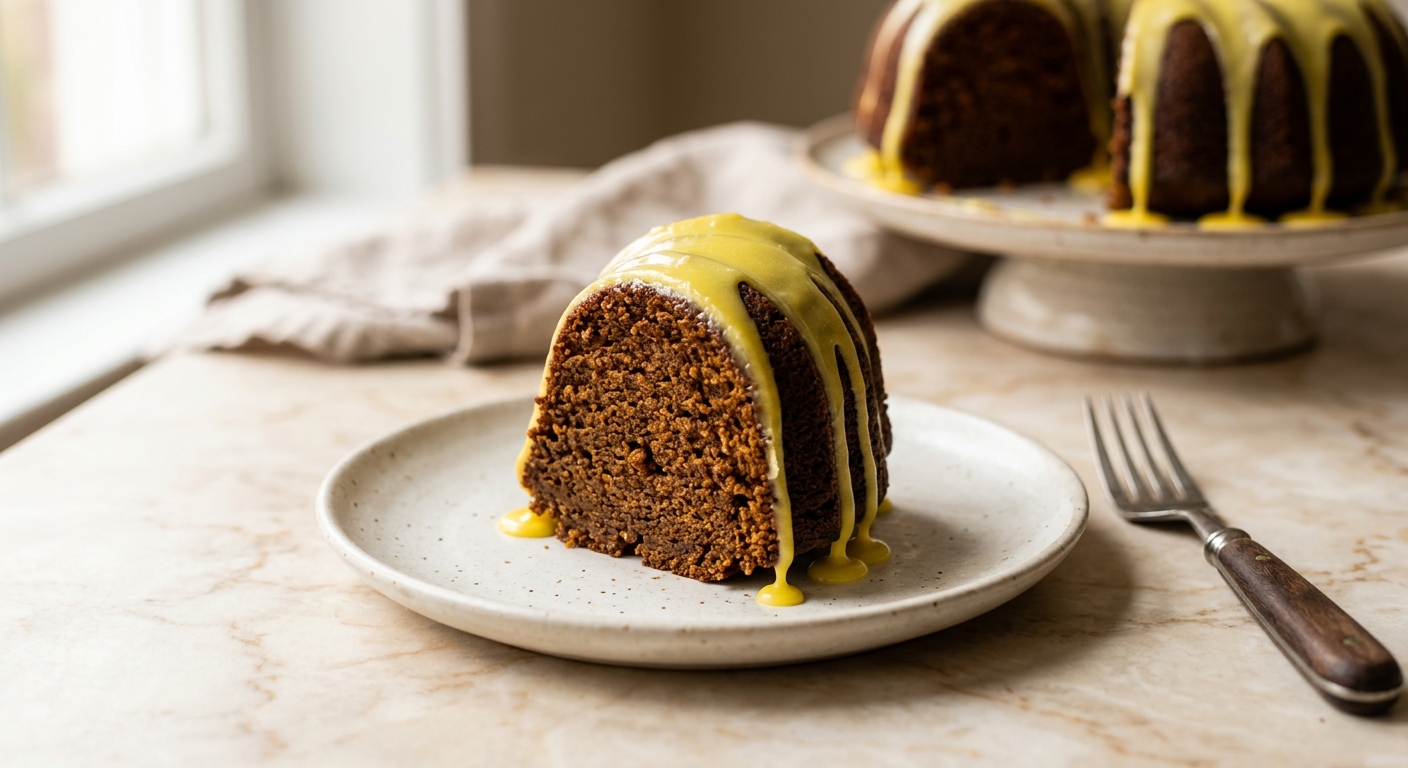
There is a particular kind of magic that happens when a Bundt cake comes out of the pan cleanly, its ridges sharp and its scent filling every corner of the room. This gingerbread version is that cake at its most festive and most comforting. The crumb is tender but sturdy, deep mahogany from a generous pour of molasses, and warmly fragrant with cinnamon, cloves, black pepper, and both ground and freshly grated ginger. Every slice looks stunning on a plate with virtually no effort from you, which is exactly what we want from a showstopper dessert.
What sets this recipe apart is the combination of two forms of ginger: ground ginger for that deep, slightly dry warmth that blooms in the oven, and freshly grated ginger for bright, sharp heat that keeps the cake from feeling heavy or one-dimensional. A splash of brewed black coffee in the batter amplifies the molasses without making the cake taste like coffee at all. It simply deepens everything. The finishing touch is a lemon glaze made with fresh juice and zest, not just a sweet drizzle but a genuinely tangy contrast that makes the spices sing louder and lifts the whole cake.
This is a medium-difficulty bake, mostly because properly preparing a Bundt pan is an art form worth learning here. Beyond that, the batter comes together easily in one bowl with a whisk and a spatula. It is perfect for holiday entertaining, weekend baking when you want something that feels special, or any time you need a cake that travels well and impresses without requiring a crumb coat or piping bag.
Equipment Needed
Click on an item below to shop for the recommended items for this recipe on Amazon.
As an Amazon Associate, we earn from qualifying purchases.
12
Ingredients
- 300 gall-purpose flour (about 2.5 cups, spooned and leveled)
- 2 tspground ginger
- 2 tspground cinnamon
- 0.5 tspground cloves
- 0.5 tspfreshly ground black pepper
- 0.25 tspground nutmeg
- 1.5 tspbaking soda
- 0.5 tspColima Sea SaltMicroplastic Free Salt
- 225 gunsalted butter, at room temperature (1 cup / 2 sticks)
- 200 gdark brown sugar, packed (1 cup)
- 3 largeeggs, at room temperature
- 240 mlunsulfured molasses (not blackstrap) (about 3/4 cup)
- 120 mlstrong brewed black coffee, cooled (1/2 cup)
- 120 mlwhole-milk buttermilk, at room temperature (1/2 cup)
- 20 gfresh ginger, peeled and finely grated (about 2 tablespoons)
- 1 tsppure vanilla extract
- —Softened butter and flour (or baking spray with flour) for preparing the pan
- 180 gpowdered sugar, sifted (about 1.5 cups)
- 45 mlfresh lemon juice (about 3 tablespoons, from 1 to 2 lemons)
- 1 tsplemon zest (from 1 lemon)
- —Pinch of Colima Sea SaltMicroplastic Free Salt (for the glaze)
Ingredient Substitutions
Instructions
- Preheat your oven to 325°F (165°C). Thoroughly grease every crevice of a 10 to 12-cup Bundt pan with softened butter using a pastry brush, then dust with flour and tap out the excess. Alternatively, use a baking spray that contains flour. This step is critical: do not rush it.
- In a medium bowl, whisk together the flour, ground ginger, cinnamon, cloves, black pepper, nutmeg, baking soda, and salt. Set aside.
- In a large bowl, beat the room-temperature butter and brown sugar together with a hand mixer or stand mixer fitted with the paddle attachment on medium-high speed for 3 to 4 minutes, until noticeably lighter and fluffy. Scrape down the sides of the bowl.
- Add the eggs one at a time, beating for 30 seconds after each addition. Add the vanilla extract and freshly grated ginger and mix briefly to combine. The mixture may look slightly curdled at this stage, which is normal.
- Add the molasses and beat on low speed until combined. In a small jug, stir together the cooled coffee and buttermilk.
- With the mixer on low, add the flour mixture in three additions, alternating with the coffee-buttermilk mixture in two additions (flour, liquid, flour, liquid, flour). Begin and end with the flour. Mix only until just combined after each addition. Finish folding with a spatula to avoid overmixing.
- Pour the batter into the prepared Bundt pan, smoothing the top with the spatula. Tap the pan firmly on the counter 3 to 4 times to release any air bubbles.
- Bake for 55 to 60 minutes, until a wooden skewer inserted into the thickest part comes out with only a few moist crumbs. The cake should pull slightly away from the sides of the pan.
- Cool the cake in the pan on a wire rack for exactly 15 minutes, no longer. Run a thin offset spatula or butter knife gently around the inner tube if needed. Invert onto the rack and lift the pan away. Allow the cake to cool completely, at least 45 minutes, before glazing.
- To make the glaze, whisk together the sifted powdered sugar, lemon juice, lemon zest, and pinch of salt until smooth. It should be thick enough to coat a spoon but still drizzle slowly. Add lemon juice a teaspoon at a time to adjust consistency. Drizzle generously over the cooled cake and allow to set for 15 minutes before slicing.
- Prepare the batter exactly as described in steps 2 through 6 of the oven method. Grease a 6-cup oven-safe Bundt insert or a round 7-inch springform pan that fits inside your 6-quart slow cooker. If using a springform pan, wrap the outside base in two layers of foil to prevent moisture seeping in.
- Pour the batter into the prepared pan. Place a double layer of paper towels under the slow cooker lid before closing it. The paper towels absorb condensation and prevent water dripping onto the cake, which would make the surface wet and gummy.
- Place the filled pan into the slow cooker. If using a springform, set it on a small wire rack or crumpled foil ring inside the cooker to elevate it slightly above the base. Cook on High for 2.5 to 3 hours. The cake is done when a skewer inserted in the center comes out with moist crumbs and the edges have pulled away from the pan. Do not lift the lid before the 2.5-hour mark.
- Carefully lift the pan out using silicone oven mitts. Cool in the pan for 20 minutes, then unmold onto a wire rack. The top surface (which was the bottom in the slow cooker) will be flat and slightly moist. Turn it so the more attractive side faces up for glazing.
- Once completely cool, make the lemon glaze as described in the oven method and drizzle over the cake. The extra moisture in this version means the glaze soaks in slightly for an even more intense lemon hit.
- Prepare the batter exactly as described in steps 2 through 6 of the oven method. Grease and flour a 7-inch Bundt or tube pan that fits in your air fryer basket with at least half an inch of clearance on all sides.
- Pour the batter into the prepared pan, filling it no more than two-thirds full. Smooth the top and tap the pan to release air bubbles. If you have extra batter, bake it separately in a small greased ramekin.
- Preheat your air fryer to 300°F (150°C) for 3 minutes. Carefully lower the pan into the basket. Bake at 300°F for 45 to 50 minutes. Check at 40 minutes: if the top is browning too quickly, lay a small piece of foil loosely over the top for the remaining time.
- The cake is done when a skewer comes out with just a few moist crumbs. The internal temperature should read around 200 to 205°F (93 to 96°C) on an instant-read thermometer if you have one.
- Remove the pan from the air fryer and cool on a wire rack for 15 minutes before inverting. Allow to cool completely before applying the lemon glaze as described in the oven method.
Nutrition Per Serving
Per 1 serving (makes one 10 to 12-cup Bundt cake, serving 12)
Why This Recipe Works
Molasses is the backbone of any true gingerbread, and here it does more than just flavor. As an invert sugar with high moisture retention, molasses keeps the crumb tender for days longer than a cake made with granulated sugar alone. Combined with brown sugar (which already contains molasses), the result is a cake that is genuinely moist without being heavy. Baking soda, rather than baking powder, is the primary leavener because it reacts with the acidic molasses and buttermilk to produce lift. This acid-base reaction is fast and vigorous, which is why you should get the batter into the prepared pan and into the oven without delay once the wet and dry ingredients are combined.
The alternating method of adding dry and wet ingredients is not just a habit from pastry school: it is a practical technique that controls gluten development. Flour proteins (glutenin and gliadin) form gluten when mixed with liquid and agitated. By adding the flour in stages and never letting the batter become too liquid or too dry at once, you build just enough structure to hold the cake together without developing the tough, chewy network that comes from overmixing. This is why the final mixing should be done with a spatula by hand, not the mixer.
The lemon glaze serves a chemical purpose beyond aesthetics. The acidity of fresh lemon juice cuts through the molasses richness and stimulates your palate’s perception of the warm spices, making them taste brighter and more complex. A purely sweet powdered sugar glaze would actually dull the spice flavors by coating the palate with sweetness. If your glaze sets too firm, it likely had too little liquid. If it runs completely off the cake, the cake was too warm or the glaze too thin. Aim for a consistency like slightly thinned honey, and always glaze a fully cooled cake.
Baker’s Tips
- Preparing the Bundt pan properly is the single most important step in this recipe. Use a pastry brush to work softened butter into every groove, then coat with flour and knock out every last bit of excess. Any bare spot is where the cake will stick. A baking spray that contains flour (such as Baker’s Joy) is a reliable alternative.
- Do not use blackstrap molasses here. It is significantly more bitter and will overpower every other flavor. Look for unsulfured molasses, such as Grandma’s Original or Brer Rabbit, which is sweeter and more balanced.
- Bring your butter, eggs, and buttermilk to room temperature before starting. Cold butter will not cream properly, cold eggs can cause the batter to curdle, and cold buttermilk can seize the melted fats. Set everything out at least 45 minutes ahead.
- Cool the cake in the pan for exactly 15 minutes before inverting. Too short and the cake is too fragile and will break. Too long and steam condenses, making the exterior sticky and causing the cake to stick to the pan.
- For the cleanest glaze drips, place the cooled cake on a wire rack set over a rimmed baking sheet before glazing. Any drips fall onto the sheet and cleanup is effortless. You can also spoon up the drips and re-drizzle them over the top.
- Taste the glaze before applying it. It should be noticeably tangy, not just faintly lemony. Do not be shy with the lemon zest, as that is where the most intense citrus fragrance lives.
- The cake genuinely improves on the second day as the spices meld and the molasses flavor deepens. If you can make it the day before serving, do so.
Variations
- Orange glaze version: Swap the lemon juice and zest in the glaze for fresh orange juice and zest. Stir a pinch of cardamom into the glaze for a fragrant Scandinavian twist.
- Chocolate gingerbread: Replace 30g of the all-purpose flour with Dutch-process cocoa powder and add 60g of melted dark chocolate (at least 70%) to the batter along with the molasses. The result is a darker, more complex cake with deeply fudgy undertones.
- Mini Bundt version: Divide the batter among two greased 6-cavity mini Bundt pans and bake at 325°F for 28 to 34 minutes. Perfect for gifting or individual servings. Reduce glaze slightly or double it if you love a heavily glazed mini cake.
- Cream cheese glaze: Beat 60g of softened cream cheese with 120g sifted powdered sugar, 2 tablespoons of lemon juice, and 1 teaspoon of lemon zest for a thicker, tangier, more luxurious topping.
Troubleshooting & FAQ
My cake stuck to the Bundt pan and came out in pieces. What went wrong?
The cake is dense and gummy in the center. What happened?
My batter looks curdled after I added the eggs. Should I start over?
My lemon glaze soaked straight into the cake instead of sitting on top. How do I get cleaner-looking glaze?
The top of my Bundt (which becomes the bottom after inverting) is rounded and domed and the cake wobbles on the plate. Can I fix this?
Storage & Make-Ahead
- Storage: Store the glazed cake loosely covered with a cake dome or plastic wrap at room temperature for up to 3 days. The spice flavor actually deepens and improves on day two. Refrigerate for up to 6 days, though bring to room temperature before serving for the best texture. Freeze the unglazed cake, well wrapped in plastic and then foil, for up to 3 months. Thaw overnight at room temperature and glaze before serving.
- Make-Ahead: The cake can be baked up to 2 days ahead, cooled completely, wrapped tightly in plastic wrap, and stored at room temperature. Add the glaze on the day you plan to serve it for the freshest appearance. The dry spice and flour mixture can also be whisked together and stored in a sealed container for up to a week.