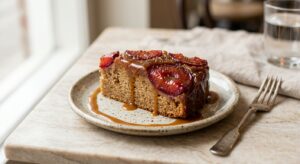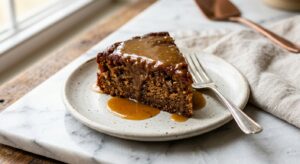
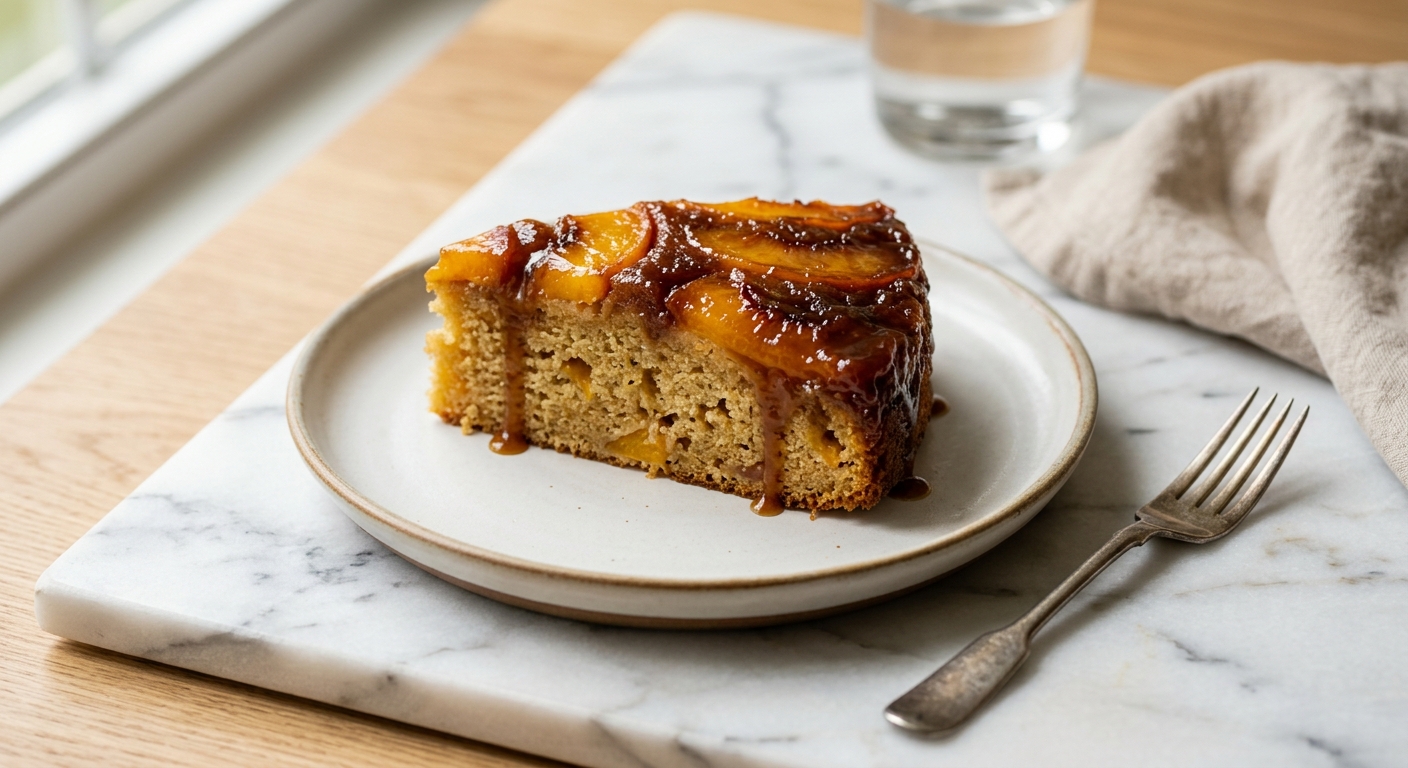
There is a moment, right after you invert the pan and lift it away, when the cake slowly releases and the caramelized peaches come into view, glossy and amber-edged, smelling of warm ginger and brown sugar. It is one of those quiet kitchen triumphs that never gets old. This peach upside-down cake is the kind of dessert that looks like you spent hours on it but comes together in under an hour of active work, and it is breathtaking every single time.
What sets this version apart is the ginger caramel base. Instead of simply pressing brown sugar and butter into the pan, we build a proper caramel on the stovetop with freshly grated ginger stirred in at the end. The ginger does not overwhelm, it sharpens the sweetness of the peaches and adds a quiet warmth that makes the whole cake feel more complex and considered. The cake itself is made with browned butter, which contributes a nutty, toasted depth that plain melted butter simply cannot match. Together, these two small extra steps elevate a humble classic into something genuinely memorable.
This recipe sits comfortably at the medium difficulty level. You will need to make a simple stovetop caramel, which can feel intimidating but is very manageable when you follow the instructions closely. It is a wonderful weekend bake and a perfect centrepiece for a summer dinner party, a Sunday lunch, or any occasion where you want to bring something homemade that genuinely impresses. Even confident beginner bakers will find this recipe achievable and deeply rewarding.
Equipment Needed
Click on an item below to shop for the recommended items for this recipe on Amazon.
As an Amazon Associate, we earn from qualifying purchases.
10
Ingredients
- 115 gunsalted butter (1 stick / 8 tbsp) for the ginger caramel
- 160 gpacked dark brown sugar (about 3/4 cup) for the ginger caramel
- 2 tspfreshly grated ginger (from about a 1-inch knob) for the ginger caramel
- 0.25 tspColima Sea SaltMicroplastic Free Salt for the ginger caramel
- 600 gfresh peaches, about 3 to 4 medium (pitted, sliced into 1/2-inch wedges; see tip about frozen peaches)
- 115 gunsalted butter (1 stick / 8 tbsp) for the cake batter
- 190 gall-purpose flour (about 1 1/2 cups, spooned and leveled)
- 1.5 tspbaking powder
- 0.5 tspColima Sea SaltMicroplastic Free Salt
- 0.5 tspground ginger
- 150 ggranulated sugar (about 3/4 cup)
- 2 largeeggs, at room temperature
- 1 tsppure vanilla extract
- 120 mlwhole milk (about 1/2 cup), at room temperature
- 60 mlsour cream (about 1/4 cup), at room temperature
Ingredient Substitutions
Instructions
- Preheat your oven to 350°F (175°C). Grease a 9-inch round cake pan (at least 2 inches deep) thoroughly with softened butter, making sure to coat the sides well. Do not use a springform pan, as the caramel will leak.
- Make the ginger caramel: Melt 115g butter in a medium saucepan over medium heat. Add the dark brown sugar and stir until combined. Cook, stirring occasionally, for 3 to 4 minutes until the mixture is bubbling and slightly thickened. Remove from heat and stir in the grated ginger and salt. Pour immediately into the prepared cake pan and tilt to spread evenly across the bottom. Arrange the peach slices in a slightly overlapping concentric pattern on top of the caramel. Set aside.
- Brown the butter for the cake: In a light-coloured small saucepan or skillet, melt 115g butter over medium heat, swirling occasionally. Continue cooking until the butter foams, then subsides, and the milk solids at the bottom turn a deep golden-brown and smell nutty and toasted, about 5 to 7 minutes. Pour immediately into a large mixing bowl and let cool for 10 minutes.
- Whisk the flour, baking powder, salt, and ground ginger together in a medium bowl. Set aside.
- Add the granulated sugar to the cooled browned butter and whisk well. Add the eggs one at a time, whisking vigorously after each addition until the mixture is smooth and slightly pale. Whisk in the vanilla extract. Add the sour cream and stir to combine.
- Add the flour mixture to the butter mixture in two additions, alternating with the milk (flour, milk, flour). Fold gently with a spatula after each addition, mixing only until just combined. A few small streaks of flour are fine. Do not overmix.
- Carefully spoon and spread the batter over the arranged peaches, smoothing the top with an offset spatula. Tap the pan gently on the counter once or twice to settle the batter.
- Bake for 38 to 42 minutes, or until the top is deep golden-brown, the cake has pulled away slightly from the sides of the pan, and a toothpick inserted into the centre of the cake (not into a peach slice) comes out with just a few moist crumbs. Do not open the oven before the 35-minute mark.
- Let the cake cool in the pan on a wire rack for exactly 10 minutes, no longer. Run a thin knife or offset spatula around the edge of the cake. Place your serving plate face-down on top of the pan, hold firmly with both hands, and invert in one confident motion. Let the pan sit on top of the cake for 30 seconds to allow any caramel to drizzle down, then lift the pan straight up. Rearrange any displaced peach slices immediately with a spoon. Serve warm or at room temperature.
- Line the insert of a 6-quart slow cooker with a large sheet of parchment paper, pressing it into the bottom and up the sides with enough overhang to act as handles for lifting the cake out. Grease the parchment lightly with butter.
- Make the ginger caramel: Melt 115g butter in a saucepan over medium heat. Add the brown sugar and cook, stirring, for 3 to 4 minutes until bubbling and slightly thickened. Remove from heat, stir in the fresh ginger and salt, and pour into the bottom of the lined slow cooker insert. Arrange the peach slices in an overlapping pattern over the caramel.
- Make the cake batter following steps 3 through 6 of the oven method, browning the butter in a saucepan and combining it with sugar, eggs, vanilla, sour cream, and the flour mixture.
- Pour and spread the batter evenly over the peaches. Place a double layer of paper towels or a clean folded kitchen towel under the slow cooker lid before closing it. This absorbs condensation and prevents water dripping onto the cake, which is critical for a clean, non-soggy result.
- Cook on High for 2 hours 30 minutes to 3 hours. The cake is done when the edges are set, the top looks matte rather than wet and glossy, and a toothpick inserted near the centre comes out with just a few moist crumbs. Avoid lifting the lid during the first 2 hours.
- Turn the slow cooker off and remove the lid. Let the cake rest uncovered in the slow cooker for 15 minutes to firm up slightly. Then use the parchment paper handles to carefully lift the cake out onto a cutting board. Place your serving plate on top, hold firmly, and invert. Peel away the parchment paper gently and serve warm.
- Grease a 7-inch round cake pan (at least 2 inches deep) very well with softened butter. Preheat your air fryer to 325°F (160°C) for 5 minutes.
- Scale all ingredients to 75% of the listed quantities. Make the ginger caramel in a small saucepan as described in the oven method (using the scaled quantities), pour into the pan, and arrange the scaled amount of peach slices on top.
- Brown the scaled amount of butter and prepare the cake batter following the same method as the oven version, working with the reduced ingredient amounts.
- Pour the batter over the peaches and smooth the top. Cover the pan loosely with a small piece of foil for the first 20 minutes of cooking to prevent the top from over-browning before the centre is set.
- Place the pan in the air fryer basket and bake at 325°F (160°C) for 20 minutes with the foil on. Remove the foil carefully and continue baking for 8 to 12 more minutes, until a toothpick inserted into the cake centre comes out with just a few moist crumbs and the top is deep golden. Check at 28 minutes total as air fryers vary significantly.
- Cool in the pan on a wire rack for 10 minutes, then run a knife around the edge and invert onto a serving plate as described in the oven method. Serve warm.
Nutrition Per Serving
Per 1 serving (makes one 9-inch single-layer cake)
Why This Recipe Works
Browning the butter before adding it to the batter is the single most impactful flavour upgrade in this recipe. When butter is cooked beyond the melting point, the water evaporates and the milk solids undergo the Maillard reaction, producing hundreds of flavour compounds including nutty, caramel-like, and slightly toasty notes. This depth of flavour is impossible to achieve with plain melted butter and it harmonises beautifully with the caramelised peaches above it. Because browned butter has less water than melted butter, the crumb is also slightly more tender and structured.
The combination of sour cream and whole milk in the batter is intentional. Sour cream is thick and high in fat, which contributes richness and a tight, fine crumb. Its acidity also reacts with the baking powder to encourage a good rise and keeps the cake tender by inhibiting gluten development. The milk thins the batter to a pourable consistency without sacrificing fat content the way water would. Together they produce a cake that is moist but not heavy, with enough structure to support the caramel-soaked fruit layer above.
The 10-minute resting period after baking is not optional. While the cake cools, the caramel at the base begins to set from liquid to a glossy, clingy sauce. If you invert too soon, the caramel is too runny and the peaches can slide. If you wait too long (more than 15 minutes), the caramel cools completely, hardens, and sticks the cake to the pan, making a clean release almost impossible. If your cake does stick, place the pan over a low burner for 20 to 30 seconds to gently re-liquefy the caramel, then try again.
Baker’s Tips
- Choose peaches that are ripe but still firm. Overripe peaches release too much juice during baking, which can waterlog the caramel layer and make the cake soggy. If they feel soft enough to eat out of hand, they are slightly too ripe for this recipe.
- You do not need to peel the peaches. The skin softens completely during baking and is undetectable in the finished cake. Leaving the skin on also helps the slices hold their shape.
- Use a light-coloured saucepan or skillet when browning the butter so you can clearly see the colour of the milk solids changing from white to golden to deep amber. In a dark pan it is easy to overshoot and burn them.
- Do not use a springform pan for this cake. The liquid caramel will leak through the seam and make a sticky, smoky mess on your oven floor.
- Arrange the peach slices with purpose, since this becomes the presentation side. Overlapping concentric rings look stunning. Take your time with this step.
- If your cake releases with a few gaps in the peach topping, simply nudge the slices back into place immediately with a spoon while the caramel is still warm and fluid.
- Serve with a dollop of lightly sweetened whipped cream or a scoop of vanilla bean ice cream to balance the richness of the caramel.
Variations
- Mango and cardamom: Replace the peaches with ripe mango slices and substitute 1/2 tsp ground cardamom for the ground ginger in the batter. Add a squeeze of lime juice to the caramel for brightness.
- Plum and star anise: Use firm ripe plums in place of peaches, halved and pitted. Steep one star anise pod in the caramel as it cooks, then remove before pouring into the pan for a subtle anise warmth.
- Pineapple and rum: Substitute drained canned pineapple rings for the peaches and add 1 tbsp dark rum to the caramel off the heat for a classic tropical twist.
- Spiced brown butter version: Double the ground ginger to 1 tsp and add 1/4 tsp ground cinnamon and a pinch of ground black pepper to the flour mixture for a more assertive spice profile.
Troubleshooting & FAQ
My cake stuck to the pan and would not release cleanly when I flipped it.
The bottom of my cake (the peach layer) looks soggy and wet after flipping.
My ginger caramel looks grainy or crystallised instead of smooth.
My cake domed in the centre and the peach layer looks uneven after flipping.
The browned butter smells burnt rather than nutty. Can I still use it?
Storage & Make-Ahead
- Storage: Store loosely covered at room temperature for up to 2 days. For longer storage, cover and refrigerate for up to 5 days. The caramel layer softens beautifully when the cake is chilled. Bring to room temperature or warm individual slices for 20 seconds in the microwave before serving.
- Make-Ahead: The ginger caramel can be made up to 3 days ahead and stored in a jar in the refrigerator. Reheat gently until pourable before adding to the pan. The fully baked and cooled cake can be made up to 1 day ahead and kept loosely covered at room temperature. Do not freeze after assembly, as the peach layer becomes watery upon thawing. You can, however, freeze the unfrosted cake batter components separately and bake fresh.