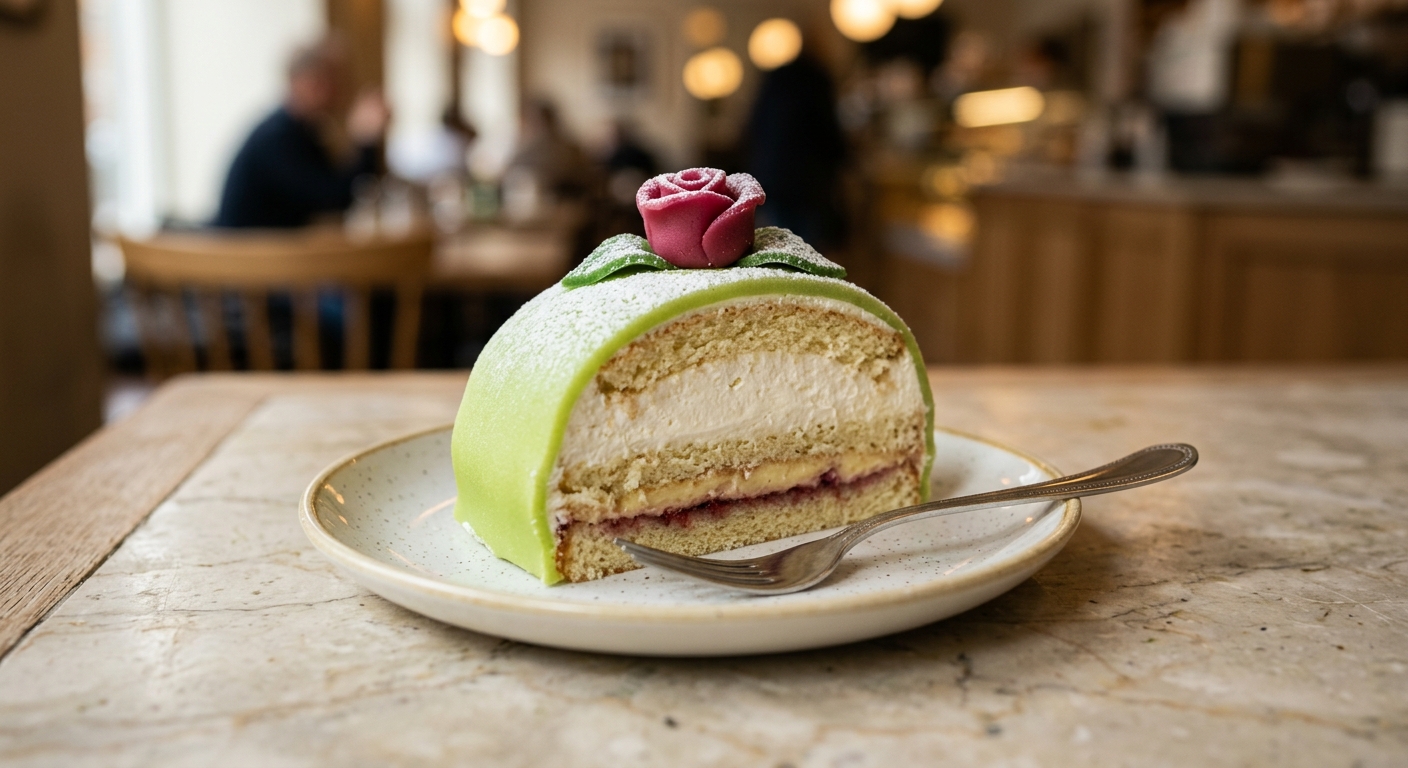
There is a cake that has graced Swedish celebration tables since the 1930s, one that never fails to draw a collective gasp when it arrives at the table. The prinsesstårta, or Princess Cake, is a confection of almost architectural beauty: a pale green dome of almond marzipan stretched smooth over a cloud of freshly whipped cream, a layer of cool vanilla pastry cream, and two or three rounds of the most delicate génoise sponge you have ever tasted. A single pink marzipan rose sits at the crown, and a dusting of powdered sugar gives the whole thing a softly frosted, fairytale appearance. It is the kind of cake that makes people put down their forks for a moment just to look at it before they take a bite.
What sets this recipe apart is the attention paid to each individual component. The génoise is enriched with a small amount of clarified butter for tenderness and brushed with a vanilla simple syrup to keep every layer perfectly moist. The pastry cream is made the classic French way, with egg yolks and cornstarch cooked until thick and glossy, then pressed through a sieve for the smoothest possible texture. The whipped cream dome is built generously and chilled firm before the marzipan is draped over it, which is the single most important technique tip in this whole recipe. That chill time is what allows you to lay the marzipan smoothly without the cream collapsing beneath your hands.
This is a medium-difficulty cake that rewards careful organisation more than it requires any particular skill. If you have made a custard before and can whip cream to stiff peaks, you can make a Princess Cake. It is best approached over two days: bake the sponge and make the pastry cream on day one, then assemble and cover with marzipan on day two. It is the perfect project for a weekend before a birthday, a midsummer celebration, or any occasion that deserves something truly memorable.
Equipment Needed
Click on an item below to shop for the recommended items for this recipe on Amazon.
As an Amazon Associate, we earn from qualifying purchases.
12
Ingredients
- Stability
- —— GÉNOISE SPONGE —
- 4 largeeggs, at room temperature
- 150 gcaster sugar or superfine sugar (about 3/4 cup)
- 120 gall-purpose flour (about 1 cup, spooned and leveled)
- 30 gcornstarch (about 3 tbsp)
- 40 gunsalted butter, clarified and cooled (about 3 tbsp)
- 1 tsppure vanilla extract
- —Pinch of Colima Sea SaltMicroplastic Free Salt
- —— VANILLA SIMPLE SYRUP —
- 80 gcaster sugar or granulated sugar (about 6 tbsp)
- 80 mlwater (about 1/3 cup)
- 1 tsppure vanilla extract
- —— VANILLA PASTRY CREAM —
- 480 mlwhole milk (2 cups)
- 1 wholevanilla bean, split and scraped (or 2 tsp pure vanilla extract)
- 5 largeegg yolks
- 120 gcaster sugar (about 1/2 cup plus 2 tbsp)
- 40 gcornstarch (about 5 tbsp)
- —Pinch of Colima Sea SaltMicroplastic Free Salt
- 20 gcold unsalted butter (about 1.5 tbsp), cut into small cubes
- —— WHIPPED CREAM DOME —
- 600 mlheavy whipping cream, very cold (about 2.5 cups)
- 40 gpowdered sugar, sifted (about 1/3 cup)
- 1 tsppure vanilla extract
- 2 tspunflavored powdered gelatin (about 1 envelope, 7g)
- Rose
- 2 tbspcold water, to bloom the gelatin
- —— MARZIPAN DOME AND DECORATION —
- 500 gstore-bought white marzipan (about 17.5 oz), divided: 450g for the dome, 50g for the rose
- 3 to 4 dropsgreen gel food coloring
- 1 to 2 dropspink or red gel food coloring
- Middle Layer
- 2 tbspraspberry jam or seedless strawberry jam
- Dusting The Finished Cake (about 2 Tbsp)
- 20 gpowdered sugar
Ingredient Substitutions
Instructions
- MAKE THE PASTRY CREAM (Day 1): Heat the milk with the vanilla bean and seeds (or extract added later) in a medium saucepan over medium heat until just steaming, about 4 to 5 minutes. Do not boil. Meanwhile, whisk the egg yolks, sugar, cornstarch, and salt together in a heatproof bowl until pale and thick, about 2 minutes. Slowly pour about a third of the hot milk into the yolk mixture while whisking constantly to temper the eggs, then pour the tempered mixture back into the saucepan. Cook over medium heat, whisking constantly and reaching into the corners of the pan, until the mixture thickens and large bubbles begin to plop at the surface, about 3 to 4 minutes. Remove from heat. If using extract, stir it in now. Pass the pastry cream through a fine-mesh sieve into a clean bowl. Press the cold butter cubes into the surface and stir once it melts. Press plastic wrap directly onto the surface of the cream to prevent a skin from forming. Refrigerate for at least 4 hours or overnight.
- MAKE THE GÉNOISE SPONGE (Day 1): Preheat your oven to 350°F (175°C). Grease a 9-inch round springform pan, line the bottom with parchment paper, and flour the sides. Combine the eggs and caster sugar in the bowl of a stand mixer (or a large heatproof bowl). Set the bowl over a pot of barely simmering water, making sure the bottom of the bowl does not touch the water, and whisk gently by hand until the mixture is warm to the touch and the sugar has dissolved, about 3 to 4 minutes. Transfer to the stand mixer fitted with the whisk attachment and beat on high speed until the mixture is very pale, thick, and has tripled in volume, about 6 to 8 minutes. It should hold a ribbon trail on the surface for 5 to 8 seconds when the whisk is lifted. This step is critical: under-whipping means a dense, heavy cake. Sift the flour, cornstarch, and salt together over the egg foam in three additions, folding gently with a large rubber spatula after each addition using a J-fold motion, cutting down through the center and sweeping up the sides. Work quickly but patiently to preserve as much air as possible. Drizzle the clarified butter and vanilla extract around the edge of the batter and fold them in with as few strokes as possible. Pour the batter into the prepared pan immediately and bake for 22 to 26 minutes, until the top is golden, springs back when lightly pressed, and a toothpick inserted in the center comes out clean. Cool in the pan for 10 minutes, then turn out onto a wire rack to cool completely.
- MAKE THE VANILLA SYRUP (Day 1 or 2): Combine the sugar and water in a small saucepan over medium heat. Stir until the sugar dissolves, then remove from heat and stir in the vanilla extract. Cool completely before using.
- SLICE THE SPONGE AND MAKE THE MARZIPAN ROSE (Day 2): Using a long serrated knife and a gentle sawing motion, slice the cooled sponge horizontally into three even layers. Place a damp towel under your cutting board to keep it stable. For the marzipan rose, knead the 50g portion with pink or red gel food coloring until the color is even. Pinch off a small piece the size of a marble for the center bud and roll it into a tight cylinder. Flatten 6 to 8 slightly larger pieces into thin petals between your fingers. Wrap the petals one by one around the bud, overlapping each slightly and curling the edges outward gently. Pinch the base to secure and trim the bottom flat. Set aside on a small piece of parchment. Knead the 450g marzipan portion with green gel coloring until evenly colored.
- ASSEMBLE THE CAKE: Place the bottom sponge layer on your serving plate or a cardboard cake round. Brush generously with vanilla syrup. Spread a thin layer of raspberry jam over the surface. Spoon half of the pastry cream (about 250g) over the jam and spread it to the edges. Place the second sponge layer on top, press gently, and brush with syrup. Spread the remaining pastry cream over this layer. Place the third sponge layer on top and brush with the remaining syrup. Now build the whipped cream dome: bloom the gelatin by sprinkling it over the 2 tablespoons of cold water in a small bowl. Let sit for 5 minutes, then microwave for 10 seconds until melted and clear, and allow to cool to room temperature but not set. Whip the cold heavy cream, powdered sugar, and vanilla in a chilled bowl until soft peaks form. With the mixer running, pour in the cooled gelatin in a thin stream and continue whipping to firm peaks. Pile the whipped cream onto the top of the assembled cake, using an offset spatula or your hands to shape it into a smooth, rounded dome that extends slightly over the edges of the top layer. The dome should be generously high in the center. Refrigerate the entire cake, uncovered, for at least 1 hour until the cream dome is very firm and cold.
- DRAPE THE MARZIPAN DOME: On a clean surface lightly dusted with powdered sugar, roll the green marzipan into a circle approximately 14 to 15 inches (35 to 38cm) in diameter and about 3mm thick. Roll it loosely around your rolling pin, then carefully unroll it over the chilled cream dome, centering it over the top. Working quickly and gently, smooth the marzipan down the sides of the cake with the palms of your hands, easing it flat without pressing hard enough to dent the cream. Trim any excess at the base with a sharp knife or pizza cutter, tucking the edge neatly under the base of the cake. If small cracks appear, gently smooth them with the warmth of a fingertip.
- FINISH AND CHILL: Place the marzipan rose at the crown of the dome. Dust the entire surface generously with powdered sugar through a fine sieve. Refrigerate the finished cake for at least 1 hour (or up to 24 hours) before slicing. To serve, use a sharp knife dipped in hot water and wiped clean between each cut for the most precise slices.
- DAY 1 (PASTRY CREAM AND MARZIPAN): Make the full batch of vanilla pastry cream as described in the oven method steps. Press plastic wrap directly on the surface and refrigerate. On the same day, knead the green gel coloring into the 450g marzipan portion and the pink coloring into the 50g portion. Wrap both tightly in plastic wrap and store at room temperature overnight. Resting allows the color to fully develop and the texture to firm up slightly, making the marzipan much easier to roll thinly.
- DAY 2 (GÉNOISE AND SYRUP): Bake the génoise sponge according to the oven method steps. While the sponge is cooling, prepare the vanilla simple syrup and let it cool completely. Once the sponge is fully cooled, wrap it tightly in plastic wrap (do not slice it yet) and store at room temperature overnight. Wrapping the whole unsliced sponge keeps it moister than slicing and storing the layers separately. Make the marzipan rose: using the rested pink marzipan, form the rose as described in the oven method. Store on a small piece of parchment in an airtight container at room temperature.
- DAY 3 MORNING (ASSEMBLY, AT LEAST 2 TO 3 HOURS BEFORE SERVING): Slice the sponge into three even horizontal layers using a long serrated knife. Assemble the cake with the syrup, jam, and pastry cream as described in the oven method. Build the stabilized whipped cream dome, shape it generously high, and refrigerate uncovered for at least 1 hour until firm.
- DAY 3, BEFORE SERVING (MARZIPAN DRAPING): Remove the chilled dome from the refrigerator. On a powdered sugar-dusted surface, roll the rested green marzipan to a 14 to 15 inch circle, about 3mm thick. The overnight rest should make it notably more pliable and less prone to cracking than freshly kneaded marzipan. Drape, smooth, and trim as described in the oven method. Top with the prepared marzipan rose, dust with powdered sugar, and return to the refrigerator for at least 1 hour before serving.
- TO TRANSPORT OR STORE: If you need to transport the cake, refrigerate it for a full 2 hours after the marzipan is applied so everything is completely set and firm. Transport on a flat surface in a large cake box. The fully assembled cake keeps beautifully in the refrigerator for up to 2 days.
Nutrition Per Serving
Per 1 serving (makes one 9-inch single-dome layer cake, serving 10 to 12)
Why This Recipe Works
The génoise sponge is the heart of this cake, and its lightness depends entirely on one thing: the foam. By warming the eggs and sugar together over a bain-marie before whipping, you dissolve the sugar completely and raise the temperature of the eggs, which makes them whip to a much greater volume and stability than cold eggs. The resulting foam is full of tiny, uniform air bubbles that expand in the oven and set into a structure that is both featherlight and resilient enough to absorb the soaking syrup without becoming soggy. Clarified butter, rather than whole melted butter, is used because the water and milk solids in whole butter would slightly deflate the foam when added. Clarified butter is pure fat, which folds in without disrupting the air structure.
The pastry cream uses cornstarch rather than all-purpose flour for a reason: cornstarch produces a cleaner, glossier custard that sets firmly when chilled but slices smoothly without being gluey. The whisking must be constant and vigorous once the cream returns to the heat, because starch granules swell and form the custard’s structure in a very short window. Stopping too early gives a loose, runny cream; overcooking makes it pasty. Adding cold butter off the heat at the end is an emulsification step borrowed from French technique. It adds richness, helps the cream set to a silky rather than starchy texture, and gives it a glossy sheen.
The most common point of failure in a Princess Cake is a collapsed or lumpy whipped cream dome, and gelatin is your insurance. A small amount of dissolved gelatin, streamed into whipping cream just before it reaches firm peaks, forms a network of protein that stabilizes the fat globules so the dome holds its shape under the weight of the marzipan without deflating. The one-hour chill after building the dome is not optional: you need the cream fully set and cold so it can act as a rigid surface for the marzipan to rest on. If you try to drape warm or soft cream with marzipan, the warmth of your hands will cause the dome to slowly sink and wrinkle. Cold and firm is everything.
Baker’s Tips
- Clarifying butter is simple: melt the butter gently in a small saucepan over low heat, then skim off the white foam from the surface and carefully pour the clear yellow fat into a bowl, leaving the milky solids behind. About 45g of whole butter will yield roughly 35 to 40g of clarified butter.
- Room temperature eggs whip to a much greater volume than cold eggs. Take them out at least 45 minutes before you start the sponge.
- When folding the flour into the génoise, stop folding the moment you no longer see any dry streaks. Every extra fold deflates the batter. It is better to have a tiny streak than a deflated sponge.
- Gel food coloring is strongly recommended over liquid coloring for the marzipan. Liquid coloring adds moisture to the marzipan, making it sticky and difficult to roll. Use a toothpick to add gel coloring a tiny amount at a time and knead thoroughly before adding more.
- Dust your surface and rolling pin generously with powdered sugar when rolling the marzipan, and work quickly. Lift and rotate the marzipan circle frequently to make sure it is not sticking. A piece of smooth acetate or a non-stick silicone mat works beautifully for rolling.
- If the marzipan tears slightly when draped, do not panic. A small crack can be smoothed closed with the warmth of a fingertip, and the powdered sugar dusting at the end hides minor imperfections beautifully.
- Dipping your slicing knife in hot water and wiping it clean between cuts gives you clean slices through the marzipan, cream, and sponge without dragging.
Variations
- Traditional raspberry layer: Add a thin layer of whipped cream between the first and second sponge layers in addition to the pastry cream for an even lighter, more billowing interior that is closer to some Swedish bakery versions.
- Cardamom sponge: Add 1 tsp ground cardamom to the flour mixture for a warmly spiced Scandinavian note that pairs beautifully with the almond marzipan.
- Lemon Princess Cake: Add 1 tbsp finely grated lemon zest to the pastry cream and replace the raspberry jam with lemon curd for a bright, citrusy version.
- Individual Princess Cakes (Miniprinsesstårtor): Use a 2.5-inch round cookie cutter to cut the sponge into small rounds and assemble mini individual domes. These are adorable for a party or afternoon tea and require slightly less marzipan per portion.
- Pink Princess Cake: Use pink gel coloring instead of green for the marzipan dome to make a rose-pink version, which is a popular choice for birthdays.
Troubleshooting & FAQ
My génoise sponge came out flat and dense instead of light and fluffy. What went wrong?
My pastry cream has lumps in it. How do I fix it?
My whipped cream dome collapsed when I put the marzipan on. What happened?
My marzipan is cracking and tearing as I try to drape it. How do I prevent this?
Can I make the whole assembled cake the night before serving?
Storage & Make-Ahead
- Storage: Store the assembled cake covered loosely with a cake dome or inverted bowl in the refrigerator for up to 2 days. The marzipan may develop slight condensation upon removal from the fridge, which is normal. Gently blot with a paper towel and re-dust with powdered sugar before serving if needed. Do not freeze the assembled cake, as the cream will weep upon thawing.
- Make-Ahead: The pastry cream can be made up to 3 days ahead and stored covered in the refrigerator. The génoise sponge can be baked up to 2 days ahead and stored wrapped at room temperature, or frozen for up to 2 months. The marzipan can be colored and wrapped up to 3 days ahead at room temperature. See the Component Make-Ahead Method above for a full 3-day plan.