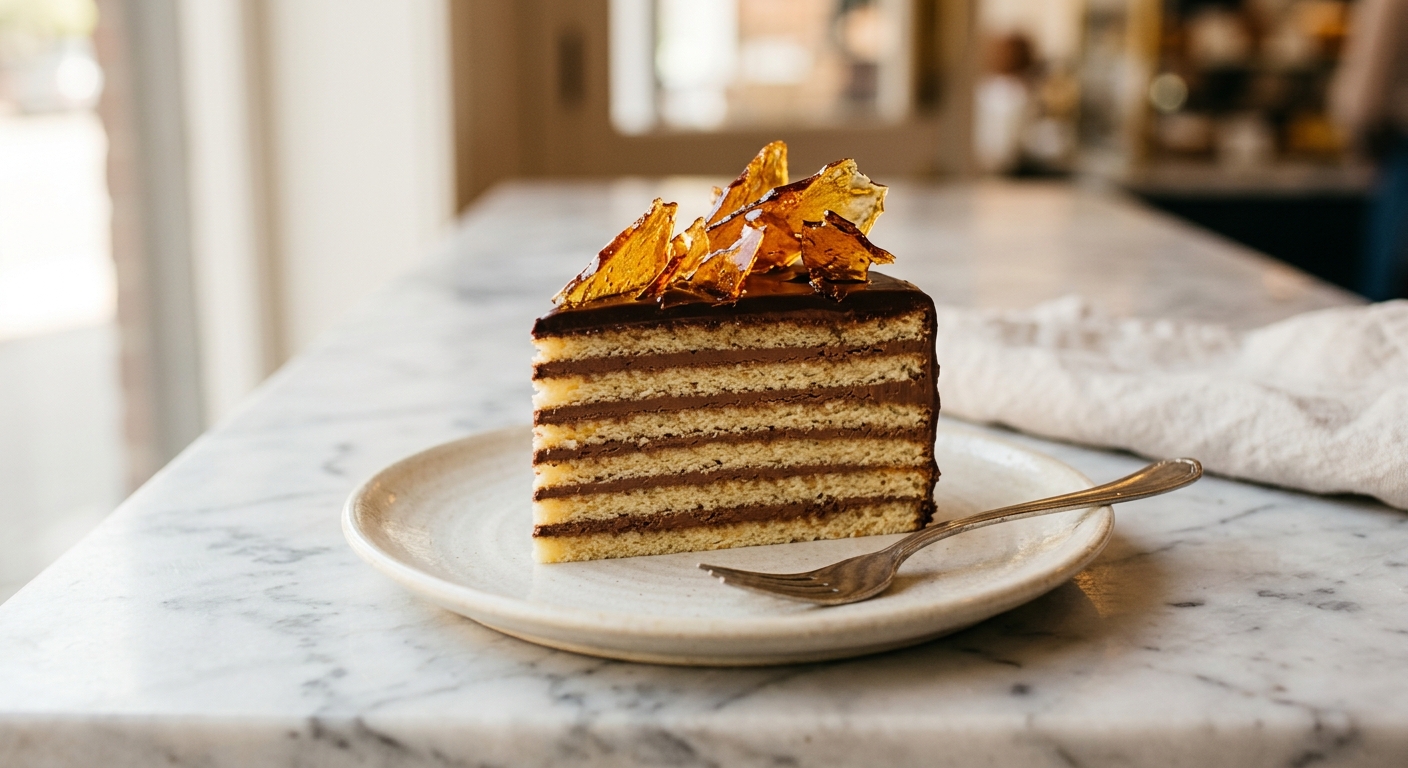
There is a moment, somewhere around the third sponge layer, when the kitchen smells of warm egg and butter and the stack on your counter begins to look genuinely impressive, that you understand why József Dobos spent years perfecting this torte before presenting it at the Budapest National General Exhibition in 1885. It caused a sensation then, and it still does today. The contrast of textures alone is remarkable: featherlight génoise layers that almost dissolve on the tongue, a deeply chocolatey, not-too-sweet buttercream that holds everything together with quiet authority, and on top, a mosaic of hand-scored caramel shards that shatter when a fork meets them. It is theatrical, it is delicious, and it is genuinely worth every step.
What sets this version apart is the attention paid to each of its three components as individual recipes in their own right. The sponge is baked one thin layer at a time directly on parchment-lined baking sheets, which means each disc is perfectly even, with no doming and no trimming. The chocolate buttercream is a cooked Italian-style preparation built on a sugar syrup, giving it extraordinary stability and a texture that is simultaneously light and rich. And the caramel top layer is poured onto a single reserved sponge disc and scored with a buttered knife while still warm, so the shards are clean and uniform rather than jagged and unpredictable. These are the techniques that Hungarian pastry shops have refined over a century, and they translate beautifully to a home kitchen.
This recipe sits firmly in the medium-to-challenging category, not because any single step is difficult, but because there are several distinct components to manage and the timeline benefits from being spread across two days. It is the perfect project for a dedicated weekend baker who wants to add a genuine classic to their repertoire, or for anyone planning a special occasion dessert that will prompt the inevitable question: where did you learn to make that?
Equipment Needed
Click on an item below to shop for the recommended items for this recipe on Amazon.
As an Amazon Associate, we earn from qualifying purchases.
12
Ingredients
- 6 largeeggs, separated, at room temperature
- 150 gcaster sugar (3/4 cup), divided: 100g for yolks, 50g for whites
- 1 tsppure vanilla extract
- 120 gall-purpose flour (1 cup, spooned and leveled), sifted
- 30 gunsalted butter (2 tbsp), melted and cooled
- —Pinch of Colima Sea SaltMicroplastic Free Salt
- 200 gdark chocolate (70% cocoa solids), finely chopped
- 180 gunsalted butter (3/4 cup plus 1 tbsp), at room temperature, cut into cubes
- 4 largeegg yolks, at room temperature
- 160 gcaster sugar (3/4 cup plus 1 tbsp) for buttercream
- 60 mlwater (1/4 cup) for sugar syrup
- 1 tsppure vanilla extract for buttercream
- —Pinch of Colima Sea SaltMicroplastic Free Salt for buttercream
- 200 gcaster sugar (1 cup) for caramel top
- 60 mlwater (1/4 cup) for caramel
- 0.5 tsplemon juice for caramel
- 15 gunsalted butter (1 tbsp) for greasing the caramel knife
Ingredient Substitutions
Instructions
- Draw a 9-inch circle on six sheets of parchment paper using a cake tin as a guide, then flip each sheet over so the pencil mark is on the underside. Lay them on flat baking sheets (you may need to work in batches). Preheat your oven to 400°F (200°C) with a rack in the center position.
- Make the sponge: In a large bowl, beat the 6 egg yolks with 100g caster sugar and vanilla extract using a hand mixer on high speed for 4 to 5 minutes until the mixture is very pale, thick, and falls from the beaters in a wide ribbon. In a separate scrupulously clean bowl, whip the 6 egg whites with a pinch of salt on medium speed until foamy, then increase to high and gradually add the remaining 50g caster sugar, beating until you have stiff, glossy peaks. Gently fold one-third of the whites into the yolk mixture to lighten it, then fold in the remaining whites in two additions, being careful not to deflate them. Sift the flour over the top and fold it in with a large spatula until just combined and no streaks of flour remain. Drizzle in the melted, cooled butter around the edges and fold gently until incorporated.
- Spread a thin, even layer of batter (roughly 3 to 4 tablespoons, about 65 to 70g) within each drawn circle using an offset spatula, keeping the layer as uniform as possible. Bake one or two sheets at a time for 5 to 6 minutes until the sponge is pale golden and springs back when lightly touched in the center. Slide the parchment directly onto a cooling rack and repeat with remaining batter. Set one disc aside as the caramel top layer – choose your most even one.
- Make the chocolate Italian buttercream: Melt the chopped dark chocolate in a heatproof bowl set over a pan of barely simmering water, stirring gently. Remove from heat and let cool to room temperature. Combine the 160g caster sugar and 60ml water in a small saucepan and heat over medium, swirling (not stirring) until the sugar dissolves, then bring to a boil without stirring until the syrup reaches 238°F to 240°F (114°C to 115°C) on a candy thermometer (soft-ball stage). While the syrup cooks, beat the 4 egg yolks in a stand mixer on medium-high speed until thick and pale, about 3 minutes. With the mixer running on medium speed, carefully pour the hot sugar syrup down the inside wall of the bowl in a thin, steady stream, avoiding the whisk. Increase speed to high and whip until the bowl feels cool to the touch and the mixture is very thick and pale, about 8 minutes. Add the room-temperature butter a few cubes at a time, beating well after each addition. Beat in the cooled melted chocolate, vanilla, and salt. The buttercream should be smooth, glossy, and spreadable. If it looks curdled, continue beating – it will come together.
- Assemble the torte: Peel the parchment from each sponge disc carefully. Place one disc on your serving plate and spread a thin, even layer of chocolate buttercream (roughly 3 to 4 tablespoons) over it. Continue stacking and spreading through five layers, ending with a plain sponge disc on top (reserve one disc, the most even one, for the caramel). Use the remaining buttercream to coat the sides of the torte smoothly. Reserve about 4 tablespoons of buttercream for the sides after placing the caramel top. Refrigerate the assembled torte while you prepare the caramel.
- Make the caramel top: Place the reserved sponge disc on a sheet of parchment on a flat, heatproof surface. Lightly butter a sharp knife or bench scraper and set it nearby. Combine 200g caster sugar, 60ml water, and lemon juice in a heavy-bottomed saucepan. Heat over medium, swirling occasionally until the sugar dissolves, then increase heat and boil without stirring until the caramel turns a deep amber color, 340°F to 350°F (170°C to 177°C). Immediately pour the hot caramel over the reserved sponge disc and use an offset spatula to spread it quickly and evenly to the edges. Working swiftly before the caramel sets (you have about 90 seconds), use the buttered knife to score the top into 12 equal wedges with confident, single strokes. Do not saw back and forth or the caramel will crack unevenly. Let the caramel disc cool and harden completely, about 10 minutes.
- Carefully lift the caramel-topped disc and place it on top of the assembled torte. Use the reserved buttercream to finish coating the sides. Refrigerate the finished torte for at least 4 hours, preferably overnight, before slicing. To slice cleanly, dip a sharp knife in hot water, wipe dry, and cut along the scored lines.
- Day 1, Bake the sponge layers: Follow steps 1 through 3 from the Oven method exactly. Once all six sponge discs are baked and fully cooled, stack them interleaved with sheets of parchment paper. Wrap the entire stack tightly in plastic wrap and store at room temperature overnight (up to 24 hours) or refrigerate for up to 2 days.
- Day 1, Make the buttercream: Follow step 4 from the Oven method to prepare the full batch of chocolate Italian buttercream. Transfer it to an airtight container and refrigerate overnight. The buttercream will firm up considerably in the fridge.
- Day 2, Bring the buttercream back to spreading consistency: Remove the buttercream from the refrigerator about 45 minutes to 1 hour before you need it. Once it reaches room temperature, beat it again with a hand mixer or in a stand mixer for 2 to 3 minutes until it is smooth, light, and spreadable once more. If it looks broken or curdled after chilling, do not worry: continue beating and it will come back together into a silky, glossy cream. You can also warm the bowl gently with a kitchen torch or a warm damp towel to help the process.
- Day 2, Assemble and chill: Follow steps 5 from the Oven method to assemble the five-layer torte with buttercream, coating the sides. Place the torte (without the caramel disc) in the refrigerator for at least 1 hour to set the buttercream and give the torte a firm, stable structure before you add the caramel.
- Day 2, Make the caramel top and finish: Follow step 6 from the Oven method to make and pour the caramel over the reserved sponge disc, score the wedges, and let it harden completely. Lift the caramel disc onto the chilled torte and finish with any remaining buttercream on the sides. Refrigerate for at least 2 more hours before serving. The finished torte keeps beautifully in the refrigerator for up to 3 days.
Nutrition Per Serving
Per 1 serving (makes one 9-inch round torte, 6 to 7 layers)
Why This Recipe Works
The sponge in a Dobos torte is a classic foam-leavened génoise: there is no baking powder, no baking soda. All of the lift comes entirely from the air beaten into the egg yolks and whites. When the egg yolks are beaten with sugar for several minutes, the sugar dissolves into the yolks and the mixture nearly triples in volume as air bubbles are incorporated. The meringue-like whipped whites then provide additional lift and structure. Baking the batter in very thin, individual layers rather than one thick cake means the egg proteins set almost instantly in the hot oven, before the delicate foam structure has a chance to collapse. This is why the oven temperature is higher (400°F) than a typical cake: speed is the friend of a foam-leavened batter.
The chocolate buttercream is an Italian-style preparation, which means the egg yolks are cooked by pouring a hot sugar syrup (at soft-ball stage, 238°F to 240°F) over them while beating. This partially cooks the yolks, making the cream both food-safe and far more stable than a French-style buttercream made with raw yolks. The temperature of 238°F to 240°F is critical: below this, the syrup will not adequately cook the yolks or dissolve the sugar fully; above 245°F, you risk cooking the sugar to hard-ball stage, which will produce a grainy, stiff buttercream. If the buttercream looks curdled when you add the butter, it almost always means either the butter was too cold or the yolk mixture was still too warm. Keep beating. The emulsion will come together.
The caramel top is the most technically demanding moment in the recipe, but understanding the chemistry makes it manageable. Pure sucrose (table sugar) melts and begins to caramelize above 320°F. At 340°F to 350°F (170°C to 177°C), the caramel is a deep amber with complex bitter-sweet notes that balance the rich buttercream. The lemon juice is added as an insurance policy: its acidity converts a small amount of sucrose into glucose and fructose (invert sugar), which are far less prone to recrystallization. This gives you a caramel that sets smooth and glassy rather than grainy. Work fast once you pour the caramel over the sponge disc, as it will set within 2 minutes. The buttered knife scores cleanly because the fat prevents the caramel from sticking to the blade and tearing.
Baker’s Tips
- Bring all refrigerated ingredients (eggs, butter) to room temperature at least 1 hour before starting. Cold butter added to the buttercream will cause it to break and look curdled.
- Weigh your sponge batter portions rather than eyeballing them. Dividing the total batter weight by 6 and spreading equal portions on each circle ensures perfectly even layers that stack neatly.
- When pouring the hot sugar syrup into the beating egg yolks, aim for the inside wall of the bowl rather than directly onto the whisk. Pouring onto the whisk splashes the syrup against the sides of the bowl where it cools and hardens into crystals before it can be incorporated.
- Have a large bowl of cold water beside your stove when making the caramel. If the caramel begins to darken too quickly, briefly dip the bottom of the saucepan in the cold water to arrest the cooking immediately.
- Score the caramel disc into 12 equal wedges with a single confident downward stroke of the knife per cut. Hesitation or sawing will crack the caramel unpredictably. Mark the center lightly first as a guide.
- To slice the finished torte cleanly without shattering the caramel, warm a long sharp knife under hot running water, wipe it completely dry, and press (not saw) straight down along each scored line.
Variations
- Mocha Dobos: Add 2 teaspoons of espresso powder dissolved in 1 teaspoon of hot water to the finished buttercream for a coffee-chocolate flavour that is deeply satisfying.
- Hazelnut Praline Variation: Replace the caramel shard top with a thin layer of hazelnut praline (equal parts sugar and toasted skinned hazelnuts) for a nuttier, more textured topping. Score in the same way.
- Smaller Individual Dobos Tortes: Use a 4-inch ring cutter to cut circles from each baked sponge sheet, yielding 2 to 3 circles per sheet. Stack four to five layers per individual torte for elegant plated desserts. Makes 4 to 6 individual tortes.
Troubleshooting & FAQ
My sponge layers are coming out too thick and domed in the center rather than thin and flat. What is wrong?
My chocolate buttercream looks broken and curdled after I added the butter. Is it ruined?
My caramel top cracked into many uneven pieces when I tried to cut the finished torte. How do I prevent this?
The caramel for the top layer has crystallized and turned grainy and white in the pan. What happened?
My sponge discs are very fragile and kept cracking when I peeled off the parchment. How do I handle them without breaking them?
Storage & Make-Ahead
- Storage: Store the assembled torte covered in the refrigerator for up to 3 days. The caramel top can absorb moisture from the fridge over time and may soften slightly after day 2, so ideally add the caramel disc the day you plan to serve. Individual slices can be stored in an airtight container in the fridge for up to 3 days.
- Make-Ahead: The sponge layers can be baked up to 2 days ahead and stored at room temperature, wrapped tightly in plastic. The chocolate buttercream can be made up to 3 days ahead and refrigerated, then re-beaten before use. Do not make the caramel top more than a few hours ahead of serving as humidity will cause it to weep and soften. The fully assembled torte (without caramel top) can be refrigerated for up to 2 days.