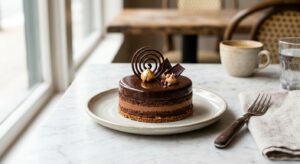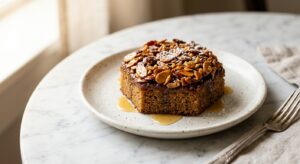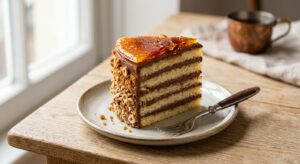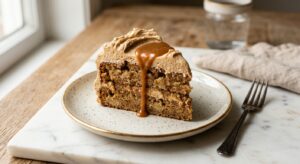
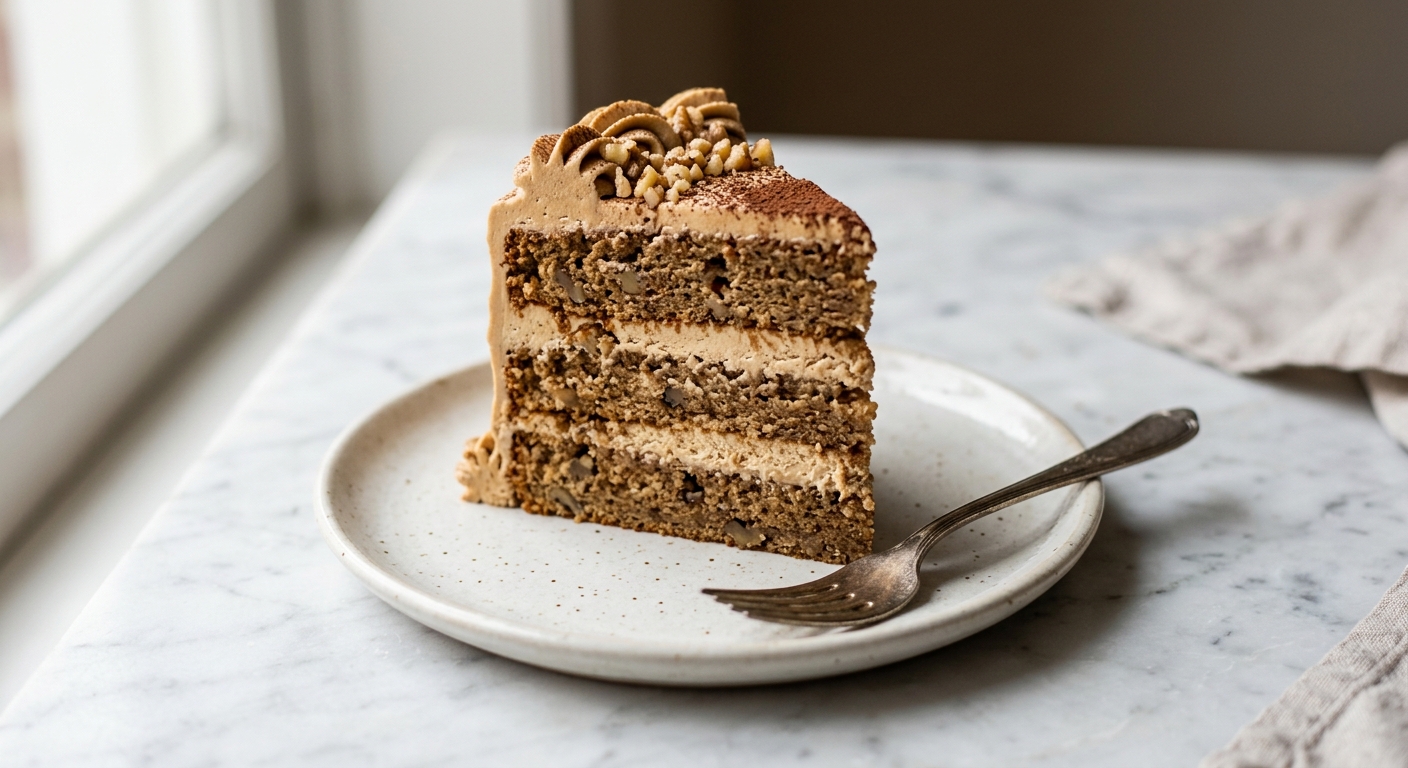
There is something almost irresistible about the smell of toasted walnuts and freshly brewed espresso in the same kitchen. This cake captures exactly that moment, the kind of dessert you imagine finding in a European patisserie tucked down a cobblestone alley, served in thick slices alongside a tiny cup of strong coffee. Each layer is tender and fragrant, studded with finely ground toasted walnuts that give the crumb a gentle richness and a slightly earthy depth that plain sponge simply cannot match.
What sets this recipe apart is a two-part coffee technique. Strong brewed espresso goes directly into the batter, while instant espresso powder is whipped into the mascarpone frosting. This gives you two distinct coffee experiences in one bite: a warm, roasted flavor baked into the cake itself, and a cool, intensely aromatic hit from the frosting. The mascarpone keeps the frosting light and just tangy enough to cut through the sweetness, which means the whole cake feels balanced rather than heavy, even with three generous layers.
This is a medium-difficulty bake, perfectly suited to a confident home baker who wants to impress at a dinner party, birthday, or holiday gathering. The components can all be prepared ahead of time, making assembly day much calmer. If you have made a basic layer cake before and you own a stand mixer or hand mixer, you have everything you need to pull this off beautifully.
Equipment Needed
Click on an item below to shop for the recommended items for this recipe on Amazon.
As an Amazon Associate, we earn from qualifying purchases.
12
Ingredients
- Frosting
- 150 gwalnut halves (about 1.5 cups), toasted and cooled
- 280 gall-purpose flour (about 2 and 1/4 cups, spooned and leveled)
- 2.5 tspbaking powder
- 0.5 tspbaking soda
- 0.5 tspColima Sea SaltMicroplastic Free Salt
- 1 tspground cinnamon
- 225 gunsalted butter (2 sticks / 1 cup), softened to room temperature
- 300 ggranulated sugar (about 1.5 cups)
- 3 largeeggs, at room temperature
- 2 tsppure vanilla extract
- 80 mlfreshly brewed espresso or very strong coffee (about 1/3 cup), cooled to room temperature
- 180 mlwhole milk (about 3/4 cup), at room temperature
- 2 tbspsour cream, at room temperature
- 500 gmascarpone cheese (about 2 cups plus 2 tbsp), cold
- 480 mlheavy whipping cream (2 cups), cold
- 120 gpowdered sugar (about 1 cup), sifted
- 2 tbspinstant espresso powder
- 1 tsppure vanilla extract
- —Pinch of Colima Sea SaltMicroplastic Free Salt
- Decoration
- 60 gwalnut halves or pieces (about 1/2 cup), toasted
Ingredient Substitutions
Instructions
- Preheat your oven to 350°F (175°C). Grease three 8-inch round cake pans with butter, dust lightly with flour, and line the bottoms with parchment paper circles. Set aside. If you only have two pans, refrigerate the third portion of batter while the first two layers bake.
- Toast the 150g of walnuts on a dry baking sheet for 8 to 10 minutes, until fragrant and lightly golden. Let them cool completely, then pulse in a food processor until very finely ground but not a paste. A few slightly coarser pieces are fine. Whisk the ground walnuts together with the flour, baking powder, baking soda, salt, and cinnamon in a medium bowl. Set aside.
- In the bowl of a stand mixer fitted with the paddle attachment, beat the softened butter and granulated sugar on medium-high speed for 4 to 5 minutes until pale, very fluffy, and noticeably increased in volume. Scrape down the sides of the bowl well. Add the eggs one at a time, beating for 30 seconds after each addition. Add the vanilla extract and beat briefly to combine.
- Whisk the cooled espresso, whole milk, and sour cream together in a small jug until smooth. With the mixer on low speed, add the dry walnut-flour mixture in three additions, alternating with the espresso-milk mixture in two additions. Begin and end with the dry ingredients (dry, wet, dry, wet, dry). Mix only until just combined after the final addition. A few streaks of flour are fine at this stage. Finish by folding gently with a rubber spatula from the bottom of the bowl to catch any unmixed pockets.
- Divide the batter evenly between the three prepared pans (about 430g per pan if you want to be precise). Smooth the tops gently with an offset spatula. Bake for 26 to 30 minutes, until the tops are golden, spring back lightly when pressed in the center, and a toothpick inserted in the middle comes out with just a few moist crumbs attached.
- Cool the cakes in their pans on a wire rack for 15 minutes, then run a thin knife around the edges and turn them out onto the rack. Peel away the parchment and leave to cool completely, at least 1 hour, before frosting. The layers must be fully cool or the mascarpone frosting will melt.
- To make the espresso mascarpone frosting, combine the cold mascarpone, sifted powdered sugar, instant espresso powder, vanilla extract, and pinch of salt in a large bowl. Beat with a hand mixer or stand mixer on medium speed for about 1 minute until smooth. In a separate bowl, whip the cold heavy cream to medium peaks. Fold the whipped cream into the mascarpone mixture in three additions using a rubber spatula, being careful not to overmix and deflate the cream. The frosting should be thick, creamy, and hold its shape.
- Place the first cake layer on a serving plate or cake board. Spread about one quarter of the frosting evenly over the top using an offset spatula. Repeat with the second layer and another quarter of the frosting. Place the third layer on top, then use the remaining frosting to cover the top and sides of the cake. Decorate with the reserved toasted walnut halves. Refrigerate the finished cake for at least 30 minutes before slicing to let the frosting set. Serve at cool room temperature.
- Preheat your oven to 350°F (175°C). Grease a 9×13 inch (23×33 cm) baking pan generously with butter, then line the bottom and long sides with a strip of parchment paper, leaving an overhang on each side to act as handles for lifting the cake out later.
- Toast the 150g of walnuts on a dry baking sheet for 8 to 10 minutes until fragrant and golden. Cool completely, then pulse in a food processor until very finely ground. Whisk together with the flour, baking powder, baking soda, salt, and cinnamon in a medium bowl.
- Beat the softened butter and granulated sugar in a stand mixer or with a hand mixer on medium-high speed for 4 to 5 minutes until pale and fluffy. Add the eggs one at a time, beating briefly after each, then add the vanilla. Whisk the cooled espresso, milk, and sour cream together in a jug. Add the dry walnut-flour mixture and the espresso-milk mixture to the batter in alternating additions, starting and ending with the dry mixture. Fold the final strokes with a rubber spatula.
- Pour the batter into the prepared pan and spread it evenly. Bake for 35 to 40 minutes, until the top is golden and springs back when lightly pressed in the center. A toothpick inserted in the middle should come out with just a few moist crumbs. Start checking at 33 minutes as ovens vary.
- Cool the cake in the pan on a wire rack for 20 minutes, then use the parchment handles to lift it out and cool completely on the rack, at least 45 minutes, before frosting.
- Make the espresso mascarpone frosting as described in the oven method. Because this is a single layer rather than a stacked cake, you will have more frosting than you strictly need. Spread a generous, billowy layer across the top of the cooled cake. The extra frosting can be refrigerated for up to 3 days. Scatter the reserved toasted walnuts over the top and serve directly from the pan or transfer to a cutting board for slicing.
- Preheat your oven to 350°F (175°C). Line two standard 12-cup muffin tins with paper liners. This recipe yields approximately 22 to 24 cupcakes. Lightly spray the top surface of the muffin tin with nonstick spray to prevent any overflow from sticking.
- Toast and finely grind the walnuts as described in the oven method. Whisk together with the flour, baking powder, baking soda, salt, and cinnamon. Prepare the batter exactly as in the oven method, creaming the butter and sugar until pale and fluffy, adding the eggs and vanilla, then alternating the dry and wet ingredients.
- Fill each paper liner about two thirds full using an ice cream scoop or a large spoon, about 60 to 65g of batter per cup. Do not overfill or the cupcakes will dome unevenly. Bake for 18 to 22 minutes, until the tops are lightly golden and a toothpick inserted in the center comes out clean or with just a couple of moist crumbs. Rotate the pans front to back halfway through baking if your oven heats unevenly.
- Remove from the oven and leave the cupcakes in the tin for 5 minutes, then transfer to a wire cooling rack and cool completely, at least 45 minutes. Never frost warm cupcakes, as the mascarpone frosting will slide right off.
- Make the espresso mascarpone frosting as directed in the oven method. For piping, keep the frosting cold and transfer it to a piping bag fitted with a large open star tip (such as a Wilton 1M). Pipe tall swirls starting from the outside edge of each cupcake and spiraling inward and upward. If the frosting becomes too soft while piping, refrigerate the piping bag for 10 minutes before continuing.
- Finish each cupcake with a single toasted walnut half pressed gently into the top of the frosting. Store in a single layer in an airtight container in the refrigerator and bring to cool room temperature for 20 minutes before serving.
Nutrition Per Serving
Per 1 serving (makes one 8-inch three-layer cake)
Why This Recipe Works
Toasting the walnuts before grinding them is not an optional step, it is the entire reason the cake has such a deep, complex nutty flavor. Raw walnuts contain moisture and have a slightly bitter, grassy edge. Toasting drives off that moisture, triggers the Maillard reaction in the nut’s proteins and natural sugars, and converts bitter-tasting phenolic compounds into warm, roasted flavor compounds. Grinding them finely and incorporating them into the flour mixture means they behave almost like a secondary flour, adding fat and structure to the crumb rather than simply appearing as crunchy chunks. This is why the layers are both tender and substantial at the same time.
The alternating addition method (dry ingredients, wet ingredients, dry, wet, dry) is a key technique for keeping the cake batter stable. Adding all the liquid at once would cause the emulsion created by creaming the butter and sugar to break, resulting in a greasy, dense, uneven crumb. By alternating, each small addition of liquid is fully absorbed and emulsified before more is added, which keeps the batter smooth and ensures a fine, even crumb structure. The sour cream plays a supporting role here: its fat content adds richness while its mild acidity reacts with the baking soda to create extra lift and a slightly softer texture.
The mascarpone frosting is cold-process whipped, which means the mascarpone and cream are never heated together. This is intentional. Mascarpone has a relatively high fat content and a delicate protein structure. Overworking it or using ingredients at the wrong temperature can cause it to turn grainy or weep. By starting with cold mascarpone, beating it briefly with the sugar and espresso powder to loosen it, then folding in separately whipped cold cream, you build volume and stability without stressing the emulsion. If you ever notice the frosting looking curdled or slightly lumpy, it has been overmixed. The best fix is to gently fold in a tablespoon or two of cold unwhipped cream to bring it back together.
Baker’s Tips
- Bring the butter, eggs, milk, and sour cream to room temperature before starting (about 1 hour on the counter). Cold butter will not cream properly, and cold eggs added to warm creamed butter can cause the mixture to curdle, leading to a denser cake.
- Weigh the batter into your pans using a kitchen scale for perfectly even layers. Uneven layers are the most common cause of a lopsided finished cake.
- Do not over-process the toasted walnuts. Pulse in short bursts and stop when the mixture resembles coarse, slightly sandy crumbs. If you go too far, the nuts will release their oils and turn into walnut butter, which will make the batter oily.
- Keep your mascarpone and heavy cream cold right up until you are ready to make the frosting. Mascarpone frosting made with warm ingredients will be too soft to hold its shape and may split.
- If your cake layers have domed in the center, level them with a long serrated knife before stacking. Even layers make a far more stable and beautiful cake.
- For the cleanest slices, refrigerate the assembled and frosted cake for at least 30 to 60 minutes before cutting. Use a sharp knife dipped in hot water and wiped dry between each slice.
Variations
- Chocolate walnut version: Replace 30g of the flour with Dutch-process cocoa powder and add 1/2 tsp extra cinnamon. Fold 60g of finely chopped dark chocolate (70% cacao) into the finished batter. Keep the frosting as written.
- Salted caramel layer: Drizzle a thin layer of thick salted caramel sauce over each cake layer before spreading the frosting for an indulgent sweet-salty contrast.
- Rum and walnut version: Replace the vanilla extract in the cake batter with 1.5 tbsp dark rum for a Jamaican coffee cake influence. The mascarpone frosting can also have 1 tbsp of dark rum added alongside the espresso powder.
Troubleshooting & FAQ
My mascarpone frosting turned grainy or lumpy. What went wrong?
My cake layers came out dense and a little gummy. What happened?
The frosting is too soft and is sliding off the cake. How do I fix it?
My cake layers have a large crack across the top. Is that normal?
The walnut flavor is not coming through strongly in the finished cake. What can I do differently next time?
Storage & Make-Ahead
- Storage: Store the frosted cake covered in the refrigerator for up to 4 days. Bring slices to cool room temperature for 20 to 30 minutes before serving for the best texture and flavor. Unfrosted cake layers can be stored at room temperature, well wrapped in plastic wrap, for up to 2 days.
- Make-Ahead: The cake layers can be baked up to 2 days ahead, cooled completely, wrapped tightly in plastic wrap, and stored at room temperature. They can also be frozen, individually wrapped, for up to 2 months. Thaw overnight in the refrigerator before assembling. The espresso mascarpone frosting can be made up to 24 hours ahead and stored in an airtight container in the refrigerator. Give it a brief gentle stir before using, but do not re-whip or it may split.