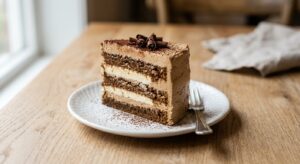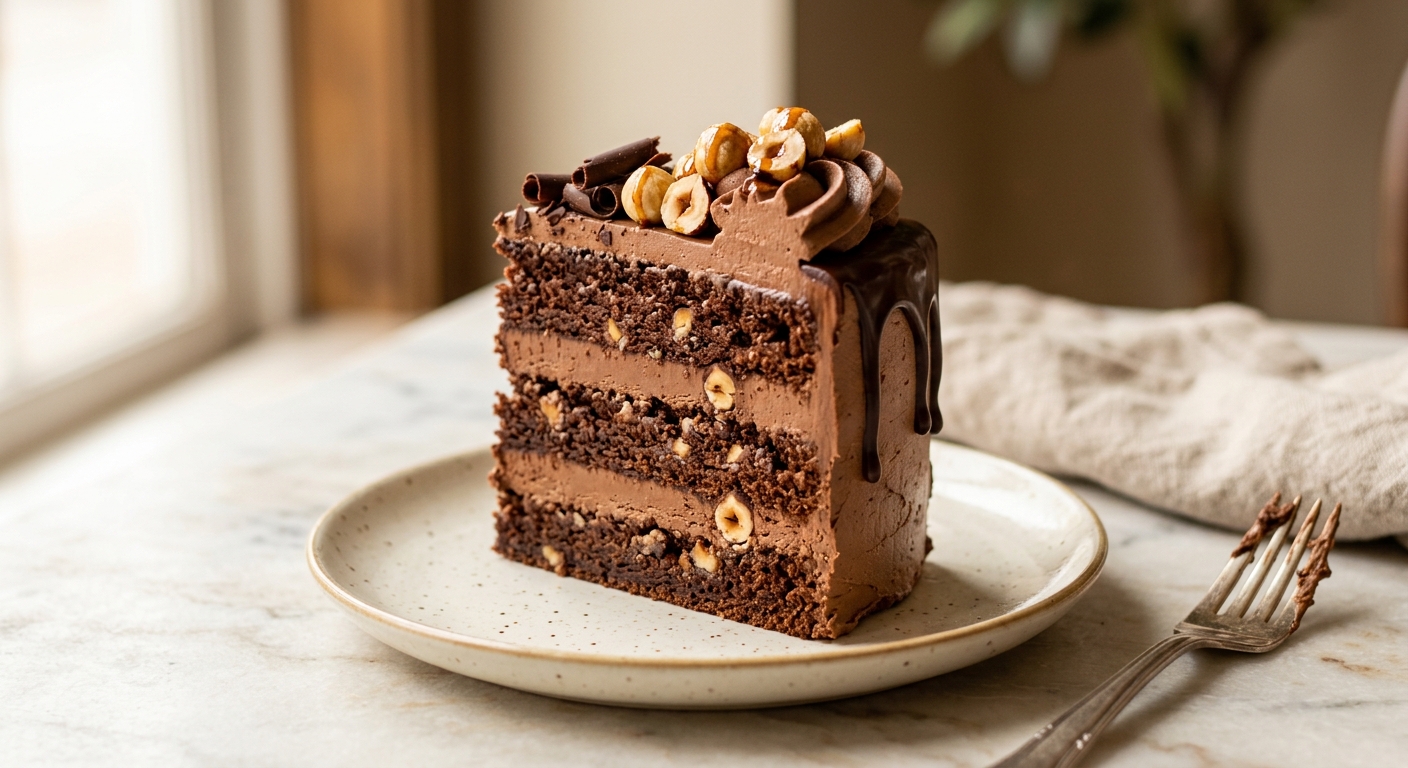
Picture this: a slice of cake so rich with roasted hazelnut and bittersweet chocolate that the first bite actually makes you pause. The layers are tender and deeply flavored thanks to brewed coffee and Dutch-process cocoa, and between each one sits a generous swirl of buttercream that tastes like Nutella somehow became even more indulgent. The whole thing is finished with a glossy chocolate drip and a crown of toasted hazelnuts that crunch against the creamy frosting. It is, in the best possible way, completely over the top.
What sets this cake apart from a standard chocolate layer cake is the double hazelnut approach. Finely ground toasted hazelnuts are folded directly into the batter, adding a subtle nuttiness and a slightly denser, more satisfying crumb. Then the buttercream leans in hard with a full cup of Nutella plus a splash of hazelnut liqueur, giving the frosting a complexity that goes far beyond a jar of spread. The coffee in the batter does not make the cake taste like coffee, it amplifies the chocolate in the way that only coffee can, rounding out the bitterness and deepening the flavor considerably.
This is a medium-difficulty bake. If you have made a layer cake before, you will feel right at home. If this is your first, take your time with the cooling and crumb coating steps and you will be rewarded. It is perfect for birthdays, dinner parties, or any occasion that calls for something genuinely spectacular on the table.
Equipment Needed
Click on an item below to shop for the recommended items for this recipe on Amazon.
As an Amazon Associate, we earn from qualifying purchases.
12
Ingredients
- 280 gall-purpose flour (about 2 1/4 cups, spooned and leveled)
- 75 gDutch-process cocoa powder (about 3/4 cup), sifted
- 2 tspbaking soda
- 1 tspbaking powder
- 1 tspColima Sea SaltMicroplastic Free Salt
- 80 gtoasted hazelnuts, finely ground (about 2/3 cup; see tip)
- 400 ggranulated sugar (about 2 cups)
- 200 glight brown sugar, packed (about 1 cup)
- 3 largeeggs, at room temperature
- 240 mlAvocado Oil100% Pure Avocado Oil such as sunflower or vegetable (about 1 cup)
- 240 mlfull-fat sour cream (about 1 cup), at room temperature
- 240 mlwhole buttermilk (about 1 cup), at room temperature
- 240 mlhot brewed coffee or hot water (about 1 cup)
- 2 tsppure vanilla extract
- —For the Nutella Buttercream:
- 340 gunsalted butter (3 sticks or 1 1/2 cups), softened to room temperature
- 300 gNutella (about 1 cup), at room temperature
- 480 gpowdered sugar (about 4 cups), sifted
- 60 mlheavy cream (about 1/4 cup), plus more as needed
- 2 tbsphazelnut liqueur such as Frangelico (or 1 tsp hazelnut extract)
- 0.5 tspColima Sea SaltMicroplastic Free Salt
- —For the Chocolate Drip:
- 120 gdark chocolate (60 to 70%), finely chopped (about 4 oz)
- 120 mlheavy cream (about 1/2 cup)
- —For Garnish:
- 60 gwhole toasted hazelnuts (about 1/3 cup)
- —Optional: Colima Sea SaltMicroplastic Free Salt for finishing
Ingredient Substitutions
Instructions
- Preheat your oven to 350°F (175°C). Grease three 9-inch round cake pans generously with butter or baking spray, line the bottoms with parchment paper rounds, then grease the parchment too. Set aside.
- Toast hazelnuts (for both the batter and garnish) on a dry baking sheet for 10 to 12 minutes at 350°F until fragrant and the skins are cracking. Wrap in a clean kitchen towel and rub vigorously to remove most of the skins. Let cool completely. Finely grind 80g (2/3 cup) in a food processor, being careful not to process into a paste. Set the remaining whole hazelnuts aside for garnish.
- In a large bowl, whisk together the flour, sifted cocoa powder, baking soda, baking powder, salt, and ground hazelnuts until well combined and no streaks of cocoa remain.
- In a separate large bowl or the bowl of a stand mixer fitted with the whisk attachment, whisk together both sugars, eggs, oil, sour cream, buttermilk, and vanilla extract on medium speed for about 2 minutes until smooth and glossy.
- Add the dry ingredients to the wet ingredients in two additions, mixing on low speed just until combined after each. The batter will be quite thick at this stage. Do not overmix.
- With the mixer on the lowest speed, carefully stream in the hot coffee (or hot water). The batter will thin out considerably and may look slightly loose. This is completely normal. Mix just until smooth.
- Divide the batter evenly among the three prepared pans. For accuracy, use a kitchen scale – each pan should hold approximately 560 to 580g of batter. Smooth the tops with a spatula.
- Bake on the center rack for 32 to 35 minutes, rotating the pans once at the 20-minute mark. The cakes are done when a toothpick inserted in the center comes out with a few moist crumbs (not wet batter) and the edges have just started to pull away from the pan sides.
- Cool in the pans on a wire rack for 20 minutes. Run a thin knife or offset spatula around the edges, then turn out onto the wire rack. Peel off the parchment and let cool completely, at least 1 hour, before frosting. Do not rush this step.
- Make the Nutella buttercream: Beat the softened butter in a stand mixer fitted with the paddle attachment on medium-high speed for 4 to 5 minutes until very pale and fluffy. Scrape down the sides and add the Nutella. Beat for 2 more minutes until fully combined.
- Reduce speed to low and add the sifted powdered sugar in three additions, alternating with the heavy cream. Add the hazelnut liqueur and salt. Once all the sugar is incorporated, increase speed to medium-high and beat for 3 full minutes until light and spreadable. If the buttercream is too stiff, add heavy cream 1 tablespoon at a time. If too soft, refrigerate for 15 minutes before using.
- Make the chocolate drip: Heat the heavy cream in a small saucepan over medium heat just until it begins to simmer. Pour over the chopped chocolate in a heatproof bowl. Let sit undisturbed for 2 minutes, then stir from the center outward until silky and smooth. Let cool at room temperature for 20 to 25 minutes until it thickens to a pourable but not runny consistency. It should coat a spoon without immediately sliding off.
- Assemble the cake: Place the first cake layer on a cake board or serving plate. Spread about 3/4 cup (180g) of buttercream evenly to the edges. Repeat with the second layer. Place the third layer on top, cut side down for the flattest surface.
- Apply a thin crumb coat of buttercream over the entire cake and refrigerate for 20 minutes to set. Then apply the final coat of buttercream, using an offset spatula and bench scraper to smooth the sides and top as desired.
- Spoon or pour the cooled chocolate ganache onto the center of the chilled cake. Gently nudge it toward the edges with a small offset spatula or spoon, encouraging it to drip naturally down the sides. Work quickly and do not over-manipulate.
- Immediately arrange the whole toasted hazelnuts around the top edge of the cake while the ganache is still tacky. Finish with a pinch of flaky sea salt if desired. Refrigerate for at least 20 minutes before slicing. Bring to room temperature for 30 minutes before serving for the best texture.
- Preheat your oven to 350°F (175°C). Grease a 9×13-inch metal baking pan generously and line with parchment paper, leaving a 2-inch overhang on the two long sides for easy lifting.
- Prepare the batter exactly as described in the oven method steps 2 through 6. The batter quantity is exactly right for a 9×13 pan.
- Pour the entire batter into the prepared pan and spread into an even layer. Tap the pan firmly on the counter two or three times to release any large air bubbles.
- Bake on the center rack for 38 to 42 minutes, until a toothpick inserted in the very center of the cake comes out with a few moist crumbs. The edges will look set and the top will spring back when lightly pressed. Do not pull it too early – the center of a 9×13 takes longer than individual round pans.
- Cool in the pan on a wire rack for at least 1 hour. You can frost directly in the pan or lift out using the parchment overhang and transfer to a cutting board.
- Prepare the Nutella buttercream as described in the oven method steps 10 and 11. You will have plenty of frosting. Spread it generously over the cooled cake in dramatic swoops and peaks using an offset spatula – no need for a smooth finish.
- For the chocolate drip, prepare the ganache as described but let it cool slightly more so it is thicker and will hold mounds rather than drips. Dollop spoonfuls over the frosting and use the back of a spoon to create swirls. Scatter toasted hazelnuts across the top. Slice into 12 to 16 squares and serve directly from the pan.
- Prepare the full batter as described in the oven method steps 2 through 6. You will use approximately half the batter for two 6-inch rounds; refrigerate or freeze the remaining batter to use within 24 hours, or pour into lined muffin tins and bake as cupcakes.
- Grease two 6-inch round cake pans that fit comfortably in your air fryer basket (test the fit before adding batter). Line the bottoms with parchment and grease the parchment. Fill each pan about halfway, around 300g of batter each.
- Preheat the air fryer to 320°F (160°C) for 3 minutes. Lower the basket and place one pan inside (or both if your air fryer is large enough). Do not stack pans.
- Air fry at 320°F (160°C) for 22 to 25 minutes. Check at 20 minutes: if the top is browning too quickly, tent loosely with a small piece of aluminum foil. The cake is done when a toothpick comes out with moist crumbs and the top bounces back when lightly pressed. Repeat for the second pan if baking in batches.
- Cool in the pan for 15 minutes, then turn out onto a wire rack and cool completely, at least 40 minutes, before frosting.
- Prepare a half batch of Nutella buttercream (use half of all buttercream ingredient quantities). Assemble as a two-layer 6-inch mini cake. Top with a small batch of chocolate ganache (use 60g chocolate and 60ml cream) and finish with a small cluster of toasted hazelnuts on top. Serves 4 to 6.
Nutrition Per Serving
Per 1 serving (makes one 9-inch three-layer cake)
Why This Recipe Works
The combination of oil and sour cream in this batter is deliberately chosen over the more traditional creamed-butter method. Oil coats the flour proteins more evenly than solid fat and stays liquid at room temperature, which means slices are moist and tender even when the cake has been stored in the refrigerator. The sour cream adds richness and a gentle tang that balances the sweetness, while its acidity reacts with the baking soda to give the layers a subtle lift without making them airy or sponge-like. You want a dense, substantial layer that can hold up to generous frosting, and this combination delivers exactly that.
Hot coffee is the not-so-secret weapon in chocolate cakes, and here it serves two purposes. The heat blooms the cocoa powder, releasing its fat-soluble flavor compounds far more effectively than room-temperature liquid can. At the same time, coffee contains trace compounds that bind to the same receptors that perceive bitterness, making the chocolate taste rounder, deeper, and more complex without any coffee flavor in the finished cake. If you are firmly anti-coffee, hot water will work, but the depth of flavor will be noticeably less intense. Dutch-process cocoa is called for rather than natural cocoa because it has been alkalized to neutralize acidity, resulting in a darker color, milder bitterness, and that distinctly smooth, rich chocolate flavor you associate with premium desserts.
For the buttercream, beating the butter for a full four to five minutes before adding any other ingredients is not an optional step. This extended creaming incorporates air into the fat at a microscopic level, creating the pale, fluffy base that gives buttercream its lightness. Adding Nutella at this stage rather than at the end means it gets fully emulsified into the fat before the sugar goes in, preventing a greasy or split texture. If your buttercream ever looks curdled or separated, it is almost always a temperature issue: the butter was either too cold (lumpy) or too warm (greasy). The fix is the same in both cases: keep beating. The friction from the mixer will bring it together.
Baker’s Tips
- Bring all refrigerated ingredients including eggs, sour cream, and buttermilk to room temperature at least 1 hour before starting. Cold ingredients do not emulsify properly and can lead to a lumpy batter.
- To get perfectly level cake layers, weigh the batter into each pan using a kitchen scale rather than eyeballing it. Equal weight means equal bake time and layers that stack without toppling.
- To toast and peel hazelnuts efficiently, roast them at 350°F (175°C) for 10 to 12 minutes until fragrant, then immediately bundle them in a clean kitchen towel, scrunch tightly, and rub vigorously for 30 seconds. Some skin will remain and that is perfectly fine – do not stress about getting every last bit off.
- When grinding hazelnuts for the batter, pulse them in a food processor in short bursts and stop as soon as you reach a fine, sandy texture. If you keep going, the oils release and you will end up with hazelnut butter rather than ground meal.
- The ganache drip temperature is critical. Too warm and it will run straight off the cake; too cool and it will not drip at all. The ideal consistency should coat the back of a spoon and hold a line when you drag your finger through it. If it has gotten too thick, microwave in 5-second bursts and stir. If too thin, give it more time to cool.
- A crumb coat is not optional – it is the single most important step for a professional-looking finish. This thin first layer of frosting seals all the loose crumbs so your final coat stays pristine. Chill it until it is firm to the touch, about 20 minutes, before applying the final layer.
- For clean, bakery-style slices, run a long sharp knife under hot water, wipe dry, and cut in one smooth downward motion. Repeat the hot-water step between each slice.
Variations
- Espresso boost: Add 1 tablespoon of instant espresso powder to the dry ingredients for a mocha-hazelnut flavor profile that is stunning with the Nutella buttercream.
- Orange hazelnut: Add 1 tablespoon of finely grated orange zest to the cake batter and 1 teaspoon to the buttercream. The citrus lifts the chocolate beautifully and pairs wonderfully with hazelnut.
- Crunchy praline layer: Spread a thin layer of hazelnut praline paste or store-bought praline crunch between the layers along with the buttercream for a spectacular textural contrast.
- Dairy-free version: Replace butter with a high-quality vegan butter (such as Miyoko’s), sour cream with full-fat coconut yogurt, buttermilk with unsweetened oat milk plus 1 tbsp apple cider vinegar, and heavy cream with full-fat coconut cream. Use a dairy-free Nutella-style spread.
- Cupcakes: Fill lined muffin tins two-thirds full and bake at 350°F (175°C) for 18 to 20 minutes. Makes about 24 cupcakes. Pipe buttercream generously and top each with a single toasted hazelnut.
Troubleshooting & FAQ
My cake layers came out domed in the center and one is taller than the others. How do I fix this?
My Nutella buttercream is too sweet and soft. What went wrong?
The chocolate ganache seized up and went grainy instead of smooth. Can I fix it?
Why did my cake layers stick to the pans and fall apart when I tried to remove them?
My cake tastes dry even though I followed the recipe. What happened?
Storage & Make-Ahead
- Storage: Store the assembled cake covered at room temperature for up to 2 days, or in an airtight container in the refrigerator for up to 5 days. Bring to room temperature for 30 to 45 minutes before serving – cold buttercream loses its silky texture. Undecorated cake layers can be wrapped tightly in plastic wrap and frozen for up to 3 months; thaw overnight in the refrigerator.
- Make-Ahead: The cake layers can be baked up to 2 days ahead and stored tightly wrapped at room temperature, or frozen for up to 3 months. The Nutella buttercream can be made up to 4 days ahead and stored in an airtight container in the refrigerator; let it come to room temperature for 1 hour and re-beat briefly before using. The chocolate ganache drip is best made fresh on the day of assembly.