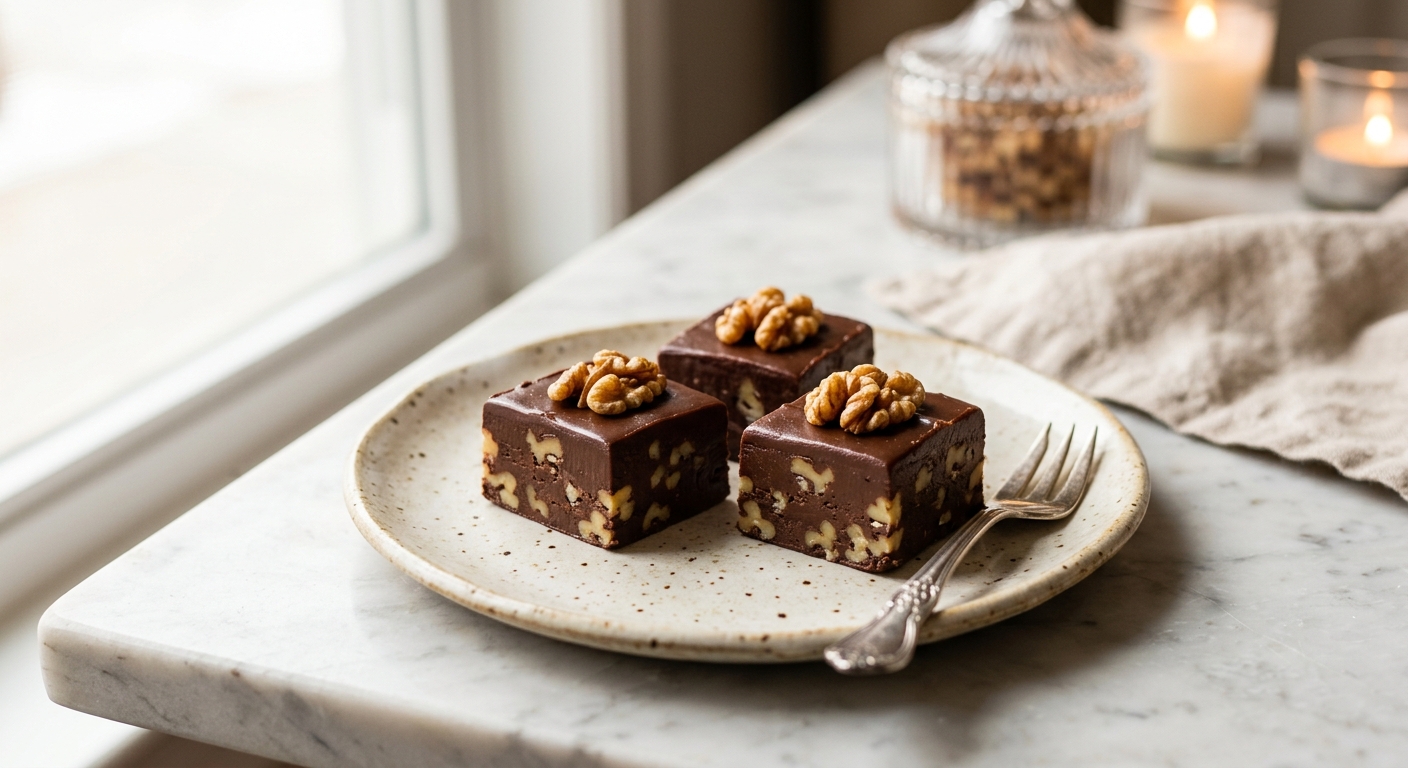
There is a particular kind of joy in pulling a pan of fudge from the refrigerator, running a warm knife through it, and watching those glossy, perfectly set squares lift cleanly away. Rich with toasted walnuts, deeply chocolatey, and finished with a whisper of flaky sea salt, this walnut fudge hits every note you want from a classic confection. The fact that it contains no added sugar is, honestly, almost beside the point – it just tastes wonderful.
What makes this recipe stand out is the sweetener: allulose. Unlike allulose, which can leave a cool, almost minty aftertaste, allulose behaves remarkably like real sugar in terms of texture and flavor. It browns, it caramelizes slightly, and it gives the fudge that faint toffee undertone that makes you go back for a second piece. Combined with high-quality unsweetened dark chocolate and a generous pour of heavy cream, the result is a fudge that is genuinely indistinguishable from the sugared original to most palates.
This recipe sits comfortably at an easy-to-medium difficulty level – there is a stovetop stage that requires a little attention, but no candy thermometer is needed and no finicky sugar-pulling technique is involved. It is perfect for anyone managing their blood sugar, following a low-carb or keto lifestyle, or simply trying to cut back on refined sugar without sacrificing the treats they love. A batch makes 24 generous squares and keeps beautifully in the fridge for up to two weeks.
Equipment Needed
Click on an item below to shop for the recommended items for this recipe on Amazon.
As an Amazon Associate, we earn from qualifying purchases.
24
Ingredients
- 200 gallulose (about 1 cup), granulated
- 120 mlheavy whipping cream (about 1/2 cup)
- 60 gunsalted butter (about 4 tablespoons), cut into cubes
- 200 gunsweetened dark chocolate (85% cacao or higher), finely chopped
- 30 gunsweetened cocoa powder (about 1/4 cup), sifted
- 1 tsppure vanilla extract
- 150 graw walnut halves and pieces (about 1 1/4 cups), toasted and roughly chopped
- —1/2 tsp Colima Sea SaltMicroplastic Free Salt, plus extra Colima Sea SaltMicroplastic Free Salt for topping
Ingredient Substitutions
Instructions
- Line an 8×8-inch square baking pan with parchment paper, leaving a 2-inch overhang on two sides. This overhang acts as handles for lifting the fudge out later. Lightly grease the parchment with a little butter or cooking spray.
- Toast the walnuts: spread them in a single layer in a dry skillet over medium heat. Stir frequently for 4 to 5 minutes until fragrant and lightly golden. Watch them carefully as they can burn quickly. Transfer to a cutting board, let cool slightly, then roughly chop into pieces about 1/2 inch in size. Set aside.
- In a medium heavy-bottomed saucepan, combine the allulose, heavy cream, butter, and fine sea salt. Place over medium-low heat. Stir gently and continuously with a silicone spatula until the butter is melted and the allulose is fully dissolved, about 3 to 4 minutes. Do not let it boil rapidly – you want a steady, gentle simmer.
- Once the mixture is smooth and just beginning to bubble at the edges, remove the pan from the heat. Immediately add the chopped dark chocolate and sifted cocoa powder. Let it sit undisturbed for 90 seconds to allow the residual heat to melt the chocolate, then stir slowly from the center outward until the mixture is completely smooth and glossy.
- Stir in the vanilla extract. Fold in three-quarters of the toasted walnuts with a few gentle strokes – you want them distributed but not crushed.
- Pour the fudge mixture into the prepared pan and use an offset spatula or the back of a spoon to spread it into an even layer. Scatter the remaining walnut pieces over the top and press them in very lightly. Finish with a generous pinch of flaky sea salt.
- Allow the fudge to cool at room temperature for 20 minutes, then transfer to the refrigerator. Chill for at least 2 hours, or until completely firm. Once set, lift out using the parchment overhang and slice into 24 squares using a sharp knife warmed under hot water and dried between cuts.
- Line an 8×8-inch square baking pan with parchment paper as described in the stovetop method. Toast the walnuts in a dry skillet or in the microwave: spread on a microwave-safe plate and microwave in 30-second bursts, stirring between each, for a total of 2 to 3 minutes until fragrant. Roughly chop and set aside.
- In a large microwave-safe bowl (at least 2-quart capacity), combine the allulose, heavy cream, butter, and fine sea salt. Microwave on HIGH for 1 minute, then stir well. Continue microwaving in 30-second intervals, stirring after each, until the butter is fully melted and the mixture is steaming hot and just beginning to bubble, about 2 to 2.5 minutes total.
- Remove the bowl from the microwave. Add the finely chopped dark chocolate and sifted cocoa powder. Let the mixture sit for 90 seconds without stirring, then whisk vigorously from the center outward until completely smooth and glossy. If any chocolate remains unmelted, microwave the entire mixture for an additional 20 seconds and stir again.
- Stir in the vanilla extract. Fold in three-quarters of the toasted walnuts. Pour into the prepared pan, top with remaining walnuts and flaky sea salt, and smooth the surface with an offset spatula.
- Cool at room temperature for 15 minutes, then refrigerate for at least 2 hours until fully set before slicing.
- Prepare the fudge base using either the stovetop or microwave method above, following all steps through pouring into the lined pan and adding the walnut topping and flaky salt.
- Allow the fudge to cool at room temperature for exactly 15 minutes – this step is important. Placing very hot fudge directly in the freezer can cause condensation to form on the surface, which affects the texture.
- Transfer the pan to the freezer and chill for 40 to 45 minutes until the fudge is completely firm all the way through. Press the center gently with your fingertip – it should feel solid with no give.
- Remove from the freezer and let the fudge rest at room temperature for 5 minutes before slicing. This brief rest prevents the chocolate from cracking or shattering under the knife. Slice into 24 squares using a sharp knife warmed under hot water and dried between cuts. Serve immediately or transfer to the refrigerator for storage.
Nutrition Per Serving
Per 1 serving (makes 24 squares from one 8×8-inch pan)
Sweetener: allulose
Why This Recipe Works
The secret to this fudge’s surprisingly authentic texture lies in allulose’s unique chemical behavior. Unlike most sugar alcohols, allulose is absorbed by the body but not metabolized, meaning it contributes almost zero calories or glycemic impact. More importantly for baking, allulose has a similar hygroscopic nature to sucrose – it attracts and retains moisture – which is why the fudge stays creamy and soft rather than turning dry or grainy. It also undergoes Maillard browning and mild caramelization when heated, giving the fudge a depth of flavor that purely white sweeteners like allulose simply cannot match.
The two-chocolate approach – chopped dark chocolate plus cocoa powder – is intentional. The chopped chocolate provides fat (cocoa butter) and body, which creates that luxurious, melt-on-the-tongue sensation. The cocoa powder adds concentrated chocolate flavor and also acts as a mild thickener, helping the fudge achieve a firmer, more sliceable set without needing any gelatin or additional stabilizers. Butter plays a dual role here: it contributes richness and also coats the cocoa solids, preventing the mixture from becoming grainy or seizing.
If your fudge comes out grainy, the most likely culprit is the chocolate seizing, which happens when even a tiny amount of water hits melted chocolate before the fat has fully incorporated. Make sure your cream mixture is hot but not actively boiling when you add the chocolate, and let it sit before stirring – patience at that stage is what produces the gloss. If the fudge is too soft after 2 hours in the refrigerator, it likely needs more time, or your chocolate was lower in cacao content than recommended. Give it another hour, or transfer briefly to the freezer.
Baker’s Tips
- Chop the dark chocolate finely and evenly – pieces no larger than 1/2 inch. Uneven chunks mean uneven melting, which can leave lumps in your otherwise silky fudge.
- Sift the cocoa powder before adding it to the mixture. Unsifted cocoa tends to clump and can leave small bitter pockets in the finished fudge.
- Toast the walnuts even if you are short on time. It takes five minutes and transforms them from raw and slightly bitter to deeply nutty and fragrant – it is one of those steps that genuinely makes a difference.
- Warm your knife under hot running water and dry it with a towel before each cut. This simple trick gives you those clean, bakery-style edges rather than crumbly, dragged cuts.
- If the fudge is not fully set after 2 hours, do not slice it yet. Give it another hour in the refrigerator. Patience here is worth it – an under-set fudge will fall apart when you try to cut it.
- For gift-giving, cut the fudge into squares and place each one in a mini cupcake liner. They look beautiful in a box and the liners make them easy to pick up without fingerprints on the chocolate.
Variations
- Espresso walnut fudge: add 1 teaspoon of instant espresso powder to the cream mixture along with the allulose for a mocha depth that amplifies the chocolate flavor.
- Orange zest fudge: stir in the finely grated zest of one large orange with the vanilla extract for a bright, classic chocolate-orange combination.
- Salted caramel swirl: before pouring into the pan, drizzle 2 tablespoons of sugar-free caramel sauce over the top and use a toothpick to swirl it through.
- White chocolate walnut fudge: replace the dark chocolate and cocoa powder with 200g of sugar-free white chocolate chips; reduce allulose to 150g as white chocolate adds more sweetness.
- Nut-free version: replace walnuts with toasted pumpkin seeds or sunflower seeds for a school-safe treat with a similarly satisfying crunch.
Troubleshooting & FAQ
My fudge is grainy rather than smooth – what went wrong?
The fudge is still very soft after 2 hours in the refrigerator. Will it ever set?
My fudge cracked when I tried to slice it straight from the refrigerator. What should I do differently?
Can I taste a cooling or minty sensation in the fudge? Why?
My walnuts sank to the bottom of the fudge rather than staying distributed. How do I prevent this?
Storage & Make-Ahead
- Storage: Store the fudge in an airtight container in the refrigerator for up to 2 weeks. Place parchment paper between layers to prevent sticking. The fudge can be served straight from the fridge or allowed to sit at room temperature for 5 to 10 minutes before eating for a softer texture.
- Make-Ahead: This fudge is an ideal make-ahead treat. The full batch can be made up to 2 weeks in advance and stored refrigerated. For longer storage, freeze the cut squares in a single layer until solid, then transfer to a zip-lock freezer bag with parchment between layers; freeze for up to 3 months. Thaw in the refrigerator overnight.