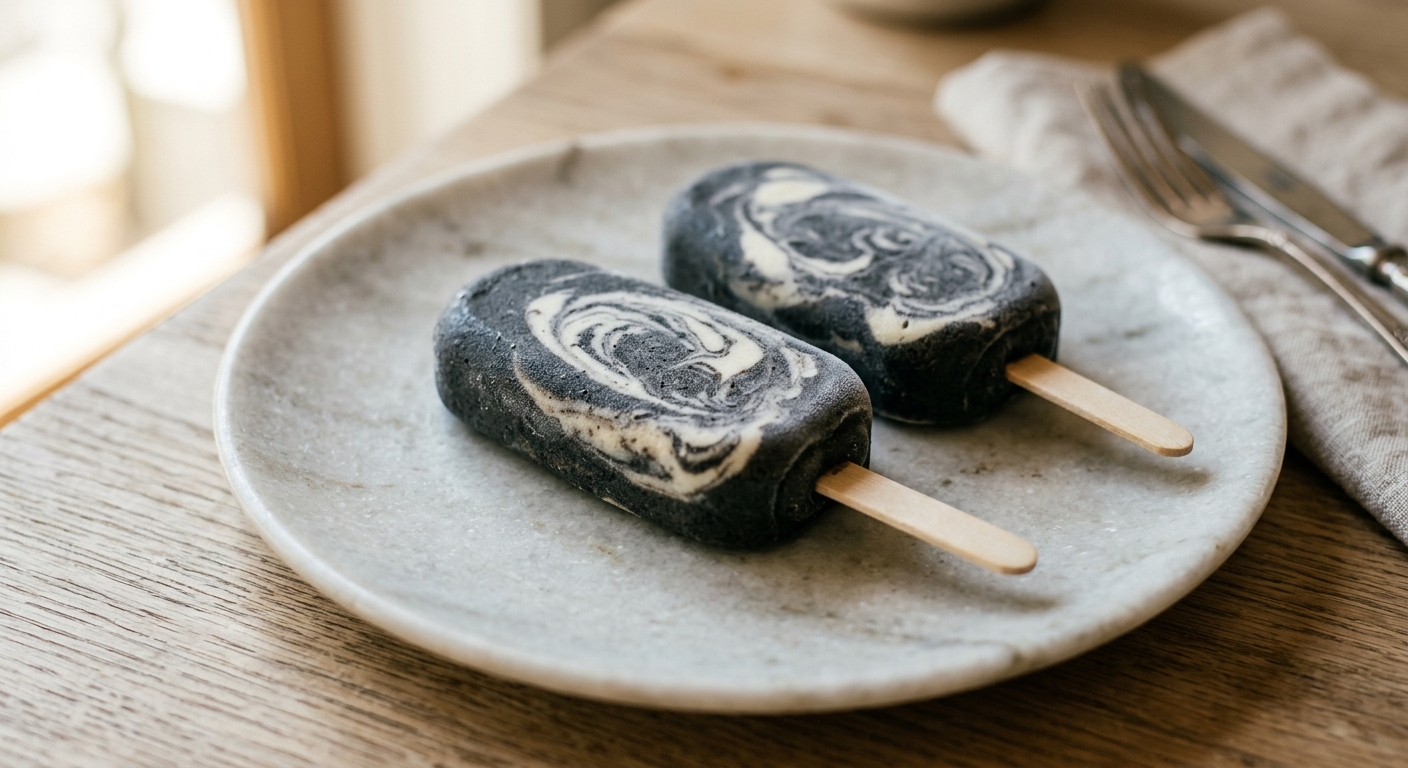
There is something almost magical about black sesame paste – the way it turns ice cream this dramatic shade of charcoal grey, and delivers a flavor that is toasty, earthy, and faintly sweet all at once. These bars are the kind of frozen treat you pull from the freezer and set on the counter, and people immediately want to know what they are. The color alone stops conversations. But the flavor is what keeps people reaching for another.
What sets this recipe apart is the use of allulose as the primary sweetener. Unlike allulose, allulose behaves almost identically to sugar in frozen desserts – it depresses the freezing point in a way that keeps the ice cream scoopable and creamy rather than rock-hard, without any of the cooling aftertaste that some sugar-free sweeteners leave behind. The black sesame paste is made fresh from toasted seeds, which takes only a few minutes and makes an enormous difference compared to store-bought. A thin coat of allulose-sweetened dark chocolate sets into a satisfying snap around each bar.
This recipe is rated medium in difficulty, mostly because of the freezing stages and the chocolate dipping step, which require patience more than any advanced skill. If you can whisk a custard and work with a loaf pan lined with plastic wrap, you can absolutely make these. They are ideal for anyone managing blood sugar who still wants a truly elegant frozen dessert, and they keep beautifully in the freezer for weeks.
Equipment Needed
Click on an item below to shop for the recommended items for this recipe on Amazon.
As an Amazon Associate, we earn from qualifying purchases.
8
Ingredients
- Chocolate Shell
- 120 gblack sesame seeds (about 3/4 cup), raw or lightly toasted
- 480 mlheavy whipping cream (2 cups), divided
- 240 mlwhole milk (1 cup)
- 150 gallulose (about 3/4 cup), divided
- 4 large egg yolks
- 1 tsppure vanilla extract
- —Pinch of Colima Sea SaltMicroplastic Free Salt
- 200 gsugar-free dark chocolate (70% or higher, sweetened with allulose or stevia), finely chopped
- 30 mlrefined coconut oil (2 tbsp)
- Garnish
- 15 gtoasted black sesame seeds (1 tbsp)
Ingredient Substitutions
Instructions
- Toast the black sesame seeds in a dry skillet over medium heat for 3 to 4 minutes, stirring constantly, until fragrant and just beginning to pop. Transfer immediately to a food processor or high-powered blender. Add 60ml (1/4 cup) of the heavy cream and blend on high for 2 to 3 minutes, scraping down the sides frequently, until you have a smooth, dark grey paste. Set aside.
- In a medium heavy-bottomed saucepan, whisk together the milk, 240ml (1 cup) of the heavy cream, and 100g (1/2 cup) of the allulose. Place over medium heat and warm until steaming and just beginning to simmer at the edges, about 5 minutes. Do not boil.
- In a separate bowl, whisk the egg yolks with the remaining 50g (1/4 cup) of allulose and the pinch of sea salt until pale and slightly thickened, about 1 minute. While whisking constantly, slowly pour about half of the hot cream mixture into the egg yolks to temper them. Pour the tempered egg mixture back into the saucepan.
- Cook the custard over medium-low heat, stirring constantly with a silicone spatula, scraping the bottom and sides of the pan. Continue until the custard thickens enough to coat the back of the spatula and holds a line when you drag your finger across it, about 6 to 8 minutes. Do not let it boil or the eggs will scramble.
- Remove from heat and whisk in the black sesame paste and vanilla extract until fully combined and smooth. Strain through a fine-mesh sieve into a large bowl to remove any fibrous sesame bits. Stir in the remaining 180ml (3/4 cup) of heavy cream. Press plastic wrap directly onto the surface of the custard and refrigerate until completely cold, at least 2 hours or overnight.
- Line a 9×5-inch loaf pan with two layers of plastic wrap, leaving plenty of overhang on all sides. Pour the chilled custard into the pan and smooth the top. Freeze for at least 4 hours or until completely firm. For cleaner bars, freeze overnight.
- Once frozen solid, lift the ice cream block out of the pan using the plastic wrap overhang and place on a cutting board. Using a sharp knife warmed under hot water and wiped dry, cut the block into 8 equal bars. Place the bars on a parchment-lined baking sheet and return to the freezer for at least 30 minutes while you prepare the chocolate shell.
- Melt the chopped sugar-free dark chocolate and coconut oil together in a heatproof bowl set over a pot of barely simmering water, stirring until completely smooth. Alternatively, microwave in 30-second intervals, stirring between each. Transfer to a tall, narrow glass or deep bowl for easier dipping. Let cool to about 95°F to 100°F (35°C to 38°C) – it should feel just barely warm to the touch.
- Working quickly with one bar at a time (keeping the rest in the freezer), insert a popsicle stick or dessert skewer into one end of each bar. Dip the bar into the chocolate, let the excess drip off for 5 seconds, then sprinkle immediately with a few toasted black sesame seeds. Set on the parchment-lined tray. The chocolate shell will set within 30 to 60 seconds on contact with the frozen bar. Return each finished bar to the freezer immediately. Repeat with the remaining bars.
- Store finished bars in the freezer in an airtight container, layered with parchment, for up to 4 weeks. Allow to sit at room temperature for 3 to 5 minutes before serving.
- Toast the black sesame seeds in a dry skillet over medium heat for 3 to 4 minutes until fragrant. Transfer to a food processor. Add 60ml (1/4 cup) of the heavy cream and 2 tablespoons of the allulose, then blend for 2 to 3 minutes, scraping down frequently, until you have a smooth paste. Set aside to cool completely.
- In a small saucepan, combine the whole milk and 80g of the allulose over medium heat. Whisk until the allulose is fully dissolved and the mixture is just warm (not simmering). Remove from heat, whisk in the black sesame paste and vanilla extract until smooth. Strain through a fine-mesh sieve into a large bowl. Refrigerate until completely cold, about 1 hour.
- In a stand mixer or with a hand mixer fitted with a whisk attachment, beat the remaining 420ml (1 and 3/4 cups) of heavy cream with the remaining allulose and a pinch of sea salt on medium-high speed until stiff peaks form, about 3 to 4 minutes. Be careful not to overwhip.
- Using a large silicone spatula, gently fold the cold black sesame milk mixture into the whipped cream in three additions. Fold slowly and deliberately, scooping from the bottom and turning, until no white streaks remain. The mixture will be a uniform dark grey. Avoid stirring – you want to keep as much air in the mixture as possible.
- Line a 9×5-inch loaf pan with plastic wrap, leaving generous overhang. Pour in the mixture and smooth the top. Press a piece of plastic wrap directly onto the surface. Freeze for at least 4 hours, or until fully firm.
- Once frozen, remove from the pan, cut into 8 bars with a warm knife, and dip in the chocolate shell following steps 8 through 10 of the Stovetop Custard method above.
Nutrition Per Serving
Per 1 serving (makes 8 ice cream bars)
Sweetener: allulose
Why This Recipe Works
The secret to creamy, scoopable sugar-free ice cream lies in understanding what sugar actually does in a frozen dessert beyond just sweetness. Sugar is what chemists call a freezing point depressant – it interferes with water molecules bonding into large ice crystals, which is what keeps regular ice cream soft enough to eat straight from the freezer. Allulose is exceptional here because it behaves almost identically to sucrose in this regard, depressing the freezing point at roughly the same rate. This is why bars made with allulose cut cleanly with a knife without shattering, while those made with allulose (which does not depress the freezing point nearly as effectively) freeze rock solid and need considerable thawing time before serving.
The egg yolk custard base (in the primary method) does two important things. First, the lecithin in egg yolks is an emulsifier, meaning it coats fat globules and helps them stay evenly suspended in the water-based milk, creating a smooth, cohesive texture rather than a grainy or icy one. Second, cooking the custard to approximately 170°F to 175°F (77°C to 79°C) partially denatures the proteins in the yolks, which thickens the base and traps small air bubbles during freezing. This directly translates to a creamier bite. The addition of coconut oil to the chocolate coating is equally deliberate – coconut oil is rich in saturated fat that melts sharply at body temperature, which is precisely what creates that satisfying, clean snap when you bite into the shell.
If your chocolate shell seizes up or becomes grainy during melting, it has likely come into contact with a small amount of water (steam counts). Start fresh with dry equipment and a completely dry bowl. If your ice cream bars are cracking or breaking during the dipping step, they may have been cut while too warm – always ensure the bars are thoroughly frozen solid and re-chilled after cutting before dipping. Work with only one or two bars at a time, keeping the rest in the freezer.
Baker’s Tips
- Blend the black sesame paste longer than you think necessary – at least 2 to 3 full minutes in a high-powered blender. Undermixed paste will leave a slightly gritty texture in the finished bars. The paste should look shiny and smooth, similar to natural peanut butter.
- Allulose is hygroscopic, meaning it absorbs moisture from the air. This is why the chocolate shell can sometimes become slightly tacky after a day or two in the freezer. Storing bars in a fully sealed airtight container rather than loosely covered will prevent this.
- For perfectly even bars with clean edges, use a ruler and score the top of the frozen block lightly before cutting all the way through. Warm the knife blade under hot running water and wipe it completely dry between each cut.
- The ideal temperature for the chocolate dipping mixture is between 95°F and 100°F (35°C to 38°C). If it is too hot, it will melt the surface of the bar; if it is too cool, it will set too quickly and pool unevenly at the base. Use an instant-read thermometer if you have one.
- If you do not have popsicle sticks, these bars are equally elegant without them – simply use a small offset spatula or fork to lower each bar into the chocolate, turn once to coat, and lift out cleanly. Place on parchment to set.
Variations
- White sesame and matcha swirl: Replace the black sesame seeds with white sesame seeds and add 1 tsp of high-quality ceremonial-grade matcha powder to the custard base for a green-hued bar with a grassy, complex flavor.
- Tahini honey bars: Substitute 80g of good-quality tahini (sesame paste) for the fresh black sesame paste if you want a smoother, more subtle sesame flavor and want to save time. Stir in 1 tbsp of raw allulose honey substitute.
- Black sesame bark: Instead of individual bars, pour the frozen mixture into a parchment-lined quarter sheet pan to a 3/4-inch thickness, freeze solid, then pour the melted chocolate over the top as a thin layer. Once set, break into shards for a dramatic dessert plate garnish.
Troubleshooting & FAQ
My chocolate shell is thick and uneven instead of a thin, crisp coat. What went wrong?
My ice cream turned out icy and grainy, not creamy. What happened?
The bars broke apart when I was cutting them. How do I prevent this?
My custard curdled or turned scrambled-eggy on the stovetop. Can I fix it?
The ice cream bars have a slightly cooling or tingling aftertaste. Is this normal?
Storage & Make-Ahead
- Storage: Store finished bars in a single layer or stacked with parchment between each bar in an airtight freezer container for up to 4 weeks. Do not refrigerate, as the chocolate shell will soften and the bars will lose their structure.
- Make-Ahead: The custard base or no-churn mixture can be made up to 2 days ahead and kept covered in the refrigerator before freezing. The finished bars (without the chocolate shell) can be frozen for up to 1 month before dipping. Dip in chocolate the day before or the morning of serving for best results.