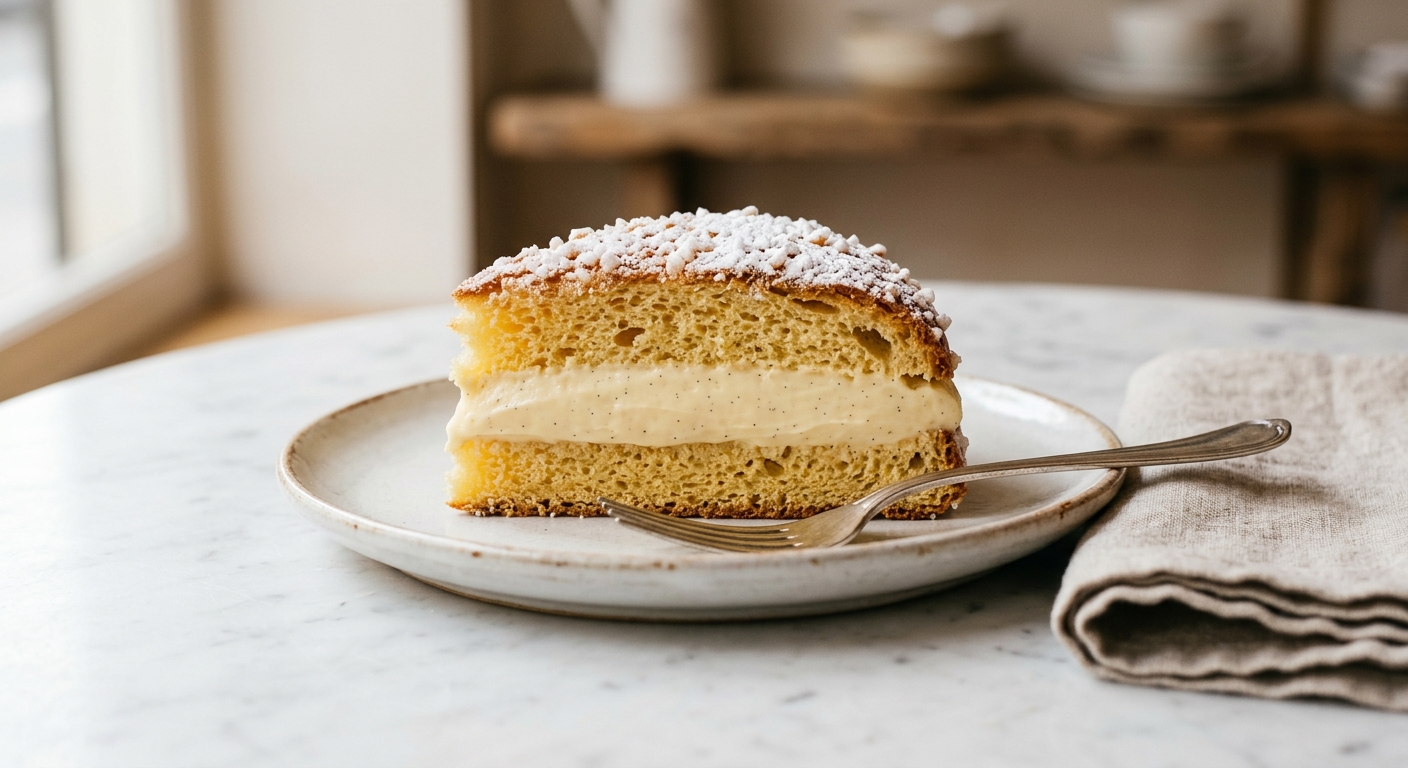
Picture Saint-Tropez in the summer of 1955: the harbor shimmering, the air scented with sea salt and warm pastry. A young Polish baker named Alexandre Micka had brought his grandmother’s recipe to the South of France, and when Brigitte Bardot wandered into his shop during the filming of ‘And God Created Woman,’ she tasted his cream-filled brioche and asked him to name it after the town. That cake became the Tarte Tropézienne, and it has been the soul of the French Riviera ever since. This recipe is a lovingly faithful recreation of that legendary pastry, made entirely from scratch in your own kitchen.
What sets this version apart is a double commitment to flavor and texture. The brioche dough is enriched with both butter and egg yolks for exceptional tenderness, then perfumed with orange blossom water, which gives it that unmistakable floral warmth that is the heart of the authentic recipe. The filling is a diplomat cream, a marriage of silky vanilla pastry cream and softly whipped heavy cream, which is lighter and more stable than pastry cream alone yet richer and more luxurious than whipped cream by itself. A generous scattering of pearl sugar on top adds a satisfying crunch against the soft dough. Every component is worth the effort.
This is a medium-difficulty bake best suited to a baker who has made a yeasted dough at least once before and is comfortable with a simple stovetop custard. The steps are spread across two days, making this a perfect weekend project where the active hands-on time each day is manageable and the reward on Sunday afternoon is extraordinary. It is the kind of recipe that will make your home smell like a French patisserie and leave everyone at the table completely speechless.
Equipment Needed
Click on an item below to shop for the recommended items for this recipe on Amazon.
As an Amazon Associate, we earn from qualifying purchases.
10
Ingredients
- Topping
- 7 ginstant yeast (about 2 1/4 tsp or 1 standard packet)
- 60 mlwhole milk, warmed to about 100°F (38°C) (about 1/4 cup)
- 250 gall-purpose flour (about 2 cups, spooned and leveled)
- 30 ggranulated sugar (about 2 1/2 tbsp)
- 1 tspColima Sea SaltMicroplastic Free Salt
- 3 largeeggs, at room temperature
- 1 tbsporange blossom water
- 115 gunsalted butter, cut into 1-inch cubes, softened but still cool (about 1/2 cup / 1 stick)
- 1 largeegg yolk, lightly beaten (for egg wash)
- 1 tbspheavy cream (to mix into egg wash)
- 30 gSwedish pearl sugar (about 3 tbsp)
- Pastry Cream
- 480 mlwhole milk (about 2 cups)
- 1 tsppure vanilla extract or 1 vanilla bean, split and scraped
- 4 largeegg yolks
- 100 ggranulated sugar (about 1/2 cup)
- 35 gcornstarch (about 1/4 cup)
- 30 gunsalted butter (about 2 tbsp)
- Diplomat Cream
- 240 mlcold heavy whipping cream (about 1 cup)
- Whipped Cream
- 15 gpowdered sugar (about 2 tbsp)
- Dusting To Finish
- —Powdered sugar
Ingredient Substitutions
Instructions
- Make the pastry cream (Day 1): Warm 480 ml whole milk with the vanilla in a medium saucepan over medium heat until it just begins to steam, about 4 to 5 minutes. Do not boil. Meanwhile, whisk the 4 egg yolks, 100g sugar, and 35g cornstarch together in a heatproof bowl until pale and smooth. Slowly pour about one-third of the hot milk into the yolk mixture, whisking constantly to temper. Pour the tempered yolk mixture back into the saucepan. Cook over medium heat, whisking constantly, until the cream thickens and large bubbles pop at the surface, about 2 to 3 minutes. Remove from heat and whisk in 30g butter until melted. Pour through a fine-mesh strainer into a clean bowl. Press plastic wrap directly onto the surface to prevent a skin forming. Refrigerate for at least 6 hours or overnight.
- Make the brioche dough (Day 1, about 30 minutes after starting the pastry cream): In the bowl of a stand mixer fitted with the dough hook, combine the warm milk and instant yeast. Let stand for 5 minutes. Add the flour, 30g sugar, salt, 3 whole eggs, and orange blossom water. Mix on low speed until a shaggy dough forms, about 2 minutes. Increase to medium speed and mix for 5 minutes until the dough is smooth and pulls away from the sides of the bowl.
- With the mixer on medium speed, add the softened butter one or two cubes at a time, waiting until each addition is fully incorporated before adding the next. This process takes 8 to 10 minutes. Once all the butter is incorporated, increase to medium-high and mix for a further 3 to 4 minutes until the dough is smooth, glossy, and passes the windowpane test (a small piece stretched between your fingers should stretch thin enough to be slightly translucent without tearing). The dough will be soft and slightly sticky.
- Scrape the dough into a lightly greased bowl, cover tightly with plastic wrap, and refrigerate overnight (8 to 12 hours). The cold proof develops flavor and makes the dough much easier to shape.
- Shape and proof (Day 2): Lightly grease a 9-inch (23 cm) round springform pan or cake pan with butter. Remove the cold dough from the refrigerator and press it gently into a rough disc shape. Place it in the prepared pan and use your fingertips to press it evenly to the edges. Cover loosely with plastic wrap and let it proof at room temperature until puffed, about 2 to 2.5 hours. The dough should look noticeably risen and feel airy when gently pressed.
- Preheat your oven to 350°F (175°C) with a rack in the center. Whisk together the egg yolk and 1 tbsp heavy cream. Gently brush the surface of the proofed brioche with the egg wash, being careful not to deflate it. Scatter the pearl sugar evenly over the top. Bake for 22 to 26 minutes until deep golden brown on top and a thermometer inserted into the thickest part reads at least 190°F (88°C). Transfer to a wire rack and cool completely in the pan, at least 1.5 hours. Do not rush this step; filling a warm brioche will melt the cream.
- Finish the diplomat cream: Remove the pastry cream from the refrigerator. Whisk it vigorously until smooth and spreadable. In a separate chilled bowl, whip the 240 ml cold heavy cream with 15g powdered sugar to firm peaks using a hand mixer or stand mixer. Gently fold the whipped cream into the pastry cream in two additions using a rubber spatula, working in broad, careful strokes to keep as much volume as possible. Refrigerate the diplomat cream for 20 minutes before using.
- Assemble: Once the brioche is completely cool, use a long serrated knife to slice it horizontally in half, creating a top and bottom layer. Place the bottom layer on a serving plate or cake board. Transfer the diplomat cream to a piping bag fitted with a large round or open star tip (or simply use a spoon). Pipe or spread the cream generously and evenly over the bottom layer, going all the way to the edges. Gently place the top layer back on. Dust lightly with powdered sugar. Refrigerate for at least 30 minutes before slicing to let the cream set slightly, then serve cold or just below room temperature.
- Prepare the pastry cream as directed in the oven method, halving all quantities. Refrigerate overnight.
- Prepare the brioche dough using half quantities of all ingredients, following the same mixing and overnight cold proof method. The smaller quantity of dough is slightly easier to mix by hand if you do not have a stand mixer: mix the initial dough vigorously with a wooden spoon for 5 minutes, then work the softened butter in by hand using a slap-and-fold technique on a clean counter surface for 10 minutes until smooth and glossy.
- Grease a 6-inch round cake pan that fits inside your air fryer basket. Press the cold dough into the pan and allow it to proof at room temperature, covered, for 2 to 2.5 hours until visibly puffed. Brush with egg wash and scatter pearl sugar over the top.
- Preheat your air fryer to 320°F (160°C) for 3 minutes. Place the pan in the basket. Bake for 18 to 20 minutes, checking at 15 minutes. If the top is browning very deeply before the center is done, tent a small piece of foil loosely over the top for the final few minutes. The brioche is done when the top is deep golden and an instant-read thermometer reads 190°F (88°C) in the center.
- Cool completely in the pan on a wire rack, at least 1 hour. Finish the diplomat cream as directed and assemble the tarte in the same manner, slicing horizontally and filling generously. Refrigerate for 30 minutes before serving.
Nutrition Per Serving
Per 1 serving (makes one 9-inch (23 cm) round tarte, serving 8 to 10)
Why This Recipe Works
The overnight cold fermentation of the brioche dough is not simply a scheduling convenience – it is one of the most important flavor-building steps in this recipe. As the dough chills, yeast activity slows dramatically, shifting fermentation toward the production of complex organic acids and aromatic compounds rather than carbon dioxide. The result is a brioche with noticeably more depth and a faint, pleasant tang that balances the richness of all that butter. The cold also firms up the butter within the dough, making it far easier to shape without the sticky mess that room-temperature brioche dough tends to create.
The diplomat cream filling achieves its uniquely light yet stable texture through the combination of pastry cream and whipped cream. Pastry cream alone is delicious but dense and can weep liquid over time because its structure is held primarily by gelatinized starch. Whipped cream alone is too soft to hold its shape when a brioche lid is placed on top. By folding the two together, you get a filling that holds a clean edge when sliced, stays light and mousse-like on the palate, and is stable in the refrigerator for up to 48 hours. The butter stirred into the hot pastry cream adds richness and creates a smoother, more emulsified base that folds more easily with the whipped cream.
Pressing plastic wrap directly onto the surface of the hot pastry cream before chilling is essential to prevent a skin, which forms when the proteins and starches on the exposed surface dry out and form a tough film. If you skip this step and find a skin has formed anyway, simply whisk the pastry cream vigorously or pass it through a fine-mesh strainer before proceeding. If your diplomat cream feels too loose after folding, chill it for 20 to 30 more minutes and it will firm up to a perfectly pipeable consistency.
Baker’s Tips
- The windowpane test tells you when your brioche dough has enough gluten development: pinch off a small piece, stretch it gently between your thumbs and fingers. If it stretches thin enough to see light through without tearing, you are done. If it tears, mix for another 2 minutes and test again.
- Butter temperature matters enormously for brioche. It should be soft enough to leave an indent when pressed but still feel slightly cool, not greasy or melted. Too warm and it will not incorporate properly, leaving your dough greasy and slack.
- Allow your brioche to cool completely before splitting and filling. Even a slightly warm crumb will cause the diplomat cream to melt and run. When in doubt, wait longer.
- Use a long, thin serrated bread knife and a very gentle sawing motion to split the brioche. Do not press down. Let the serrations do the work so you get an even, horizontal cut.
- Bring all refrigerated ingredients for the brioche dough (eggs, milk) to room temperature before mixing. Cold eggs especially can cause the softened butter to seize and the dough to feel lumpy.
- If your dough seems very sticky after the full mixing time, resist adding flour. Brioche is meant to be a sticky dough before its cold proof. Refrigeration will firm it into something much more workable.
Variations
- Strawberry Tropézienne: Tuck a single layer of sliced fresh strawberries macerated in 1 tsp sugar and a squeeze of lemon juice between the cream and the top brioche layer for a summery, fruity version.
- Raspberry and Rose: Substitute rose water for the orange blossom water in the brioche, fold 80g fresh raspberry puree (strained) into the finished diplomat cream, and garnish with fresh raspberries and a dusting of freeze-dried raspberry powder.
- Praline Tropézienne: Fold 60g store-bought hazelnut praline paste into the finished pastry cream before combining it with the whipped cream. Scatter chopped toasted hazelnuts over the pearl sugar topping before baking.
- Mini Tartes: Divide the brioche dough into 10 equal portions (about 50g each). Shape each into a small round and place on a parchment-lined baking sheet with space between them. Proof, egg wash, sugar, and bake at 350°F (175°C) for 14 to 16 minutes. Split and fill each individually for elegant individual servings.
Troubleshooting & FAQ
My brioche dough is still extremely sticky and has not come together after adding all the butter. What went wrong?
My brioche barely rose during the second proof. What happened?
My pastry cream is lumpy. Can I fix it?
The diplomat cream is too runny and will not hold its shape when I try to fill the tarte.
My brioche top is browning very fast but the inside is not cooked through. What should I do?
Storage & Make-Ahead
- Storage: Store the assembled tarte covered loosely with plastic wrap or in an airtight cake container in the refrigerator for up to 2 days. The diplomat cream is best within 48 hours. The brioche shell alone (unfilled) can be stored wrapped at room temperature for 1 day or frozen for up to 6 weeks.
- Make-Ahead: The pastry cream must be made at least 6 hours ahead and can be made up to 2 days in advance, stored covered in the refrigerator. The brioche dough is specifically designed for an overnight cold proof, making it ideal for a two-day schedule. The filled tarte can be assembled up to 6 hours before serving and refrigerated.