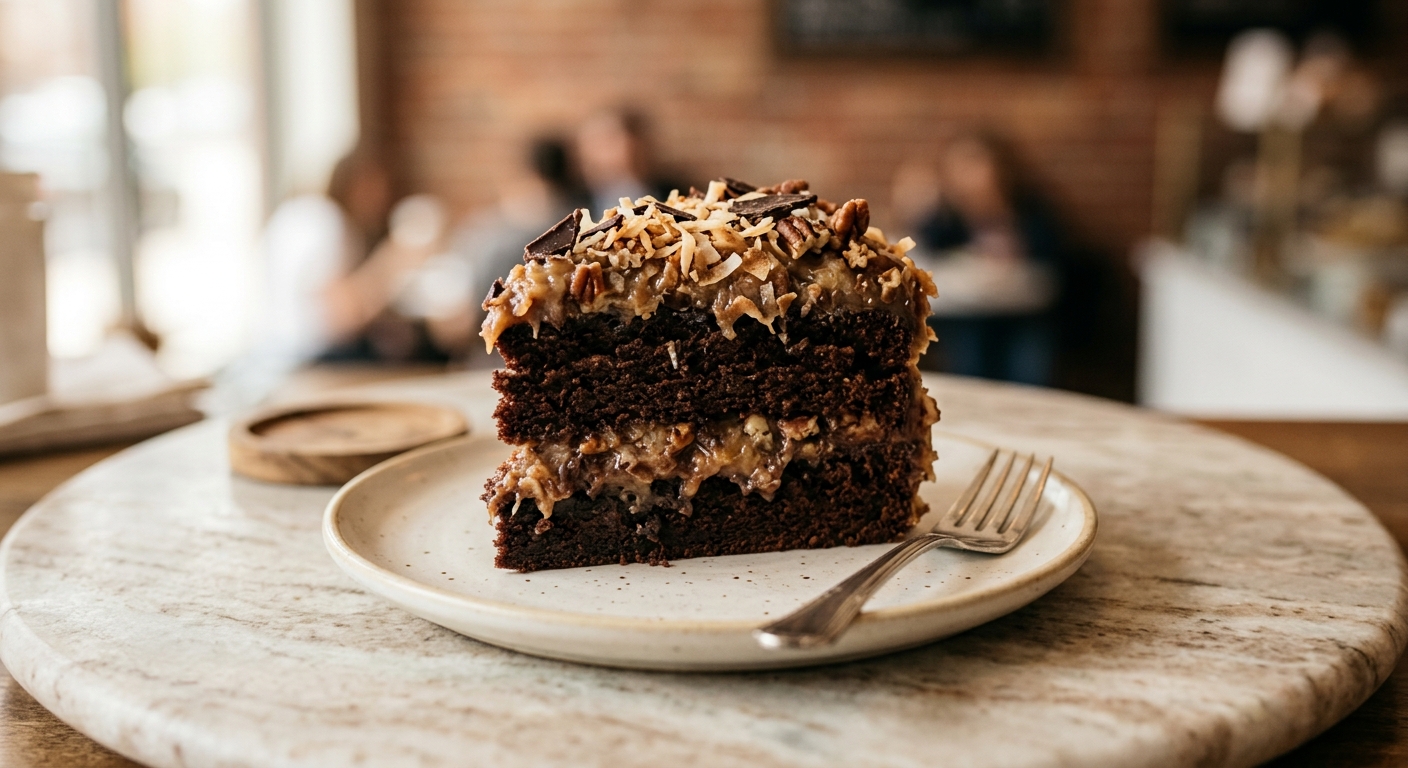
There’s a moment, usually sometime in late autumn or around a birthday table draped in a familiar tablecloth, when someone brings out a German chocolate cake and the whole room shifts. It’s not just the height of it, those dark, tender layers stacked generously with a frosting that’s almost more of a filling, thick with toasted pecans and sweet coconut. It’s the smell: warm chocolate and toasted sugar and something almost caramel-like drifting from the kitchen. This cake carries a particular kind of nostalgia, the kind that makes you feel like you’re somewhere you belong.
What sets this version apart is a double commitment to depth and texture. The chocolate cake itself is built on real melted sweet baking chocolate, not just cocoa powder, which gives the crumb a uniquely smooth, mild chocolate flavor that isn’t bitter or aggressive. Buttermilk and a touch of hot water keep the layers supremely moist, while the coconut pecan frosting is cooked low and slow on the stovetop until it thickens into a glossy, scoopable custard loaded with toasted pecans and sweetened coconut. That stovetop method is everything: it creates a genuine egg-yolk custard base, giving the frosting a richness and structure that no shortcut version can match.
This is a medium-difficulty bake that rewards patience more than skill. If you’ve successfully made a layer cake before and aren’t afraid of stirring a pot on the stove, you’ll handle this beautifully. It’s the ideal project for a weekend when you want to make something truly memorable, whether for a birthday, a holiday gathering, or simply because someone you love deserves a cake that takes your breath away.
Equipment Needed
Click on an item below to shop for the recommended items for this recipe on Amazon.
As an Amazon Associate, we earn from qualifying purchases.
12
Ingredients
- 113 gBaker’s sweet baking chocolate (one 4-oz bar), roughly chopped
- 120 mlboiling water (1/2 cup)
- 250 gall-purpose flour (2 cups, spooned and leveled)
- 1 tspbaking soda
- 0.5 tspColima Sea SaltMicroplastic Free Salt
- 227 gunsalted butter, at room temperature (1 cup / 2 sticks)
- 400 ggranulated sugar (2 cups)
- 4 largeeggs, separated, at room temperature
- 2 tsppure vanilla extract
- 240 mlfull-fat buttermilk, at room temperature (1 cup)
- —— Coconut Pecan Frosting —
- 240 mlevaporated milk (one 12-oz can, about 1.5 cups – use the full can for a generous yield)
- 300 ggranulated sugar (1.5 cups)
- 3 largeegg yolks, lightly beaten, at room temperature
- 170 gunsalted butter, cut into pieces (3/4 cup / 1.5 sticks)
- 1.5 tsppure vanilla extract
- —Pinch of Colima Sea SaltMicroplastic Free Salt
- 200 gsweetened shredded coconut (about 2 cups), toasted
- 150 gpecans (about 1.5 cups), roughly chopped and toasted
Ingredient Substitutions
Instructions
- Toast your coconut and pecans first. Spread them on separate rimmed baking sheets and toast in a 350°F (175°C) oven: coconut for 5 to 7 minutes, stirring once, until golden at the edges; pecans for 8 to 10 minutes until fragrant. Set aside to cool. Keep the oven at 350°F.
- Grease three 9-inch round cake pans, line the bottoms with parchment paper, then grease the parchment and dust lightly with flour. Tap out any excess. This triple-protection method ensures your layers release cleanly every time.
- Melt the chopped sweet baking chocolate in the boiling water: place the chocolate in a small heatproof bowl, pour the boiling water over it, and stir until completely smooth. Set aside to cool to room temperature (about 10 minutes). In a separate bowl, whisk together the flour, baking soda, and salt. Set aside.
- In the bowl of a stand mixer fitted with the paddle attachment, beat the butter and sugar on medium-high speed for 4 to 5 minutes until very pale, light, and fluffy. Scrape down the sides and bottom of the bowl. Add the egg yolks one at a time, beating for 30 seconds after each addition. Mix in the vanilla extract, then the cooled melted chocolate mixture.
- Reduce mixer speed to low. Add the flour mixture in three additions, alternating with the buttermilk in two additions (flour, buttermilk, flour, buttermilk, flour). Begin and end with flour. Mix only until just combined after each addition – overmixing develops gluten and toughens the crumb. Scrape the bowl well.
- In a clean bowl with clean beaters, beat the 4 egg whites on medium-high speed until stiff peaks form (they should hold their shape but not look dry or clumpy). Using a large spatula, gently fold one-third of the egg whites into the chocolate batter to lighten it, then fold in the remaining whites in two additions. Use long, sweeping strokes from the bottom of the bowl up and over. A few white streaks are fine – they’ll bake out.
- Divide the batter evenly among the three prepared pans (a kitchen scale makes this precise – about 520g per pan). Smooth the tops gently. Bake for 30 to 34 minutes, rotating the pans once at the halfway mark, until a toothpick inserted in the center comes out with just a few moist crumbs. The edges will pull slightly from the pan sides.
- Cool the layers in the pans on wire racks for 15 minutes, then run a thin knife around the edges and turn out onto the racks. Peel off the parchment and let cool completely, at least 1 hour, before assembling. Warm cake will melt your frosting.
- While the cakes cool, make the coconut pecan frosting. In a medium heavy-bottomed saucepan, combine the evaporated milk, sugar, egg yolks, and butter over medium heat. Stir constantly with a heatproof spatula or wooden spoon, making sure to scrape the bottom and corners of the pan. Cook for 12 to 15 minutes until the mixture thickens noticeably, turns a light golden color, and coats the back of a spoon. Do not rush this over high heat – patience here prevents scrambled eggs.
- Remove the frosting from heat and stir in the vanilla, salt, toasted coconut, and toasted pecans. Transfer to a wide bowl or shallow dish and let cool to room temperature, stirring occasionally. The frosting will thicken further as it cools. It should be thick, scoopable, and spreadable before assembling – about 45 minutes to 1 hour at room temperature, or speed it up in the refrigerator, stirring every 15 minutes.
- To assemble: place one cooled cake layer on your serving plate or cake board. Spoon one-third of the frosting onto the top and spread it evenly to the edges. Repeat with the second and third layers, using the remaining frosting on the top. German chocolate cake is traditionally frosted only on top and between the layers, leaving the sides exposed to show off those beautiful dark chocolate layers. Serve at room temperature.
- Preheat your oven to 350°F (175°C). Grease a 9×13-inch baking pan thoroughly, line with parchment paper leaving a 1-inch overhang on the long sides, and grease the parchment. This overhang acts as handles for easy removal.
- Toast your coconut and pecans (as described in the oven method above) and prepare the full cake batter following the same steps: melt chocolate in boiling water, cream butter and sugar, add yolks and vanilla and chocolate, alternate flour and buttermilk, fold in beaten egg whites.
- Pour the batter into the prepared pan and smooth the top evenly. Bake for 38 to 44 minutes until a toothpick in the center comes out with just a few moist crumbs. Because this is a thicker single layer than the three-layer cake pans, it needs more time – check at 38 minutes and continue checking every 3 minutes. Do not overbake.
- Cool the cake completely in the pan on a wire rack, at least 1 hour. Meanwhile, prepare the coconut pecan frosting on the stovetop following the same method: cook the evaporated milk, sugar, yolks, and butter over medium heat, stirring constantly for 12 to 15 minutes, then stir in vanilla, salt, toasted coconut, and pecans. Cool the frosting to a thick, spreadable consistency.
- Spread the entire batch of frosting over the top of the cooled cake directly in the pan. Serve straight from the pan, cut into squares. Store covered at room temperature for up to 3 days.
- Preheat your oven to 350°F (175°C) and line two standard 12-cup muffin tins with paper liners. Do not grease the top of the pan – it makes no difference here and you don’t want the liners slipping.
- Toast your coconut and pecans and prepare the full cake batter following the same steps as the oven method: melt chocolate in boiling water, cream butter and sugar, incorporate yolks and flavoring, alternate dry ingredients and buttermilk, fold in stiffly beaten egg whites.
- Divide the batter evenly among the 24 lined cups, filling each about two-thirds full. An ice cream scoop or large cookie scoop makes this fast and consistent. Do not overfill or the cupcakes will dome and overflow.
- Bake for 18 to 22 minutes, rotating the pans once at the 10-minute mark, until the tops spring back lightly when touched and a toothpick comes out with just a few moist crumbs. Cool in the pans for 5 minutes, then transfer to a wire rack and cool completely before frosting, at least 45 minutes.
- Prepare the coconut pecan frosting on the stovetop. Because it contains toasted coconut and pecans, it won’t pipe through a standard piping tip. Instead, use a small offset spatula or a large spoon to mound the frosting generously on top of each cooled cupcake. The frosting should be thick enough to hold a swooped peak. If it’s too warm and loose, refrigerate for 15 minutes before frosting.
Nutrition Per Serving
Per 1 serving (makes one 9-inch three-layer cake)
Why This Recipe Works
The defining character of a German chocolate cake starts with the chocolate itself. Sweet baking chocolate, like Baker’s brand, has a lower cacao percentage and higher sugar content than bittersweet or dark chocolate. This gives the cake its distinctive mild, almost creamy chocolate flavor rather than the assertive bitterness you’d get with a standard devil’s food cake. Dissolving it in boiling water before adding it to the batter serves two purposes: it fully melts the chocolate for seamless incorporation, and the hot water blooms the cocoa solids, intensifying the chocolate aroma and color without adding any bitterness.
The technique of separating the eggs and folding in beaten egg whites is the structural heart of this cake. Creaming the butter and sugar with only the yolks builds a rich, tender crumb with plenty of fat, while the separately beaten whites contribute air and lift, keeping the layers light rather than dense despite all that richness. The buttermilk reacts with the baking soda to create carbon dioxide bubbles for additional lift, and its acidity tenderizes the gluten in the flour, resulting in a crumb that is soft and fine-grained. Alternating the dry ingredients and buttermilk when mixing prevents the batter from breaking (fat and liquid separating) and ensures everything is incorporated without overdeveloping the gluten.
The coconut pecan frosting is a genuine stovetop custard, thickened by cooking egg yolks with sugar, butter, and evaporated milk until the proteins in the yolks set and the mixture reduces. Evaporated milk is used rather than fresh milk or cream because its water has been partially removed, concentrating its proteins and sugars for a richer, more stable custard that thickens more readily. If your frosting isn’t thickening after 15 minutes, increase the heat slightly and keep stirring – it should reach a temperature of around 170 to 175°F (77 to 79°C) to fully cook the yolks. If you accidentally scramble the eggs (visible curds), strain the frosting through a fine-mesh sieve, then stir in the coconut and pecans as usual.
Baker’s Tips
- Bring all refrigerated ingredients to room temperature before starting. Cold butter won’t cream properly, cold egg whites won’t whip to full volume, and cold buttermilk can cause the batter to look curdled. Set everything out 45 minutes to 1 hour ahead.
- When folding egg whites into the batter, use a large wide spatula and work deliberately but not frantically. The goal is to keep as much air as possible while fully incorporating the whites. A few small white streaks are fine and will disappear during baking.
- Use a kitchen scale to divide batter evenly between pans. Eyeballing often leads to uneven layers – a scale takes 10 seconds and guarantees uniform baking and a level stack.
- The frosting is ready when it coats the back of a spoon and a line drawn through it with your finger holds its shape for a few seconds. If you have a thermometer, you’re looking for 170 to 175°F (77 to 79°C).
- Do not frost warm cake layers. Even slightly warm cake will melt the frosting and cause it to slide. If you’re short on time, freeze the layers for 20 minutes after they’ve cooled for 30 minutes at room temperature.
- For the cleanest presentation, trim the very top of each cake layer with a long serrated knife to level any doming before assembling. This small step makes a big difference in stability and appearance.
- Toasting the pecans and coconut is not optional for the best flavor. Raw coconut tastes flat and slightly raw; toasting caramelizes its natural sugars and transforms it. Same with the pecans – toasting brings out their oils and nutty depth.
Variations
- Dark chocolate version: Substitute a 70% dark chocolate bar for the sweet baking chocolate and reduce the sugar in the cake by 2 tablespoons. The result is more intense and less sweet, beautifully balanced by the sweet frosting.
- Espresso boost: Add 1 teaspoon of instant espresso powder to the boiling water with the chocolate. You won’t taste coffee – it simply amplifies and deepens the chocolate flavor dramatically.
- Salted caramel drizzle: After assembling the cake, drizzle the exposed sides with a few tablespoons of salted caramel sauce for a gorgeous presentation and an extra layer of flavor.
- Coconut cake layers: Replace 60ml of the buttermilk with canned coconut milk and add 1 teaspoon of coconut extract to the batter for a more pronounced coconut flavor throughout.
- Mini layer cakes: Use four 6-inch round pans instead of three 9-inch pans. Reduce bake time to 24 to 28 minutes. Makes 6 to 8 generous servings with a taller, more dramatic look.
Troubleshooting & FAQ
My cake layers came out dense and heavy instead of light. What went wrong?
My coconut pecan frosting isn’t thickening. How do I fix it?
My frosting looks curdled or I can see bits of cooked egg. Is it ruined?
Why did my cake layers sink in the middle?
My cake layers are sticking to the pans and tearing when I try to remove them.
Storage & Make-Ahead
- Storage: Store the assembled cake loosely covered at room temperature for up to 2 days, or refrigerate for up to 5 days. Bring refrigerated slices to room temperature for 30 minutes before serving for the best texture and flavor. Unfrosted cake layers can be wrapped tightly in plastic wrap and frozen for up to 3 months. The frosting does not freeze well on its own, as the texture becomes grainy when thawed.
- Make-Ahead: The cake layers can be baked up to 2 days ahead, wrapped tightly in plastic wrap, and stored at room temperature, or frozen for up to 3 months. The coconut pecan frosting can be made up to 3 days ahead and stored in an airtight container in the refrigerator. Bring it to room temperature and stir well before assembling – if it seems too thick, microwave in 10-second bursts, stirring between each, until spreadable.