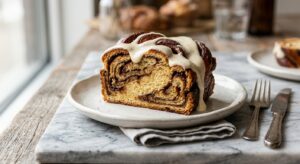
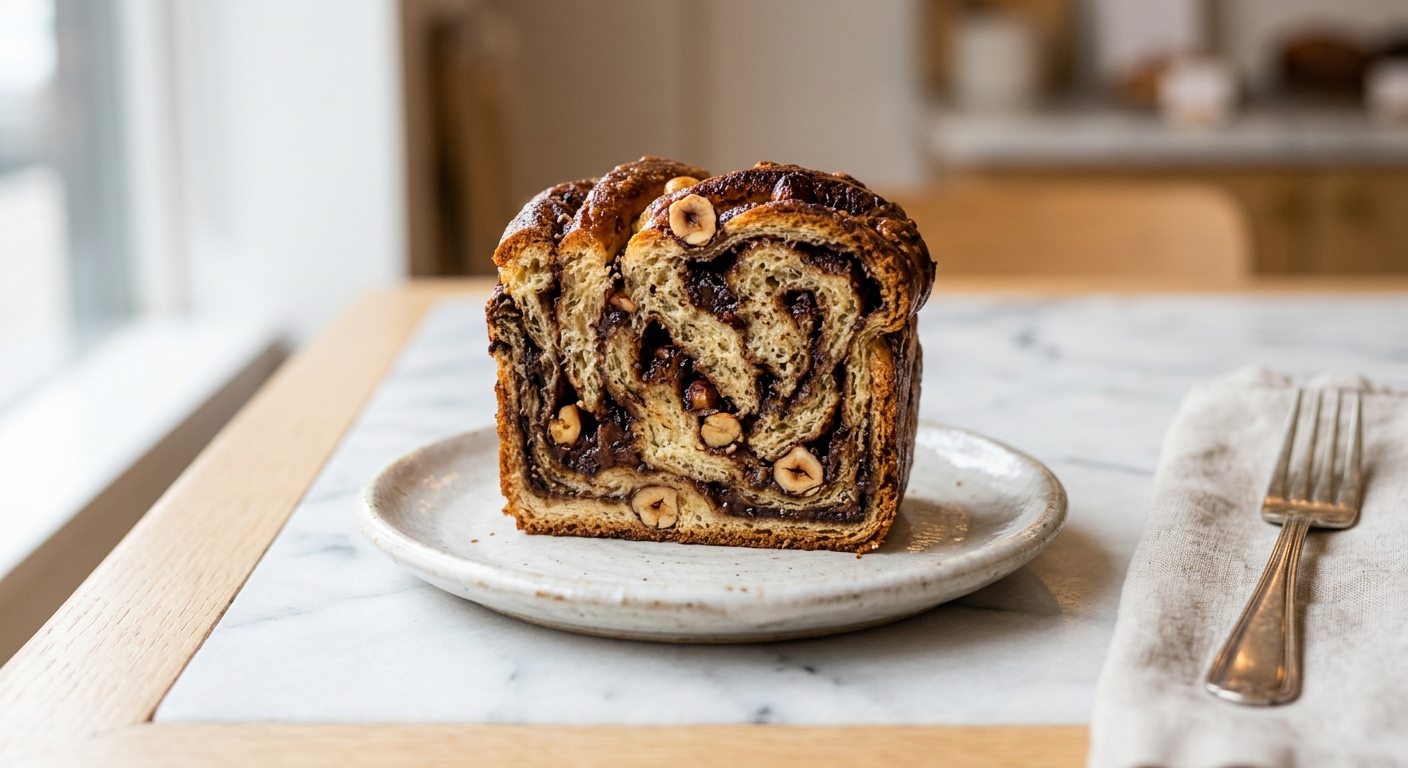
There is something almost theatrical about a babka fresh from the oven, its glossy braided top glistening under a brush of warm sugar syrup, the kitchen smelling of toasted hazelnuts and dark chocolate. Cut a slice and you reveal the real magic: tight, hypnotic spirals of chocolate filling wound through a soft, buttery, brioche-style dough. It is the kind of bake that makes people stop mid-conversation and reach for a piece before you have even set it down on the table.
What sets this version apart is the filling. Rather than a simple chocolate-butter paste, we roast whole hazelnuts and blitz them into a coarse, fragrant crumb before folding them through melted dark chocolate, butter, and a whisper of espresso powder. The espresso does not make the filling taste like coffee – it deepens the chocolate, pulling out bitter, complex notes that balance the enriched dough beautifully. The dough itself is built on the tangzhong method, where a small portion of the flour is cooked with milk into a paste before being added to the main dough. This gelatinizes the starch, locking in moisture and giving the crumb an impossibly soft, feathery texture that stays tender for days.
This is a medium-difficulty bake with two rises, so plan for a relaxed weekend morning or an afternoon with nowhere to be. It is perfect for confident beginners who want to level up their bread baking, and a genuine pleasure for experienced bakers who love the process as much as the result. Everything can be broken across two days, making it far less daunting than it first appears.
Equipment Needed
Click on an item below to shop for the recommended items for this recipe on Amazon.
As an Amazon Associate, we earn from qualifying purchases.
12
Ingredients
- Tangzhong
- 60 mlwhole milk (1/4 cup)
- 15 gall-purpose flour (about 1 tbsp plus 1 tsp)
- Dough
- 300 gall-purpose flour (about 2 1/2 cups, spooned and leveled)
- 50 ggranulated sugar (1/4 cup)
- 7 ginstant yeast (2 1/4 tsp, one standard packet)
- 1 tspColima Sea SaltMicroplastic Free Salt
- 120 mlwhole milk (1/2 cup), warmed to 110°F / 43°C
- 2 largeeggs, at room temperature
- 85 gunsalted butter (6 tbsp), softened to room temperature and cut into cubes
- 150 gblanched hazelnuts (about 1 cup)
- 170 gdark chocolate (60 to 70% cacao), finely chopped (about 1 cup chopped)
- Filling
- 60 gunsalted butter (4 tbsp)
- 60 gpowdered sugar (1/2 cup), sifted
- 1 tspespresso powder
- 0.5 tspground cinnamon
- —Pinch of Colima Sea SaltMicroplastic Free Salt
- Syrup
- 100 ggranulated sugar (1/2 cup)
- 80 mlwater (1/3 cup)
Ingredient Substitutions
Instructions
- Make the tangzhong: In a small saucepan, whisk together 60ml whole milk and 15g flour over medium-low heat, stirring constantly, until the mixture thickens into a smooth paste, about 2 minutes. It should coat a spoon and leave a clear line when you drag your finger through. Scrape it into a small bowl and let it cool to room temperature.
- Toast the hazelnuts: Spread the blanched hazelnuts on a dry baking sheet and toast in a preheated 350°F (175°C) oven for 10 to 12 minutes, until deep golden and fragrant. Let them cool completely, then pulse in a food processor until you have a coarse, sandy crumb with some slightly larger pieces for texture. Do not over-process into a paste.
- Make the dough: In the bowl of a stand mixer fitted with the dough hook, combine the 300g flour, granulated sugar, instant yeast, and fine sea salt. Whisk briefly to combine. Add the cooled tangzhong, the warmed milk, and both eggs. Mix on low speed until a shaggy dough forms, about 2 minutes. Increase to medium speed and knead for 5 minutes. The dough will be sticky and rough at this stage.
- Add the butter: With the mixer on medium-low, add the softened butter one or two cubes at a time, waiting for each addition to be fully incorporated before adding the next. This process takes about 8 to 10 minutes. Once all the butter is in, increase speed to medium-high and knead for another 5 minutes. The dough should be smooth, shiny, and pull cleanly away from the sides of the bowl. It will be soft and slightly tacky but should not stick aggressively to your fingers. If kneading by hand, this stage will take about 15 minutes of firm, patient kneading.
- First rise: Shape the dough into a smooth ball, place it in a lightly oiled bowl, and cover with plastic wrap or a damp towel. Let it rise at room temperature until doubled in size, about 1.5 to 2 hours, depending on how warm your kitchen is. Alternatively, refrigerate overnight (8 to 12 hours) for a slower, more flavorful rise and a much easier-to-handle dough.
- Make the chocolate hazelnut filling: Melt the dark chocolate and 60g unsalted butter together in a heatproof bowl set over a saucepan of barely simmering water (or microwave in 30-second bursts, stirring between each). Stir until completely smooth. Add the sifted powdered sugar, espresso powder, cinnamon, and pinch of salt, and stir until glossy and combined. Fold in the toasted hazelnut crumbs. Let the filling cool until it is thick and spreadable but not liquid, about 20 minutes at room temperature. If it firms up too much, rewarm briefly.
- Shape the babka: Line a 9×5-inch loaf pan with parchment paper, leaving an overhang on the long sides. On a lightly floured surface, roll the chilled or risen dough into a rectangle approximately 12 inches wide by 16 inches long. Spread the filling evenly over the surface, leaving a 1/2-inch border along the far long edge. Starting from the long edge nearest you, roll the dough up into a tight log. Pinch the seam to seal.
- Twist and pan: Using a sharp knife, cut the log in half lengthwise, exposing the layers. With the cut sides facing up, twist the two strands around each other twice, keeping the cut sides facing upward throughout so the layers stay visible. Tuck the ends under neatly and transfer the twisted loaf into the prepared pan. Cover loosely with oiled plastic wrap.
- Second rise: Let the shaped babka proof at room temperature until noticeably puffed and the dough slowly springs back when gently pressed, about 45 minutes to 1 hour. Do not rush this step. Meanwhile, preheat your oven to 350°F (175°C).
- Bake: Place the pan on the middle rack of the preheated oven and bake for 35 to 40 minutes, until deeply golden brown on top. Tent the loaf loosely with aluminum foil after 20 minutes if it is browning too quickly. The internal temperature should read between 185°F and 190°F (85 to 88°C) on an instant-read thermometer.
- Make the sugar syrup: While the babka bakes, combine 100g granulated sugar and 80ml water in a small saucepan. Bring to a simmer over medium heat, stirring until the sugar fully dissolves. Remove from heat and set aside.
- Glaze: As soon as the babka comes out of the oven, immediately brush the entire surface generously with the warm sugar syrup. Use all of it. This is what gives the babka its signature glossy, slightly sticky top and also helps lock in moisture. Allow the babka to cool in the pan for 20 minutes before lifting it out by the parchment. Let it cool on a wire rack for at least 30 minutes before slicing.
- Make the tangzhong and dough: Follow steps 1 through 4 of the oven method exactly, making the tangzhong, toasting the hazelnuts, and mixing and kneading the enriched dough with butter.
- Cold first rise: Instead of proofing at room temperature, place the covered dough directly in the refrigerator for 8 to 12 hours, ideally overnight. The cold slows the yeast significantly, so the rise is gradual. The dough will roughly double in this time. This cold dough is much firmer and easier to roll and shape without tearing.
- Make the filling (evening or next morning): Prepare the chocolate hazelnut filling as in step 6 of the oven method. If made the evening before, press plastic wrap directly onto the surface and refrigerate it. The next morning, let it sit at room temperature for 20 to 30 minutes until soft and spreadable again before using.
- Shape the babka with cold dough: Remove the dough from the refrigerator and roll it directly on a lightly floured surface without letting it warm up first. Cold dough is firmer and holds its shape beautifully during rolling and twisting. Spread the filling, roll, cut, and twist as described in steps 7 and 8 of the oven method. Transfer to the parchment-lined pan.
- Final proof at room temperature: Cover the shaped loaf loosely with oiled plastic wrap and proof at room temperature for 1.5 to 2 hours. Because the dough is starting cold, it needs longer than the standard method to wake the yeast back up and puff properly. It is ready when the dough looks noticeably pillowy and springs back slowly when pressed.
- Bake, glaze, and cool: Preheat the oven to 350°F (175°C) during the last 30 minutes of proofing. Bake for 35 to 40 minutes, tenting with foil if needed after 20 minutes. Brush immediately with the warm sugar syrup, cool in the pan for 20 minutes, then transfer to a wire rack. Slice once it has rested at least 30 minutes.
- Prepare a half-batch: Make exactly half the dough quantity listed (use 150g flour, 1 egg, 42g butter, 30ml milk for the tangzhong, and halve all other dough ingredients). Follow the tangzhong method and kneading steps as written in the oven method. Complete the first rise at room temperature or overnight in the refrigerator.
- Prepare a half-batch of filling: Halve all filling ingredients. Prepare as described in step 6 of the oven method and allow to cool until spreadable.
- Shape the mini babka: Roll the dough into a roughly 10×14-inch rectangle on a lightly floured surface. Spread the filling evenly, roll into a tight log, cut in half lengthwise, and twist the two strands together with cut sides facing up. Tuck the ends under. Place into a greased and parchment-lined 7-inch round cake pan or small loaf pan that fits your air fryer basket.
- Second proof: Cover loosely and let rise at room temperature for 45 minutes to 1 hour, until puffed. Do not preheat the air fryer until the dough is ready.
- Bake with care: Preheat the air fryer to 325°F (163°C) for 3 minutes. Place the pan in the basket and cover the top of the babka loosely with a small piece of aluminum foil. Air-fry for 15 minutes, then carefully remove the foil and continue cooking for another 7 to 11 minutes, until the top is deep golden brown and an instant-read thermometer inserted in the center reads 185 to 190°F (85 to 88°C). Check at 20 minutes as air fryer wattages vary considerably.
- Glaze and cool: Make a half-batch of the sugar syrup (50g sugar and 40ml water) and brush it over the hot babka immediately upon removing it from the air fryer. Allow to cool in the pan for 15 minutes, then transfer to a wire rack for at least 20 minutes before slicing.
Nutrition Per Serving
Per 1 serving (makes one 9×5-inch loaf, yielding about 12 generous slices)
Why This Recipe Works
The tangzhong paste is the quiet hero of this recipe. When flour is cooked with liquid before being added to dough, the starch granules absorb the water and swell in a process called gelatinization. This pre-gelatinized starch can hold more moisture than raw flour, which means the final dough contains more water without feeling wet or difficult to handle. The result is a crumb that is extraordinarily soft and that stays that way for two to three days rather than staling overnight. It is a technique borrowed from Japanese milk bread, and it works beautifully in any enriched dough.
The butter incorporation method also matters enormously. Adding softened butter gradually to an already-developed dough, rather than mixing it in at the start, allows the gluten network to build first. Gluten strands are what give bread its chew and structure, and fat interrupts gluten development when added too early. By letting the gluten form before introducing the fat, you end up with a dough that is both tender (from the fat coating those strands) and structurally strong enough to hold the swirl without collapsing. If the dough seems to break apart when you first add the butter, keep going. It will come back together into a smooth, cohesive mass.
The sugar syrup finish is not optional, even though it might seem like a mere cosmetic step. Brushing the hot loaf with a warm syrup serves two purposes: it adds a gentle sweetness to the crust and, critically, it seals the surface while the bread is still steaming, trapping moisture inside. As the babka cools, that moisture redistributes through the crumb rather than escaping as steam. If your babka ever turns out drier than expected, the syrup was likely applied too late or in too small a quantity. Use it all, and use it while the bread is still hot from the oven.
Baker’s Tips
- Use an instant-read thermometer to check the milk temperature before adding it to the yeast. Too cool (below 100°F / 38°C) and the yeast will be sluggish. Too hot (above 120°F / 49°C) and you risk killing it. Warm to the touch, like a comfortable bath, is the right zone.
- Cold dough is your friend during shaping. If your dough tears, resists rolling, or becomes sticky and unmanageable, cover it and refrigerate for 20 minutes before continuing. This relaxes the gluten and firms the butter.
- When you cut the twisted log lengthwise, use your sharpest knife and do it in one confident motion. A dull knife or a sawing motion will compress the layers and reduce the visual drama of the swirl.
- Do not skip the parchment overhang in the loaf pan. Babka filling that leaks during baking can stick ferociously. The parchment handles make lifting the finished loaf out clean and easy.
- The filling should be the consistency of peanut butter when you spread it, not runny and not solid. If it has cooled too firm, set the bowl over warm water for two minutes and stir. If it is too runny, give it another 10 minutes at room temperature.
- Resist the urge to slice the babka the moment it comes out of the oven. The interior continues to set as it cools, and cutting too early will give you a gummy, doughy crumb. Thirty minutes minimum on the rack before slicing.
Variations
- Tahini and dark chocolate: Replace the hazelnut crumbs with 80g (1/3 cup) of good-quality runny tahini stirred directly into the chocolate-butter mixture. The result is nutty, slightly bitter, and deeply savory-sweet.
- Orange zest and dark chocolate: Add the zest of one large navel orange to the filling and a teaspoon to the dough. The citrus cuts through the richness beautifully and makes the loaf feel bright and festive.
- Cinnamon sugar swirl (nut-free): Skip the chocolate-hazelnut filling entirely. Instead, spread the rolled dough with 60g (4 tbsp) softened butter and sprinkle with a mixture of 100g (1/2 cup) brown sugar and 2 tsp ground cinnamon. Twist and bake as written for a classic cinnamon babka.
- Mini babka rolls: Instead of making one large twisted loaf, cut the twisted log into 8 to 10 equal portions and place them cut-side up in a greased 9×13-inch baking dish. Proof and bake at 350°F for 22 to 25 minutes for individual pull-apart rolls. Ideal for serving a crowd.
Troubleshooting & FAQ
My dough is still a sticky, greasy mess after adding all the butter. Did I ruin it?
My dough is not rising. What went wrong?
My filling leaked out all over the oven. How do I prevent this?
The top of my babka is beautifully brown but the center seems underdone and gummy when I slice it.
My babka slices look pale and the swirl is barely visible. Where did the layers go?
Storage & Make-Ahead
- Storage: Store the babka at room temperature, wrapped tightly in plastic wrap or in an airtight container, for up to 3 days. It is at its absolute best on day one and two. For longer storage, refrigerate for up to 5 days, though the crumb will firm slightly. To refresh a slice, warm it in a 300°F (150°C) oven for 8 minutes or microwave for 20 seconds. Freeze individual slices tightly wrapped in plastic and then foil for up to 2 months. Thaw at room temperature or warm straight from frozen in a low oven.
- Make-Ahead: The dough can be made through the first rise and refrigerated overnight (see the cold-proof method). The shaped, unbaked babka can also be covered and refrigerated after shaping for up to 18 hours. Remove it from the refrigerator and let it come to room temperature and complete its final proof (about 2 hours) before baking. The chocolate hazelnut filling can be made up to 3 days ahead and stored in an airtight container in the refrigerator. Rewarm gently until spreadable before using.