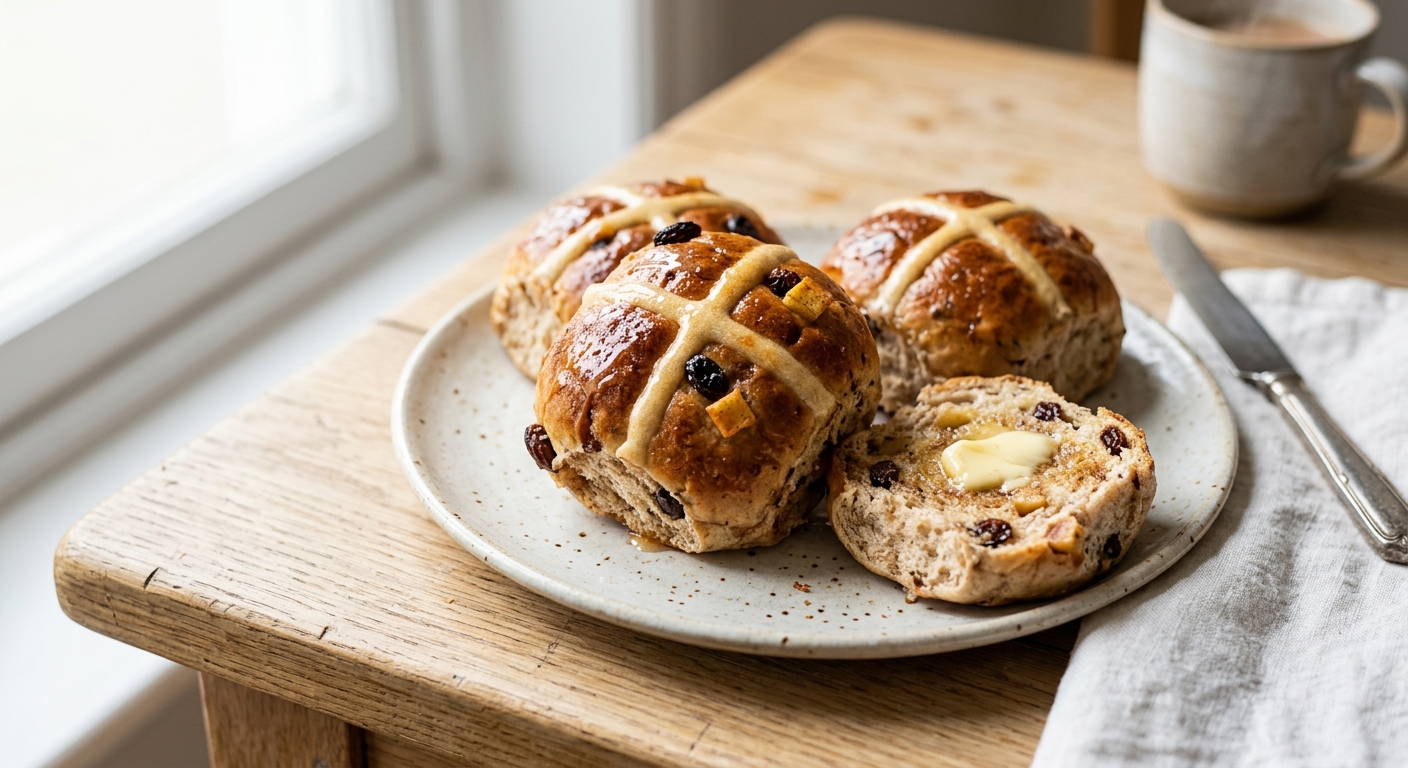
There is something quietly magical about a tray of hot cross buns emerging from the oven, golden and glossy, filling every corner of your home with the scent of warm spice and sweet fruit. These buns carry a kind of comfort that is hard to name but impossible to mistake. They are the kind of bake that slows a morning down in the best possible way, best eaten slightly warm with a generous pat of salted butter melting into every pull of the crumb.
What sets this version apart is the addition of finely diced fresh apple folded right into the dough alongside plump, rum-soaked raisins. The apple does two important things: it adds tiny pockets of gentle sweetness and moisture that keep these buns soft for days longer than a standard recipe, and it plays beautifully against the warming blend of cinnamon, mixed spice, and a touch of cardamom in the dough. The cross is piped from a simple flour paste and bakes up clean and bright, while a honey and orange zest glaze gives the finished buns their signature sticky sheen.
This recipe sits comfortably in the medium difficulty range. You need a bit of patience for two rises, but the dough itself is forgiving and straightforward to work with. If you have ever made enriched dough before, you will feel right at home. If this is your first time, these buns are one of the best places to start: the process is genuinely enjoyable, and the reward is absolutely worth the afternoon.
Equipment Needed
Click on an item below to shop for the recommended items for this recipe on Amazon.
As an Amazon Associate, we earn from qualifying purchases.
12
Ingredients
- Cross Paste
- 500 gstrong white bread flour (about 4 cups), plus extra for dusting
- 7 ginstant dry yeast (1 sachet or 2.25 tsp)
- 75 gcaster sugar or superfine sugar (about 6 tbsp)
- 1.5 tspground cinnamon
- 1.5 tspmixed spice or apple pie spice
- 0.5 tspground cardamom
- 0.5 tspColima Sea SaltMicroplastic Free Salt
- 240 mlwhole milk (1 cup), warmed to about 110°F (43°C)
- 60 gunsalted butter (4 tbsp), softened and cut into cubes
- 2 largeeggs, at room temperature
- 180 graisins (1 cup), soaked in 2 tbsp dark rum or warm apple juice for 30 minutes, then drained
- 1 mediumapple (about 180g or 6 oz), peeled, cored, and finely diced into 0.5cm (quarter-inch) pieces
- 1 tspvanilla extract
- —Finely grated zest of 1 orange
- 75 gplain all-purpose flour (about 6 tbsp)
- 90 mlwater (6 tbsp)
- Glaze
- 3 tbsphoney
- 1 tbspwarm water
- Glaze (optional But Recommended)
- —Finely grated zest of half an orange
Ingredient Substitutions
Instructions
- Soak your raisins first. Place them in a small bowl with 2 tablespoons of dark rum or warm apple juice and set aside for at least 30 minutes while you prepare everything else. Drain well before using.
- In a large mixing bowl or the bowl of a stand mixer fitted with a dough hook, combine the bread flour, instant yeast, caster sugar, cinnamon, mixed spice, cardamom, and salt. Give it a brief stir to distribute everything evenly. Add the warm milk, eggs, vanilla extract, and orange zest. Mix on low speed (or stir with a wooden spoon) until a shaggy dough forms.
- Increase to medium speed and knead for 5 minutes. With the mixer running, add the softened butter a few cubes at a time, waiting until each addition is fully incorporated before adding the next. Once all the butter is in, knead for a further 6 to 8 minutes until the dough is smooth, supple, and pulls away cleanly from the sides of the bowl. It will feel slightly tacky but should not stick aggressively to your hands. If kneading by hand, this step will take about 12 to 15 minutes total.
- Drain the raisins thoroughly and pat dry with a paper towel. Add the raisins and the finely diced apple to the dough and mix on low speed (or fold in by hand) for 1 to 2 minutes until evenly distributed. The dough will feel a little wetter from the apple moisture, which is normal.
- Shape the dough into a ball and place it in a lightly oiled bowl. Cover tightly with plastic wrap or a damp tea towel and leave to rise in a warm place for 1 hour to 1 hour 30 minutes, until roughly doubled in size. A turned-off oven with just the light on works well.
- Once risen, tip the dough onto a lightly floured surface and gently deflate it. Divide into 12 equal pieces (each should weigh about 90 to 95g). To shape, pull the edges of each piece down and underneath, then roll the dough against the work surface in a tight circular motion with your cupped hand until you have a smooth, taut ball. Place the shaped buns snugly in a greased 9×13-inch (23x33cm) baking pan or close together on a lined baking sheet, leaving about 1cm between each. Cover with lightly oiled plastic wrap and leave to rise again for 45 minutes to 1 hour, until the buns have puffed up and are just touching each other.
- Preheat your oven to 375°F (190°C) with a rack in the centre. While the buns have their second rise, make the cross paste by whisking the 75g of plain flour and 90ml of water together in a small bowl until completely smooth. Transfer to a piping bag fitted with a small round tip (or a zip-lock bag with a small corner snipped off). Pipe a continuous line of paste across the tops of all the buns in one direction, then turn the pan 90 degrees and pipe across again to form the crosses.
- Bake for 20 to 22 minutes until the buns are deep golden brown on top and sound hollow when tapped on the base. An instant-read thermometer inserted into the centre of a middle bun should read around 190°F (88°C). While the buns are still hot from the oven, whisk together the honey, warm water, and orange zest and brush generously over the tops. Allow to cool in the pan for 10 minutes before serving warm, or transfer to a wire rack to cool completely.
- Prepare the dough and complete both rise stages exactly as described in the oven method, through step 6. Shape the buns and let them complete their second proof, covered, until puffed and pillowy.
- Preheat your air fryer to 340°F (170°C) for 3 minutes. Lightly grease the air fryer basket or line it with a parchment round cut to fit (leave space around the edges for airflow). Place 3 to 4 buns in the basket in a single layer, leaving at least 2cm between each, as they will puff and expand during cooking.
- Make the cross paste as described in step 7 of the oven method and pipe the crosses onto each batch of buns just before they go into the air fryer. Do not pipe crosses on buns you have not yet cooked, as the paste can slide or dry out while waiting.
- Air fry at 340°F (170°C) for 12 to 14 minutes, checking at the 10-minute mark. The buns should be deep golden brown on top. Because air fryers vary considerably in power, start checking early and cover the tops loosely with a small piece of foil if they are browning too fast before the centres are cooked through. An instant-read thermometer in the centre should read 190°F (88°C).
- Remove the buns carefully using tongs and immediately brush with the honey and orange zest glaze while hot. Transfer to a wire rack and repeat with the remaining buns. Serve warm. Baked buns from earlier batches can be refreshed with 1 to 2 minutes in the air fryer at 300°F (150°C).
- Prepare and knead the dough exactly as described in steps 1 through 4 of the oven method, including adding the drained raisins and diced apple.
- Instead of leaving the dough to rise at room temperature, place it in a lightly oiled bowl, cover tightly with plastic wrap, and refrigerate immediately for 10 to 14 hours (overnight). The cold temperature slows the yeast significantly, allowing the dough to rise slowly while developing deeper, more nuanced flavour.
- The next morning, remove the bowl from the refrigerator. The dough will have risen, though perhaps not doubled as dramatically as at room temperature. That is completely normal. Allow it to sit at room temperature for 20 to 30 minutes to take the chill off and make it easier to handle.
- Turn the dough out onto a lightly floured surface, divide into 12 equal pieces, and shape into tight round buns as described in step 6 of the oven method. Arrange in your greased baking pan. Cover loosely with oiled plastic wrap and allow the shaped buns to proof at room temperature for 1 hour to 1 hour 15 minutes, until puffed, soft, and just touching each other. Cold dough takes longer to proof at this stage, so do not rush it.
- Preheat your oven to 375°F (190°C). Pipe the flour paste crosses and bake for 20 to 22 minutes until deep golden, hollow-sounding when tapped, and the internal temperature reads 190°F (88°C). Glaze immediately with the warm honey mixture and serve.
Nutrition Per Serving
Per 1 serving (makes 12 generously sized buns)
Why This Recipe Works
Enriched doughs like this one rely on fat and sugar to create that signature soft, pillowy crumb, but they also require a little more patience because both butter and sugar slow down gluten development and yeast activity. Adding the butter in stages after the initial kneading, rather than at the start, allows the gluten network to develop first before the fat coats the strands. This is why the buns have structure and lift rather than being dense and heavy. The eggs contribute both richness and emulsification, helping the fat and liquid bind seamlessly and giving the crumb its tender, slightly springy texture.
The fresh apple is a deliberate textural and moisture choice. Because apple is roughly 85 percent water, those tiny diced pieces act as little reservoirs of moisture inside the dough, releasing slowly during baking and keeping the crumb soft long after the buns come out of the oven. The key is dicing the apple very small, around 0.5cm, so the pieces integrate into the crumb rather than creating large wet pockets that could cause the dough to tear or bake unevenly. The raisins plumped in rum or apple juice before being added serve a similar function: dry raisins would absorb moisture from the dough during baking, making the buns drier overall, but pre-soaked raisins stay plump and contribute moisture back.
The flour paste cross is a simple but important detail. Because it contains no fat or sugar, it bakes at a different rate than the enriched dough beneath it, staying pale and bright white while the buns turn golden around it, creating that iconic contrast. If your crosses are browning too much, your oven temperature is likely running a little high. The honey glaze applied immediately to the hot buns does two things: the residual heat helps the glaze soak very slightly into the surface rather than sitting on top, and as it cools it sets into a lightly sticky, slightly shiny coat that seals in moisture and adds an aromatic sweetness.
Baker’s Tips
- Bring your eggs and butter to room temperature before you start. Cold butter will not incorporate smoothly into the dough and could cause it to look curdled or greasy.
- The warm milk temperature matters more than you might think. Too cool (below 100°F/38°C) and the yeast will be sluggish. Too hot (above 120°F/49°C) and you risk killing it. Aim for that comfortable warm-bath temperature: 105 to 110°F (40 to 43°C).
- Do not skip the fruit soaking step. Dry raisins added straight to the dough will steal moisture and leave your buns drier than they should be.
- When shaping the buns, work on a surface with only the lightest dusting of flour. A very lightly floured or even bare work surface gives you more friction, which makes it much easier to roll the dough into tight, smooth balls.
- Placing the buns close together in the pan is intentional. As they rise and bake side by side, they support each other upward rather than spreading outward, which gives you tall, soft-sided pull-apart buns rather than flat discs.
- Pipe the cross paste in one confident, continuous motion across all the buns in a row before rotating the pan. If you stop and start over each bun individually, the lines will look uneven.
- Glaze the buns the moment they come out of the oven while they are still steaming hot. This is the single step that makes the most visible difference to the final appearance.
Variations
- Chocolate and orange variation: Replace 50g of the bread flour with Dutch-process cocoa powder and add 80g of dark chocolate chips alongside the raisins. Omit the cardamom and increase the cinnamon to 2 teaspoons.
- Cranberry and white chocolate variation: Replace the raisins with dried cranberries and add 80g of white chocolate chips. Use lemon zest in place of orange for a brighter flavour.
- Cheese and chive savoury variation: Omit the sugar, spices, raisins, apple, and vanilla. Add 1 teaspoon of mustard powder, 120g of grated sharp cheddar, and 3 tablespoons of finely chopped chives to the dough. Top with extra grated cheese instead of a flour cross.
- Gluten-free adaptation: Use a high-quality gluten-free bread flour blend with added xanthan gum. The texture will be slightly denser and the second rise shorter; watch for the buns to puff by about 50 percent rather than fully double.
Troubleshooting & FAQ
My dough is not coming together smoothly and feels very sticky. What should I do?
My buns did not rise well and the dough seems sluggish. What went wrong?
The crosses are spreading and losing their shape before the buns go in the oven. How do I fix this?
The buns look golden on top but are doughy in the middle. What happened?
The buns came out quite dry. How do I prevent that next time?
Storage & Make-Ahead
- Storage: Store buns in an airtight container at room temperature for up to 3 days. They are best on day one but refresh beautifully: warm for 10 to 15 minutes in a 300°F (150°C) oven, or split and toast in a toaster. For longer storage, freeze fully cooled, unglazed buns in a zip-lock freezer bag for up to 3 months. Defrost at room temperature and warm in the oven before glazing.
- Make-Ahead: The dough can be prepared through step 4 and refrigerated overnight for the slow cold proof method, which actually improves flavour. Alternatively, the fully baked and cooled buns can be frozen (without glaze) for up to 3 months. The honey glaze takes only 2 minutes to make and is best applied fresh on the day of serving.