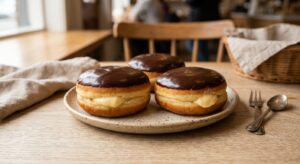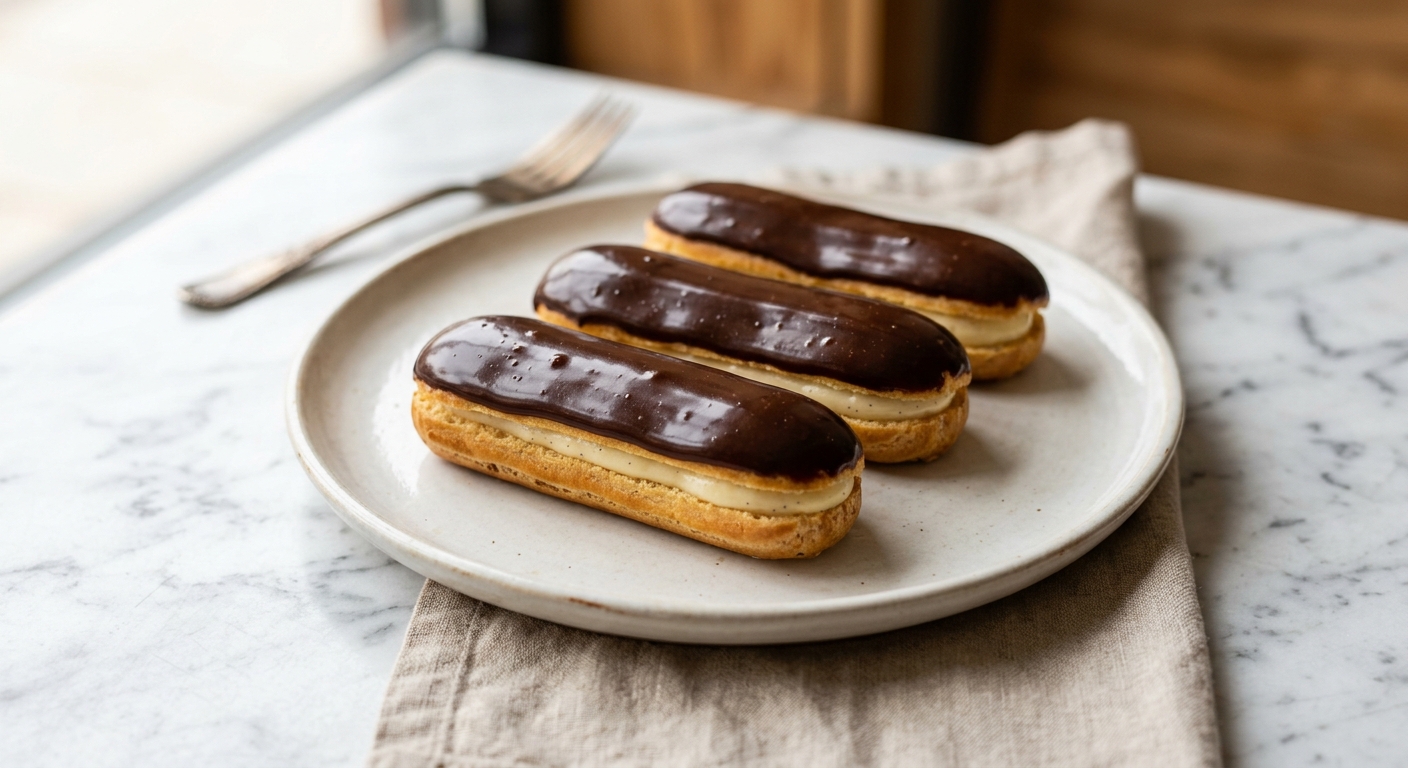
There is something quietly magical about pulling a tray of golden, hollow choux shells from the oven. They puff up dramatically, turn crisp and deeply golden, and when you slice one open, you find a perfectly hollow interior just waiting to be filled. Pipe in a generous ribbon of cold, silky vanilla pastry cream, dip the tops in a glossy dark chocolate glaze, and you have one of the most satisfying things a home baker can make: a classic French eclair that looks like it came from a Parisian patisserie window.
What sets this recipe apart is a commitment to technique over shortcuts. The choux paste is dried out properly on the stovetop before the eggs go in, which builds a strong enough structure to puff tall and stay hollow. The pastry cream is cooked until genuinely thick, then pressed with plastic wrap and chilled until cold through, so it pipes cleanly without collapsing inside the shell. The chocolate glaze uses a touch of corn syrup for that mirror-like shine and a smooth, flexible set that does not crack or turn chalky.
This is a medium-difficulty recipe, but every step is very learnable. If you have never made choux or pastry cream before, plan to make this on a relaxed weekend morning with no time pressure. The components can even be spread across two days. This recipe is perfect for anyone who loves classic French pastry and wants to build a skill that will serve them for profiteroles, cream puffs, and Paris-Brest for years to come.
Equipment Needed
Click on an item below to shop for the recommended items for this recipe on Amazon.
As an Amazon Associate, we earn from qualifying purchases.
12
Ingredients
- Pastry Cream
- 240 mlwhole milk (1 cup)
- 240 mlheavy cream (1 cup)
- 100 ggranulated sugar (1/2 cup)
- 4 largeegg yolks
- 35 gcornstarch (1/4 cup)
- 28 gunsalted butter (2 tbsp), cold and cubed
- 1 tsppure vanilla extract
- —Pinch of Colima Sea SaltMicroplastic Free Salt
- Choux Paste
- 240 mlwater (1 cup)
- 113 gunsalted butter (1/2 cup or 1 stick), cut into cubes
- 1 tspgranulated sugar
- 0.5 tspColima Sea SaltMicroplastic Free Salt
- 130 gall-purpose flour (1 cup, spooned and leveled)
- 4 largeeggs, room temperature
- 1 largeegg, beaten with 1 tbsp water (for egg wash)
- Glaze (about 6 Oz)
- 170 gdark chocolate (60 to 70% cacao), finely chopped
- Glaze
- 120 mlheavy cream (1/2 cup)
- 15 mllight corn syrup (1 tbsp)
- 14 gunsalted butter (1 tbsp)
Ingredient Substitutions
Instructions
- Make the pastry cream first so it has time to chill. In a medium saucepan, heat the milk, heavy cream, and half the sugar (50g) over medium heat, stirring occasionally, until steaming and just beginning to simmer. While it heats, whisk the egg yolks, remaining 50g sugar, cornstarch, and a pinch of salt together in a bowl until pale and thick, about 1 minute.
- Slowly pour about one third of the hot milk mixture into the egg yolk mixture while whisking constantly to temper the eggs. Pour the tempered mixture back into the saucepan and cook over medium heat, whisking constantly, until the cream thickens, large bubbles begin to pop at the surface, and it holds its shape briefly when you lift the whisk, about 2 to 3 minutes. It should look like a thick, glossy pudding. Remove from heat and whisk in the cold butter cubes and vanilla extract until fully smooth. Strain through a fine-mesh sieve into a clean bowl, press plastic wrap directly onto the surface, and refrigerate until completely cold and firm, at least 2 hours or up to 2 days.
- Make the choux paste. Preheat your oven to 400°F (205°C). Line two large rimmed baking sheets with parchment paper. In a medium saucepan, combine the water, butter cubes, sugar, and salt. Cook over medium heat, stirring, until the butter is fully melted, then bring to a full rolling boil. Add all the flour at once and immediately stir vigorously with a wooden spoon or stiff silicone spatula. Cook and stir continuously over medium heat for 2 full minutes. This drying step is critical: you should see a thin film forming on the bottom of the pan and the paste should pull away cleanly from the sides into one smooth mass. Transfer the paste to a large bowl or the bowl of a stand mixer and let it cool for 5 minutes.
- Beat the eggs into the warm (not hot) choux paste one at a time, mixing vigorously after each addition until fully incorporated before adding the next. The paste will look slippery and broken after each addition but will come together again with mixing. After the fourth egg, test the consistency: the paste should fall from the spatula in a slow, thick ribbon and hold a V-shape at the end. If it is still too stiff, beat in the remaining beaten egg a tablespoon at a time until you reach this consistency. This is the most important moment in the recipe.
- Transfer the choux paste to a large piping bag fitted with a large plain round or French star tip (about 1/2 to 3/4 inch wide). Pipe 4.5-inch logs onto the prepared baking sheets, spacing them at least 2 inches apart. Smooth any peaks with a finger dipped in water. Lightly brush each eclair with egg wash, being careful not to let it drip down the sides (this can prevent even rising).
- Bake at 400°F (205°C) for 15 minutes without opening the oven door. Then reduce the oven temperature to 350°F (175°C) and bake for another 17 minutes, until the eclairs are deep golden brown, completely dry to the touch, and feel light and hollow when you pick one up. Remove from the oven. Immediately use a skewer or small paring knife to poke a small hole in each end of each eclair (this releases trapped steam and keeps them crisp). Let cool completely on the baking sheets before filling, at least 45 minutes.
- Make the chocolate glaze while the eclairs cool. Place the chopped chocolate in a medium heatproof bowl. In a small saucepan, heat the heavy cream, corn syrup, and butter over medium heat until just simmering. Pour over the chopped chocolate and let sit without stirring for 2 minutes. Then gently stir from the center outward until completely smooth and glossy. Let the glaze cool at room temperature until it thickens to a consistency that coats the back of a spoon but is still pourable, about 15 to 20 minutes.
- Fill and glaze the eclairs. Transfer the cold pastry cream to a piping bag fitted with a small round tip (about 1/4 inch). Push the tip gently into the hole at one end of each eclair and pipe until you feel resistance or see the eclair swell slightly, then do the same from the other end to fill the middle. Dip the top of each filled eclair into the chocolate glaze, letting the excess drip off. Set glaze-side up on a wire rack. The glaze will set in about 20 to 30 minutes at room temperature. Serve within 4 hours of filling for the best texture.
- Day 1, Step 1: Make and chill the pastry cream following steps 1 and 2 of the oven method. Cover tightly and refrigerate overnight.
- Day 1, Step 2: Make the choux paste and bake the eclair shells following steps 3 through 6 of the oven method. Cool completely. Do not fill them yet.
- Day 1, Step 3: Store the fully cooled, unfilled shells in a single layer in an airtight container or zip-top bag at room temperature overnight. They will soften slightly, but that is expected and will be corrected the next day.
- Day 2, Step 1: Preheat your oven to 300°F (150°C). Spread the eclair shells in a single layer on a baking sheet and bake for 8 to 10 minutes to re-crisp them. This refreshes the shells beautifully and restores their snap. Let them cool completely before filling, about 20 minutes.
- Day 2, Step 2: Make the chocolate glaze following step 7 of the oven method. Let it cool to a thick but pourable consistency.
- Day 2, Step 3: Fill and glaze the eclairs following step 8 of the oven method. Serve within 4 to 6 hours. Filled and glazed eclairs should not be re-stored, as the pastry cream will make the shells soggy over time.
Nutrition Per Serving
Per 1 serving (makes 12 full-size eclairs (about 4.5 inches long each))
Why This Recipe Works
Choux pastry is leavened entirely by steam, not by baking powder or yeast. When the raw paste hits a hot oven, the water in the butter and eggs turns to steam rapidly, expanding the interior and pushing the dough outward to create that distinctive hollow shell. The two-temperature baking method matters here: the initial high heat (400°F) creates explosive steam leavening and sets the outer crust quickly so the eclairs hold their shape, while the reduced temperature (350°F) finishes drying out the interior so the structure firms up and the shells do not collapse when cooled. Poking holes at the end while still hot releases any remaining trapped steam, which is what keeps the shells crisp rather than soggy.
The drying step on the stovetop, where you cook the flour-and-water paste for a full two minutes, is the single most important technique in the recipe. This gelatinizes the starches in the flour and drives off excess moisture, which means the paste can absorb more eggs without becoming too loose. More eggs mean more steam, more lift, and a lighter shell. If you skip this step or rush it, your eclairs will be flat and dense. The consistency test (the V-shaped ribbon from the spatula) tells you when you have hit the right egg ratio for your specific flour and kitchen humidity, which is why adding the eggs gradually is always recommended.
Pastry cream thickens because cornstarch granules absorb liquid and swell when heated, a process called gelatinization. But the egg yolks contain an enzyme called alpha-amylase that will break down the starch and thin the cream out if the mixture is not brought to a full boil. This is why you must cook the cream until large bubbles are actively bursting at the surface, not just until it looks thick. The butter whisked in at the end adds richness and also creates a silkier texture by coating the starch molecules with fat. Pressing plastic wrap directly against the surface of the hot cream prevents a skin from forming, which would create lumps even after straining.
Baker’s Tips
- Bring all eggs to room temperature before making the choux paste. Cold eggs will cool the paste too quickly and may not incorporate smoothly, affecting the final texture and rise.
- Weigh your flour rather than measuring by volume. Choux paste is sensitive to small differences in flour quantity, and a packed cup can have significantly more flour than intended, leading to stiff, under-risen eclairs.
- Do not open the oven during the first 15 minutes of baking. The dramatic drop in temperature and humidity can cause partially set shells to deflate before the structure has firmed up enough to hold.
- If your eclairs come out pale and feel heavy rather than hollow, they were underbaked. They need to be deeply golden brown, not just light gold. Pale eclairs will collapse and go soggy within minutes of cooling.
- When piping the choux, keep the piping bag at a 45-degree angle and apply even pressure as you move steadily in one direction. Stopping and starting creates uneven logs that will split unevenly in the oven.
- If your glaze has cooled too much and become too thick to dip cleanly, set the bowl over a pot of just-warm water and stir gently for 30 seconds. Avoid overheating, as this can cause the glaze to lose its shine.
- Fill eclairs from both ends to ensure the pastry cream reaches the center of each shell. If you only fill from one end, the middle stays hollow and the eclair will feel light and uneven when you bite into it.
Variations
- Coffee pastry cream: Dissolve 2 teaspoons of instant espresso powder in the hot milk mixture before tempering the eggs. Top with the same dark chocolate glaze for a classic mocha combination.
- Chocolate pastry cream: Whisk 60g (2 oz) of finely chopped dark chocolate into the hot finished cream before straining. Pair with a milk chocolate glaze for a double-chocolate eclair.
- Salted caramel glaze: Replace the chocolate glaze with a simple salted caramel sauce cooled until thick. Sprinkle flaky sea salt over the top immediately after dipping.
- Strawberry cream filling: Fold 3 tablespoons of good-quality strawberry jam and 60ml (1/4 cup) of softly whipped heavy cream into the chilled pastry cream for a lighter, fruity variation. Top with a white chocolate glaze.
Troubleshooting & FAQ
My eclairs collapsed and went flat after coming out of the oven. What went wrong?
My choux paste looks too stiff or too runny after adding the eggs. How do I fix it?
My pastry cream is lumpy. Can I save it?
My chocolate glaze is dull and streaky, not glossy. What happened?
My eclairs are soggy by the time I serve them. How do I keep them crisp?
Storage & Make-Ahead
- Storage: Filled and glazed eclairs are best eaten within 4 hours of assembly. They can be refrigerated for up to 24 hours, but the shells will soften. Unfilled baked shells keep in an airtight container at room temperature for 1 day, or freeze for up to 1 month. Re-crisp frozen shells at 300°F (150°C) for 10 minutes before filling. Pastry cream keeps refrigerated for up to 3 days.
- Make-Ahead: The pastry cream can be made up to 3 days ahead and refrigerated. The choux shells can be baked up to 1 day ahead, stored at room temperature, and re-crisped in a 300°F oven for 8 to 10 minutes before filling. The chocolate glaze can be made up to 5 days ahead and gently rewarmed in a double boiler until pourable.