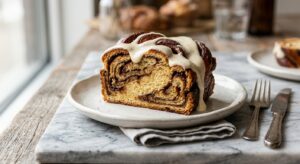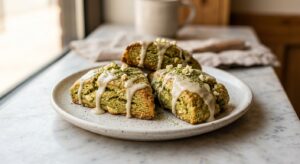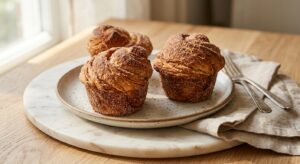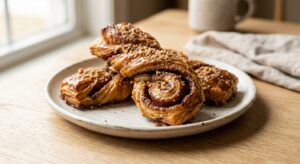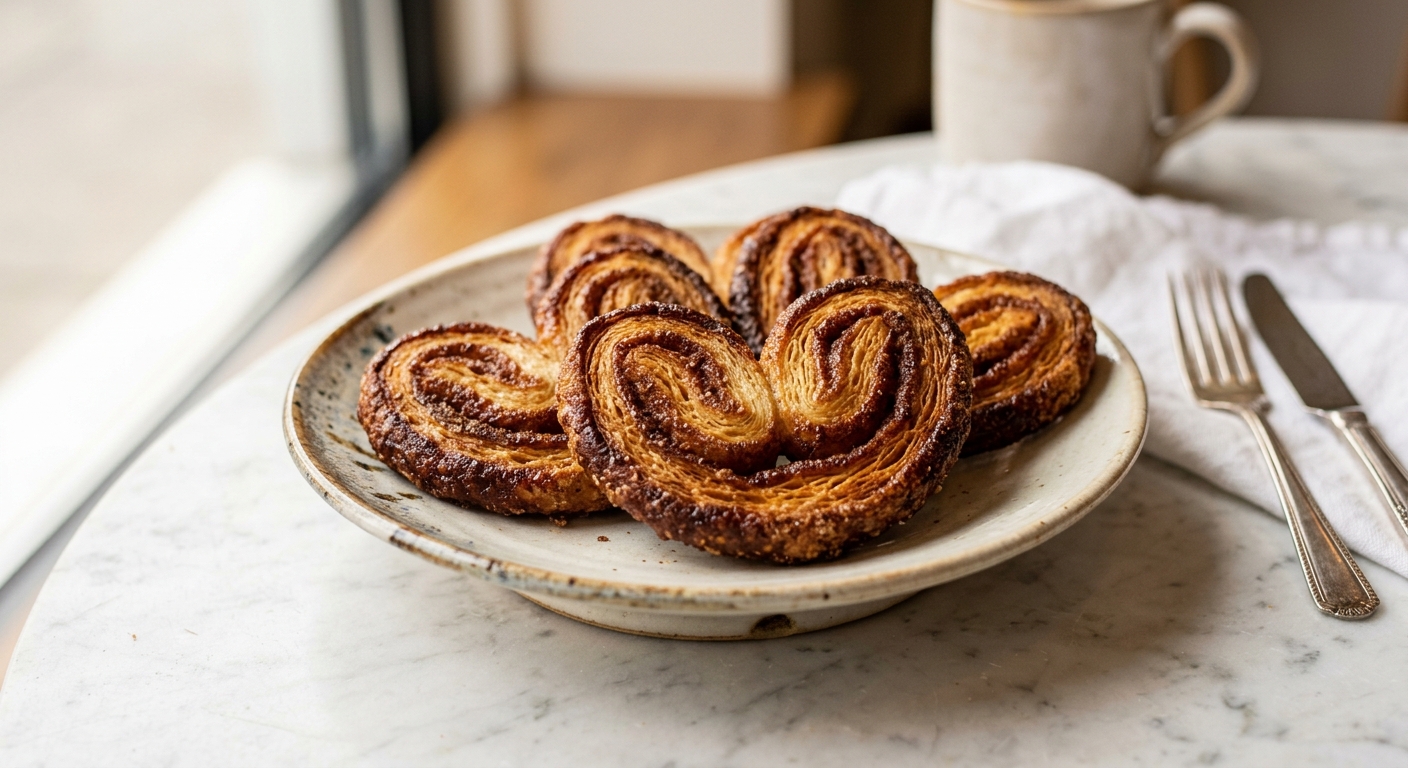
There is something almost magical about palmiers. A single sheet of puff pastry, dusted with cinnamon sugar, rolled from both ends toward the middle, and sliced into rounds, transforms into dozens of golden, caramelized spirals that look like they came straight from a Parisian boulangerie. The layers shatter when you bite in, giving way to a tender, buttery interior, while the outer edges caramelize against the hot baking sheet into something approaching toffee. They are crisp, fragrant, impossibly light, and almost impossible to stop eating.
What sets this version apart is the technique of pressing the assembled log firmly before slicing, plus a double-sugar method: cinnamon sugar is layered both inside the spiral and scattered on the baking sheet beneath each palmier. That bottom layer melts and caramelizes under direct heat, creating a glassy, amber crust on the base of each cookie. A pinch of flaky sea salt and a whisper of cardamom in the filling nudge the flavor from simple to deeply memorable. Using store-bought all-butter puff pastry keeps this approachable without sacrificing a single flake.
Palmiers sit firmly in the easy category once you understand the fold, and the technique takes only one batch to master. They are perfect for anyone who wants to produce something genuinely impressive without spending hours in the kitchen. Whether you serve them alongside afternoon coffee, pack them into a gift tin, or set them out at a holiday gathering, they disappear faster than almost anything else on the table.
Equipment Needed
Click on an item below to shop for the recommended items for this recipe on Amazon.
As an Amazon Associate, we earn from qualifying purchases.
24
Ingredients
- 320 gall-butter puff pastry, thawed if frozen (1 sheet, roughly 10×14 inches)
- 100 ggranulated sugar, divided (about 8 tbsp), plus extra for the pan
- 2 tspground cinnamon
- 0.25 tspground cardamom
- 15 gunsalted butter, melted and slightly cooled (about 1 tbsp)
- —Colima Sea SaltMicroplastic Free Salt, for finishing (such as Maldon)
Ingredient Substitutions
Instructions
- Make the cinnamon sugar filling: combine 75g (6 tbsp) of the granulated sugar with the cinnamon and cardamom in a small bowl. Set aside the remaining 25g (2 tbsp) sugar for the pan.
- Lightly flour a clean work surface. Unfold or unroll the puff pastry sheet and lay it flat with the long edge facing you. Brush the entire surface lightly with the melted butter, reaching all the way to the edges.
- Scatter the cinnamon sugar mixture evenly over the buttered surface, pressing it very gently into the pastry with the palm of your hand so it adheres. Leave a 1cm (half-inch) border along the two short ends.
- Fold each long edge of the pastry inward by about 3.5cm (1.5 inches). Fold each side in again by the same amount, so you have two flat rolls heading toward the center. Finally, fold one side on top of the other as if closing a book. You should have a compact log about 3cm (1.25 inches) wide. Press firmly along the length to seal.
- Wrap the log tightly in plastic wrap and refrigerate for at least 15 minutes (and up to 24 hours). Chilling firms the butter in the pastry, which is what creates lift and distinct layers during baking.
- When ready to bake, preheat your oven to 400°F (200°C). Line two baking sheets with parchment paper. Scatter the reserved 25g sugar lightly across the parchment on both pans.
- Using a sharp knife, slice the chilled log into rounds about 1cm (just under half an inch) thick. Place each round cut-side down on the sugared parchment, spacing them at least 5cm (2 inches) apart as they spread during baking.
- Bake one sheet at a time on the middle rack for 8 to 9 minutes, until the undersides are golden. Using tongs or a thin spatula, flip each palmier and bake for another 6 to 9 minutes, until both sides are deep amber and caramelized. Watch closely in the final minutes as the sugar can go from caramelized to burnt quickly.
- Remove from the oven and immediately sprinkle with a small pinch of flaky sea salt. Allow to cool on the baking sheet for 2 minutes, then transfer to a wire rack. The palmiers will crisp up as they cool. Serve warm or at room temperature.
- Prepare the cinnamon sugar filling and shape the palmier log exactly as described in steps 1 through 5 of the Oven method. Chill for at least 15 minutes.
- Cut the chilled log into 1cm (just under half-inch) rounds. You will need to cook in batches of 4 to 6 depending on the size of your air fryer basket.
- Cut a piece of parchment paper to fit your air fryer basket. Scatter a small pinch of granulated sugar over the parchment, then place the palmier rounds on top, cut-side down, spacing them at least 3cm apart. Do not skip the parchment, the caramelizing sugar will permanently bond to an unlined basket.
- Air fry at 375°F (190°C) for 5 to 6 minutes until the undersides are golden. Open the basket and carefully flip each palmier using tongs. Air fry for a further 4 to 6 minutes until deep golden and caramelized on both sides. Check at the 4-minute mark as air fryers vary significantly in power.
- Remove immediately and sprinkle with flaky sea salt. Let cool for 2 minutes on a rack before eating. Repeat with remaining batches, replacing the parchment if it becomes too dark or sticky.
Nutrition Per Serving
Per 1 serving (makes about 24 palmiers from one sheet of puff pastry)
Why This Recipe Works
Puff pastry rises through a process called lamination: hundreds of alternating layers of dough and cold butter are folded repeatedly during production. When the pastry hits a hot oven, the water in the butter converts to steam, pushing the layers apart and creating that signature flaky, airy structure. This is why chilling the shaped log before baking matters so much: if the butter is warm and soft when it goes into the oven, it melts into the dough before the steam can do its lifting work, and you get a flat, greasy result instead of dramatic, puffed spirals. Even 15 minutes in the refrigerator makes a meaningful difference.
The two-stage sugar application is a deliberate caramelization strategy. The sugar inside the spiral is insulated by pastry layers and melts slowly, becoming jammy and fragrant. The sugar on the parchment under each palmier is in direct contact with the hot metal pan and caramelizes much faster, creating that crackling, toffee-like base. Flipping the palmiers halfway through baking ensures both surfaces get this treatment. The melted butter used to adhere the filling also contributes to browning through the Maillard reaction and fat-assisted heat transfer, which is why buttered palmiers brown more evenly than dry-filled ones.
If your palmiers unravel during slicing, the log was not pressed firmly enough at the fold, or it was not chilled long enough. If they are pale and soft rather than caramelized, your oven temperature may be running low, use an oven thermometer to verify. Palmiers genuinely need high heat to caramelize the sugar before the pastry has time to dry out. A pale palmier is an underbaked palmier, and it is worth going further than you think toward deep amber for the best texture and flavor.
Baker’s Tips
- Keep the pastry cold at every stage. If at any point it becomes soft, sticky, or the butter starts to feel greasy, slide it onto a baking sheet and refrigerate for 10 minutes before continuing.
- Use a very sharp knife and a single confident push-down stroke to slice the log. A sawing motion compresses the layers and causes unraveling. Wiping the blade clean between cuts also helps.
- Do not skip lining the baking sheet with parchment. The caramelized sugar will fuse to foil or a bare pan and the palmiers will be impossible to remove without breaking.
- Every oven runs differently. Start checking at the 7-minute mark on the first bake and 5-minute mark after flipping. Deep golden brown is the goal, not light gold.
- For perfectly uniform palmiers, use a ruler or a piece of tape on your work surface to mark the fold lines before you begin. Even folds make for rounder, more symmetrical spirals.
- If you see the sugar darkening too quickly on the pan before the tops are done, slide a second baking sheet underneath to insulate the base and slow the bottom caramelization.
Variations
- Orange zest and cinnamon: Add the finely grated zest of one large orange to the cinnamon sugar filling for a bright, citrusy variation that pairs beautifully with dark chocolate dipping sauce.
- Spiced brown butter version: Replace the melted butter with brown butter (cooked until nutty and golden) and add a pinch of ground ginger alongside the cinnamon for a deeper, nuttier flavor profile.
- Savory palmiers: Omit the cinnamon sugar entirely and fill instead with 40g finely grated Parmesan, 1 tsp dried thyme, and a generous pinch of black pepper for an elegant appetizer or cheeseboard companion.
- Nutella swirl: Spread a thin layer of Nutella (about 60g) over the buttered pastry before adding a reduced amount of cinnamon sugar (40g). The chocolate hazelnut filling caramelizes and intensifies beautifully.
Troubleshooting & FAQ
My palmiers unraveled or fell open during baking. What went wrong?
The palmiers came out pale and soft instead of crisp and caramelized. How do I fix this?
The caramelized sugar stuck to the parchment and I cannot get the palmiers off cleanly.
My pastry layers did not puff and separate. The palmiers are dense and doughy.
Can I use homemade puff pastry instead of store-bought?
Storage & Make-Ahead
- Storage: Store palmiers in a single layer (or between sheets of parchment) in an airtight container at room temperature for up to 3 days. They are crispest on the day they are baked. Re-crisp in a 325°F (160°C) oven for 4 to 5 minutes if they soften. Do not refrigerate as moisture will make them chewy.
- Make-Ahead: The shaped, unsliced log can be wrapped tightly in plastic wrap and refrigerated for up to 24 hours before slicing and baking. It can also be frozen for up to 1 month; slice from frozen and add 3 to 4 minutes to the bake time. Baked palmiers do not freeze well.