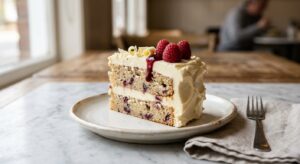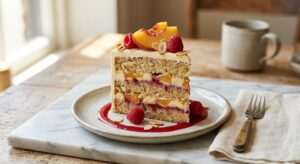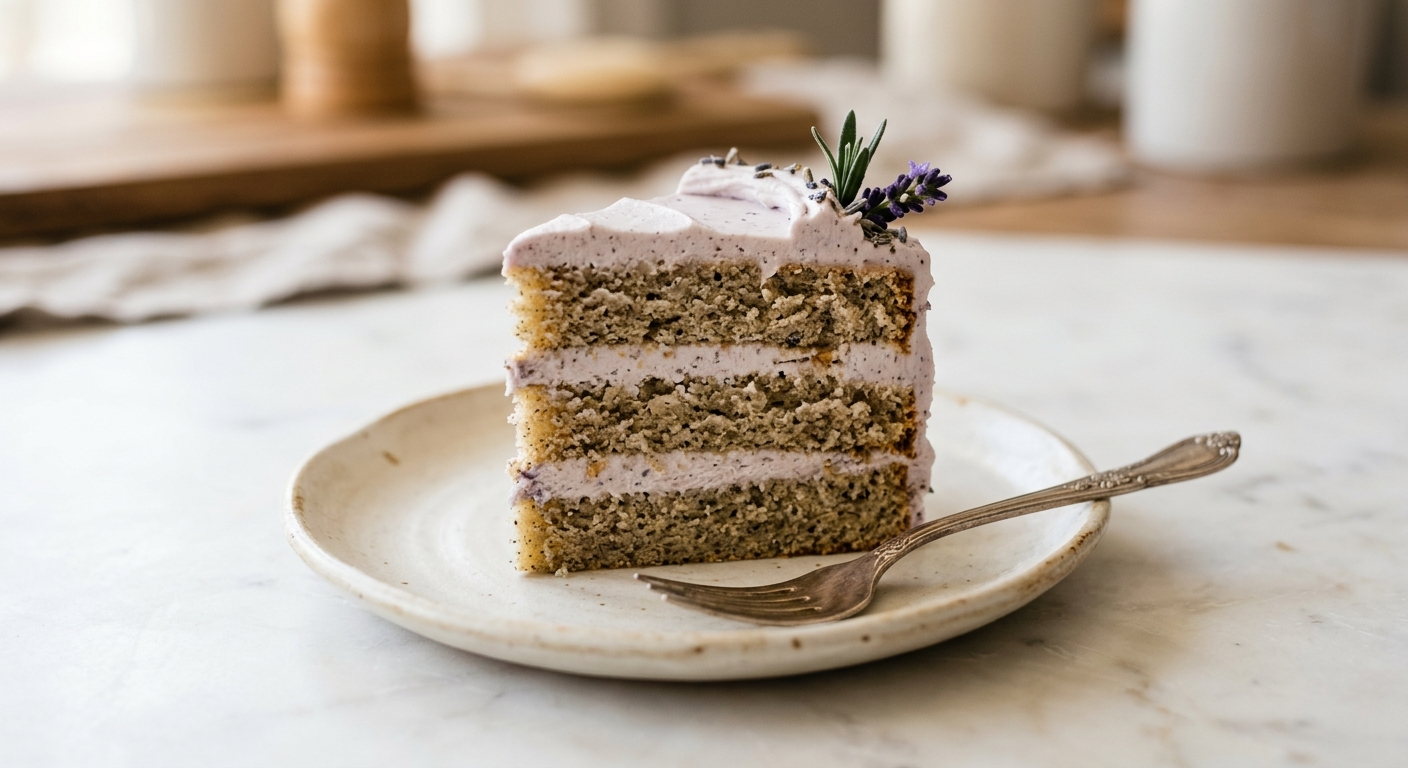
There is something quietly magical about the way Earl Grey tea transforms a cake. The bergamot-forward black tea steeps directly into warm milk, coaxing out its citrusy, faintly floral notes, and those flavors weave themselves into every bite of the finished crumb. The result is not a cake that shouts its ingredients at you, but one that lingers, sophisticated and a little mysterious, the kind of slice you find yourself reaching for again before the first is finished. Pair that with a buttercream scented with real lavender and local honey, and you have something that tastes like a slow afternoon in a sun-filled kitchen.
What sets this version apart is the double-infusion method. The tea steeps into warm whole milk for the cake batter, and loose-leaf Earl Grey is also creamed briefly into the butter itself, coaxing out the fat-soluble aromatic compounds in the bergamot oil that water alone cannot fully capture. The lavender in the buttercream is handled with equal care: culinary-grade dried lavender blooms are steeped in warmed heavy cream before it is whipped into the frosting, keeping the flavor gentle and unmistakably floral rather than soapy or perfumed. Honey replaces a portion of the powdered sugar, adding a nuanced sweetness and a slight glossy softness to the frosting.
This cake sits comfortably in the medium-difficulty range. There is nothing technically demanding here, but the infusion steps require a little patience and planning ahead. It is a wonderful bake for an experienced home baker looking for something a bit more refined, and equally approachable for a confident beginner who is ready to move beyond basic vanilla sponge. It is perfect for birthdays, bridal showers, afternoon tea parties, or simply because you bought a beautiful tin of Earl Grey and you want to do something worthy of it.
Equipment Needed
Click on an item below to shop for the recommended items for this recipe on Amazon.
As an Amazon Associate, we earn from qualifying purchases.
12
Ingredients
- 240 mlwhole milk (1 cup)
- 10 gloose-leaf Earl Grey tea, divided (about 3 tbsp), or 4 tea bags
- 285 gall-purpose flour (2 1/4 cups, spooned and leveled)
- 2 tspbaking powder
- 0.5 tspbaking soda
- 0.5 tspColima Sea SaltMicroplastic Free Salt
- 200 ggranulated sugar (1 cup)
- 100 glight brown sugar, packed (1/2 cup)
- 170 gunsalted butter, softened to room temperature (3/4 cup, 1 1/2 sticks)
- 3 largeeggs, at room temperature
- 1 tsppure vanilla extract
- 120 gsour cream, at room temperature (1/2 cup)
- 2 tspfinely grated lemon zest (from about 1 lemon)
- —For the Honey Lavender Buttercream:
- 60 mlheavy cream (1/4 cup)
- 4 gdried culinary lavender (about 2 tsp)
- 340 gunsalted butter, softened to room temperature (1 1/2 cups, 3 sticks)
- 480 gpowdered sugar, sifted (4 cups)
- 85 ggood-quality honey (1/4 cup)
- 1 tsppure vanilla extract
- 0.25 tspColima Sea SaltMicroplastic Free Salt
- —For garnish (optional): dried culinary lavender blooms, fresh edible flowers, lemon zest curls
Ingredient Substitutions
Instructions
- Make the tea-infused milk: Heat the whole milk in a small saucepan over medium-low heat until steaming but not boiling (about 150°F / 65°C). Remove from heat, add 6g (about 2 tbsp) of the loose-leaf Earl Grey, and steep for 8 to 10 minutes. Strain through a fine-mesh sieve, pressing the leaves gently to extract maximum flavor. Let the infused milk cool to room temperature. You need 180ml (3/4 cup) of liquid after straining, so start with a little extra milk if needed.
- Preheat your oven to 350°F (175°C). Grease two 8-inch round cake pans, line the bottoms with parchment paper circles, and lightly flour the sides. Set aside.
- Whisk together the flour, baking powder, baking soda, and salt in a medium bowl. Set aside.
- In the bowl of a stand mixer fitted with the paddle attachment (or in a large bowl with a hand mixer), beat the softened butter on medium speed for 2 minutes until pale and creamy. Add the remaining 4g (about 1 tbsp) of loose-leaf Earl Grey directly to the butter and beat for another 1 minute. The tea will not dissolve, but beating it into the fat releases its bergamot oils into the batter. Add the granulated sugar and brown sugar, and beat on medium-high speed for 4 to 5 minutes, scraping the bowl twice, until very light and fluffy.
- With the mixer on medium-low, add the eggs one at a time, beating for 30 seconds after each addition. Add the vanilla extract and lemon zest. Scrape down the sides of the bowl.
- Add the sour cream to the egg mixture and mix on low just until combined. The batter may look slightly curdled at this point, which is normal. With the mixer on low, add the flour mixture in three additions, alternating with the cooled tea-infused milk (flour, milk, flour, milk, flour), beginning and ending with flour. Mix each addition only until just combined. Finish folding the batter by hand with a rubber spatula to ensure no streaks remain and to avoid overmixing.
- Divide the batter evenly between the two prepared pans (use a kitchen scale for precision, about 550g per pan). Smooth the tops with an offset spatula. Bake for 30 to 35 minutes, until a toothpick inserted in the center comes out with just a few moist crumbs and the edges are pulling slightly away from the sides. Avoid opening the oven before 28 minutes.
- Cool the cakes in their pans on a wire rack for 15 minutes, then run a thin spatula around the edges and turn them out. Peel off the parchment and let cool completely on the rack, at least 1 hour, before frosting.
- Make the lavender cream: Warm the heavy cream in a small saucepan until it just begins to simmer. Remove from heat, add the dried culinary lavender, and steep for 10 to 12 minutes. Strain through a fine-mesh sieve and let cool completely. You should have about 3 to 4 tbsp of lavender-infused cream.
- Make the buttercream: Beat the softened butter in a stand mixer with the paddle attachment on medium-high for 3 to 4 minutes until very pale and fluffy. Reduce speed to low and gradually add the sifted powdered sugar, about 120g (1 cup) at a time, mixing until combined after each addition. Add the honey, vanilla, salt, and 2 tbsp of the lavender cream. Increase speed to medium-high and beat for 3 minutes until the buttercream is light, smooth, and spreadable. Taste and add more lavender cream for a stronger floral note, up to 1 additional tablespoon. If the frosting is too soft, refrigerate for 15 minutes before using.
- Assemble: Place one cooled cake layer on a serving plate or cake board. Spread about one-third of the buttercream evenly over the top using an offset spatula. Place the second layer on top, pressing gently. Apply a thin crumb coat of buttercream all over the outside of the cake and refrigerate for 20 minutes to set. Apply the remaining buttercream in a smooth final layer or decorative swirls. Garnish with dried lavender blooms and fresh edible flowers if desired. Slice with a warm, clean knife.
- Prepare the tea-infused milk and buttercream exactly as described in the oven method steps 1 and 9 through 10.
- Preheat your oven to 350°F (175°C). Grease a 9×13-inch (23x33cm) metal baking pan and line with parchment paper, leaving an overhang on the long sides for easy lifting.
- Prepare the cake batter exactly as described in oven method steps 3 through 6. Pour the entire batter into the prepared pan and smooth the top evenly with an offset spatula.
- Bake for 28 to 33 minutes, until a toothpick inserted in the center comes out with a few moist crumbs and the top is lightly golden. The edges will pull slightly away from the sides. Cool completely in the pan on a wire rack, at least 1 hour. Do not attempt to frost a warm cake.
- Once fully cooled, lift the cake out using the parchment overhang and transfer to a cutting board or serving platter. Spread all of the honey lavender buttercream in a thick, even layer over the top. Garnish with dried lavender and a light drizzle of honey if desired. Cut into 15 to 20 squares to serve.
- Prepare the tea-infused milk and allow it to cool completely as described in oven method step 1.
- Preheat your oven to 350°F (175°C). Line two standard 12-cup muffin tins with paper liners. This batter yields 18 to 20 cupcakes, so you will not fill every cup.
- Prepare the cake batter as described in oven method steps 3 through 6. Using a large cookie scoop or a 1/4-cup measure, fill each liner about two-thirds full. Do not overfill, as these cupcakes have a good rise.
- Bake one tray at a time on the center rack for 18 to 22 minutes, until the tops spring back when lightly touched and a toothpick inserted in the center comes out clean or with just a crumb or two. Rotating the pan at the 15-minute mark ensures even doming.
- Transfer cupcakes to a wire rack immediately and cool completely, at least 45 minutes. Frosting warm cupcakes will cause the buttercream to melt and slide.
- Prepare the honey lavender buttercream as described in oven method steps 9 through 10. Transfer to a piping bag fitted with a large open-star or French star tip. Pipe a generous swirl starting from the outside edge and spiraling inward and upward. Finish with a small pinch of dried culinary lavender and a tiny drizzle of honey over each cupcake.
Nutrition Per Serving
Per 1 serving (makes one 8-inch two-layer cake)
Why This Recipe Works
The key to genuine Earl Grey flavor in a cake is fat. Bergamot oil, the aromatic compound responsible for Earl Grey’s distinctive character, is fat-soluble rather than fully water-soluble. Steeping the tea in warm milk captures the water-soluble tannins and some of the bergamot, but creaming the loose-leaf tea directly into the softened butter unlocks a second, deeper wave of flavor. This double-infusion approach means the cake tastes unmistakably of Earl Grey from the very first bite rather than offering just a vague background warmth.
The combination of baking powder and baking soda provides lift while keeping the crumb tender. The baking soda, which needs an acid to activate, reacts with the sour cream in the batter. This reaction also neutralizes some of the acidity, which helps the delicate tea flavor come through clearly without being muddied by tang. Using both brown and granulated sugar is intentional: the granulated sugar creams with butter to form air pockets that give the cake its structure and lift, while the brown sugar contributes moisture and a faint caramel warmth that complements the bergamot without competing with it.
In the buttercream, honey serves two purposes beyond flavor. Its natural glucose and fructose content makes it hygroscopic, meaning it attracts and holds moisture, which keeps the frosting silky and prevents it from crusting over the way an all-powdered-sugar buttercream often does. Steeping lavender in warm cream, rather than adding an extract, allows the fat in the cream to absorb the floral compounds gently, giving you a perfumed but not overwhelming flavor. If your buttercream tastes too sweet, a tiny extra pinch of fine sea salt will balance it immediately. If it feels too dense or greasy, the butter was likely too warm. Refrigerate the bowl for 10 minutes and then re-beat.
Baker’s Tips
- Bring all refrigerated ingredients (butter, eggs, sour cream, milk) to room temperature before starting. Cold butter will not cream properly, and cold eggs can cause the batter to curdle, leading to a denser crumb.
- Use a kitchen scale to divide the batter evenly between your cake pans. Even layers are the secret to a professional-looking finished cake, and eyeballing is less reliable than you might think.
- Do not skip straining the tea from the milk. Leaving even small leaf fragments in the batter creates a slightly bitter, gritty texture in the finished cake.
- If your loose-leaf tea has very large or coarse pieces, give it a quick pulse in a spice grinder to break it down before creaming into the butter. Finer particles mean more surface area and more flavor.
- For the cleanest, smoothest slices, refrigerate the frosted cake for at least 30 minutes before cutting. Run your knife under hot water, dry it, and make each cut in one smooth downward motion without sawing.
- Culinary lavender is important here. Decorative or craft lavender has a much more intense, sometimes harsh flavor and may contain pesticide residue. Look for food-grade dried lavender in specialty spice shops or online.
- The crumb coat is not optional. A thin initial layer of buttercream seals in any loose crumbs and gives your final coat a smooth, clean surface to adhere to. It takes five extra minutes and makes an enormous visual difference.
Variations
- London Fog version: Replace half of the whole milk with sweetened condensed milk reduced by half, and add 1 tsp vanilla bean paste to the batter for a richer, creamier tea-shop flavor.
- Lemon Earl Grey: Double the lemon zest to 4 tsp and add 1 tbsp fresh lemon juice to the batter. Swap the lavender in the buttercream for lemon curd swirled through at the end.
- Chocolate Earl Grey: Replace 30g (1/4 cup) of the flour with Dutch-process cocoa powder and add a small amount of espresso powder (1/2 tsp) to deepen the chocolate flavor. The honey lavender buttercream pairs surprisingly well.
- Dairy-free adaptation: Use full-fat oat milk for the tea infusion, plant-based butter sticks in both the cake and the buttercream, full-fat coconut cream (chilled and skimmed) in place of heavy cream for the lavender infusion, and dairy-free sour cream.
Troubleshooting & FAQ
My cake layers came out dense and barely rose. What went wrong?
The Earl Grey flavor is really faint in my finished cake. How do I make it stronger?
My buttercream tastes like it has too much lavender and is almost soapy. How do I fix it?
My buttercream is greasy and looks separated or curdled. Can I save it?
The cake stuck to the pan and came out in pieces when I tried to turn it out. What should I do differently next time?
Storage & Make-Ahead
- Storage: Store the finished cake covered at room temperature for up to 2 days, or refrigerate in an airtight container or under a cake dome for up to 5 days. The honey in the buttercream keeps it softer than a standard frosting, so bring refrigerated slices to room temperature for 20 to 30 minutes before serving for the best texture. Unfrosted cake layers can be wrapped tightly in plastic wrap and frozen for up to 3 months.
- Make-Ahead: The cake layers can be baked up to 2 days in advance. Wrap each cooled layer tightly in plastic wrap and store at room temperature, or freeze for up to 3 months. The lavender-infused cream can be made up to 3 days ahead and refrigerated. The full buttercream can be made up to 4 days ahead and stored in an airtight container in the refrigerator. Before using, bring it to room temperature and re-beat with a stand mixer for 2 to 3 minutes until fluffy and spreadable again.