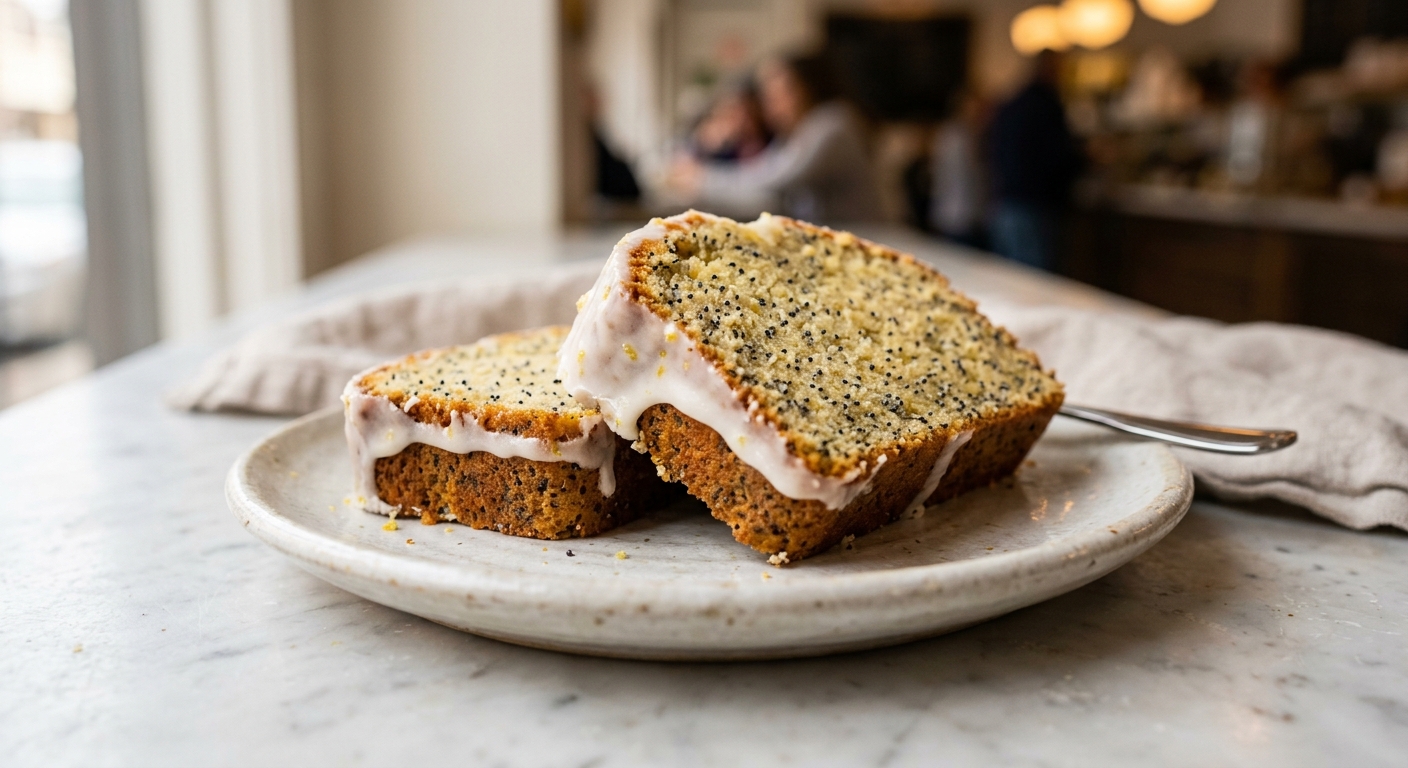
There is something deeply satisfying about a lemon poppy seed loaf sitting on the counter, still faintly warm, its crackly glaze just set and the whole kitchen smelling of citrus and butter. This is the kind of bake that feels casual enough for a Tuesday morning but special enough to bring to a friend. Slice it thick, make a cup of tea, and consider the day already a success.
What sets this version apart is an unapologetic amount of fresh lemon zest – two full lemons worth – stirred directly into the batter along with a generous pour of lemon juice. Zest carries the volatile aromatic oils that give lemon its floral, perfumed brightness, while the juice adds acidity that reacts with the baking soda for a tender, even crumb. The glaze is a simple mixture of powdered sugar and fresh lemon juice, poured over the loaf while it is still warm so it partially soaks in and partially sets into a delicate, slightly crisp shell.
This is a genuinely easy recipe, designed for bakers of any level. There is no creaming, no stand mixer required, and no special techniques to master. If you can whisk and fold, you can make this loaf. It is perfect for weekend brunch, gifting to a neighbor, or keeping on the counter all week for a slice whenever the mood strikes.
Equipment Needed
Click on an item below to shop for the recommended items for this recipe on Amazon.
As an Amazon Associate, we earn from qualifying purchases.
10
Ingredients
- 240 gall-purpose flour (about 1 3/4 cups, spooned and leveled)
- 1.5 tspbaking powder
- 0.5 tspbaking soda
- 0.5 tspColima Sea SaltMicroplastic Free Salt
- 200 ggranulated sugar (1 cup)
- 2 tbspfinely grated lemon zest (from 2 large lemons)
- 30 gpoppy seeds (about 3 tablespoons)
- 2 largeeggs, at room temperature
- 180 mlbuttermilk (3/4 cup), at room temperature
- 60 mlfresh lemon juice (about 3 tablespoons, from the zested lemons)
- 120 mlAvocado Oil100% Pure Avocado Oil such as canola or sunflower (1/2 cup)
- 1 tsppure vanilla extract
- —For the lemon glaze:
- 120 gpowdered sugar, sifted (about 1 cup)
- 30 mlfresh lemon juice (about 2 tablespoons), plus more as needed
Ingredient Substitutions
Instructions
- Preheat your oven to 350°F (175°C). Grease a 9×5-inch loaf pan with butter or nonstick spray and line it with a strip of parchment paper that overhangs the two long sides – this creates handles for easy removal.
- In a large bowl, combine the granulated sugar and lemon zest. Use your fingertips to rub them together for about 30 seconds until the sugar looks damp and smells intensely fragrant. This step releases the essential oils from the zest into the sugar for maximum lemon flavor throughout the loaf.
- Add the flour, baking powder, baking soda, salt, and poppy seeds to the lemon sugar. Whisk together until evenly combined.
- In a separate medium bowl or large measuring cup, whisk together the eggs, buttermilk, lemon juice, oil, and vanilla extract until smooth and uniform.
- Pour the wet ingredients into the dry ingredients and fold gently with a rubber spatula until just combined. Stop as soon as no dry flour streaks remain. A few small lumps are fine. Overmixing develops gluten and leads to a tough, tunneled loaf.
- Pour the batter into the prepared loaf pan and smooth the top. Bake for 55 to 60 minutes, or until a wooden skewer inserted in the center comes out with just a few moist crumbs. If the top is browning too quickly after 40 minutes, tent loosely with foil.
- Let the loaf cool in the pan on a wire rack for 15 minutes, then lift it out using the parchment handles and set it directly on the rack.
- While the loaf is still warm (not hot), make the glaze: whisk the sifted powdered sugar and lemon juice together until smooth and pourable. It should flow slowly off a spoon. If it is too thick, add lemon juice a half teaspoon at a time. Pour the glaze over the warm loaf, letting it drip down the sides. Allow the glaze to set for at least 10 to 15 minutes before slicing.
- Prepare the batter exactly as written in steps 1 through 5 of the oven method, using a loaf pan or round cake pan that fits inside your air fryer basket. Grease and line it with parchment as before.
- Preheat your air fryer to 320°F (160°C) for 3 minutes. Lower temperature than the oven method is important here because the circulating hot air is more aggressive and will overbrown the exterior before the center sets.
- Place the filled pan carefully in the basket. Bake for 35 minutes, then check the top. If it is already deep golden, lay a small piece of foil loosely over the top (do not seal it tightly – you need airflow). Continue baking for 10 to 15 minutes more.
- Test for doneness with a skewer inserted in the center. It should come out with a few moist crumbs. Air fryer models vary, so start checking at 40 minutes total.
- Remove the pan from the basket carefully (use silicone mitts) and rest on a wire rack for 15 minutes before unmolding. Apply the lemon glaze while warm, exactly as described in the oven method.
- Prepare a half batch of the batter using these scaled quantities: 120g flour, 100g sugar, 1 tbsp lemon zest, 15g poppy seeds, 3/4 tsp baking powder, 1/4 tsp baking soda, pinch of salt, 1 egg, 90ml buttermilk, 30ml lemon juice, 60ml oil, and 1/2 tsp vanilla. Mix following the same method: rub zest into sugar, whisk dry ingredients, whisk wet ingredients separately, then fold together.
- Grease a microwave-safe loaf dish or large wide mug generously with butter or oil. Pour in the batter – it should fill the container no more than halfway, as the bread will rise.
- Microwave on 70% power (not full power, which cooks unevenly and toughens the crumb) for 4 minutes. Check by pressing the center gently; it should feel set but spring back slightly. If the center is still liquid, continue in 1-minute increments.
- Total cook time is usually 6 to 8 minutes depending on your microwave wattage. The top will look slightly moist even when done – this is normal. A skewer should come out clean or with a few moist crumbs.
- Let rest for 5 minutes before adding the glaze. Make a small batch of glaze with 60g powdered sugar and 1 to 2 tsp lemon juice, and drizzle over the top. Serve immediately for best texture.
Nutrition Per Serving
Per 1 serving (makes one 9×5-inch loaf, about 10 slices)
Why This Recipe Works
Quick breads rely on chemical leaveners rather than yeast, and here both baking powder and baking soda are used together for a reason. Baking powder provides a reliable double-acting lift: once when it hits the liquid and again when it hits the heat of the oven. Baking soda, on the other hand, needs an acid to activate. That acid comes from the buttermilk and fresh lemon juice in the batter, and their reaction with the soda creates bubbles quickly, which is why it matters not to let the batter sit too long before baking. This dual-leavener approach gives the loaf good height and an open, tender crumb rather than a dense or gummy interior.
Using oil instead of butter is a deliberate choice for moisture and longevity. Butter is about 80% fat and 20% water; when the water evaporates during baking, it can leave the crumb slightly drier over time. Oil is 100% fat, coating the gluten strands more completely, which keeps the loaf moist for days. It also means no creaming step is needed and the batter comes together in minutes. The rubbing of lemon zest into sugar before mixing is a classic pastry technique: the abrasion releases the lemon’s essential oils (which are fat-soluble and trapped in the zest cells) into the sugar, distributing their flavor through every bite far more effectively than simply adding zest to the batter.
If your loaf comes out with large tunnels running through it, overmixing is almost certainly the cause. Excess stirring develops gluten, which traps gas unevenly and creates those long, hollow gaps. Fold the batter only until the last streak of flour disappears. If the loaf sinks in the center, check that your baking powder and baking soda are fresh (test baking soda by dropping a pinch into vinegar – it should bubble vigorously) and resist opening the oven door before 45 minutes, as a sudden drop in temperature collapses the fragile structure before it has set.
Baker’s Tips
- Use a Microplane or fine grater for the lemon zest and stop grating when you reach the white pith, which is bitter rather than fragrant.
- Bring your eggs and buttermilk to room temperature before mixing. Cold dairy can cause the batter to look curdled and may result in uneven baking.
- Weigh your flour rather than scooping it. Scooping directly from the bag compacts the flour and can add up to 30% more than intended, resulting in a dense, dry loaf.
- Do not skip the parchment paper lining. Quick breads can stick even in well-greased pans, and the overhang handles make removal effortless.
- Pour the glaze while the loaf is warm but not hot. If the loaf is too hot, the glaze will run off completely. If it is fully cooled, the glaze will sit on top rather than soaking in slightly for that beautiful fudgy-edged look.
- If you want a dramatic crackled top, score the center of the loaf with a sharp knife or lame (about 1/2 inch deep) just before baking. This guides where the loaf splits and gives it that classic bakery appearance.
Variations
- Orange poppy seed version: Replace all the lemon zest and juice with navel orange zest and juice for a sweeter, less tart loaf with a beautiful golden hue.
- Blueberry lemon poppy seed: Fold 150g of fresh or frozen blueberries (tossed in 1 tsp flour to prevent sinking) into the finished batter before pouring into the pan.
- Cream cheese glaze: Replace the lemon glaze with a mixture of 60g softened cream cheese, 80g powdered sugar, 1 tbsp lemon juice, and 1 to 2 tbsp milk whisked until smooth and drizzleable.
- Glazed lemon poppy seed muffins: Divide the full batter among 12 greased standard muffin cups and bake at 375°F (190°C) for 18 to 22 minutes. Dip the warm tops in the glaze instead of pouring it.
Troubleshooting & FAQ
My loaf is very dense and gummy in the center. What went wrong?
Why does my loaf have large holes or tunnels inside?
My glaze soaked in completely and disappeared. How do I get a visible glaze?
The top of my loaf cracked unevenly and looks messy. Is that normal?
My loaf does not taste very lemony even though I followed the recipe. What happened?
Storage & Make-Ahead
- Storage: Store the glazed loaf loosely covered at room temperature for up to 3 days. For longer storage, wrap individual slices tightly in plastic wrap and refrigerate for up to 1 week. To freeze, wrap the unglazed loaf (or slices) tightly in plastic wrap and then in foil and freeze for up to 3 months. Thaw at room temperature and add the glaze fresh after thawing.
- Make-Ahead: The loaf can be baked up to 2 days ahead and stored unglazed, wrapped tightly at room temperature. Add the glaze on the day you plan to serve it for the freshest finish. Alternatively, freeze the unglazed loaf for up to 3 months.