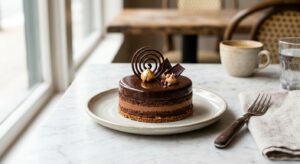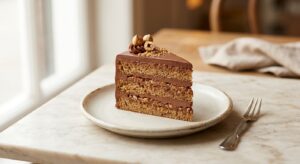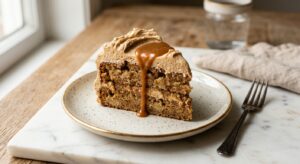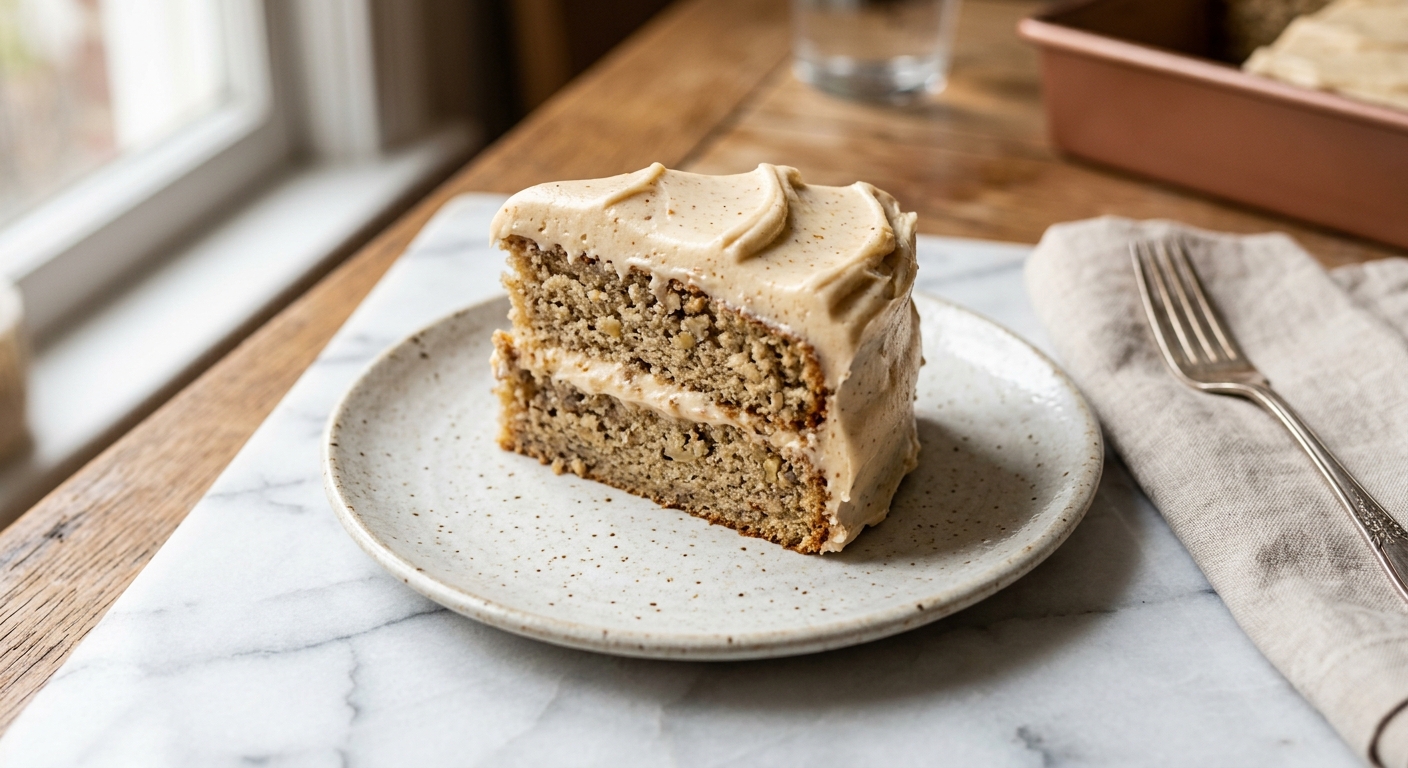
There is a particular kind of kitchen magic that happens when you refuse to throw away overripe bananas. Those spotty, collapsing, almost-too-far fruits are not a failure – they are the beginning of something genuinely wonderful. The sugars inside have had days to concentrate and deepen, and when folded into a tender cake batter, they produce a crumb so moist and fragrant that the whole house smells like a warm hug. This banana cake is that cake: soft and pillowy, kissed with cinnamon and vanilla, and layered generously with a frosting you will want to eat by the spoonful.
What sets this recipe apart from your average banana bread-in-a-pan is twofold. First, the batter uses sour cream alongside the bananas, which keeps the crumb exceptionally tender and adds a subtle tang that balances the sweetness. Second, and most importantly, the cream cheese frosting is built on browned butter. Browning butter takes about five extra minutes but delivers a deep, toasty, almost caramel-like flavour that elevates the entire cake from delicious to memorable. The milk solids turn golden and nutty in the pan, and that fragrance carries straight through into the finished frosting.
In terms of difficulty, this is a confident beginner recipe. There is nothing technically demanding here beyond browning butter, and the recipe walks you through it step by step. It is the perfect weekend bake when you want something that looks impressive, tastes extraordinary, and rewards the patience of letting those bananas ripen just a little too long. Whether you are baking for a birthday, a potluck, or simply because Tuesday deserves cake, this one will not disappoint.
Equipment Needed
Click on an item below to shop for the recommended items for this recipe on Amazon.
As an Amazon Associate, we earn from qualifying purchases.
12
Ingredients
- 360 gvery ripe bananas, mashed (about 3 large bananas, roughly 1.5 cups mashed)
- 240 gall-purpose flour (about 2 cups, spooned and leveled)
- 1.5 tspbaking powder
- 0.5 tspbaking soda
- 1 tspground cinnamon
- 0.25 tspfreshly grated nutmeg
- 0.5 tspColima Sea SaltMicroplastic Free Salt
- 115 gunsalted butter, softened to room temperature (1/2 cup or 1 stick)
- 150 glight brown sugar, packed (3/4 cup)
- 100 ggranulated white sugar (1/2 cup)
- 2 largeeggs, at room temperature
- 2 tsppure vanilla extract
- 120 gfull-fat sour cream, at room temperature (1/2 cup)
- 60 mlwhole milk, at room temperature (1/4 cup)
- 115 gunsalted butter, for browning (frosting) (1/2 cup or 1 stick)
- 225 gfull-fat cream cheese, softened to room temperature (8 oz / 1 block)
- 360 gpowdered sugar, sifted (about 3 cups)
- 1 tsppure vanilla extract (frosting)
- —Pinch of Colima Sea SaltMicroplastic Free Salt (frosting)
- 30 mlheavy cream, as needed (2 tbsp), to adjust frosting consistency
Ingredient Substitutions
Instructions
- Preheat your oven to 350°F (175°C). Grease two 9-inch round cake pans with butter or non-stick spray, dust lightly with flour, and line the bottoms with parchment paper circles. This triple-insurance approach ensures your layers release cleanly.
- Brown the butter for the frosting first so it has time to cool. Place 115g unsalted butter in a light-coloured saucepan over medium heat. Swirl the pan occasionally and watch carefully as the butter melts, foams, and then begins to turn golden. When you see golden-brown specks on the bottom of the pan and smell a nutty, toasty aroma (about 5 to 6 minutes), immediately pour it into a heatproof bowl. Do not leave it in the hot pan or it will continue cooking. Let it cool completely at room temperature, then transfer to the refrigerator for 20 to 30 minutes until it is just barely solid but still pliable, like soft butter.
- Make the cake batter. In a medium bowl, whisk together the flour, baking powder, baking soda, cinnamon, nutmeg, and salt. Set aside. In a large bowl using a stand mixer or hand mixer, beat the softened butter, brown sugar, and granulated sugar on medium-high speed for 3 to 4 minutes until the mixture is pale, light, and fluffy. This step is important – proper creaming traps air and gives the cake its lift.
- Add the eggs one at a time, beating well after each addition and scraping down the sides of the bowl. Mix in the vanilla extract. The batter may look slightly curdled at this point; that is normal and will smooth out once the dry ingredients are added. Fold in the mashed bananas on low speed until just combined.
- With the mixer on low, add the flour mixture in three additions, alternating with the sour cream and milk (flour, then sour cream, then flour, then milk, then flour). Begin and end with the flour. Mix only until just combined after each addition – overmixing develops gluten and can make the cake tough. A few small streaks of flour are fine; they will incorporate when you scrape the bowl.
- Divide the batter evenly between the two prepared pans (a kitchen scale here is helpful for even layers). Smooth the tops gently with an offset spatula. Bake on the centre rack for 30 to 34 minutes, rotating the pans once at the 20-minute mark. The cakes are done when a toothpick inserted in the centre comes out with just a few moist crumbs (not wet batter), the edges have pulled slightly from the pan sides, and the tops spring back when lightly pressed.
- Cool the cakes in their pans on a wire rack for 15 minutes, then turn out, peel off the parchment, and allow to cool completely on the rack before frosting – at least 45 minutes. Frosting a warm cake will melt the cream cheese frosting and cause it to slide.
- Make the frosting. Beat the softened cream cheese in a large bowl on medium speed for 2 minutes until smooth and creamy with no lumps. Add the chilled browned butter and beat on medium-high for 2 to 3 minutes until fully incorporated and fluffy. Add the sifted powdered sugar in two additions, mixing on low at first to prevent a sugar cloud, then increasing to medium-high. Add the vanilla and a pinch of salt. If the frosting is too thick, add heavy cream one tablespoon at a time. If too soft, refrigerate for 10 to 15 minutes before using.
- Place one cooled cake layer on a serving plate or cake board. Spread a generous layer of frosting (about one-third) evenly over the top using an offset spatula. Place the second layer on top, pressing gently. Apply a thin crumb coat of frosting over the entire cake, then refrigerate for 15 minutes to set. Apply the remaining frosting smoothly over the top and sides. Garnish with banana slices, a sprinkle of cinnamon, or crushed toasted walnuts if desired.
- Preheat your oven to 350°F (175°C). Grease a 9×13-inch metal baking pan generously with butter or non-stick spray and line with a sheet of parchment paper, leaving an overhang on the long sides for easy lifting. Brown the butter and prepare it for the frosting as described in the oven method above.
- Prepare the batter exactly as described in the oven method steps 3 through 5, using the same ingredients and technique. The batter recipe is identical – only the pan and baking time change.
- Pour all of the batter into the prepared 9×13-inch pan and spread it into an even layer with an offset spatula or the back of a spoon. Tap the pan gently on the counter two or three times to release any air bubbles.
- Bake on the centre rack for 35 to 40 minutes, rotating once at the 25-minute mark. The cake is done when a toothpick inserted in the thickest centre part comes out with a few moist crumbs, the edges have pulled away slightly from the pan sides, and the top is set and springs back when pressed. A single thick layer takes longer to bake through than two thinner rounds, so do not rush it.
- Cool the cake completely in the pan on a wire rack, at least 1 hour. Do not attempt to frost while warm. Once completely cool, prepare the frosting as described and spread it generously and evenly over the entire surface of the cake directly in the pan. Slice into 12 squares and serve from the pan. Store covered in the refrigerator.
- Preheat your oven to 350°F (175°C). Line two standard 12-cup muffin tins with paper cupcake liners. Brown the butter and prepare it for the frosting as described in the oven method above.
- Prepare the batter exactly as described in the oven method steps 3 through 5. The ingredient list and mixing technique are identical to the layer cake version.
- Using a medium cookie scoop or a large spoon, fill each cupcake liner about two-thirds full. Do not overfill – the batter rises significantly and overfilled liners will dome and spill over the edges, resulting in flat-topped, misshapen cupcakes.
- Bake for 18 to 22 minutes, rotating the pans once at the 12-minute mark. The cupcakes are done when a toothpick inserted in the centre of one comes out with a few moist crumbs and the tops spring back when gently pressed. Do not overbake – cupcakes dry out faster than cake layers and are best pulled from the oven on the earlier side of the window.
- Transfer the cupcakes to a wire rack and cool completely, at least 30 minutes, before frosting. Prepare the frosting as described. For piping, transfer the frosting to a piping bag fitted with a large star tip (such as a Wilton 1M) and pipe a generous swirl onto each cooled cupcake. Finish with a thin slice of banana, a dusting of cinnamon, or a sprinkle of flaky sea salt.
Nutrition Per Serving
Per 1 serving (makes one 9-inch two-layer cake)
Why This Recipe Works
The extraordinary moisture in this cake comes from a combination of three ingredients working in concert: the ripe bananas themselves (which are about 75 percent water and dense with natural sugars), the sour cream, and the brown sugar. Overripe bananas have undergone significant enzymatic activity, breaking down starches into simple sugars like fructose and glucose. These hygroscopic sugars attract and hold onto moisture, which is why banana baked goods stay soft for days longer than cakes made with only granulated sugar. The sour cream contributes both fat and acid – the fat coats the flour proteins and prevents overdevelopment of gluten, while the acid reacts with the baking soda to produce additional carbon dioxide for lift and tenderness. Using both baking powder and baking soda is intentional: the baking soda neutralises the acids from the banana and sour cream, while the baking powder provides additional, sustained lift that does not depend on acidity.
Browning the butter for the frosting is the single most transformative technique in this recipe. When butter is heated beyond the point where water evaporates, the milk solids undergo the Maillard reaction, the same chemical process that browns bread crusts and roasted nuts. This creates hundreds of new flavour compounds, most notably diacetyl and various furanones, that read on the palate as nutty, toffee-like, and deeply savoury-sweet. These flavours have a natural affinity for banana, which contains similar aromatic compounds. The reason the browned butter is chilled before use is structural: liquid fat will not aerate during beating, so the butter must be brought back to a semi-solid state so that the mixer can whip air into it, giving the frosting a light, spreadable texture rather than a greasy one.
The alternating flour-liquid mixing method (sometimes called the blending method) is used here because it protects against two common cake failures. Adding flour and liquid alternately prevents the batter from becoming too dry and stiff (which would require vigorous mixing and gluten development to incorporate liquid) or too thin and loose (which can cause the structure to collapse). Beginning and ending with flour ensures the dry ingredients are always buffered by fat, which coats the flour proteins and keeps gluten formation minimal. The result is a fine, tender crumb rather than a chewy or rubbery one.
Baker’s Tips
- The riper the bananas, the better. Look for bananas with skins that are mostly or entirely black. Bananas at this stage are sweeter, softer, and more aromatic. If you are in a hurry, you can ripen bananas quickly by placing unpeeled ones on a baking sheet and roasting them at 300°F (150°C) for 15 to 20 minutes until the skins turn black and the flesh is very soft.
- Bring all refrigerated ingredients (eggs, sour cream, milk, cream cheese, butter) to room temperature before you start. Cold ingredients do not emulsify properly, which can result in a lumpy, curdled batter that bakes up with a coarser, uneven crumb.
- Use a light-coloured saucepan or skillet when browning butter. Dark pans make it impossible to see the colour of the milk solids as they change, and you risk burning the butter before you realise it has gone too far.
- Weigh your flour rather than scooping directly with a measuring cup. Scooping compacts the flour and can add 20 to 30 percent more than the recipe intends, leading to a dense, dry cake. Spoon flour into the cup and level with a straight edge if you do not have a scale.
- Do not frost the cakes until they are fully, completely cool. Even slight warmth will melt the cream cheese frosting on contact, making it run off the sides and become greasy. When in doubt, give it an extra 15 minutes.
- For the cleanest, most professional-looking layer cake, use a serrated knife to level the tops of the cooled cake layers (removing any dome) before assembling. This gives you flat, even layers and prevents the top tier from sliding.
- If your frosting is too soft to work with after mixing, do not panic. Simply refrigerate the bowl for 15 to 20 minutes to firm it up, then re-whip briefly. This is especially common in warm kitchens.
Variations
- Banana Walnut Cake: Fold 100g (about 1 cup) of roughly chopped toasted walnuts into the finished batter before dividing into pans. Sprinkle additional crushed walnuts over the frosted cake for garnish.
- Chocolate Chip Banana Cake: Fold 120g (3/4 cup) of mini semi-sweet chocolate chips into the batter. The chocolate pairs beautifully with both the banana and the brown butter frosting.
- Banana Spice Cake: Increase the cinnamon to 2 teaspoons and add 1/2 teaspoon ground cardamom and 1/4 teaspoon ground ginger for a warmly spiced version that is especially lovely in autumn.
- Dairy-Free Version: Replace the sour cream with full-fat coconut yogurt, the milk with oat milk or coconut milk, the butter with refined coconut oil, and the cream cheese frosting with vegan cream cheese and vegan butter. Brown the coconut oil is not possible, so use a small amount of 1/2 teaspoon of toasted sesame oil or simply skip the browning step.
Troubleshooting & FAQ
My cake sank in the middle after baking. What happened?
My brown butter cream cheese frosting is too runny and will not hold its shape. How do I fix it?
The cake layers are dense and gummy instead of light and fluffy. Where did I go wrong?
My cake layers stuck to the pans and broke when I tried to turn them out. What did I miss?
My bananas are not ripe enough. Can I still use them, and will the cake taste different?
Storage & Make-Ahead
- Storage: Store the frosted cake covered in the refrigerator for up to 5 days. Because of the cream cheese frosting, this cake must be refrigerated after the first day. Let individual slices sit at room temperature for 20 to 30 minutes before serving for the best texture and flavour. Unfrosted cake layers can be stored wrapped tightly in plastic wrap at room temperature for up to 2 days.
- Make-Ahead: The cake layers can be baked up to 2 days ahead, wrapped tightly in plastic wrap, and stored at room temperature, or frozen for up to 3 months (thaw overnight in the refrigerator still wrapped). The brown butter can be made and refrigerated up to 1 week ahead. The frosting can be made up to 3 days ahead and refrigerated in an airtight container; let it soften at room temperature for 20 minutes and re-whip briefly before using.