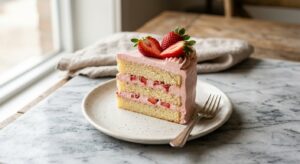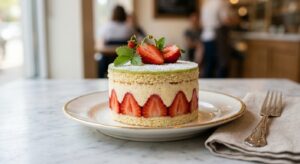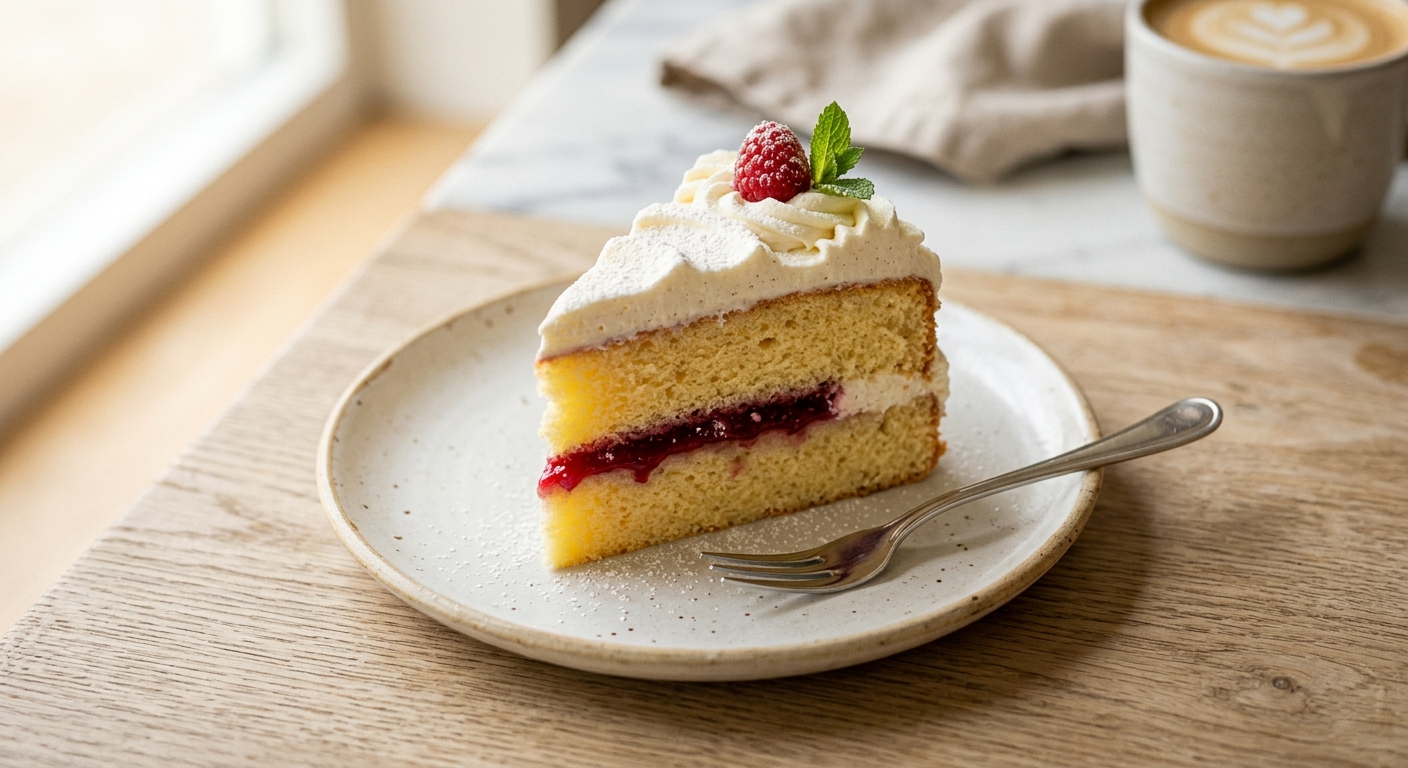
There is a particular kind of cake that makes everyone at the table go quiet for a moment after the first bite. This is that cake. The crumb is so tender and airy it practically sighs when you cut into it, the whipped cream is cold and cloud-soft, and the raspberry jam cuts through with just enough brightness to keep every bite from feeling too rich. It is the kind of dessert that feels like a special occasion even on a perfectly ordinary Tuesday afternoon.
What sets this chiffon cake apart from a standard sponge or butter cake is the use of neutral oil instead of butter, combined with a generous volume of whipped egg whites folded gently into the batter. Oil coats the flour proteins more evenly than melted butter and stays liquid at room temperature, which is exactly why chiffon cakes stay moist and tender even after a night in the refrigerator. The whipped whites are the second secret: beaten to a firm, glossy peak and carefully folded in, they create a network of tiny air bubbles that gives the cake its signature feather-light lift without relying heavily on chemical leaveners.
This recipe sits comfortably at a medium difficulty level. You do not need any special equipment beyond a tube pan or angel food cake pan, a stand mixer or hand mixer, and a little patience with the egg whites. It is a wonderful project for a weekend bake, and it is genuinely impressive enough to serve at a birthday, a baby shower, or any gathering where you want the dessert to earn a round of applause.
Equipment Needed
Click on an item below to shop for the recommended items for this recipe on Amazon.
As an Amazon Associate, we earn from qualifying purchases.
12
Ingredients
- 225 gcake flour (about 1 3/4 cups, spooned and leveled – do not substitute all-purpose flour without adjusting)
- 300 ggranulated sugar (about 1 1/2 cups), divided
- 2 tspbaking powder
- 0.5 tspColima Sea SaltMicroplastic Free Salt
- 6 largeeggs, separated, at room temperature
- 160 mlAvocado Oil100% Pure Avocado Oil (about 2/3 cup)
- 180 mlwhole milk, at room temperature (about 3/4 cup)
- 2 tsppure vanilla extract
- 1 tspvanilla bean paste (optional but adds beautiful flecks and deeper flavor)
- 0.5 tspcream of tartar
- 240 ggood-quality raspberry jam (about 3/4 cup), seedless or seeded based on preference
- 480 mlheavy whipping cream, cold (about 2 cups)
- 40 gpowdered sugar, sifted (about 1/3 cup)
- 1 tspcornstarch (helps stabilize the whipped cream so it holds for hours)
- —Fresh raspberries, to garnish
- —Powdered sugar, for dusting
Ingredient Substitutions
Instructions
- Preheat your oven to 325°F (160°C). Do NOT grease your tube pan or angel food cake pan. The ungreased sides are essential: the batter needs to cling to the walls as it rises to achieve its full height. Set a rack in the lower third of the oven.
- In a large bowl, whisk together the cake flour, 200g (1 cup) of the granulated sugar, baking powder, and salt. Make a well in the center and add the egg yolks, oil, milk, vanilla extract, and vanilla bean paste if using. Whisk until the batter is completely smooth and glossy, about 1 to 2 minutes. Do not overmix. Set aside.
- In a clean, grease-free bowl of your stand mixer (or a large bowl with a hand mixer), beat the egg whites and cream of tartar on medium speed until foamy, about 1 minute. Increase to medium-high and gradually stream in the remaining 100g (1/2 cup) of granulated sugar. Continue beating until the whites hold firm, glossy peaks that curl just slightly at the tip when you lift the beater. Do not beat to stiff, dry peaks or the batter will not fold smoothly.
- Using a large flexible spatula, fold one-third of the whipped whites into the yolk batter to lighten it. Use confident, sweeping strokes, cutting down through the center and folding up and over. Add the remaining whites in two additions, folding gently until just combined with no white streaks visible. A few very faint streaks are fine. Overmixing will deflate the batter.
- Pour the batter into the ungreased tube pan and run a thin spatula or butter knife through the batter once in a wide circle to release any large air pockets. Smooth the top gently.
- Bake for 48 to 55 minutes, until the top is deep golden and springs back firmly when lightly pressed. A skewer inserted into the thickest part should come out clean. Do not open the oven before the 45-minute mark.
- Immediately invert the pan onto its legs or over the neck of a bottle. The cake must cool completely upside down, at least 1 hour and 30 minutes. This prevents the delicate structure from collapsing under its own weight while it sets. Do not rush this step.
- To release, run a thin offset spatula or knife carefully around the outer edge and the center tube. Turn out gently onto a cutting board. Using a long serrated knife, split the cake horizontally into two even layers.
- Whip the cold heavy cream, sifted powdered sugar, and cornstarch together on medium-high speed until the cream holds firm, smooth peaks that hold their shape when the beater is lifted. Do not overbeat or it will turn grainy.
- Place the bottom cake layer on your serving plate. Spread the raspberry jam evenly over the cut surface, leaving a 1/2-inch border at the edge. Spoon or pipe half of the whipped cream over the jam and spread gently. Set the top layer in place, cut-side down. Top with the remaining whipped cream and decorate with fresh raspberries and a dusting of powdered sugar. Refrigerate for at least 30 minutes before slicing for the cleanest cuts.
- Preheat your oven to 350°F (175°C). Line a 12×17-inch rimmed baking sheet (half sheet pan) with parchment paper. Lightly spray only the parchment with nonstick spray, leaving the short ends of the pan unsprayed so the cake can grip during rolling.
- Prepare the batter exactly as described in the oven method steps 2 through 4, following the same procedure for the yolk batter, whipping the egg whites to firm glossy peaks, and folding them together gently.
- Pour the batter onto the prepared sheet pan and spread it into an even layer with an offset spatula, working quickly and gently to avoid deflating the foam. Bake for 12 to 15 minutes until the surface is golden, springs back when pressed, and a toothpick comes out clean.
- While the cake bakes, lay a clean kitchen towel flat on your counter and dust it generously with powdered sugar. The moment the cake comes out of the oven, run a knife around the edges and invert it immediately onto the sugared towel. Peel off the parchment paper carefully.
- Starting from one short end, roll the hot cake up tightly inside the towel. This trains the cake to hold a rolled shape without cracking once it cools. Leave it rolled up until completely cool, about 45 minutes.
- Whip the cream as described in the oven method step 9. Unroll the cooled cake gently. Spread the raspberry jam evenly over the surface, then spread three-quarters of the whipped cream over the jam, leaving a 1-inch border at the far short edge so the filling does not squeeze out.
- Re-roll the cake firmly but gently without the towel this time. Transfer seam-side down to a serving platter. Pipe or spoon the remaining whipped cream along the top, garnish with fresh raspberries and powdered sugar, and refrigerate for 30 minutes before slicing on the diagonal.
Nutrition Per Serving
Per 1 serving (makes one 10-inch chiffon cake, split into two layers)
Why This Recipe Works
Chiffon cake sits at a fascinating crossroads between a foam cake like angel food and a fat-enriched butter cake. The fat in this recipe comes entirely from oil rather than butter, and that distinction matters enormously. Butter is roughly 80% fat and 20% water and milk solids, and it solidifies when cold. Oil is 100% fat and stays liquid at any serving temperature, which is why chiffon cake retains that uniquely moist, tender crumb even straight from the refrigerator. The oil also interferes with gluten development, keeping the texture fine-grained and plush rather than chewy.
The second structural pillar of this cake is the whipped egg whites. Egg whites are roughly 90% water and 10% protein. When beaten, those proteins unfold and trap air bubbles within a network of interconnected strands. Adding sugar gradually during beating strengthens this network and creates a stable, glossy meringue. The acid from the cream of tartar further stabilizes the foam by tightening the protein bonds and helping the whites hold volume through the folding and baking stages. When the batter enters the hot oven, the trapped air expands, the proteins set around it, and the cake rises dramatically. This is why the pan must not be greased: without friction, the batter slides down the walls instead of climbing them, and the cake never reaches its full potential height.
The cornstarch in the whipped cream is a quiet workhorse. As the cream is whipped, the fat globules cluster around air bubbles and form the foam we recognize as whipped cream. On its own, this structure is somewhat fragile and begins to weep and deflate within a few hours. Cornstarch absorbs any moisture that escapes from the cream, acting as a physical brace that keeps the foam firm and slice-ready for significantly longer. If your whipped cream does begin to look watery around the edges after a day in the refrigerator, it simply needs a brief re-whip with a balloon whisk, and it will come right back together.
Baker’s Tips
- Separate your eggs while cold from the refrigerator, as cold yolks are firmer and less likely to break into the whites. Then let the separated whites come to room temperature before whipping, since room-temperature whites whip to a greater volume.
- Any trace of egg yolk, grease, or water in your whites or mixing bowl will prevent the whites from whipping properly. Wipe the bowl and beaters with a paper towel dampened with white vinegar before you begin, then dry thoroughly.
- Do not open the oven door before the 45-minute mark. The structure of a chiffon cake is fragile while it is still setting, and a sudden rush of cold air can cause it to collapse in the center before the proteins have had time to set fully.
- Invert the cake immediately when it comes out of the oven. This is non-negotiable for chiffon cakes. The structure is still soft and slightly fragile when hot, and the weight of the cake will compress the crumb if you let it cool right-side up.
- Use a long serrated knife and a gentle sawing motion to split the layers. Chilling the bare cake for 30 minutes before slicing makes it much easier to cut cleanly without tearing the delicate crumb.
- For the neatest slices when serving the assembled cake, dip your knife in hot water and wipe it dry between each cut. The whipped cream releases cleanly without dragging.
Variations
- Lemon chiffon: Add the zest of 2 lemons and 2 tablespoons of fresh lemon juice to the yolk batter in place of the vanilla bean paste. Pair with lemon curd instead of raspberry jam for an all-citrus version.
- Strawberry cream: Replace the raspberry jam with fresh strawberry compote (simmer 250g hulled strawberries with 50g sugar and 1 tsp lemon juice until jammy, then cool completely). Fold a handful of thinly sliced fresh strawberries into the whipped cream filling.
- Chocolate swirl: Fold 3 tablespoons of sifted cocoa powder into half the finished batter before combining. Swirl the two batters together in the pan with a skewer for a dramatic marbled interior.
- Coconut chiffon: Replace the whole milk with full-fat coconut milk and add 60g toasted shredded coconut to the dry ingredients. Scatter toasted coconut over the finished cream topping.
Troubleshooting & FAQ
My chiffon cake collapsed or sank in the center after I took it out of the oven. What went wrong?
My egg whites deflated when I folded them into the batter. The cake turned out dense and heavy.
My whipped cream is weeping or becoming soupy after a few hours on the cake.
My cake cracked deeply on top during baking. Is that a problem?
The cake is sticking to the tube pan and will not release cleanly.
Storage & Make-Ahead
- Storage: Store the assembled cake covered in the refrigerator for up to 3 days. The whipped cream will remain stable thanks to the cornstarch stabilizer. The bare chiffon cake layers (without filling) can be stored wrapped tightly in plastic wrap at room temperature for up to 2 days, or frozen for up to 2 months.
- Make-Ahead: The chiffon cake can be baked up to 2 days ahead and stored tightly wrapped at room temperature, or frozen for up to 2 months. Thaw at room temperature still wrapped before filling. The whipped cream is best made on the day of serving for maximum volume, though the cornstarch stabilizer does extend its life well. The raspberry jam requires no preparation ahead.