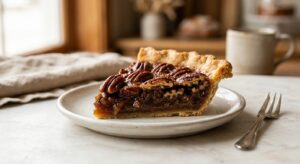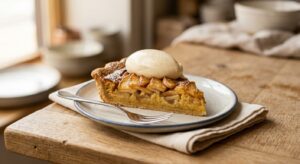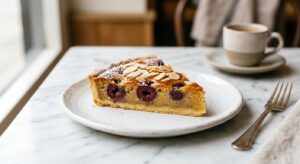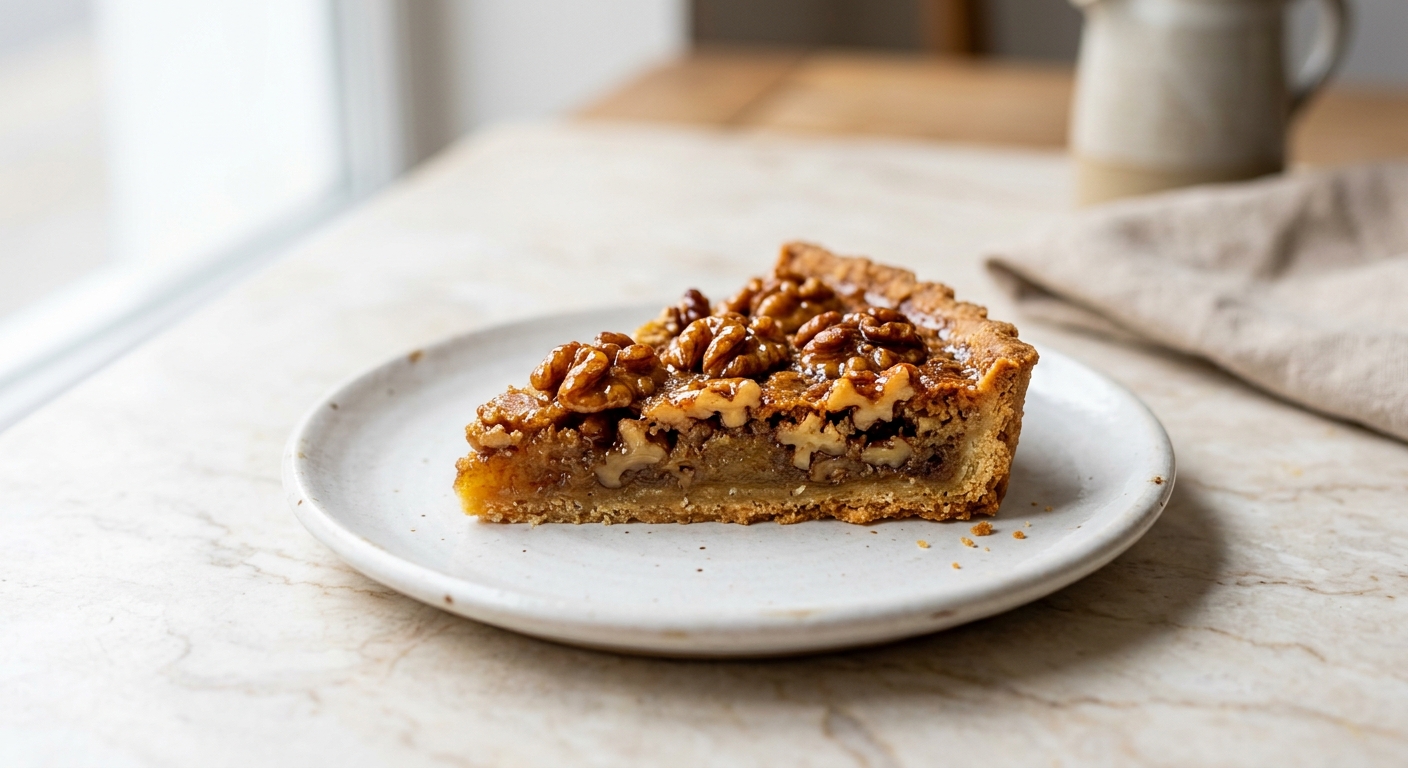
There is something quietly magnificent about a walnut and honey tart. Cut into it and you find layer upon layer of texture and flavour: a crisp, buttery shell that shatters just slightly at the fork, then a filling that is somewhere between a soft caramel and a custard, rich with floral honey and the deep, earthy crunch of toasted walnuts. It is the kind of tart that looks impossibly elegant but is rooted in the simplest, most honest ingredients. The sort of thing a grandmother in Provence or a pastry counter in Athens might offer you without ceremony, as though extraordinary things require no explanation.
What sets this version apart is the brown butter shortcrust. Instead of simply rubbing cold butter into flour, you first brown it on the stovetop until it smells of hazelnuts and toasted milk solids, then chill it back to a workable consistency. Those toasted milk solids stay in the dough and bake into a pastry that is measurably more flavourful than anything made with plain butter. The filling itself uses a generous pour of a good, floral honey, a touch of double cream, eggs for set, and a whisper of vanilla and sea salt to sharpen every note. The walnuts are toasted first, which drives off moisture and deepens their flavour considerably.
This tart sits comfortably in the medium difficulty range. The brown butter step and the blind-baking require a little attention, but neither is difficult once you understand what you are looking for. It is a superb weekend bake, equally at home at a casual Sunday lunch or a dinner party. If you can make a basic shortcrust, you can make this.
Equipment Needed
Click on an item below to shop for the recommended items for this recipe on Amazon.
As an Amazon Associate, we earn from qualifying purchases.
10
Ingredients
- Brown Butter Pastry, About 14 Tbsp Total, Divided: 140g For Pastry, 60g For Filling
- 200 gunsalted butter
- Finishing (such As Maldon)
- 240 gall-purpose flour (about 2 cups, spooned and leveled), plus extra for dusting
- 30 gicing sugar (powdered sugar, about 4 tbsp), sifted
- 0.5 tspColima Sea SaltMicroplastic Free Salt, divided
- 1 largeegg yolk, cold
- 2 tbspice-cold water, plus more if needed
- 220 gwalnut halves (about 2 cups), coarsely chopped
- 200 ggood-quality floral honey (about 9 tbsp), such as acacia or wildflower
- 120 mldouble cream or heavy cream (about 1/2 cup)
- 100 glight brown sugar, lightly packed (about 1/2 cup)
- 2 largewhole eggs, at room temperature
- 1 largeegg yolk, at room temperature
- 1 tsppure vanilla extract
- —Colima Sea SaltMicroplastic Free Salt
Ingredient Substitutions
Instructions
- Make the brown butter for the pastry: Place 140g of the unsalted butter in a small light-coloured saucepan over medium heat. Swirl occasionally. After 4 to 5 minutes, the butter will foam, then the foam will subside and you will see golden-brown specks appear on the bottom of the pan. It will smell like toasted hazelnuts. Immediately pour it into a heatproof bowl, scraping in every bit of the brown solids. Stir in a pinch of the fine sea salt. Refrigerate for 45 to 60 minutes until solidified to the consistency of softened butter, not completely hard.
- Make the pastry: In a large bowl, whisk together the flour and icing sugar. Add the chilled brown butter in small spoonfuls and use your fingertips to rub it in until the mixture resembles coarse, slightly damp breadcrumbs with some pea-sized pieces remaining. In a small bowl, whisk the egg yolk with 2 tbsp ice-cold water. Drizzle over the flour mixture and use a fork, then your hands, to bring it together into a shaggy dough. If it seems dry, add ice water one teaspoon at a time. Press into a flat disc, wrap in plastic wrap, and refrigerate for at least 30 minutes.
- Blind bake the shell: Preheat your oven to 375°F (190°C) with a rack in the lower third. On a lightly floured surface, roll the pastry to about 3mm (1/8 inch) thick and carefully lay it into a 9-inch (23 cm) fluted tart tin with a removable base. Press into the corners gently and trim the overhang by rolling a pin over the top. Prick the base all over with a fork. Line with crumpled parchment paper and fill generously with baking beans or dried rice. Bake for 15 minutes, then carefully remove the parchment and weights. Return to the oven for 5 more minutes until the base is pale gold and dry. Let it cool slightly while you make the filling. Reduce oven temperature to 325°F (165°C).
- Toast the walnuts: Spread the chopped walnuts in a single layer on a dry baking sheet and toast in the oven at 325°F (165°C) for 8 to 10 minutes, stirring once, until fragrant and lightly golden. Watch them carefully as they can go from toasted to burnt quickly. Tip onto a plate to cool.
- Make the honey filling: In a medium saucepan over medium-low heat, melt the remaining 60g of butter. Add the honey and brown sugar and stir gently until the sugar has dissolved and the mixture is smooth and just beginning to bubble at the edges, about 3 minutes. Remove from heat and let it cool for 5 minutes. In a separate bowl, whisk together the 2 whole eggs, extra yolk, double cream, vanilla, and the remaining fine sea salt. Slowly pour the warm honey mixture into the egg mixture in a thin, steady stream while whisking constantly. This tempers the eggs and prevents scrambling.
- Fill and bake: Scatter the toasted walnuts evenly over the base of the blind-baked tart shell. Carefully pour the honey custard over the walnuts. Some will float up, which is fine. Transfer to the oven and bake at 325°F (165°C) for 30 to 35 minutes. The filling should be just set around the edges with a slight, gentle wobble in the very centre, like a soft jelly. It will firm up as it cools. Do not overbake.
- Cool and serve: Remove the tart from the oven and place on a wire cooling rack. Sprinkle with a few flakes of sea salt while still warm. Leave to cool completely in the tin, at least 1 hour, before removing the base and slicing. Serve at room temperature or very slightly warm, with a spoonful of crème fraîche or lightly whipped cream.
- Prepare and blind bake the tart shell exactly as described in steps 2 and 3 of the Oven method. Fully blind bake the shell until it is a deep golden brown (bake an extra 5 minutes after removing the weights, until it is fully cooked through with no raw patches), since it will not return to the oven. Let cool completely.
- Toast the walnuts on the stovetop: Place the chopped walnuts in a dry frying pan over medium heat. Toast, stirring frequently, for 5 to 7 minutes until fragrant and lightly browned. Tip onto a plate and set aside.
- Make the stovetop caramel filling: In a medium heavy-bottomed saucepan, combine the honey, brown sugar, and 60g butter over medium heat. Stir until the sugar dissolves, then stop stirring and let the mixture cook until it reaches 240°F (115°C) on a candy thermometer, about 5 to 7 minutes. This is the soft-ball stage. Remove from heat immediately. Carefully pour in the double cream (it will bubble vigorously), then stir to combine. Stir in the vanilla and fine sea salt. Allow to cool for 10 minutes until slightly thickened but still pourable.
- Fill the tart: Scatter the toasted walnuts over the cooled tart shell. Pour the warm caramel filling over the walnuts, using a spatula to spread it evenly. The walnuts will rise to the surface, which is the intended result for this version.
- Set and finish: Allow the tart to cool at room temperature for 30 minutes, then refrigerate uncovered for at least 2 hours until the filling is fully set and firm enough to slice cleanly. Just before serving, scatter flaky sea salt over the top. Remove from the tin and slice with a sharp knife, wiping the blade clean between cuts. Serve at cool room temperature. Note: this filling does not contain eggs, so it is safe to eat without being cooked to temperature.
Nutrition Per Serving
Per 1 serving (makes one 9-inch (23 cm) tart, 10 slices)
Why This Recipe Works
The brown butter pastry is not just a flavour upgrade; it changes the structure of the shortcrust. When you brown butter, you evaporate the water content (butter is about 16 to 18% water) and caramelise the milk solids. The lower water content in the browned butter means less gluten development in the dough, producing a more tender, crumblier crust. Those toasted milk solids bake into something extraordinarily fragrant. The trade-off is that brown butter dough is slightly softer to work with initially, which is why chilling is non-negotiable: you need the fat to re-solidify so the pastry holds its shape during rolling and blind baking.
The filling is a tempered egg custard enriched with honey and cream. Tempering, the act of slowly adding a hot liquid to eggs while whisking constantly, is essential here. Eggs begin to scramble at around 160°F (71°C). If you pour the hot honey mixture directly onto the eggs all at once, the outer proteins will seize before they can blend smoothly. Adding it gradually raises the eggs’ temperature slowly, so by the time all the liquid is incorporated, the mixture is warm and homogenous rather than lumpy. The cream also plays a role in setting: its fat coats the egg proteins and slows their coagulation, giving the filling a silkier, more yielding set than a filling made with milk alone.
Baking the filled tart at a lower temperature, 325°F (165°C), is a deliberate choice. High heat causes the eggs to over-coagulate quickly, producing a grainy, curdled texture with possible bubbling and weeping. At a lower temperature, the custard sets slowly and evenly, resulting in a smooth, glossy surface. The wobble test is your most reliable guide: the edges should be fully set while the very centre still trembles like a soft jelly when you nudge the pan. Residual heat will carry the centre to the correct temperature as the tart cools. If you wait until the centre looks completely solid in the oven, it will be overbaked by the time it reaches the table.
Baker’s Tips
- Do not skip chilling the pastry dough. The resting time allows the gluten to relax, making the dough easier to roll and less likely to shrink dramatically during blind baking.
- Use a light-coloured saucepan when making brown butter so you can clearly see the colour of the milk solids as they darken. Dark or non-stick pans make it very hard to judge when to stop.
- Crumple your parchment paper before lining the tart shell for blind baking. A crumpled piece conforms to the fluted edges of the tin far better than a flat sheet.
- If your pastry tears when transferring to the tin, do not panic. Press the dough back together firmly with your fingers. Shortcrust is very forgiving and patches are invisible once baked.
- Allow the honey mixture to cool for at least 5 minutes before adding it to the eggs. If you can hold your hand over the bowl and it feels uncomfortably hot rather than searing, it is ready to temper.
- A metal tart tin conducts heat better than ceramic, giving you a crisper bottom crust. A removable base is strongly recommended for this recipe.
- Use a good-quality, strongly flavoured honey. Mild clover honey can get lost against the brown sugar and walnuts. Acacia, wildflower, or buckwheat honey all perform beautifully.
Variations
- Orange and walnut: Add the finely grated zest of one large orange to the filling along with the vanilla. A teaspoon of orange blossom water in place of half the vanilla is also stunning.
- Dark chocolate drizzle: Once the tart has cooled completely, drizzle 60g of melted dark chocolate (70% cocoa) over the top in thin lines. Let set before slicing.
- Spiced version: Add 1/2 tsp ground cinnamon, 1/4 tsp ground cardamom, and a tiny pinch of ground cloves to the filling mixture for a warmly spiced, almost baklava-adjacent flavour.
- Individual tartlets: Divide the pastry among 8 to 10 individual 3-inch tart tins. Reduce the blind bake time to 10 minutes and the filled bake time to 18 to 22 minutes.
Troubleshooting & FAQ
My pastry shrank badly during blind baking. What happened?
The filling looks set but then collapsed or became very runny once the tart cooled. Where did I go wrong?
My filling looks grainy or has bubbled and has a curdled texture on top. What went wrong?
The bottom of my tart shell is soggy even after blind baking. How do I fix it?
My walnuts are floating to the top of the filling and all clumping in one place. How do I stop this?
Storage & Make-Ahead
- Storage: Store the tart loosely covered at room temperature for up to 2 days. For longer storage, refrigerate for up to 5 days, though the pastry will soften slightly. Bring to room temperature before serving. Freeze whole or in slices, well wrapped, for up to 2 months. Thaw overnight in the refrigerator.
- Make-Ahead: The tart shell can be blind-baked up to 2 days ahead and stored at room temperature, loosely covered. The entire finished tart can be made 1 day ahead and refrigerated, then brought to room temperature for 30 to 45 minutes before serving. The pastry dough can be made and refrigerated up to 2 days ahead, or frozen for up to 1 month.