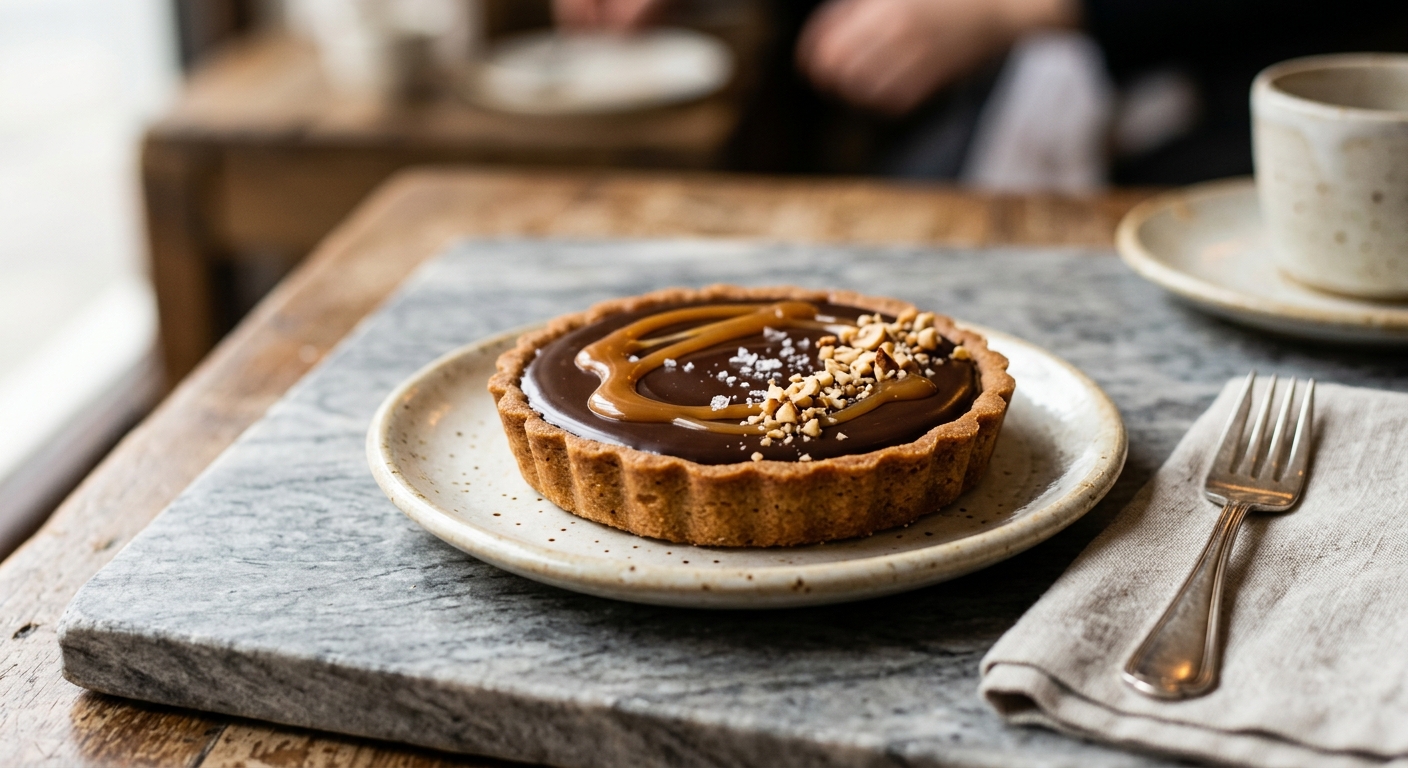
There is a particular kind of dessert that stops a dinner table mid-conversation, and this is exactly that. Imagine cutting through a mirror-smooth layer of dark chocolate ganache to reveal a golden, pull-apart ribbon of salted caramel underneath, all sitting in a crust that smells of toasted hazelnuts and brown butter. Every single bite has that perfect push-pull of bitter and sweet, salty and rich, snappy and yielding. This tart is the kind of thing people will ask you about for years.
What sets this recipe apart is the hazelnut crust, made from finely ground toasted hazelnuts blended with flour and a touch of brown sugar. It is pressed rather than rolled, which removes the stress of a traditional pastry crust entirely, and it bakes up with a delicate, shortbread-like snap that is far more interesting than plain pastry. The caramel is a dry-method version, cooked to a deep amber before cream is added, giving it a complexity and slight bitterness that keeps the whole tart from tasting overly sweet. The ganache on top is just two ingredients, poured warm and left to set into something that looks absolutely professional.
This is a medium-difficulty recipe, mostly because the caramel requires your full attention for about five minutes. But there are no tricky techniques that require special skills, and every component can be made in stages. It is perfect for dinner parties, holiday tables, or any occasion where you want to bring something genuinely impressive without spending an entire day in the kitchen.
Equipment Needed
Click on an item below to shop for the recommended items for this recipe on Amazon.
As an Amazon Associate, we earn from qualifying purchases.
10
Ingredients
- Caramel
- 130 gblanched hazelnuts, toasted (about 1 cup)
- 150 gall-purpose flour (about 1 cup + 2 tbsp, spooned and leveled)
- 30 glight brown sugar, packed (about 2 tbsp)
- 0.25 tspColima Sea SaltMicroplastic Free Salt
- 115 gunsalted butter, cold and cut into 1 cm cubes (about 1/2 cup or 1 stick)
- 1 largeegg yolk
- 1 tbspice water, plus more if needed
- 200 ggranulated sugar (about 1 cup)
- 60 mlwater (about 1/4 cup)
- 120 mlheavy cream, warmed (about 1/2 cup)
- 60 gunsalted butter, cut into pieces (about 4 tbsp)
- 1 tspColima Sea SaltMicroplastic Free Salt (such as Maldon), plus extra for garnish
- Ganache
- 240 mlheavy cream (about 1 cup)
- 200 gdark chocolate (70% cacao), finely chopped (about 1 1/3 cups chopped)
- 1 tbspunsalted butter, at room temperature
- —Extra Colima Sea SaltMicroplastic Free Salt for finishing
Ingredient Substitutions
Instructions
- Toast the hazelnuts: Spread hazelnuts on a baking sheet and toast in a 350°F (175°C) oven for 10 to 12 minutes until deep golden and fragrant. Let cool completely. Keep the oven on.
- Make the hazelnut crust: Add the cooled hazelnuts, flour, brown sugar, and fine sea salt to a food processor. Pulse 15 to 20 times until the hazelnuts are very finely ground and the mixture resembles coarse sand. Do not over-process or the nuts will release their oils and become paste. Add the cold butter pieces and pulse 8 to 10 times until the mixture resembles damp crumbs. Add the egg yolk and 1 tbsp ice water and pulse just until the dough begins to clump together when pressed between your fingers. If it is still dry, add another teaspoon of ice water.
- Press and blind-bake the crust: Transfer the dough into a 9-inch (23 cm) fluted tart pan with a removable bottom. Using the flat bottom of a measuring cup, press the dough evenly across the base and up the sides, aiming for a consistent thickness of about 5mm. Freeze for 15 minutes. Line the chilled shell with parchment and fill with pie weights or dried beans. Bake for 15 minutes, then remove the weights and parchment and bake for another 7 minutes until the crust is golden brown and dry to the touch. Transfer to a wire rack and cool completely before filling.
- Make the salted caramel: Combine the granulated sugar and water in a medium, light-colored saucepan (so you can monitor the color) over medium-high heat. Stir gently just until the sugar dissolves, then stop stirring completely. Let the mixture boil undisturbed until it turns a deep amber color, similar to an old copper penny, about 8 to 12 minutes. Watch it carefully near the end because it can go from perfect to burned in seconds. Remove from the heat and immediately pour in the warmed cream in a slow, steady stream – it will bubble violently, so use a long-handled spoon. Stir until smooth, then stir in the butter pieces and flaky sea salt until fully incorporated. Let the caramel cool for 10 minutes.
- Fill with caramel: Pour the warm salted caramel into the cooled tart shell and spread it into an even layer. Transfer to the refrigerator and chill for at least 45 minutes, until the caramel is set and no longer jiggles when you move the pan.
- Make the chocolate ganache: Place the finely chopped dark chocolate in a heatproof bowl. Heat the heavy cream in a small saucepan over medium heat until it just begins to simmer and small bubbles appear around the edges. Do not let it boil. Pour the hot cream over the chocolate and let it sit undisturbed for 2 minutes. Then stir slowly from the center outward in concentric circles until the ganache is completely smooth and glossy. Stir in the room-temperature butter for extra shine.
- Assemble and set: Pour the ganache over the set caramel layer. Gently tilt the tart pan to spread the ganache to the edges in an even, smooth layer. Do not use a spatula, as this can cause streaks. Sprinkle immediately with a pinch of flaky sea salt. Refrigerate for at least 1 hour until the ganache is fully set.
- Serve: Remove the tart from the refrigerator 20 minutes before serving to bring it to room temperature, which improves both the flavor and the texture of the ganache. Carefully remove the tart from the pan by placing it on a wide can or jar and pressing down to release the outer ring. Slice with a sharp knife warmed in hot water and wiped dry between each cut.
- Make the no-bake crust: Finely crush 200g (about 7 oz) of chocolate wafer cookies or Oreos with the filling scraped out in a food processor until they resemble fine crumbs. Add 75g (about 5 tbsp) of melted unsalted butter and a pinch of fine sea salt and pulse until the crumbs are evenly moistened and hold together when pressed. Transfer to a 9-inch (23 cm) fluted tart pan with a removable bottom and press firmly and evenly across the base and up the sides using the flat bottom of a measuring cup. Freeze for 30 minutes until solid.
- Make the salted caramel: Follow the same caramel instructions from the oven method (step 4). Combine 200g granulated sugar and 60ml water in a medium light-colored saucepan and cook without stirring over medium-high heat until deep amber. Remove from heat, carefully pour in 120ml warmed heavy cream, then stir in 60g butter and 1 tsp flaky sea salt. Cool for 10 minutes.
- Fill the crust: Pour the warm salted caramel into the frozen crust and spread evenly. Return to the freezer for 20 minutes to set the caramel quickly while keeping the crust firm.
- Make the ganache: Place 200g finely chopped dark chocolate in a heatproof bowl. Heat 240ml heavy cream until just simmering, pour over the chocolate, and let sit for 2 minutes. Stir from the center outward until smooth and glossy, then stir in 1 tbsp room-temperature butter.
- Finish and chill: Pour the ganache over the set caramel, tilt gently to level, and sprinkle with flaky sea salt. Refrigerate for at least 1.5 hours until fully set. Because this crust does not have the rigidity of a baked shell, keep the tart chilled until just before serving and slice straight from the refrigerator for the cleanest cuts.
- Bake the hazelnut crust exactly as described in the oven method (steps 1 through 3). Cool completely.
- Make the salted caramel on the stovetop as described in the oven method (step 4). Pour into the cooled crust and refrigerate for 45 minutes until set.
- Make the microwave ganache: Place 200g finely chopped dark chocolate in a large microwave-safe bowl. Pour 240ml heavy cream over the top. Microwave on 50% power for 90 seconds. Stir well. If there are still unmelted pieces, return to the microwave at 50% power in 20-second increments, stirring after each, until the ganache is fully smooth. Do not use full power, as this risks scorching the chocolate and breaking the emulsion. Stir in 1 tbsp room-temperature butter until glossy.
- Assemble: Pour the ganache over the set caramel, tilt the pan gently to level, and immediately sprinkle with flaky sea salt. Refrigerate for at least 1 hour until fully set.
- Serve at room temperature: Remove the tart from the refrigerator 20 minutes before serving. Press up from the removable base to release, and slice with a warm, wiped knife.
Nutrition Per Serving
Per 1 serving (makes one 9-inch round tart, serves 10)
Why This Recipe Works
The dry-method caramel in this recipe cooks sugar without added water initially making contact for too long, which means fewer opportunities for crystallization. When you add warm (not cold) cream to the finished caramel, the temperature difference is smaller, reducing the violent boiling reaction and lowering the risk of the caramel seizing. Adding the butter after the cream is fully incorporated gives you a smooth, emulsified sauce rather than a grainy one. The flaky salt does double duty here: it enhances your perception of sweetness while also providing those satisfying bursts of contrast that keep each bite interesting.
The ganache relies on a precise fat-to-liquid ratio to set at room temperature. Using 70% dark chocolate with equal parts cream by volume creates a firm, sliceable but still yielding texture. The small amount of room-temperature butter stirred in at the end is not just for flavor – it adds extra fat that encourages the ganache to emulsify more completely, giving you that professional mirror-shine. If your ganache ever looks broken or greasy, it means the emulsion has separated. You can rescue it by adding a tablespoon of warm cream and stirring from the center out until it comes back together.
The hazelnut crust behaves differently from a standard pate sucree because the ground nuts replace some of the flour, reducing the gluten network. Less gluten means a more tender, crumbly snap rather than a firm, chewy bite. Freezing the crust before blind baking firms the butter back up so the sides hold their shape instead of slumping. The egg yolk acts as a binder and adds richness, while the cold butter creates small pockets of steam during baking that give the crust a delicate, almost layered quality at the edges.
Baker’s Tips
- Toast the hazelnuts until they are genuinely deep golden brown, not just lightly tan. Under-toasted hazelnuts taste raw and bland. The skins can stay on if they are blanched hazelnuts; remove them from raw hazelnuts by rubbing in a clean kitchen towel while warm.
- Use a light-colored or stainless steel saucepan for the caramel so you can accurately judge the color. Dark or nonstick pans make it nearly impossible to tell when the caramel has reached the right amber.
- Warm your cream before adding it to the caramel. Cold cream causes a more violent splatter reaction and can cause the caramel to seize. Microwave it for 30 to 45 seconds or warm it in a small saucepan.
- Chop the chocolate very finely for the ganache. Larger chunks take longer to melt and can create hot spots that cause the ganache to seize or become grainy.
- For the cleanest slices, run a sharp knife under hot water, wipe it dry with a kitchen towel, and make each cut in one smooth downward motion without sawing. Wipe and rewarm between each slice.
- Do not rush the chilling time between the caramel and ganache layers. If the caramel is not fully set, the ganache will sink into it and you will lose the beautiful distinct layers.
- Let the tart rest at room temperature for 20 minutes before serving. Cold ganache is waxy and muted in flavor. Room-temperature ganache is silky, glossy, and tastes dramatically better.
Variations
- Espresso ganache: Dissolve 1 tsp of instant espresso powder in the warm cream before pouring over the chocolate. The coffee deepens the chocolate flavor without tasting like mocha.
- Orange and dark chocolate: Add 1 tsp of finely grated orange zest to the ganache along with the butter. The citrus cuts through the richness beautifully.
- Milk chocolate version: Use milk chocolate (around 40% cacao) in the ganache and reduce the cream to 180ml to ensure it sets properly. Reduce or omit the salt in the caramel layer slightly so the overall tart stays balanced.
- Individual tartlets: Press the crust into six 4-inch (10 cm) mini tart pans and reduce the bake time to 12 to 14 minutes total. Scale caramel and ganache quantities remain the same.
Troubleshooting & FAQ
My caramel crystallized and turned grainy. What went wrong?
My caramel seized and turned into a hard lump when I added the cream. Can I fix it?
My ganache is dull and streaky rather than glossy. What happened?
The sides of my tart crust slumped down during baking. How do I prevent this?
My ganache layer cracked after setting in the refrigerator. What caused that?
Storage & Make-Ahead
- Storage: Store the finished tart loosely covered in the refrigerator for up to 4 days. The ganache can absorb odors, so cover it with a cake dome or tent loosely with plastic wrap without touching the surface. Bring slices to room temperature for 15 to 20 minutes before eating for the best texture and flavor. The tart does not freeze well once assembled, as the ganache can crack and the caramel can weep.
- Make-Ahead: The hazelnut crust can be baked up to 3 days ahead and stored at room temperature, wrapped tightly. The salted caramel can be made up to 5 days ahead and stored in a sealed jar in the refrigerator. Rewarm gently before pouring. The fully assembled tart keeps beautifully in the refrigerator for up to 2 days before serving, making it an ideal make-ahead dessert for dinner parties.