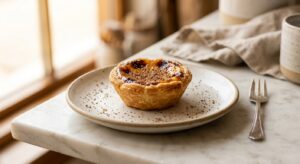
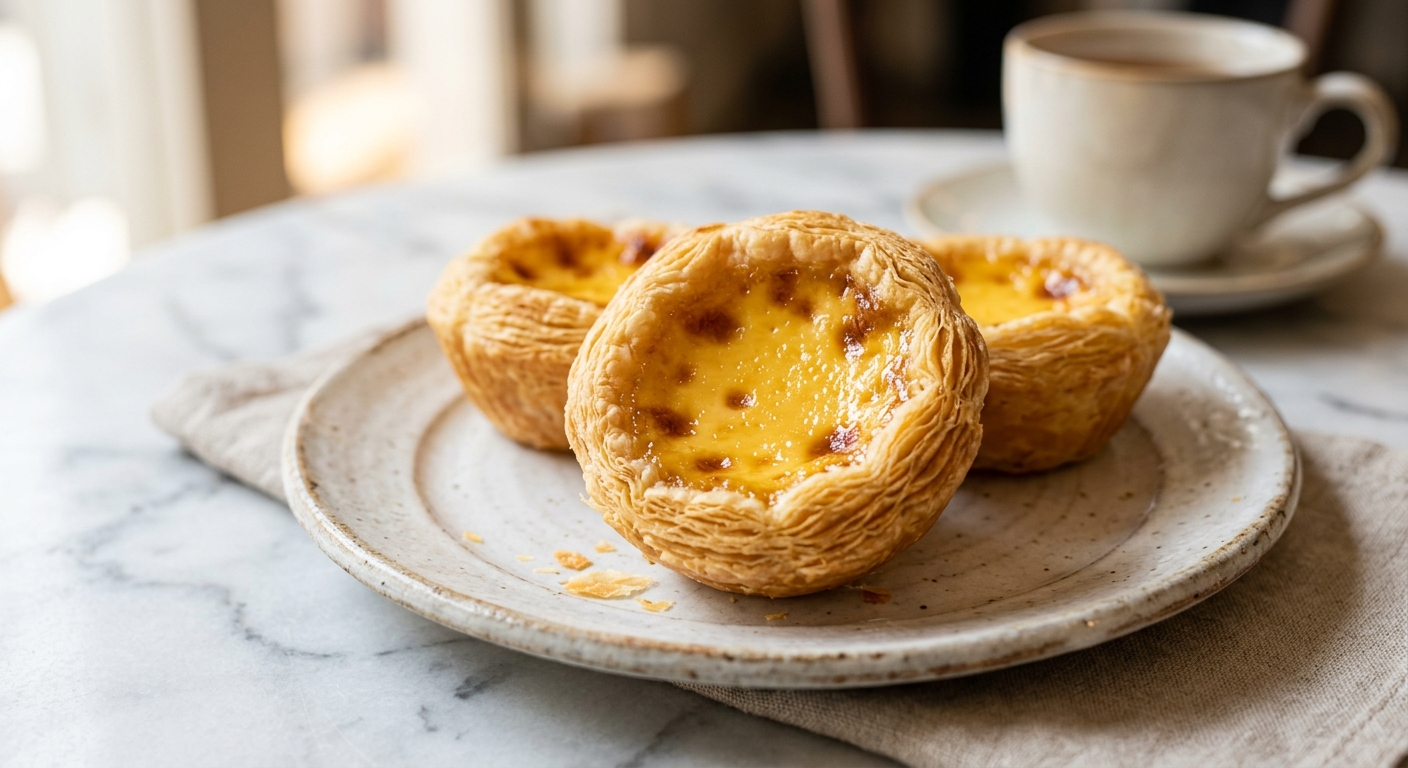
Walk past any Hong Kong cha chaan teng or dim sum parlour and the smell will stop you in your tracks: warm pastry, sweet egg, the faintest hint of vanilla drifting out from behind a glass counter stacked high with golden tarts. Dan tat – egg tarts – are one of the great pleasures of Cantonese baking, and they occupy a very specific place in the memory of anyone who grew up eating them. The custard trembles when you tap the tin. The crust shatters in the best possible way. You eat them warm, standing up, not bothering with a plate.
What sets this version apart is the pastry technique. Rather than a standard shortcrust or a simple lard dough, we use a traditional Chinese water-and-oil laminated dough: two separate doughs, one made with cold water and one made with oil or shortening, that are layered together through a simple folding process. No rolling pin chasing butter across the counter, no resting overnight. The result is a crust with dozens of flaky, papery layers that pull apart as you bite into them, far more delicate than anything a standard pie dough can produce. The custard filling is equally precise: a gentle ratio of eggs, evaporated milk, sugar syrup, and just a whisper of vanilla that sets into a smooth, jiggly, pale-yellow custard without a single bubble or crack.
This recipe sits firmly in the medium-difficulty category. The laminated dough has a few steps but no scary techniques, and once you have made it once you will find it quicker than it looks on paper. It is a wonderful weekend baking project and an absolutely showstopping addition to a homemade dim sum spread. If you can line a muffin tin and use a rolling pin, you can make these.
Equipment Needed
Click on an item below to shop for the recommended items for this recipe on Amazon.
As an Amazon Associate, we earn from qualifying purchases.
12
Ingredients
- Water Dough
- 180 gall-purpose flour for the water dough (about 1.5 cups, spooned and leveled), divided from oil dough below
- 30 gicing sugar (powdered sugar, about 3 tbsp) for the water dough
- 1 tspColima Sea SaltMicroplastic Free Salt, divided between both doughs
- 85 mlcold water (about 6 tbsp)
- 60 gunsalted butter, softened to room temperature
- 120 gall-purpose flour for the oil dough (about 1 cup, spooned and leveled)
- Oil Dough
- 90 gvegetable shortening or lard (about 7 tbsp), softened
- Custard
- 3 largeeggs (about 150g cracked weight)
- 160 mlevaporated milk (about 2/3 cup), full-fat
- Sugar Syrup
- 120 mlwater (about 1/2 cup)
- 100 gcaster sugar (about 1/2 cup)
- Custard
- 1 tsppure vanilla extract
- —Flour for dusting the work surface
Ingredient Substitutions
Instructions
- Make the sugar syrup first so it has time to cool completely. Combine 100g caster sugar and 120ml water in a small saucepan over medium heat. Stir gently just until the sugar dissolves, then stop stirring and let the syrup come to a simmer for 1 minute. Remove from heat and stir in the vanilla extract. Set aside to cool to room temperature, at least 20 minutes. You can speed this up by placing the saucepan in a bowl of iced water.
- Make the water dough: In a medium bowl, whisk together 180g flour, 30g icing sugar, and a pinch of salt. Add the 60g softened butter and rub it in with your fingertips until the mixture resembles coarse breadcrumbs. Add the cold water a little at a time, mixing with a fork and then your hands until a smooth, pliable dough forms. Do not overwork it. Shape into a flat rectangle, wrap in cling film, and rest at room temperature for 20 minutes.
- Make the oil dough: In a separate bowl, combine 120g flour, the remaining pinch of salt, and 90g softened shortening or lard. Mix with a fork and then knead briefly until a smooth, cohesive dough forms. It will look slightly greasy and should hold together easily. Shape into a flat rectangle slightly smaller than the water dough. Set aside.
- Laminate the dough: On a lightly floured surface, roll the water dough out into a rectangle roughly 20cm x 30cm (8 x 12 inches). Place the oil dough in the centre and fold the long sides of the water dough over it like an envelope, enclosing the oil dough completely. Pinch the seams to seal. Roll this combined dough gently into a long rectangle again, then fold it into thirds like a business letter. This is one fold. Rotate 90 degrees and repeat the roll and fold one more time. Wrap and rest for 10 minutes. Then do two more folds (four total). Wrap and rest a final 10 minutes.
- Preheat your oven to 375°F (190°C). Lightly grease a standard 12-cup muffin tin. Roll the laminated dough out to about 3mm (1/8 inch) thick. Using a round cutter slightly larger than the muffin cup opening (about 10cm or 4 inches), cut out 12 rounds. Press each round gently into a muffin cup, working it up the sides. Prick the base of each shell twice with a fork. Refrigerate the lined tin while you prepare the custard.
- Make the custard: In a medium bowl, lightly whisk the 3 eggs, being careful not to create too many bubbles. Add the cooled sugar syrup and the 160ml evaporated milk, whisking gently to combine. Strain the mixture twice through a fine-mesh sieve into a pourable jug to ensure a smooth, bubble-free custard.
- Remove the lined muffin tin from the refrigerator. Carefully pour the strained custard into each pastry shell, filling each one to about 80 percent full. Do not overfill, as the custard puffs slightly during baking.
- Bake for 22 to 25 minutes, until the pastry is deep golden and the custard is just set with a very slight wobble in the very centre when gently shaken. Do not overbake, as the custard will continue to set from residual heat. A perfectly baked egg tart custard should be smooth and crack-free. Leave to cool in the tin for 5 minutes before carefully lifting out with a small offset spatula or butter knife. Serve warm.
- Prepare the laminated dough and custard filling exactly as described in steps 1 through 6 of the oven method. Have silicone cupcake moulds or small foil tart tins ready (about 7cm or 2.75 inches in diameter at the base).
- Roll the laminated dough to about 3mm thick and cut rounds using a cutter about 9cm (3.5 inches) in diameter to fit the smaller moulds. Press each round into a mould, shaping it up the sides. Refrigerate the lined moulds for 10 minutes while you preheat the air fryer.
- Preheat your air fryer to 320°F (160°C) for 3 minutes. Lightly spray the basket with cooking spray to prevent any drips from sticking. Carefully pour the strained custard into each lined mould, filling to 75 percent full (the air fryer circulates hot air more aggressively, so leave a little more headroom to prevent spilling).
- Place 4 to 6 tarts in the air fryer basket, ensuring they are level. Air-fry at 320°F (160°C) for 18 to 20 minutes. Check at 15 minutes: the pastry should be golden and the custard should have a minimal wobble in the very centre. If the tops are browning too quickly before the custard sets, loosely lay a small piece of foil over the tarts for the remaining time.
- Remove carefully from the basket and rest in the moulds for 5 minutes before unmoulding. The custard surface should be smooth and glossy. Serve warm. Repeat with remaining tarts, allowing the air fryer to return to temperature between batches.
- Make a simple shortcrust: In a food processor or by hand, combine 200g all-purpose flour, 30g icing sugar, and a pinch of salt. Add 120g cold unsalted butter cut into small cubes and pulse (or rub in with fingertips) until the mixture resembles fine breadcrumbs. Add 1 egg yolk and 2 to 3 tbsp cold water, one tablespoon at a time, mixing until the dough just comes together. Do not overwork. Flatten into a disc, wrap, and refrigerate for 15 minutes.
- While the dough chills, make the sugar syrup and custard as described in steps 1 and 6 of the oven method. Strain twice through a fine-mesh sieve and set aside in a pourable jug.
- Preheat your oven to 375°F (190°C) and grease a standard 12-cup muffin tin. Roll the chilled shortcrust dough to 3mm thickness on a lightly floured surface. Cut 12 rounds with a 10cm (4-inch) cutter and press each gently into a muffin cup, working the dough up the sides without tearing. Prick the base of each shell twice.
- Pour the strained custard into each shell, filling to 80 percent. Bake for 22 to 25 minutes until the pastry is golden and the custard is set with a gentle wobble in the centre. Cool in the tin for 5 minutes, then remove with a small offset spatula. Serve warm.
Nutrition Per Serving
Per 1 serving (makes 12 individual egg tarts (made in a standard 12-cup muffin tin))
Why This Recipe Works
The laminated dough used here is a simplified version of a technique called shui you su (water-and-oil pastry), and understanding why it works makes it far less intimidating. The water dough contains gluten-forming flour and butter, giving it elasticity and structure. The oil dough contains flour and fat but no water, which means almost no gluten develops in it. When the oil dough is encased inside the water dough and folded repeatedly, you are creating thin alternating layers of gluten-strong and gluten-weak dough. In the oven, the moisture in the water dough turns to steam, forcing these layers apart and creating the characteristic flakiness. Because we use shortening or lard rather than butter in the oil dough, the layers stay distinct and separate more cleanly, resulting in more pronounced flakiness than an all-butter dough would achieve.
The custard science is just as deliberate. Making a sugar syrup first rather than adding granulated sugar directly to the eggs serves two purposes: it ensures the sugar is completely dissolved (no gritty custard), and it lowers the mixture’s temperature before it meets the eggs, preventing accidental scrambling. Straining the custard twice through a fine-mesh sieve removes any chalazae from the eggs and any undissolved solids, which is the key step separating a silky-smooth professional custard from a bumpy homemade one. Baking at a moderate temperature, 375°F rather than a high blast, allows the egg proteins to coagulate slowly and evenly, setting the custard into a tender, barely-trembling texture rather than a rubbery or porous one.
If your custard develops bubbles or cracks on the surface, it has been overbaked or baked at too high a temperature. The proteins have over-coagulated and expelled moisture. If your pastry layers are not flaking as expected, the oil dough may have been too warm when you assembled it, causing the fat to merge with the water dough rather than stay distinct. A 10-minute rest in the refrigerator after laminating can help reset the fats and restore the layering.
Baker’s Tips
- The custard must be strained at least twice through a fine-mesh sieve. This is non-negotiable for a smooth, pore-free surface. Any bubbles you see in the jug can be popped with a toothpick before pouring.
- When laminating the dough, use a light touch with the rolling pin. The goal is to extend the layers, not compress them. If the dough resists or tears, it needs to rest longer before continuing.
- Cool the sugar syrup completely before adding it to the eggs. Even slightly warm syrup can partially cook the eggs, resulting in small cooked flecks in the custard.
- Press the pastry rounds firmly enough into the muffin cups to eliminate air pockets beneath the dough, but do not stretch them thin. Thin spots will bake through before the custard sets, leading to leaks.
- Bake on the middle rack of the oven. Too close to the top and the custard surface browns before setting; too close to the bottom and the pastry can burn before the custard is done.
- The tarts are best eaten within 30 minutes of coming out of the oven, when the pastry is at its crispest. They are wonderful at room temperature too, but the pastry softens noticeably after a few hours.
Variations
- Pandan egg tarts: Replace the vanilla extract with 1 tsp pandan extract or 2 tbsp fresh pandan juice strained from blended pandan leaves. The custard will turn a pale, fragrant green.
- Portuguese-style custard tarts (Pasteis de Nata): Use the same laminated dough but swap evaporated milk for 160ml full-fat cream, increase the sugar syrup to 130g sugar, and bake at a high heat of 475°F (245°C) for 12 to 14 minutes until the custard develops charred caramel spots.
- Matcha custard tarts: Whisk 1.5 tsp ceremonial-grade matcha powder into the warm sugar syrup until fully dissolved before combining with the egg and milk. The result is an earthy, slightly bittersweet custard that pairs beautifully with the flaky pastry.
- Mini cocktail size: Use a 24-cup mini muffin tin and cut dough rounds with a 6cm (2.5-inch) cutter. Reduce bake time to 16 to 18 minutes. Makes approximately 24 bite-sized tarts.
Troubleshooting & FAQ
My custard has a bubbly or pitted surface instead of being smooth. What went wrong?
The custard cracked down the middle during baking. How do I prevent this?
My pastry dough kept tearing when I tried to press it into the muffin tin. What did I do wrong?
The pastry was not very flaky and the layers did not separate. What happened?
The custard filling leaked out through the pastry during baking. Why did this happen?
Storage & Make-Ahead
- Storage: Store cooled egg tarts in an airtight container in the refrigerator for up to 3 days. Reheat in a 300°F (150°C) oven for 8 minutes or in an air fryer at 300°F (150°C) for 5 minutes to restore the crisp pastry. Do not microwave, as the pastry will become soggy. The baked custard does not freeze well, but unbaked pastry shells can be frozen for up to 1 month.
- Make-Ahead: The laminated dough can be made through all four folds, wrapped tightly, and refrigerated for up to 2 days or frozen for up to 1 month. The sugar syrup can be made up to 1 week ahead and stored in a sealed jar in the refrigerator. The raw custard mixture should be made fresh on the day of baking for the smoothest results. Pastry shells can be pressed into the muffin tin and refrigerated (unbaked) for up to 24 hours before filling and baking.