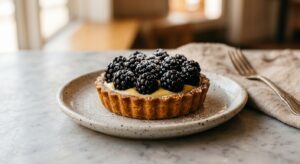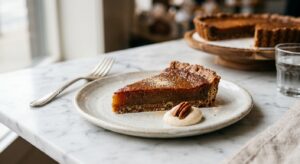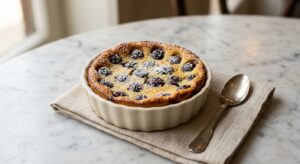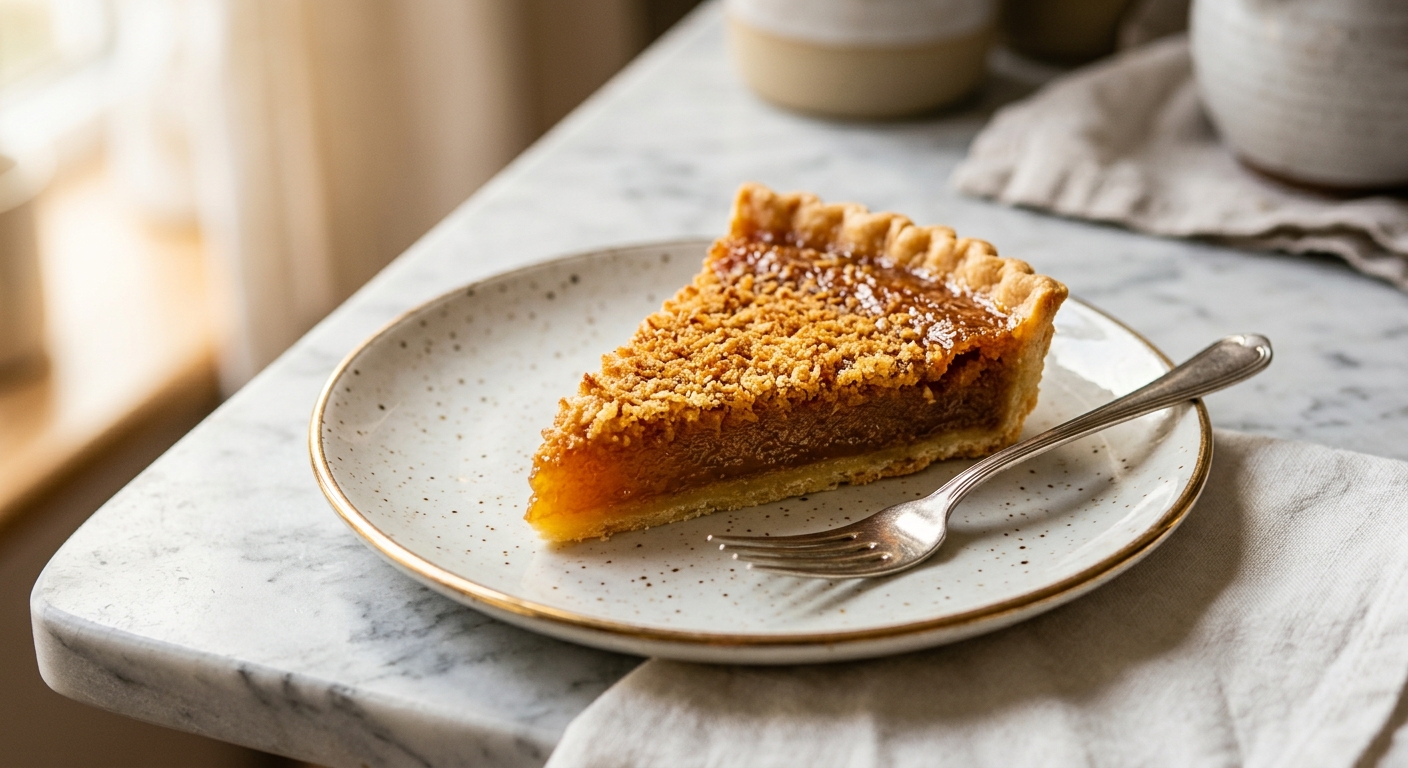
There is something almost nostalgic about the smell of treacle tart baking. As the golden syrup bubbles gently into the breadcrumbs, the kitchen fills with a warm, butterscotch-like sweetness that is distinctly, unmistakably British. This is the tart that appears at school dinners and Sunday lunches alike, served warm with a generous pour of double cream or a scoop of vanilla ice cream slowly melting at its edges. It is humble food done with quiet pride.
What sets this version apart is attention to the filling balance. Many treacle tarts lean too sweet or too thin, but here a careful ratio of fresh white breadcrumbs soaks up the syrup without turning stodgy, while lemon zest and a small squeeze of juice cut through the richness with a bright, citrusy lift. The pastry is a classic all-butter shortcrust, blind-baked for a properly crisp base that holds up beautifully against the sticky filling rather than going soft and soggy beneath it.
This is a medium-difficulty bake, mostly because the shortcrust pastry requires a light hand and a little patience with chilling. That said, it is very forgiving once the filling comes together, making it a lovely project for a confident beginner or anyone who wants to revisit a true British classic. It is ideal as a weekend bake, a comforting after-dinner dessert, or a centrepiece for a traditional Sunday roast spread.
Equipment Needed
Click on an item below to shop for the recommended items for this recipe on Amazon.
As an Amazon Associate, we earn from qualifying purchases.
8
Ingredients
- 200 gall-purpose flour (about 1 2/3 cups, spooned and leveled), plus extra for dusting
- 25 gicing sugar (powdered sugar, about 3 tbsp)
- 0.25 tspColima Sea SaltMicroplastic Free Salt
- 120 gunsalted butter, very cold, cut into 1cm cubes (about 1/2 cup)
- 1 largeegg yolk
- 2 tbspice-cold water, plus more as needed
- 450 ggolden syrup (about 1 1/3 cups), such as Lyle’s
- 100 gfresh white breadcrumbs (about 1 3/4 cups, from day-old white bread)
- 1 largelemon, zest finely grated and 1 tbsp juice
- 30 mldouble cream or heavy cream (2 tbsp)
- —Pinch of ground ginger (optional, for warmth)
Ingredient Substitutions
Instructions
- Make the shortcrust pastry: Combine the flour, icing sugar, and salt in a large bowl or food processor. Add the cold cubed butter and rub it in with your fingertips (or pulse) until the mixture resembles coarse breadcrumbs with some pea-sized pieces remaining. Do not overwork it.
- Add the egg yolk and 2 tablespoons of ice-cold water. Mix with a fork or pulse briefly until the dough just starts to come together. If it seems dry, add water one teaspoon at a time. Turn out onto a lightly floured surface and press gently into a flat disc. Wrap in plastic wrap and refrigerate for at least 30 minutes.
- Preheat your oven to 375°F (190°C) with the rack in the lower third. Lightly grease a 9-inch (23cm) loose-bottomed tart pan. On a lightly floured surface, roll the chilled dough out to a circle about 12 inches (30cm) wide and 3mm thick. Carefully lift it into the pan, press gently into the fluted edges, and trim the overhang. Prick the base all over with a fork. Return to the fridge for 15 minutes.
- Line the chilled pastry shell with parchment paper and fill with baking beans or dried rice. Blind bake for 15 minutes, then remove the paper and beans and bake for a further 5 minutes until the base looks dry and just barely golden. Reduce the oven temperature to 325°F (165°C).
- Make the filling: Gently warm the golden syrup in a medium saucepan over low heat for 1 to 2 minutes until it becomes slightly more fluid. Do not boil it. Remove from the heat and stir in the fresh breadcrumbs, lemon zest, lemon juice, double cream, and a pinch of ground ginger if using. The mixture should be thick, sticky, and well combined. Taste and adjust lemon if desired.
- Pour the filling into the warm pastry shell and spread evenly with the back of a spoon. If you like a decorative lattice top, cut thin strips of any leftover pastry and lay them across the filling in a crosshatch pattern, pressing the ends gently onto the pastry edge.
- Bake at 325°F (165°C) for 22 to 25 minutes, until the filling is set at the edges and has a very slight wobble in the very centre when gently shaken. It will firm up as it cools. If the pastry edges begin to brown too quickly, cover them loosely with a strip of foil.
- Cool in the pan on a wire rack for at least 20 minutes before slicing. Treacle tart is best served warm, with double cream, clotted cream, or a scoop of vanilla ice cream.
- Prepare the shortcrust pastry exactly as in steps 1 and 2 of the oven method, chilling for 30 minutes. Roll out to fit a 7-inch (18cm) loose-bottomed tart pan greased lightly with butter. Press into the pan, trim the edges, prick the base with a fork, and chill again for 15 minutes.
- Preheat your air fryer to 340°F (170°C) for 3 minutes. Line the chilled pastry shell with a small piece of parchment paper and fill with baking beans or dried rice. Place the pan carefully in the air fryer basket. Blind bake for 10 minutes, then remove the paper and beans and air fry for a further 3 minutes until the base looks dry and pale gold.
- While the shell blind bakes, make the filling: Gently warm the golden syrup in a saucepan over low heat for 1 to 2 minutes. Remove from the heat and stir in the breadcrumbs, lemon zest, lemon juice, and cream. The mixture should be thick and glossy. Note: for the smaller 7-inch tart, use 350g golden syrup and 80g breadcrumbs.
- Reduce the air fryer temperature to 300°F (150°C). Pour the filling into the blind-baked shell and spread evenly. Cover the tart loosely with a small piece of foil to prevent the surface from catching, making sure the foil does not touch the filling.
- Air fry for 15 to 18 minutes, removing the foil for the last 4 minutes to let the surface set and colour lightly. The filling should be just set at the edges with a faint wobble in the centre. Check at 15 minutes as air fryers vary. Cool for at least 20 minutes before carefully removing from the pan and serving warm.
- Make the biscuit base: Blitz 200g (7oz) digestive biscuits (or graham crackers) in a food processor into fine crumbs. Add 80g (6 tbsp) melted unsalted butter and a pinch of salt, and pulse until evenly combined. Press firmly and evenly into the base and up the sides of a 9-inch (23cm) loose-bottomed tart pan. Use the back of a spoon or the base of a glass to compact it well. Refrigerate for 30 minutes to set.
- Make the no-bake filling: In a medium saucepan over low heat, combine 450g golden syrup and 30ml double cream. Stir until just warm and fluid, about 2 minutes. Do not allow it to bubble. Remove from the heat.
- Stir in 100g fresh white breadcrumbs, the lemon zest, and 1.5 tablespoons of lemon juice (slightly more than the baked version, as the heat normally drives off some acidity). Mix thoroughly until the breadcrumbs have fully absorbed the syrup and the mixture is thick and cohesive. Let it cool for 10 minutes, stirring occasionally.
- Pour the filling into the chilled biscuit shell and smooth the top with an offset spatula or the back of a spoon. Tap the pan gently on the counter to settle any air pockets. Cover loosely with plastic wrap, being careful not to touch the surface.
- Refrigerate for at least 4 hours, or overnight for best results. The filling will firm to a soft, sliceable consistency. Slice with a warm knife (dipped in hot water and wiped dry) and serve cold or allow to sit at room temperature for 15 minutes before serving. Accompany with cold double cream or a dollop of crème fraiche.
Nutrition Per Serving
Per 1 serving (makes one 9-inch (23cm) round tart)
Why This Recipe Works
Golden syrup is an invert sugar, meaning sucrose has been broken down into its component glucose and fructose molecules. This gives it a silky, pourable consistency and its characteristic resistance to crystallisation, which is why the filling stays smooth and glossy rather than grainy after baking. The breadcrumbs play a crucial structural role: they absorb the liquid portion of the syrup during baking, swelling and setting into a cohesive, sliceable filling that is firm enough to hold a clean slice while remaining tender and slightly chewy at the centre. Too few breadcrumbs and the filling stays runny; too many and it becomes dense and dry, so the ratio here is carefully balanced.
Lemon juice does more than just cut the sweetness. The acid also interacts very gently with the gluten in the breadcrumbs and the proteins in the cream, helping to set the filling at a slightly lower temperature and keeping the texture soft rather than rubbery. The double cream adds a small amount of fat that rounds out the flavour and contributes to the glossy, almost caramel-like surface of the finished tart. Blind baking the pastry shell before adding the filling is non-negotiable: the wet, heavy syrup filling would saturate raw pastry before the heat could set it, resulting in the dreaded soggy bottom. The pre-baked crust creates a moisture barrier that keeps every slice crisp from base to edge.
If your filling looks very liquid when it comes out of the oven, do not panic. Golden syrup sets as it cools, and a slightly wobbly centre at the end of baking will firm beautifully within 30 minutes at room temperature. Cutting into it too soon is the most common mistake, so be patient. Conversely, if the surface of your tart is cracking or looks dry, it was overbaked; aim to pull it from the oven when the centre still has a very subtle shimmer and a gentle jiggle, similar to a lemon tart.
Baker’s Tips
- Use day-old white bread for the breadcrumbs rather than fresh. Very fresh bread makes crumbs that are too moist and can make the filling slightly gluey. Pulse the bread in a food processor for evenly sized, fluffy crumbs.
- Keep your pastry cold at every stage. Warm butter melts into the flour rather than staying in distinct pieces, and those buttery pockets are what create a flaky, short texture. If your kitchen is warm, chill your bowl and even your hands under cold water before rubbing in the butter.
- Warm the golden syrup gently before mixing with the breadcrumbs. Cold syrup is very thick and will not combine evenly, leaving pockets of dry crumbs. A minute or two over low heat makes it much more workable.
- Do not skip the second chill after lining the tart pan. Resting the raw pastry shell in the fridge relaxes the gluten (preventing shrinkage during blind baking) and firms the butter back up (preventing a greasy, dense crust).
- If you do not have baking beans for blind baking, dried rice, lentils, or even dried chickpeas work perfectly. Store them in a jar after use and reuse them each time.
- For a neat slice, use a thin, sharp knife and wipe it clean between cuts. A warm knife (briefly dipped in hot water) glides through the sticky filling much more cleanly than a cold one.
Variations
- Ginger treacle tart: Add 1 tsp ground ginger and 1/2 tsp ground cinnamon to the filling, and stir in 30g finely chopped stem ginger in syrup for a warming, spiced version.
- Oat-crumble topped treacle tart: Replace the top lattice pastry with a simple crumble of 50g rolled oats, 30g brown sugar, and 25g cold butter rubbed together. Sprinkle over the filling before baking for a textural twist.
- Mini treacle tartlets: Divide the pastry and filling between twelve 3-inch loose-bottomed tartlet pans. Blind bake for 10 minutes, fill, and bake for 12 to 14 minutes. Ideal for afternoon tea or dinner parties.
- Brown butter treacle tart: Brown the butter before making the pastry for a nutty, toasty flavour throughout the crust. Allow the browned butter to solidify in the fridge until firm before using.
Troubleshooting & FAQ
My pastry shrank badly during blind baking and now the shell is too shallow. What went wrong?
My filling is still very runny after the full bake time. Is it ruined?
The pastry base is soggy underneath the filling. How do I prevent this?
The surface of my tart is cracked and dry. What happened?
I cannot find golden syrup at my local shops. Can I really substitute it?
Storage & Make-Ahead
- Storage: Store covered at room temperature for up to 2 days, or refrigerate for up to 5 days. The tart is best gently rewarmed in a low oven (300°F/150°C) for 8 to 10 minutes before serving. The baked tart (unfilled pastry shell only) can be frozen for up to 1 month; the filled tart does not freeze well as the filling can weep on thawing.
- Make-Ahead: The pastry dough can be made up to 2 days ahead and refrigerated, or frozen for up to 1 month (thaw overnight in the fridge before rolling). The blind-baked pastry shell can be made 1 day ahead and stored uncovered at room temperature. The filling is best made and poured on the day of baking.