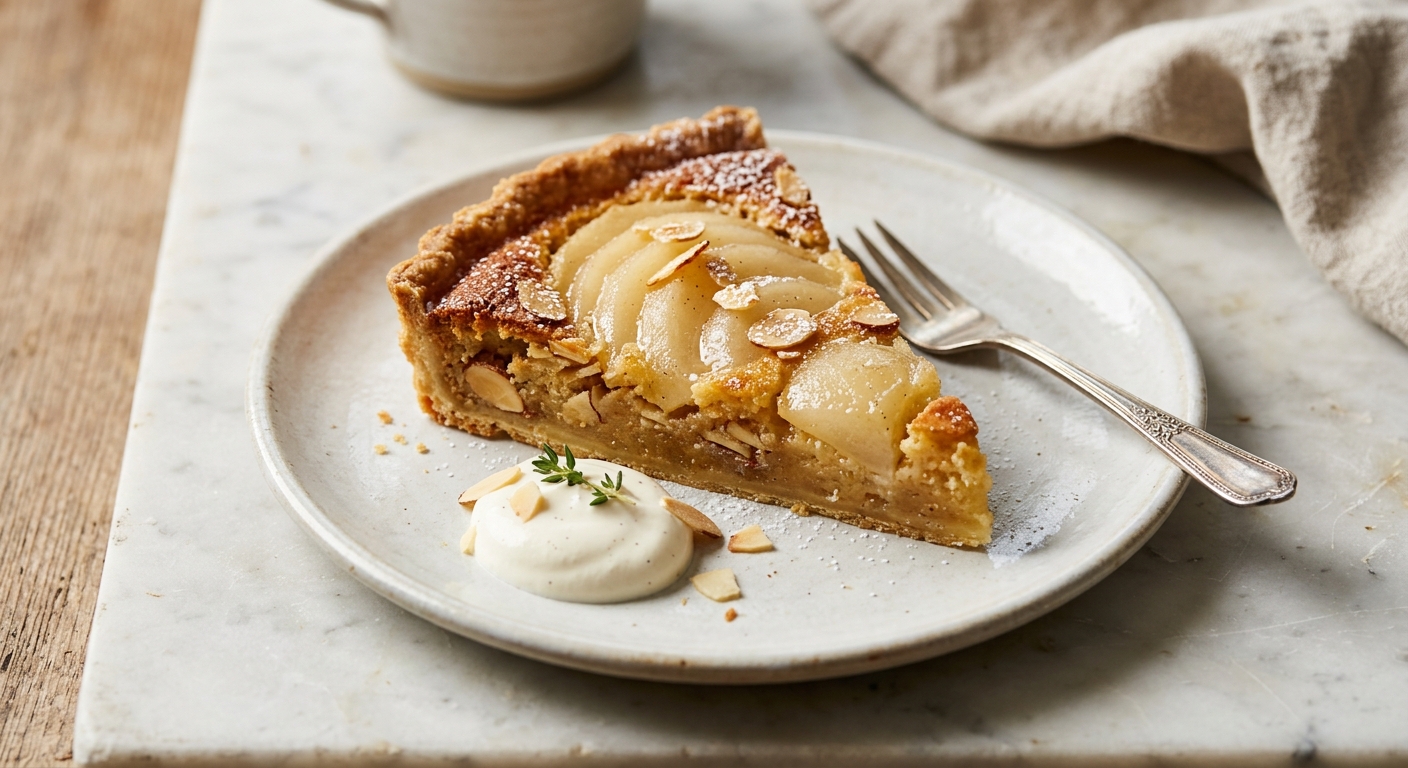
There is a particular kind of magic in a frangipane tart. The moment it comes out of the oven, the kitchen fills with the warm, nutty scent of toasted almonds, and the filling has puffed up just slightly around the pears like a golden cushion. The pears, poached until tender in a bath of white wine, vanilla, and honey, sink gently into the almond cream as it bakes, their edges caramelising at the tips while the interior stays soft and yielding. Every slice reveals a cross-section of that gorgeous pale fruit nestled in a rich, dense crumb, all held inside a crisp, buttery shell that shatters just slightly under the fork. It is, without question, one of the most beautiful things you can pull from a home oven.
What sets this version apart is a two-stage technique borrowed from professional pastry kitchens. First, the pears are fully poached in advance and left to cool in their syrup, which deepens their flavour and perfumes them all the way through. Second, the frangipane is made with a small proportion of almond flour alongside whole butter that has been browned to a noisette, giving the filling a toasty, almost caramel-like depth that plain almond cream simply cannot match. The tart shell uses a classic pâte sucrée, enriched with egg yolk and icing sugar for a fine, biscuit-like snap that holds up beautifully to the moist filling without going soggy.
This tart sits in the medium difficulty range. Each component is straightforward on its own, but you are managing three elements: the pastry, the poached pears, and the frangipane. The good news is that all three can be made ahead, so on the day of serving there is very little stress. It is perfect for an experienced home baker who wants to stretch their skills, or for any baker confident with pastry who is ready to tackle something truly showstopping for a dinner party, holiday table, or a very special weekend afternoon.
Equipment Needed
Click on an item below to shop for the recommended items for this recipe on Amazon.
As an Amazon Associate, we earn from qualifying purchases.
8
Ingredients
- Pastry
- 200 gall-purpose flour (about 1 2/3 cups, spooned and leveled)
- 30 gicing sugar (powdered sugar, about 1/4 cup)
- 0.25 tspColima Sea SaltMicroplastic Free Salt
- 115 gunsalted butter, cold and cubed (about 1/2 cup)
- 1 largeegg yolk
- 2 tbspice-cold water
- Poached Pears
- 3 mediumfirm-ripe pears (about 600g / 1.3 lbs), such as Bosc or Conference, peeled, halved, and cored
- Poaching Liquid
- 500 mldry white wine (about 2 cups), such as Sauvignon Blanc or Pinot Grigio
- 250 mlwater (about 1 cup)
- 100 ggranulated sugar (about 1/2 cup)
- 1 wholevanilla bean, split and seeds scraped (or 1 tsp pure vanilla extract)
- 1 striplemon peel (about 5 cm / 2 inches)
- Frangipane
- 130 gunsalted butter (about 9 tbsp)
- 120 gblanched almond flour (about 1 1/4 cups)
- 120 ggranulated sugar (about 3/4 cup minus 1 tbsp)
- 2 largeeggs, at room temperature
- 1 tbspall-purpose flour
- 0.5 tsppure almond extract
- 0.25 tspColima Sea SaltMicroplastic Free Salt
- Topping
- 2 tbspflaked almonds
- Glaze
- 2 tbspapricot jam
- Loosening The Glaze
- 1 tspwater
- —Icing sugar for dusting (optional)
Ingredient Substitutions
Instructions
- Make the pâte sucrée: Whisk together the flour, icing sugar, and salt in a large bowl. Add the cold cubed butter and rub it in with your fingertips until the mixture resembles coarse breadcrumbs with a few pea-sized pieces remaining. Mix the egg yolk with the ice water, then drizzle over the flour mixture. Stir with a fork until the dough just comes together – do not overwork it. Press into a flat disc, wrap in plastic wrap, and refrigerate for at least 1 hour (or up to 2 days).
- Poach the pears: Combine the white wine, water, sugar, vanilla bean and seeds, and lemon peel in a medium saucepan over medium heat. Stir until the sugar dissolves, then bring to a gentle simmer. Add the peeled, halved, and cored pears. They should be mostly submerged – if not, lay a small piece of parchment directly on top to keep them in contact with the liquid. Simmer gently for 12 to 18 minutes, until the pears are just tender when pierced with a paring knife at their thickest point. Remove the pan from heat and let the pears cool completely in the poaching liquid. (This can be done a day ahead; store pears submerged in their syrup in the refrigerator.)
- Brown the butter for the frangipane: Melt 130g butter in a light-coloured saucepan over medium heat. Continue cooking, swirling occasionally, until the milk solids at the bottom turn golden brown and the butter smells nutty and toasty, about 5 to 7 minutes. Immediately pour into a heatproof bowl and let it cool to room temperature until it is soft and opaque but not resolidified, about 20 to 25 minutes.
- Make the frangipane: Beat the cooled browned butter and sugar together in a medium bowl until pale and creamy, about 2 to 3 minutes with a hand mixer. Add the eggs one at a time, beating well after each addition. Stir in the almond flour, all-purpose flour, almond extract, and salt until smooth. Set aside (or refrigerate if working ahead).
- Blind bake the tart shell: Preheat your oven to 375°F (190°C). On a lightly floured surface, roll the chilled dough into a circle about 12 inches (30 cm) in diameter and 3 to 4mm thick. Drape it over a 9-inch (23 cm) fluted tart pan with a removable bottom and gently press it into the edges. Trim any overhang by rolling a rolling pin across the top. Prick the base all over with a fork. Line with parchment paper and fill with pie weights or dried beans. Bake for 15 minutes, then remove the parchment and weights and bake for a further 5 minutes, until the base looks dry and just barely golden. Remove from the oven and let cool for 10 minutes.
- Assemble the tart: Reduce the oven temperature to 350°F (175°C). Spread the frangipane evenly over the tart base using an offset spatula. Drain the poached pear halves thoroughly on a paper towel-lined plate and pat dry. Thinly slice each pear half crosswise, keeping the slices together so the half retains its shape. Gently press each sliced pear half onto the frangipane, fanning them slightly. Scatter flaked almonds around the pears.
- Bake the tart at 350°F (175°C) for 30 to 35 minutes, until the frangipane is puffed, golden, and set – it should spring back lightly when pressed in the centre and a skewer inserted between pears should come out clean. If the edges of the pastry darken too quickly, shield them with a strip of foil. Transfer to a wire rack.
- Glaze and serve: Warm the apricot jam with 1 tsp water in a small saucepan or microwave until liquid. Brush gently over the surface of the warm tart for a professional sheen. Allow the tart to cool in the pan for at least 20 minutes before removing the outer ring. Serve warm or at room temperature, dusted with icing sugar if desired. A dollop of crème fraîche or a scoop of vanilla ice cream alongside is highly recommended.
- Make the press-in shell: Preheat the oven to 350°F (175°C). In a food processor, pulse 160g (about 1 1/2 cups) of almond flour, 60g (about 1/2 cup) of rolled oats, 30g (about 2 tbsp) of honey or maple syrup, 60g (4 tbsp) of melted unsalted butter, 1/4 tsp fine sea salt, and 1/4 tsp vanilla extract until the mixture clumps together when pressed between your fingers. If it feels too dry, add 1 tsp of cold water.
- Press the crumb mixture firmly and evenly into the bottom and up the sides of a 9-inch (23 cm) fluted tart pan with a removable bottom. Use the flat bottom of a measuring cup to compact the base. There is no need to chill or blind bake this shell.
- Poach the pears as described in steps 2 of the oven method. This step is the same regardless of the shell you choose and can be done 1 to 2 days ahead.
- Make the frangipane using the browned butter as in steps 3 and 4 of the oven method. Spread it directly over the unbaked crumb shell. Drain and pat dry the poached pear halves, slice them, and arrange on top. Scatter flaked almonds over the surface.
- Bake at 350°F (175°C) for 30 to 35 minutes, until the frangipane is puffed and golden and the crumb edges are deep golden-brown. Because there is no blind-baked pastry, check the base is cooked through by gently lifting one edge of the tart with a thin spatula – the base should feel firm, not soft. Cool for 20 minutes in the pan before unmoulding. Glaze with warmed apricot jam as described in the final step of the oven method.
Nutrition Per Serving
Per 1 serving (makes one 9-inch (23 cm) round tart)
Why This Recipe Works
The browned butter in the frangipane is the most important technique in this recipe, and it is worth understanding why. When butter is heated past the point of melting, the water evaporates and the milk solids undergo the Maillard reaction, producing hundreds of new flavour compounds including diacetyl (buttery, caramel notes) and furanones (nutty, roasted tones). This transformed butter, called beurre noisette in French, adds a dimension of toasty complexity to the almond cream that plain softened butter simply cannot replicate. The key is letting it cool back to a creamy consistency before beating, so it can still incorporate air when creamed with the sugar.
The small amount of all-purpose flour in the frangipane is not an accident. Almond flour contains very little starch and a high proportion of fat, which means a pure almond-flour filling can be overly dense and greasy if not given some structure. That single tablespoon of all-purpose flour provides just enough gluten network to give the baked frangipane a slightly cakey lift and help it set firmly rather than remaining gummy in the centre. Similarly, the egg yolk in the pâte sucrée (rather than a whole egg) contributes extra fat and less water, resulting in a more tender, less tough crust that is far less likely to shrink during blind baking.
Poaching the pears in liquid rather than baking them raw is critical for two reasons. Raw pears contain a significant amount of moisture that would release into the frangipane during baking, creating a wet, sunken layer and potentially making the pastry base soggy. Poaching removes some of that moisture and firms the cell structure of the fruit. It also means the pears are already cooked through, so during the 30 to 35 minute bake you are only asking the frangipane to set, not also asking the pears to cook from raw. If your frangipane still seems slightly wobbly after the full baking time, do not panic: it will firm up considerably as it cools, just like a custard.
Baker’s Tips
- Use firm pears, not ripe ones. Bosc, Conference, or Forelle varieties hold their shape beautifully through poaching and baking. Overly ripe pears will turn mushy and release too much liquid into the frangipane.
- Do not skip patting the poached pears dry before placing them on the frangipane. Any excess poaching liquid sitting on the surface will create a wet patch in the filling and risk a soggy base.
- When rolling the pâte sucrée, work quickly and do not over-flour your surface. Too much flour worked into the dough makes it tough. If it tears during transfer to the pan, simply patch it with your fingers – pâte sucrée is forgiving.
- The browned butter must be fully cooled to a soft, spreadable consistency (similar to softened butter) before you cream it. If it is still liquid and warm, it will melt the sugar rather than aerating it, and the frangipane will be greasy.
- Resist the urge to increase the oven temperature to speed up the bake. A lower 350°F (175°C) allows the frangipane to cook through gently and evenly without the outside setting hard before the centre is done.
- Save the strained poaching syrup – it is liquid gold. Reduce it by half over medium heat and serve it drizzled over the sliced tart, stir it into sparkling water for a pear spritzer, or brush it over cakes in place of simple syrup.
Variations
- Cherry frangipane tart: Omit the pears entirely and press 200g of fresh or jarred (drained) cherries into the raw frangipane before baking. Reduce bake time to 28 to 32 minutes.
- Chocolate almond tart: Replace 15g of almond flour with 15g of Dutch-process cocoa powder in the frangipane, and add 60g of finely chopped dark chocolate (70%) scattered over the base before spreading the filling. Omit the apricot glaze and dust with cocoa powder to finish.
- Citrus and almond version: Add the zest of 1 large orange and 1/2 tsp of cardamom to the frangipane for a floral, warming twist. Poach the pears with a cinnamon stick and 2 star anise added to the poaching liquid.
- Individual tartlets: Divide the pastry and frangipane among eight 4-inch (10 cm) tartlet pans. Use one poached pear half per tartlet, sliced and fanned. Reduce the bake time for the filled tartlets to 22 to 26 minutes.
Troubleshooting & FAQ
My frangipane is still jiggly and wet in the centre after the full baking time. Is it done?
The pastry shrank down the sides of the pan during blind baking and now I have very thin walls. What went wrong?
My pears sank to the bottom and the frangipane swallowed them completely. How do I prevent this?
The bottom of my tart shell is soggy even though I blind baked it.
My browned butter went from golden to dark brown and bitter very fast. Did I ruin it?
Storage & Make-Ahead
- Storage: Store the tart loosely covered at room temperature for up to 2 days, or refrigerate for up to 4 days. The glaze will keep it looking fresh. Bring to room temperature before serving for the best texture and flavour. This tart does not freeze well once assembled, as the poached pears become watery on thawing.
- Make-Ahead: The poached pears can be made up to 3 days ahead and stored submerged in their syrup in the refrigerator. The pâte sucrée dough can be made up to 2 days ahead and refrigerated, or frozen for up to 1 month. The frangipane can be made up to 2 days ahead and stored in an airtight container in the refrigerator – bring it to room temperature and stir before using. The fully baked, glazed tart is best made the day before serving and stored at room temperature.