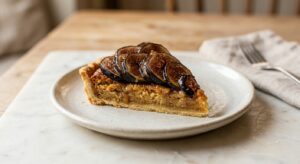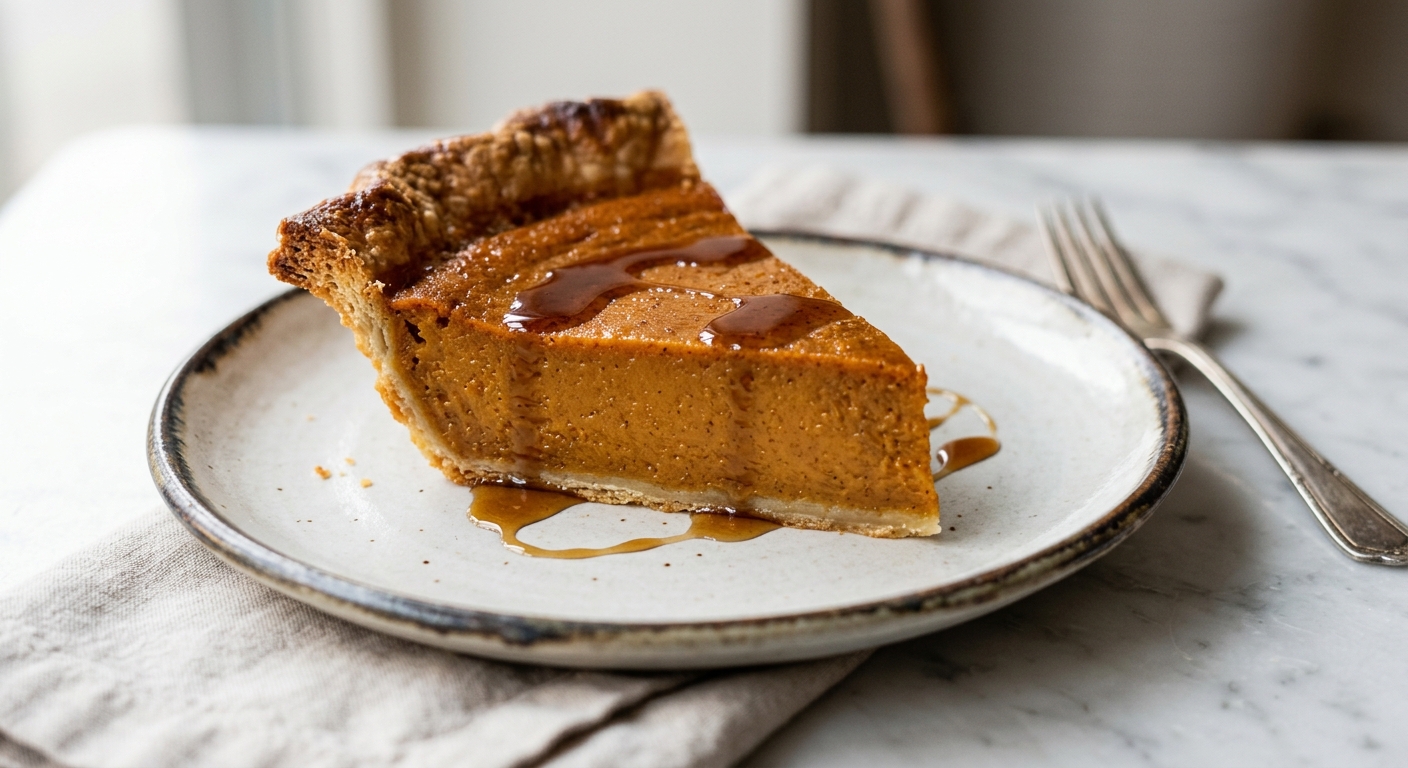
There is a moment, somewhere between Thanksgiving and the first real cold snap of winter, when a slice of sweet potato pie feels like the most comforting thing in the world. This one is the color of amber, fragrant with cinnamon, ginger, nutmeg, and cardamom, and just sweet enough to feel indulgent without tipping into cloying. The filling trembles gently when you pull it from the oven, and after a long rest in the refrigerator it slices clean and gorgeous, the kind of pie that earns quiet at the table.
What sets this version apart is a two-part approach to flavor. First, the sweet potatoes are roasted rather than boiled, which caramelizes their natural sugars and drives off excess moisture, giving the filling a concentrated, almost butterscotch-like depth. Second, real maple syrup steps in alongside brown sugar to add a layer of complexity that plain granulated sugar simply cannot deliver. A splash of bourbon is optional but deeply encouraged. The custard base uses both whole eggs and egg yolks for a filling that is rich and creamy but never dense or rubbery.
This pie falls squarely in the medium difficulty range. The crust requires a little patience and cold hands, and the filling comes together quickly in a blender or food processor for a completely lump-free result. It is an ideal weekend bake or make-ahead holiday project, and it is genuinely perfect for anyone who loves pumpkin pie but wants something a little more nuanced and a lot more interesting.
Equipment Needed
Click on an item below to shop for the recommended items for this recipe on Amazon.
As an Amazon Associate, we earn from qualifying purchases.
8
Ingredients
- Roasting
- 900 gwhole sweet potatoes, unpeeled (about 2 large)
- Crust
- 200 gall-purpose flour (about 1 2/3 cups, spooned and leveled)
- 8 ggranulated sugar (about 2 tsp)
- 4 gColima Sea SaltMicroplastic Free Salt, divided (about 3/4 tsp total, split between crust and filling)
- 113 gunsalted butter, very cold, cut into 1/2-inch cubes (about 1/2 cup or 1 stick)
- 60 mlice water (about 4 tbsp), for the crust, use only as much as needed
- 360 groasted sweet potato flesh (about 1 1/2 cups, mashed), from the roasted potatoes above
- 150 glight brown sugar, packed (about 3/4 cup)
- 60 mlpure maple syrup, Grade A Dark Robust (about 1/4 cup)
- 240 mlheavy cream (about 1 cup)
- 60 mlwhole milk (about 1/4 cup)
- 2 largewhole eggs, at room temperature
- 2 largeegg yolks, at room temperature
- 30 mlbourbon whiskey (about 2 tbsp), optional but recommended
- 1 tsppure vanilla extract
- 1.5 tspground cinnamon
- 0.75 tspground ginger
- 0.5 tspfreshly grated nutmeg
- 0.25 tspground cardamom
- 0.25 tspground allspice
- Serving
- —Lightly sweetened whipped cream
Ingredient Substitutions
Instructions
- Roast the sweet potatoes: Preheat your oven to 400°F (205°C). Pierce each sweet potato several times with a fork and place directly on a foil-lined baking sheet. Roast for 50 to 60 minutes until completely tender and caramelized juices are bubbling from the skin. Let cool completely, then scoop out the flesh. You need 360g of flesh. Any extra can be saved for another use. Reduce oven temperature to 375°F (190°C).
- Make the pie crust: In a large bowl, whisk together the flour, granulated sugar, and 2g (about 1/4 tsp) of the sea salt. Add the cold butter cubes and use your fingertips or a pastry cutter to work the butter into the flour until the mixture resembles coarse, shaggy crumbs with some flat, pea-sized pieces of butter still visible. Those visible butter pieces are what create flaky layers. Drizzle in the ice water one tablespoon at a time, mixing gently with a fork after each addition, until the dough just barely holds together when you pinch a bit between your fingers. It should not feel wet. Turn the dough out onto a lightly floured surface, press into a disk, wrap tightly in plastic wrap, and refrigerate for at least 1 hour or up to 2 days.
- Blind bake the crust: On a lightly floured surface, roll the chilled dough into a 12-inch circle about 1/8-inch thick. Carefully drape it into a 9-inch deep-dish pie pan, press gently into the bottom and sides, and trim the overhang to about 1 inch. Fold the overhang under itself and crimp decoratively. Refrigerate the lined pan for 20 minutes. Line the crust with parchment paper, fill with pie weights or dried beans, and blind bake at 375°F (190°C) for 15 minutes. Remove the weights and parchment, prick the bottom lightly with a fork, and bake for another 5 minutes until the bottom looks dry and just barely golden. Let cool slightly while you make the filling. Reduce oven to 325°F (165°C).
- Make the filling: Combine the roasted sweet potato flesh, brown sugar, maple syrup, heavy cream, whole milk, whole eggs, egg yolks, bourbon (if using), vanilla extract, cinnamon, ginger, nutmeg, cardamom, allspice, and the remaining 2g (about 1/2 tsp) sea salt in a blender or food processor. Blend on medium-high speed for 60 to 90 seconds until the mixture is completely smooth, silky, and uniform in color. Taste and adjust spices if needed. Pass the filling through a fine-mesh strainer into a large measuring cup or bowl with a pouring spout for extra insurance against lumps (optional but recommended for the smoothest result).
- Bake the pie: Place the blind-baked crust on a rimmed baking sheet. Pour the filling slowly into the crust, filling it to within 1/4 inch of the rim. Carefully transfer to the oven. Bake at 325°F (165°C) for 38 to 45 minutes. The pie is done when the edges are fully set and puffed slightly, but the center 3 inches still wobble gently like Jell-O when you nudge the pan. It will continue to set as it cools. Do not overbake.
- Cool and chill: Transfer the pie to a wire rack and let it cool completely at room temperature, at least 2 hours. Then refrigerate for a minimum of 2 hours (overnight is ideal) before slicing. The filling needs time to fully set for clean slices. Serve cold or at room temperature with lightly sweetened whipped cream.
- Roast the sweet potatoes as described in the oven method: pierce, roast at 400°F (205°C) for 50 to 60 minutes, cool, and scoop out 360g of flesh.
- Prepare your crust: For a graham cracker crust, combine 200g (about 1 1/2 cups) graham cracker crumbs, 40g (about 3 tbsp) granulated sugar, and 85g (6 tbsp) melted unsalted butter. Press firmly and evenly into the bottom and up the sides of a 9-inch deep-dish pie pan using the bottom of a measuring cup. Freeze for 15 minutes to firm up. Alternatively, use one store-bought deep-dish frozen pie shell, thawed according to package directions. No pre-baking is needed for the graham cracker crust. For the store-bought pastry shell, follow the package instructions for blind baking.
- Make the filling: Follow the same blending instructions from the oven method, combining all filling ingredients in a blender and processing until completely smooth. Pass through a strainer if desired.
- Bake the pie: Preheat your oven to 325°F (165°C). Place the filled crust on a rimmed baking sheet. Pour in the filling. Bake for 38 to 45 minutes, watching carefully from the 35-minute mark. The center should wobble gently but the edges should be set. Graham cracker crusts can brown quickly at the edges, so check at 30 minutes and loosely tent the edges with foil if needed.
- Cool completely on a wire rack for at least 2 hours, then refrigerate for at least 2 hours before slicing. Serve with whipped cream. Note that graham cracker crusts are best sliced and served directly from the refrigerator while cold, as they soften quickly at room temperature.
- Roast the sweet potatoes as described in the oven method: pierce all over, roast at 400°F (205°C) for 50 to 60 minutes until tender, cool completely, and scoop out 360g of flesh. The oven is only needed for this step.
- Prepare your slow cooker: Generously grease the inside of a 6-quart slow cooker insert with butter or nonstick spray. Alternatively, grease 6 to 8 individual ramekins or heatproof cups (6 oz each), place them inside the slow cooker, and add 1 inch of hot water to the bottom of the slow cooker to create a gentle water bath for the ramekins. The water bath method produces a creamier, more even texture.
- Make the custard: Combine the sweet potato flesh, brown sugar, maple syrup, heavy cream, whole milk, whole eggs, egg yolks, bourbon (if using), vanilla extract, all the spices, and sea salt in a blender. Blend for 90 seconds until completely smooth. Pour directly into the greased slow cooker insert or divide among the ramekins.
- Cook on Low for 2.5 to 3 hours (insert method) or 1.5 to 2 hours (ramekin method). The custard is done when the edges are fully set and the center jiggles only slightly. Avoid lifting the lid during the first 2 hours or condensation will drip onto the surface. Place a double layer of paper towels under the lid to absorb steam and keep the surface from becoming wet.
- Turn off the slow cooker, remove the lid, and allow the custard to cool with the lid ajar for 30 minutes. Then refrigerate, uncovered at first and then covered once cool, for at least 2 hours until fully chilled and set. Scoop into bowls or unmold ramekins onto plates. Serve with whipped cream, a drizzle of maple syrup, and a dusting of cinnamon.
Nutrition Per Serving
Per 1 serving (makes one 9-inch deep-dish pie)
Why This Recipe Works
Roasting the sweet potatoes rather than boiling them is the single most important step in this recipe. When sweet potatoes sit in boiling water, they absorb moisture, which dilutes flavor and can make a custard filling watery or prone to weeping after baking. Roasting does the opposite: the dry heat of the oven evaporates excess moisture while the sugars in the potato caramelize through the Maillard reaction, creating complex, nutty, almost toffee-like flavor compounds that no amount of added sugar can replicate. The result is a filling with a deeper color and a more concentrated, complex sweetness.
The combination of whole eggs and egg yolks is deliberate. Whole eggs provide the structural proteins that allow the custard to set into sliceable slices, while the extra yolks add richness, a deeper golden color, and a velvety, almost crème brûlée-like mouthfeel. Too many whole eggs would make the filling rubbery and tight. Too few and it will not set cleanly. The ratio here is calibrated so the custard is just firm enough to slice neatly after chilling but still trembles with creaminess. Baking at the lower temperature of 325°F (165°C) also protects the eggs from scrambling or curdling, which can cause a grainy texture or cracked surface.
If your filling cracks across the top, it was almost certainly overbaked or cooled too quickly. Custard fillings crack when the egg proteins tighten too much from excess heat or thermal shock. The gentle wobble test is your best friend here: the center should still have movement when you pull the pie from the oven. If the edges pull away from the crust and the top looks dry and domed, it has gone too far. The pie will still taste good, but chill it promptly and top generously with whipped cream to cover any imperfections with grace.
Baker’s Tips
- Use Grade A Dark Robust maple syrup for the most pronounced maple flavor. The lighter Grade A Golden syrup is more delicate and can get lost among the warm spices.
- When making the crust, if your kitchen is warm, put the flour and mixing bowl in the freezer for 15 minutes before starting. Cold tools make a flakier crust.
- Do not skip the chill time after rolling and fitting the crust. Resting the lined pan in the refrigerator for 20 minutes before blind baking relaxes the gluten and prevents the sides from slumping during baking.
- Blend the filling long enough, a full 60 to 90 seconds, to completely break down any fibrous strands in the sweet potato. Even well-roasted sweet potato can have some texture, and blending is what gives the filling its silky, restaurant-quality smoothness.
- Place the pie pan on a rimmed baking sheet before pouring in the filling and transferring to the oven. This makes transport far easier, catches any drips, and helps the bottom crust bake more evenly through reflected heat.
- For the cleanest slices, refrigerate the pie overnight and use a thin, sharp knife wiped clean between each cut. The custard continues to firm up and develop flavor the longer it chills.
Variations
- Pecan praline topping: After the pie has cooled and set, make a quick praline by cooking 100g chopped pecans, 75g brown sugar, and 30g butter in a small pan until bubbling and glossy. Spoon over the top of the chilled pie before serving.
- Pumpkin-sweet potato hybrid: Replace half the sweet potato flesh with an equal weight of plain canned pumpkin puree (not pie filling). The result is slightly lighter in sweetness with a more classic pumpkin flavor profile.
- Ginger snap crust: Replace the graham cracker crust variation with crushed ginger snap cookies for an intensely spiced base that doubles down on the ginger in the filling.
- Dairy-free version: Replace heavy cream with full-fat coconut cream (chilled, solids only), whole milk with oat milk, and butter in the crust with cold vegan butter sticks. The pie will have a subtle coconut note and a beautiful, clean set.
Troubleshooting & FAQ
My filling has lumps or looks grainy after baking. What went wrong?
The top of my pie cracked. Can I fix it?
My pie crust shrank down the sides and the bottom puffed up during blind baking. What happened?
My filling did not set and is still liquid after chilling for 2 hours. What should I do?
The pie crust is raw or soggy on the bottom. How do I prevent this?
Storage & Make-Ahead
- Storage: Store the baked pie loosely covered in the refrigerator for up to 5 days. The filling can weep slightly if stored uncovered, so a loose tent of plastic wrap or a pie dome is ideal. Do not store at room temperature for more than 2 hours due to the egg-based custard filling. The baked pie (without whipped cream topping) freezes well for up to 6 weeks: wrap tightly in plastic wrap and then in foil, and thaw overnight in the refrigerator before serving.
- Make-Ahead: This pie is an excellent make-ahead dessert. The pie crust dough can be made up to 3 days ahead and refrigerated, or frozen for up to 2 months. The sweet potatoes can be roasted 2 days ahead and the flesh refrigerated. The entire baked pie is best made 1 day ahead, as it slices cleaner and the flavor deepens overnight in the refrigerator.