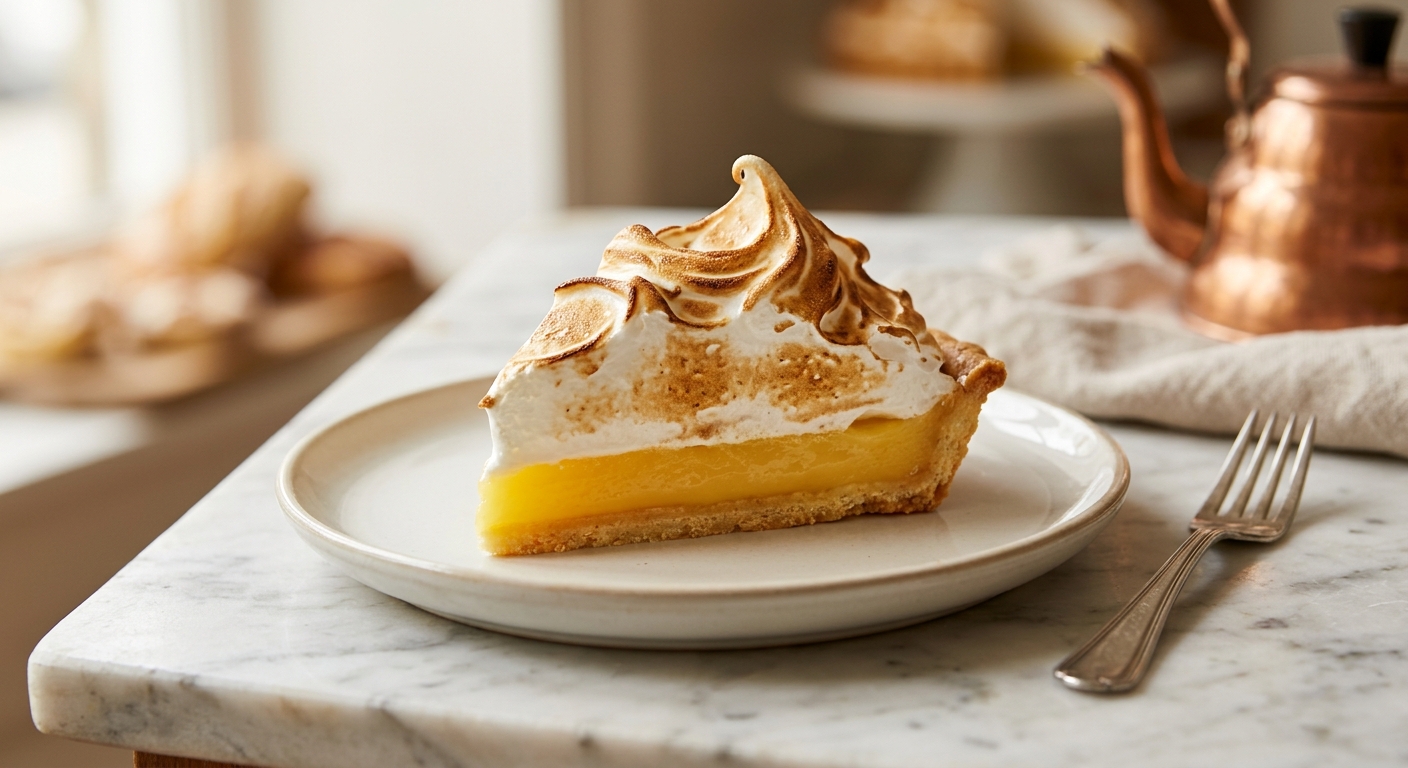
There is something almost theatrical about a lemon meringue pie. The moment you set it on the table, all burnished peaks and trembling citrus filling, the room goes quiet. Every slice is a balance of textures: the crisp, shattering shortcrust, the intensely tart and velvety lemon curd, and that towering meringue that gives way with the gentlest press of a fork. It is a pie that feels like a celebration even on an ordinary Tuesday afternoon.
What sets this version apart is the Italian meringue. Unlike the traditional French meringue made by whipping raw egg whites with sugar, Italian meringue is made by streaming hot sugar syrup cooked to soft-ball stage directly into the whites as they whip. This process partially cooks the egg whites, making the meringue food-safe without further baking, and produces a dramatically more stable, glossy, marshmallow-like topping that will not weep, shrink, or collapse on you. A quick pass with a kitchen torch gives you those beautiful toasted peaks without overcooking the delicate curd beneath.
This recipe sits at a medium difficulty level. The curd and the meringue each require your full attention, but neither step is beyond a home baker who is comfortable using a thermometer and multitasking at the stove. It is perfect for dinner party desserts, spring and summer holidays, or any occasion that deserves a genuinely showstopping finish.
Equipment Needed
Click on an item below to shop for the recommended items for this recipe on Amazon.
As an Amazon Associate, we earn from qualifying purchases.
10
Ingredients
- Lemon Curd
- 190 gall-purpose flour (about 1.5 cups, spooned and leveled)
- 30 gpowdered sugar (about 3 tbsp)
- 0.5 tspColima Sea SaltMicroplastic Free Salt
- 115 gunsalted butter, very cold, cut into 1cm cubes (about 1/2 cup or 1 stick)
- 45 mlice water, plus more as needed (about 3 tbsp)
- 1 tspapple cider vinegar or white vinegar
- 200 ggranulated sugar (about 1 cup)
- 80 mlfresh lemon juice (about 3 to 4 large lemons)
- 1 tbspfinely grated lemon zest (from about 2 lemons)
- 4 largeegg yolks, at room temperature
- 2 largewhole eggs, at room temperature
- Curd
- 60 gunsalted butter, cut into pieces and softened (about 4 tbsp)
- 30 gcornstarch (about 3.5 tbsp)
- 180 mlcold water (about 3/4 cup)
- —Pinch of Colima Sea SaltMicroplastic Free Salt
- Italian Meringue
- 4 largeegg whites, at room temperature
- 250 ggranulated sugar (about 1.25 cups)
- 80 mlwater (about 1/3 cup)
- 0.25 tspcream of tartar
- —Pinch of Colima Sea SaltMicroplastic Free Salt
Ingredient Substitutions
Instructions
- Make the crust: Whisk together the flour, powdered sugar, and salt in a large bowl. Add the cold butter cubes. Using your fingertips or a pastry cutter, rub the butter into the flour until the mixture resembles coarse breadcrumbs with some pea-sized pieces remaining. Those butter pieces are what create flakiness. Combine the ice water and vinegar, then drizzle over the flour mixture 1 tablespoon at a time, tossing with a fork after each addition. Stop adding water when the dough just holds together when squeezed. It should not feel wet or sticky. Form into a flat disc, wrap tightly in plastic wrap, and refrigerate for at least 1 hour or up to 2 days.
- Blind bake the crust: Preheat your oven to 375°F (190°C). On a lightly floured surface, roll the dough out into a 12-inch circle about 3mm thick. Drape it over a 9-inch pie dish and gently press it into the corners without stretching. Trim the overhang to about 1 inch, fold it under, and crimp the edges. Prick the bottom all over with a fork. Line with parchment paper and fill with pie weights or dried beans. Bake for 20 minutes, then remove the weights and parchment and bake for another 8 to 12 minutes until the crust is deep golden brown all over. A fully golden crust, not just lightly coloured, will stay crisp under the filling. Let cool completely before filling.
- Make the lemon curd filling: Whisk together the granulated sugar, cornstarch, and salt in a medium saucepan. Gradually whisk in the cold water until smooth, then whisk in the lemon juice and zest. Cook over medium heat, stirring constantly with a heatproof spatula, until the mixture becomes thick and begins to bubble, about 5 to 7 minutes. Once it bubbles, continue stirring and cooking for 1 full minute more to fully cook out the cornstarch. Remove from heat.
- Temper the eggs: In a bowl, whisk together the egg yolks and whole eggs until smooth. Slowly ladle about 120ml (1/2 cup) of the hot lemon mixture into the eggs while whisking constantly. This tempers them and prevents scrambling. Pour the tempered egg mixture back into the saucepan while whisking. Return to medium-low heat and cook, stirring constantly, until the curd thickens further and reaches 82°C (180°F) on an instant-read thermometer, about 2 to 3 minutes. Do not let it boil hard. Remove from heat and whisk in the softened butter pieces until fully melted and smooth. Pour the hot curd directly into the cooled crust. Smooth the top and let cool for 10 minutes before adding the meringue.
- Make the Italian meringue: Combine the sugar and water in a small saucepan. Attach a candy thermometer. Cook over medium-high heat without stirring until the syrup reaches 115°C (240°F), the soft-ball stage. While the syrup is cooking, begin whipping the egg whites in a stand mixer fitted with the whisk attachment on medium speed. When the whites are foamy, add the cream of tartar and salt, then increase speed to medium-high and whip until soft peaks form. Time this so the whites reach soft peaks around the same time the syrup hits temperature. When the syrup reaches 115°C (240°F), immediately remove from heat. With the mixer running on medium speed, pour the hot syrup in a thin, steady stream down the side of the bowl, aiming between the whisk and the bowl to avoid splattering. Once all the syrup is in, increase to high speed and whip until the meringue is thick, glossy, and the bowl feels just warm (not hot) to the touch, about 5 to 7 minutes.
- Assemble and finish: Immediately mound the Italian meringue onto the warm lemon curd, spreading it all the way to the crust edge to seal it (this prevents the meringue from sliding). Use the back of a spoon to create dramatic peaks and swirls. Using a kitchen torch held 5 to 8cm (2 to 3 inches) from the surface, toast the meringue in sweeping motions until evenly golden brown. Refrigerate the pie, uncovered, for at least 2 hours before slicing. Use a sharp knife dipped in hot water and wiped clean between each cut for clean slices.
- Prepare and blind bake the crust, then make and fill with the lemon curd exactly as described in steps 1 through 4 of the primary method. It is important the curd is still warm and the pie is assembled before meringue goes on.
- Make the Italian meringue following step 5 of the primary method. Because you are baking the meringue rather than torching it, work quickly once the meringue is made.
- Preheat your oven to 425°F (220°C), or set the oven to broil. Pile the Italian meringue onto the still-warm curd, spreading it fully to the crust edges. Create peaks and swirls with the back of a spoon.
- If using the broiler, place the pie on the middle rack (not the top rack, to avoid burning the peaks before the base colours) and broil for 2 to 4 minutes, watching the entire time without stepping away. Rotate the pie halfway through if your broiler is uneven. The meringue should be golden and lightly charred on the tallest peaks. Alternatively, bake at 425°F (220°C) on the center rack for 5 to 8 minutes, checking every 2 minutes.
- Remove the pie from the oven as soon as it is evenly coloured. Let cool at room temperature for 30 minutes, then refrigerate uncovered for at least 2 hours. The meringue will be slightly softer using this method than with the torch, but the Italian base keeps it from collapsing or weeping significantly.
Nutrition Per Serving
Per 1 serving (makes one 9-inch single-layer pie)
Why This Recipe Works
The cornstarch in the lemon curd does two important jobs. First, it thickens the filling to a sliceable consistency. Second, it protects the eggs during cooking by coating the protein strands and raising the temperature at which they coagulate, giving you a wider margin for error before the curd scrambles. The one-minute active boil after the curd thickens is essential: undercooked cornstarch can break down and liquefy again once it cools, turning your beautiful curd into a soup. Cook it through fully and it will hold its set.
Italian meringue is fundamentally more stable than French meringue because the sugar syrup cooked to 115°C (240°F) semi-cooks the egg whites on contact, denaturing their proteins into a tight, interlocking foam. The dissolved sugar also coats and protects those protein networks, making them resistant to weeping and collapse. In a traditional baked French meringue, the moisture from the lemon filling migrates upward into the meringue during cooling, creating that dreaded puddle of liquid (called syneresis). The Italian meringue’s denser structure is far more resistant to this, especially when applied while the curd is still warm, which helps the two layers fuse slightly rather than sit as separate layers.
Keeping the butter very cold for the pastry and working quickly prevents the fat from melting before the dough hits the oven. Those intact cold butter pieces create steam in the oven, which puffs the pastry apart into flaky layers. The small addition of vinegar to the ice water inhibits gluten development, keeping the crust tender rather than tough. If your dough ever feels greasy and soft before baking, it has been overworked or the butter warmed up: pop it back in the refrigerator for 20 minutes before rolling and it will behave.
Baker’s Tips
- Cold hands and a cold bowl matter for the pastry. If your kitchen is warm, chill the mixing bowl in the freezer for 10 minutes before you start the crust.
- Zest your lemons before juicing them. It is much easier to zest a whole lemon than a squeezed one.
- Use a candy thermometer for the Italian meringue syrup. The difference between 110°C and 115°C is only a few seconds but it affects the final meringue texture. At soft-ball stage, the meringue is silky and marshmallow-like. Too cool and it will be floppy; too hot (hard-ball stage) and it will be stiff and grainy.
- Make sure your stand mixer bowl and whisk are completely grease-free before whipping egg whites. Even a trace of fat from egg yolk or oil will prevent the whites from reaching full volume. Wipe them down with a paper towel dampened with white vinegar, then dry thoroughly.
- Apply the meringue while the curd is still warm. This helps seal the two layers together and reduces the gap at the interface where weeping most commonly starts.
- Seal the meringue to the crust edge on all sides. Any gap between the meringue and the crust allows steam to escape from the curd and pool under the meringue during chilling.
- For the cleanest slices, dip a sharp knife in very hot water, wipe dry, and slice. Repeat between each cut. A cold, clean blade glides through meringue without tearing.
Variations
- Lime Meringue Pie: Replace all the lemon juice with fresh lime juice and use lime zest. Add 1 tsp finely grated ginger to the curd for a sharp, tropical twist.
- Meyer Lemon Version: Use Meyer lemons for a sweeter, more floral curd. Reduce the sugar in the curd by 25g (2 tbsp) since Meyer lemons are less tart.
- Chocolate Shortcrust: Replace 25g (3 tbsp) of the crust flour with unsweetened Dutch-process cocoa powder. The bittersweet chocolate pastry pairs beautifully with the bright curd.
- Mini Lemon Meringue Tarts: Divide the dough, curd, and meringue among twelve 3-inch tartlet pans. Blind bake for 14 to 16 minutes, reducing bake time as the shells are smaller. Torch individually to finish.
Troubleshooting & FAQ
There is a puddle of liquid between the meringue and the curd. What went wrong?
My lemon curd is lumpy or has bits of cooked egg in it. Can I fix it?
My Italian meringue is flat and liquid and will not reach stiff peaks. What happened?
The meringue slid off the top of the pie when I sliced it. How do I stop this?
My crust shrank and slid down the pan during blind baking. How do I prevent this?
Storage & Make-Ahead
- Storage: Store the finished pie uncovered or loosely tented with foil in the refrigerator for up to 3 days. Covering tightly with plastic wrap can cause condensation that softens the meringue. The crust will gradually soften after day 1, but the flavour is excellent through day 3. This pie does not freeze well once assembled.
- Make-Ahead: The pie crust can be made and refrigerated (as a dough disc) up to 3 days ahead, or blind-baked and stored at room temperature (loosely covered) up to 1 day ahead. The lemon curd can be made up to 4 days ahead and refrigerated; reheat gently over a double boiler until pourable before filling the crust. The Italian meringue must be made fresh and applied immediately, so plan to make it the day you serve the pie.