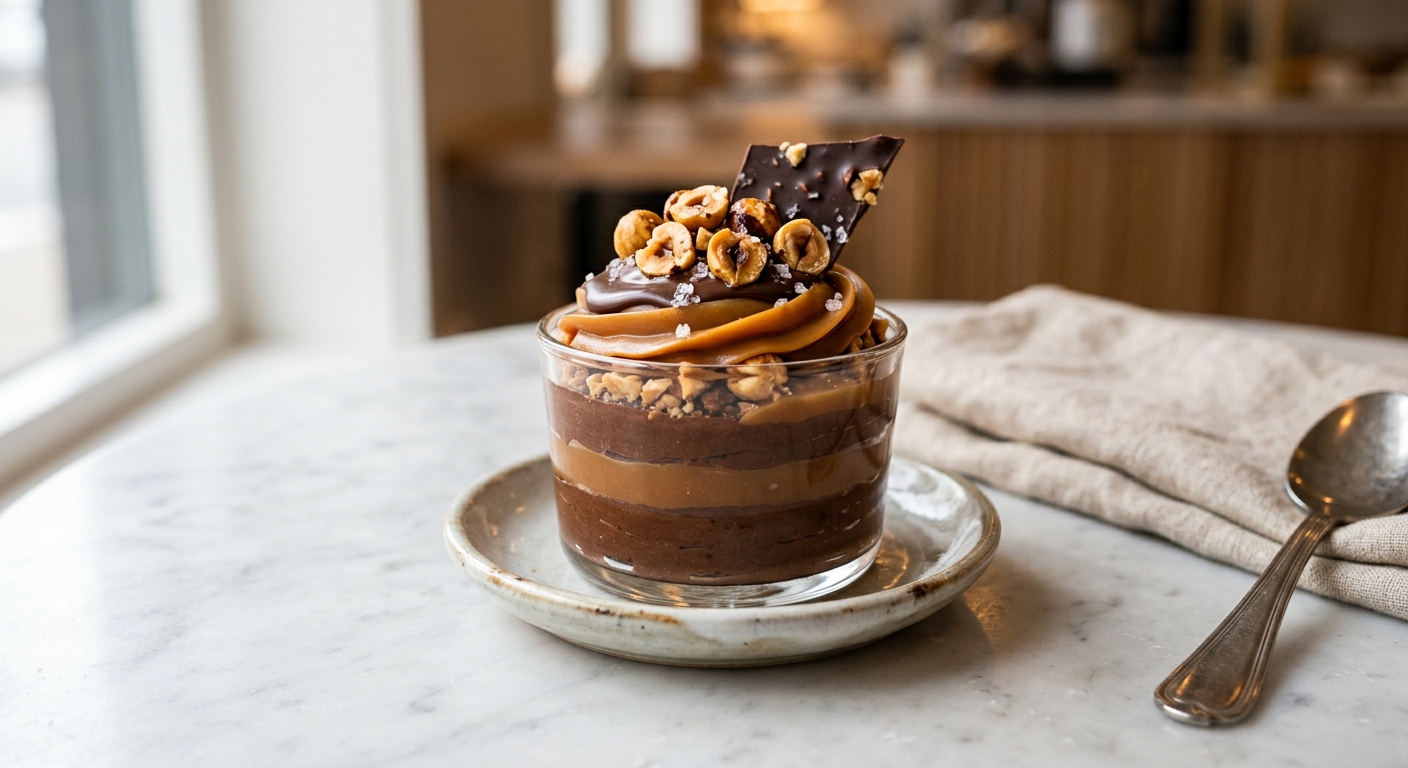
There is a moment, right after you pour freshly made caramel over a scattering of toasted hazelnuts and hear that satisfying crackle as it sets, when you know something special is happening in your kitchen. This salted caramel and dark chocolate parfait is built on exactly those kinds of sensory moments: a glossy amber caramel that smells of toffee and sea salt, a dark chocolate custard so deeply flavored it tastes like the inside of a fine truffle, and a praline layer that shatters under a spoon with an almost theatrical crunch. Served in tall glasses so every layer is on full display, it is the kind of dessert that earns a long pause before anyone speaks.
What sets this version apart is the technique behind the custard. Rather than a standard chocolate mousse or box pudding, the base here is a true stovetop custard, cooked gently with egg yolks and cream until it coats the back of a spoon. This gives the chocolate layer a dense, velvet texture that holds its shape in the glass without needing gelatin. The caramel is a dry-method caramel, meaning the sugar melts without added water, which produces a deeper, more complex flavor with a beautiful amber color. The sea salt is added in two stages: stirred into the warm caramel and then flaked on top at serving, so every bite has a little pop of salinity in a different place.
This is a medium-difficulty recipe that rewards patience more than skill. If you have made caramel or custard before, you will feel right at home. If this is your first time with either, the detailed steps and troubleshooting notes below will walk you through every stage. This parfait is ideal for dinner parties and date nights when you want to prepare everything in advance and simply assemble and chill, arriving at the table completely composed.
Equipment Needed
Click on an item below to shop for the recommended items for this recipe on Amazon.
As an Amazon Associate, we earn from qualifying purchases.
6
Ingredients
- Caramel
- 200 ggranulated sugar (about 1 cup), divided: 120g for caramel, 80g for praline
- 120 mlheavy cream for caramel (about 1/2 cup), warmed
- 30 gunsalted butter, cut into cubes
- 1 tspColima Sea SaltMicroplastic Free Salt
- 100 graw hazelnuts (about 3/4 cup), toasted and roughly chopped
- Finishing
- —Colima Sea SaltMicroplastic Free Salt (such as Maldon)
- 180 gdark chocolate, 70% cocoa solids, finely chopped (about 1 cup chopped)
- 480 mlheavy cream for custard, divided (about 2 cups): 360ml for custard, 120ml for whipping
- 120 mlwhole milk (about 1/2 cup)
- 4 largeegg yolks, at room temperature
- 50 ggranulated sugar for custard (about 1/4 cup)
- 1 tsppure vanilla extract
- Custard
- —Pinch of Colima Sea SaltMicroplastic Free Salt
Ingredient Substitutions
Instructions
- Make the hazelnut praline first so it has time to cool and set. Line a baking sheet with parchment paper and scatter the toasted, roughly chopped hazelnuts across the center. In a small, heavy-bottomed saucepan over medium heat, add the 80g of sugar for the praline. Cook without stirring, swirling the pan gently once the edges begin to melt. Continue cooking until the sugar is fully melted and a deep amber color, about 5 to 7 minutes. Immediately pour over the hazelnuts in a thin, even layer. Let cool completely at room temperature for at least 20 minutes, then break into shards and pulse briefly in a food processor or crush in a zip-lock bag into coarse crumbs. Set aside.
- Make the salted caramel. Warm the 120ml of heavy cream in a small saucepan or microwave until steaming but not boiling. Keep it warm and nearby. Place the 120g of sugar in a medium, heavy-bottomed saucepan over medium heat. Cook without stirring, swirling the pan only if hot spots develop, until the sugar is fully melted and a rich amber, about 6 to 8 minutes. Remove from heat and carefully pour in the warm cream in a slow, steady stream while whisking constantly. The mixture will bubble vigorously. Return to low heat and stir until completely smooth. Add the butter cubes one at a time, stirring until each is melted. Stir in the 1 tsp fine sea salt. Pour into a heatproof bowl and let cool to room temperature, then refrigerate until thick but still pourable, about 30 to 40 minutes.
- Make the dark chocolate custard. Combine the 360ml of heavy cream and the whole milk in a medium saucepan over medium heat. Bring just to a simmer, then remove from heat and add the finely chopped dark chocolate. Let sit for 2 minutes, then whisk until completely smooth. In a separate bowl, whisk the egg yolks with the 50g of sugar, vanilla extract, and pinch of salt until pale and slightly thickened, about 2 minutes. Slowly pour the warm chocolate cream into the yolk mixture in a thin stream, whisking constantly to temper the eggs. Return the entire mixture to the saucepan over low heat and cook, stirring constantly with a wooden spoon or silicone spatula, until the custard thickens enough to coat the back of a spoon and registers 170 to 175°F (77 to 80°C) on an instant-read thermometer, about 6 to 9 minutes. Do not let it boil.
- Strain the custard through a fine-mesh sieve into a clean bowl to catch any cooked egg bits and ensure a silky texture. Press a sheet of plastic wrap directly against the surface to prevent a skin from forming. Refrigerate until cool and set to a soft, spoonable consistency, about 1.5 to 2 hours.
- Once the custard has chilled and the caramel has thickened, lightly whip the remaining 120ml of heavy cream to soft peaks. Fold gently into the chilled chocolate custard to lighten the texture slightly, using a wide spatula and folding from the bottom up. Do not overmix.
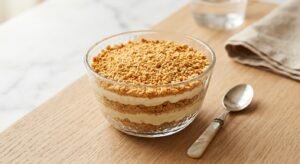
- Assemble the parfaits. Spoon a generous layer of chocolate custard into the bottom of each glass (about 3 to 4 tablespoons). Add a layer of praline crumbs (about 1 tablespoon per glass). Drizzle a layer of salted caramel over the praline (about 1 tablespoon). Repeat the layers once more: custard, praline, caramel. Finish with a final small spoonful of custard, a drizzle of caramel, and a few pinches of flaky sea salt on top. Refrigerate for at least 30 minutes before serving, or up to 8 hours ahead.
- Make the praline and salted caramel on the stovetop following Steps 1 and 2 of the primary method. Set aside to cool.
- Make the microwave chocolate custard. Combine the 360ml of heavy cream, whole milk, and finely chopped dark chocolate in a large microwave-safe bowl. Microwave on medium power (50%) in 45-second intervals, stirring well between each, until the chocolate is fully melted and the mixture is steaming, about 3 to 4 intervals total. Whisk until completely smooth.
- In a separate bowl, whisk the egg yolks with the 50g of sugar, vanilla, and pinch of salt until pale. Slowly pour the warm chocolate cream into the yolk mixture in a thin, steady stream while whisking constantly to temper the eggs. Return the combined mixture to the large microwave-safe bowl.
- Microwave the custard on medium-low power (30%) in 1-minute intervals, whisking thoroughly after each interval. Continue for 4 to 6 intervals, until the custard thickens noticeably and leaves a thick coating on the back of a spoon. It should register 170 to 175°F (77 to 80°C) if you have a thermometer. If you see small lumps forming, immediately strain through a fine-mesh sieve and whisk vigorously.
- Press plastic wrap directly onto the surface and refrigerate until set, about 1.5 to 2 hours. Fold in lightly whipped cream and assemble the parfaits as described in Steps 5 and 6 of the primary method.
- Make the hazelnut praline using Steps 1 of the primary method, or substitute crushed chocolate wafer cookies for a truly no-cook base.
- Make the chocolate ganache mousse. Place the finely chopped dark chocolate in a heatproof bowl. Heat 180ml (3/4 cup) of the heavy cream in a small saucepan until just simmering, then pour over the chocolate. Let sit 2 minutes and stir until completely smooth. Add the vanilla extract and a pinch of salt. Press plastic wrap onto the surface and refrigerate until the ganache is cool and firm but not hard, about 45 to 60 minutes.
- Once chilled, transfer the ganache to the bowl of a stand mixer or use a hand mixer. Whip the remaining 300ml (1 and 1/4 cups) of heavy cream to stiff peaks in a separate bowl. Add the chilled ganache to the whipped cream and beat together on medium speed for 30 to 45 seconds until light, fluffy, and uniform. Do not overwhip or the mousse will become grainy.
- Use a high-quality store-bought salted caramel sauce (such as Bonne Maman or a local specialty brand), warmed slightly so it is pourable. Taste and add flaky sea salt if it needs more salt.
- Assemble exactly as in Step 6 of the primary method: layer the chocolate mousse, praline crumbs, and caramel sauce in tall glasses, finishing with flaky salt. Refrigerate for at least 20 minutes before serving.
Nutrition Per Serving
Per 1 serving (makes 6 individual parfaits in tall glasses (approximately 250ml each))
Why This Recipe Works
The dry-method caramel in this recipe produces a richer, more complex flavor than a wet caramel (where water is added to the sugar). When sugar is heated dry, it undergoes pyrolysis: the sucrose molecules break down and recombine into hundreds of new compounds including diacetyl, which gives caramel its buttery note, and furans, which contribute a slightly nutty bitterness. Adding warm cream (not cold) prevents violent spattering and the risk of seizing, because a smaller temperature difference between the caramel and cream means a gentler reaction. Adding the butter in cubes off the heat allows it to emulsify smoothly into the caramel without breaking, creating the glossy, scoopable sauce you want.
The custard is built on the principle of tempering: slowly raising the temperature of the egg yolks by adding the hot chocolate cream gradually rather than all at once. Egg proteins begin to coagulate and scramble around 160 to 180°F (71 to 82°C), and by tempering, you keep the yolks just warm enough to cook gently and thicken the cream into a velvety custard rather than curdled scrambled eggs. Cooking to 170 to 175°F is the sweet spot: hot enough to safely cook the yolks and activate their thickening proteins, but not so hot that they seize. The fat content of both the cream and the dark chocolate also helps buffer the eggs against overheating, which is why chocolate custards are slightly more forgiving than vanilla ones.
Pressing plastic wrap directly onto the custard surface while it chills prevents oxidation and, more practically, prevents the formation of a thick rubbery skin. This skin forms because the proteins on the surface dry out and cross-link as they cool, which is useful to know for troubleshooting: if your custard does form a skin, simply peel it away before folding in the whipped cream, and no one will ever know.
Baker’s Tips
- Toast the hazelnuts in a dry skillet over medium heat for 4 to 5 minutes, shaking frequently, until fragrant and the skins begin to crack. Tip them onto a clean kitchen towel, bundle them up, and rub vigorously to remove the papery skins before using.
- Use a light-colored or stainless steel saucepan for your caramel so you can see the color of the sugar clearly. Dark non-stick pans make it very difficult to judge doneness.
- Have all your caramel ingredients measured and within arm’s reach before you begin cooking the sugar. Caramel moves fast and you cannot leave the pan to find cream or butter mid-cook.
- If your caramel seizes and turns grainy after adding the cream, return it to low heat and stir gently. The lumps will dissolve back into the sauce as it warms.
- For the cleanest layers when assembling, use a piping bag or a zip-lock bag with a corner snipped off to pipe the custard and caramel neatly down the sides of the glass.
- Bring the egg yolks to room temperature before making the custard. Cold yolks take longer to warm during tempering and increase the risk of uneven cooking.
- Taste your caramel before it sets completely. If it is not salty enough, stir in more fine sea salt a pinch at a time. The salt should be present but not overwhelming.
Variations
- Espresso and Dark Chocolate: Add 1 tsp of instant espresso powder to the chocolate custard with the sugar for a mocha-flavored version that deepens the chocolate flavor beautifully.
- Orange and Dark Chocolate: Stir 1 tsp of finely grated orange zest into the finished caramel and add another 1/2 tsp to the custard for a classic chocolate-orange combination.
- Vegan Version: Use full-fat coconut cream in place of all dairy cream and milk, vegan butter in the caramel, and replace egg yolks with 3 tbsp cornstarch whisked with 60ml cold coconut milk. Use dairy-free dark chocolate.
- Layered Trifle Style: Double the recipe and assemble in a large glass trifle bowl for a stunning centerpiece dessert that serves 10 to 12. Add a layer of crushed chocolate wafer cookies at the base.
Troubleshooting & FAQ
My caramel turned grainy and crystallized. What went wrong?
My chocolate custard has lumps of cooked egg in it. Can I fix it?
My caramel sauce set too hard in the fridge and will not pour. How do I fix it?
My whipped cream deflated when I folded it into the custard. What happened?
My praline came out chewy instead of brittle and crunchy. Why?
Storage & Make-Ahead
- Storage: Assembled parfaits can be covered with plastic wrap and refrigerated for up to 2 days. The praline crumbs will soften slightly over time, so for maximum crunch, store the crumbs separately in an airtight container at room temperature and add them just before serving. The caramel sauce keeps refrigerated in a sealed jar for up to 2 weeks. The chocolate custard on its own keeps refrigerated for up to 3 days.
- Make-Ahead: This dessert is ideal for making ahead. The praline crumbs can be made up to 1 week in advance and stored in an airtight container at room temperature. The salted caramel can be made up to 1 week ahead and kept refrigerated. The chocolate custard can be made up to 2 days ahead. Assemble the parfaits up to 8 hours before serving and refrigerate, covered, until needed.