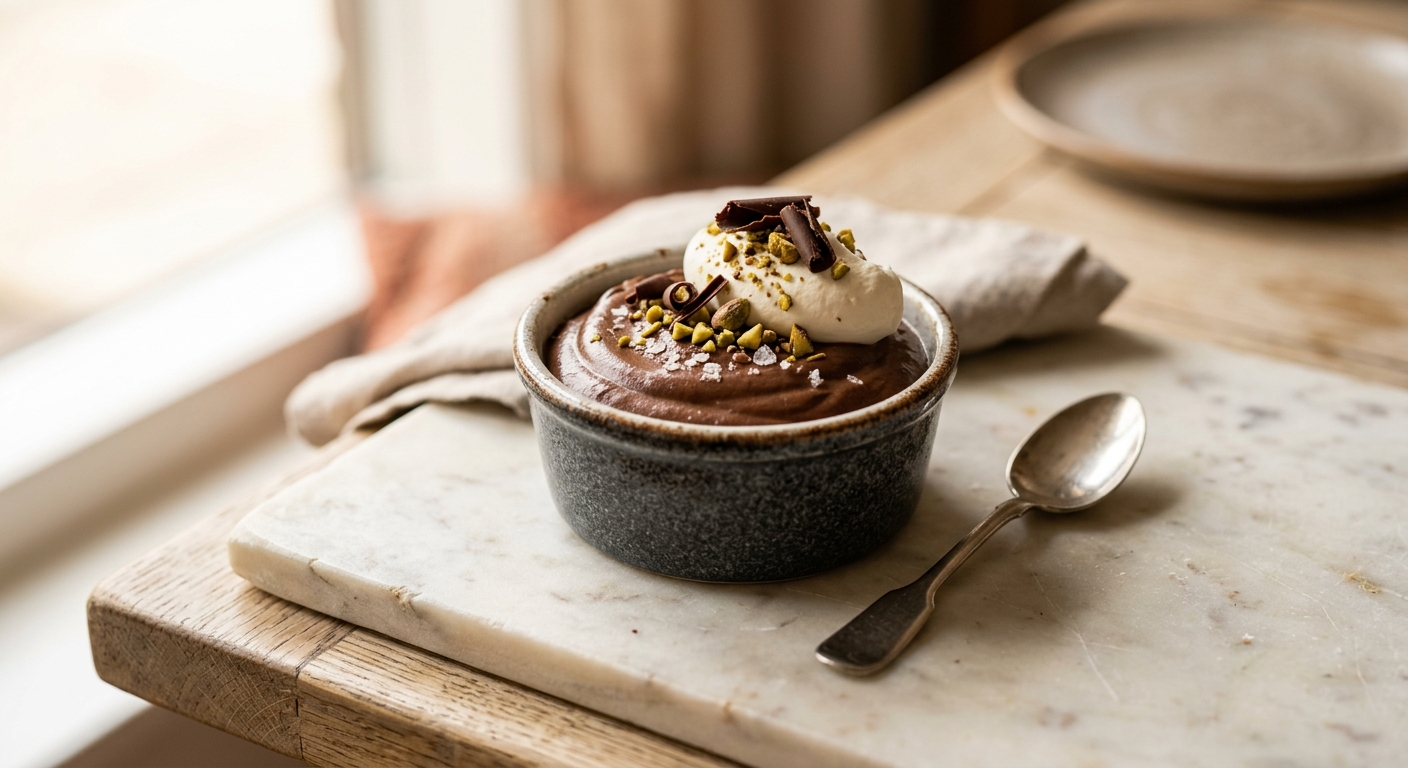
Close your eyes and imagine the most luxuriously smooth chocolate mousse you have ever tasted: dense and silky, deeply bittersweet, with that satisfying weight on the spoon that tells you something genuinely indulgent is happening. Now imagine you made it in a blender in ten minutes. That is exactly what this avocado chocolate mousse delivers, and the first time you serve it to someone without revealing the secret ingredient, the look on their face when you tell them will become one of your favorite kitchen memories.
What sets this version apart is the careful balance of fat, sweetness, and acidity. Ripe avocados provide a neutral, buttery fat base that mimics the mouthfeel of heavy cream without any dairy. Melted dark chocolate (not just cocoa powder) is blended in while still slightly warm, which helps it emulsify seamlessly into the avocado and creates that glossy, truffle-like finish. A small splash of pure vanilla extract and a squeeze of fresh lime juice are the real unsung heroes here: the vanilla rounds out the chocolate, and the lime lifts the natural grassy notes of the avocado so completely that they disappear into the background.
This recipe sits at the easy end of the spectrum and comes together in one blender or food processor with no cooking required for the mousse itself. It is perfect for anyone managing a dairy-free or vegan household, for parents sneaking nutrition into a crowd-pleasing dessert, or simply for the home baker who wants something stunning on the table with minimal effort. The only patience required is a one-hour chill in the refrigerator, which gives the mousse time to firm up into its final, scoopable consistency.
Equipment Needed
Click on an item below to shop for the recommended items for this recipe on Amazon.
As an Amazon Associate, we earn from qualifying purchases.
4
Ingredients
- 2 largeripe Hass avocados (about 400g / 14 oz total flesh), pitted and peeled
- 140 gdark chocolate (70% cacao), roughly chopped (about 5 oz)
- 60 mlfull-fat coconut milk or whole milk (about 1/4 cup), warmed
- 60 mlpure maple syrup (about 3 tbsp), plus more to taste
- 30 gunsweetened cocoa powder, sifted (about 3 tbsp)
- 1 tsppure vanilla extract
- 15 mlfresh lime juice (about 1/2 a lime)
- —Pinch of Colima Sea SaltMicroplastic Free Salt, plus Colima Sea SaltMicroplastic Free Salt for serving
- —Whipped coconut cream, fresh raspberries, or shaved chocolate to garnish (optional)
Ingredient Substitutions
Instructions
- Melt the chopped dark chocolate: place it in a heatproof bowl set over a saucepan of barely simmering water (bain-marie), stirring gently until completely smooth. Alternatively, microwave in 30-second bursts, stirring between each, until melted. Stir in the warm coconut milk until fully combined and glossy. Set aside to cool for 5 minutes. You want it fluid but not hot enough to cook the avocado.
- Halve the avocados, remove the pits, and scoop the flesh into your blender or food processor. Add the maple syrup, sifted cocoa powder, vanilla extract, lime juice, and a pinch of fine sea salt.
- Blend on high for 30 seconds, scrape down the sides, then blend again for another 30 seconds until the avocado mixture is completely smooth with no lumps. It should look pale and creamy at this stage.
- With the blender running on low (or with the food processor running), slowly pour in the warm chocolate and coconut milk mixture through the opening. Increase to high speed and blend for a full 60 seconds until the mousse is glossy, uniform, and deeply chocolatey. Stop and taste: add a little more maple syrup if you prefer it sweeter, or another small squeeze of lime if you want more brightness.
- Divide the mousse evenly among four serving cups or ramekins (approximately 150g each). Smooth the tops with a small spatula or the back of a spoon.
- Cover each cup with plastic wrap pressed directly onto the surface of the mousse to prevent a skin from forming, then refrigerate for at least 1 hour (or up to 24 hours). The mousse will firm up noticeably as it chills.
- Just before serving, remove the plastic wrap and finish each cup with a pinch of flaky sea salt. Add whipped coconut cream, fresh raspberries, or a few curls of shaved dark chocolate if desired. Serve cold.
- Combine the chopped dark chocolate and warm coconut milk in a medium microwave-safe bowl. Microwave on 50% power for 60 seconds. Stir well. Continue microwaving at 50% power in 20-second intervals, stirring after each, until the chocolate is fully melted and the mixture is smooth and glossy. This usually takes 2 to 3 intervals after the first minute. Do not rush with full power: chocolate burns quickly and seized chocolate cannot be rescued for this recipe. Set aside for 3 to 4 minutes to cool slightly.
- While the chocolate cools, scoop the avocado flesh into your blender or food processor. Add the maple syrup, sifted cocoa powder, vanilla extract, lime juice, and a pinch of fine sea salt. Blend on high for 45 seconds until completely smooth.
- Pour the cooled chocolate mixture into the blender with the avocado base. Blend on high for 60 to 90 seconds, scraping down the sides once halfway through, until the mousse is perfectly smooth, shiny, and uniform. Taste and adjust sweetness or acidity as needed.
- Spoon into four serving cups, smooth the tops, and press plastic wrap directly onto the surface of each mousse. Refrigerate for at least 1 hour until set and cold.
- Garnish with flaky sea salt and any desired toppings just before serving.
- Prepare the mousse exactly as described in Steps 1 through 4 of the primary blender method, ensuring the mixture is completely smooth and well-blended.
- For individual frozen cups: pour the mousse into silicone muffin molds, small paper cups, or directly into the scooped-out avocado shells (saved from the original avocados, wiped clean). For a smoother frozen texture, stir in an additional 30ml (2 tbsp) of full-fat coconut milk into the mousse before portioning, which slows ice crystal formation.
- Place the filled molds or cups on a flat baking sheet. Tap the sheet gently on the counter twice to remove air bubbles and level the tops. Do not cover with plastic wrap for this method.
- Freeze for a minimum of 3 hours, or overnight for the firmest texture. The mousse will not freeze rock-solid due to its fat content: it will reach a scoopable, fudge-like consistency similar to frozen ganache.
- Remove from the freezer 5 to 8 minutes before serving to allow the mousse to soften just slightly at the edges. If using silicone molds, unmold onto a chilled plate. Finish with flaky sea salt and, if desired, a drizzle of melted dark chocolate that will set quickly against the frozen surface.
Nutrition Per Serving
Per 1 serving (makes 4 individual dessert cups (approximately 150g each))
Why This Recipe Works
The science behind avocado chocolate mousse is genuinely elegant. Avocados are made up of roughly 15% monounsaturated fat, primarily oleic acid, which is the same type of fat found in olive oil. This fat is naturally emulsified within tiny cell membranes in the fruit, which is why blended avocado feels so impossibly smooth rather than greasy. When you apply high-speed blending, those cell walls break down completely and the fat disperses into a stable, homogenous emulsion that mimics the texture of whipped cream or a ganache without any of the aeration or dairy proteins normally responsible for that silkiness in traditional mousse.
Melting the dark chocolate with warm coconut milk before adding it to the blender is a key technique borrowed from ganache-making. The fat in the coconut milk helps the cocoa butter in the chocolate stay fluid and pliable, making it far easier to blend seamlessly into the avocado base. If you were to add cold or improperly melted chocolate, it would seize into small solid flecks throughout the mousse rather than incorporating smoothly. The slight warmth of the chocolate mixture also gently warms the avocado blend during mixing, helping the entire mixture emulsify into one cohesive texture before it firms up in the refrigerator.
The lime juice serves a double purpose that is easy to overlook. First, its acidity helps neutralize the subtle green, grassy flavor compounds in avocado (primarily a group of lipid-derived aldehydes) that can make avocado taste savory rather than dessert-appropriate. Second, the acid slows enzymatic browning: the same reaction that turns cut avocado brown is caused by an enzyme called polyphenol oxidase, and an acidic environment significantly inhibits its activity, keeping your mousse a beautiful deep chocolate-brown for days rather than hours. This is why pressing plastic wrap directly onto the surface also helps: it eliminates the oxygen exposure that activates the browning reaction in the first place.
Baker’s Tips
- Avocado ripeness makes or breaks this recipe. Your avocados must be fully ripe: the flesh should yield easily to gentle thumb pressure and the skin should be very dark, nearly black for Hass avocados. Underripe avocados will leave the mousse with a starchy, slightly bitter taste that no amount of chocolate can fully mask.
- Taste your avocado before blending. If it has even the faintest off or fermented flavor, use a different one. The mousse will amplify any off-notes rather than hide them.
- Sift the cocoa powder before adding it to the blender. Unsifted cocoa can clump and leave tiny dry pockets in the final mousse, especially in a food processor that does not fully pulverize dry lumps.
- Do not skip the chilling step. The mousse straight from the blender tastes good but has a soft, almost pourable consistency. One hour in the refrigerator transforms it into a properly thick, scoopable mousse with significantly better flavor as the chocolate and avocado fully meld together.
- Use chocolate you would happily eat on its own. Since chocolate is the dominant flavor here, its quality matters more than in a baked cake batter where other flavors compete. A 70% single-origin bar will produce a noticeably more complex mousse than a generic baking chip.
- For the smoothest possible result in a standard blender, cut the avocado into rough chunks before adding it rather than scooping it in large halves. More surface area means less work for the blades and a faster path to silky smoothness.
Variations
- Spiced Mexican Chocolate version: add 1/2 tsp ground cinnamon, 1/4 tsp cayenne pepper, and a tiny pinch of ground cloves to the blender with the avocado for a warm, complex heat that plays beautifully against the dark chocolate.
- Mint Chocolate version: replace the vanilla extract with 1/2 tsp pure peppermint extract (not mint flavoring, which can taste medicinal). Start with a small amount and taste as you go since peppermint extract is very potent.
- Mocha version: dissolve 1 tsp of instant espresso powder in the warm coconut milk before combining it with the melted chocolate. This deepens the chocolate flavor dramatically and adds a subtle coffee note.
- Lighter Sweetened version: replace the maple syrup with 2 to 3 ripe Medjool dates blended directly into the avocado base along with 2 tbsp warm water, for a whole-food sweetener with no added sugar beyond the chocolate.
Troubleshooting & FAQ
My mousse tastes like avocado and not enough like chocolate. What went wrong?
My mousse came out grainy or lumpy instead of silky smooth. How do I fix it?
The top of my mousse turned brown in the refrigerator overnight. Is it still safe to eat?
My mousse is too soft and will not hold its shape in the cups. What can I do?
Can I make this mousse without a blender or food processor?
Storage & Make-Ahead
- Storage: Store covered in the refrigerator for up to 3 days. Press plastic wrap directly onto the surface of each cup to prevent oxidation and browning. The mousse may darken slightly on top after day one but will taste just as good. Do not store at room temperature. Frozen cups can be kept in the freezer for up to 6 weeks; transfer to the refrigerator for 20 minutes before serving if you prefer a softer texture.
- Make-Ahead: This mousse is an ideal make-ahead dessert. It can be fully prepared and refrigerated up to 24 hours before serving, and actually benefits from the extended chill time as the flavors meld and deepen overnight. Add garnishes only just before serving to keep them fresh.