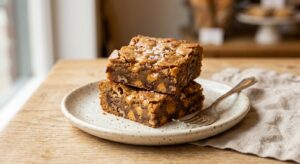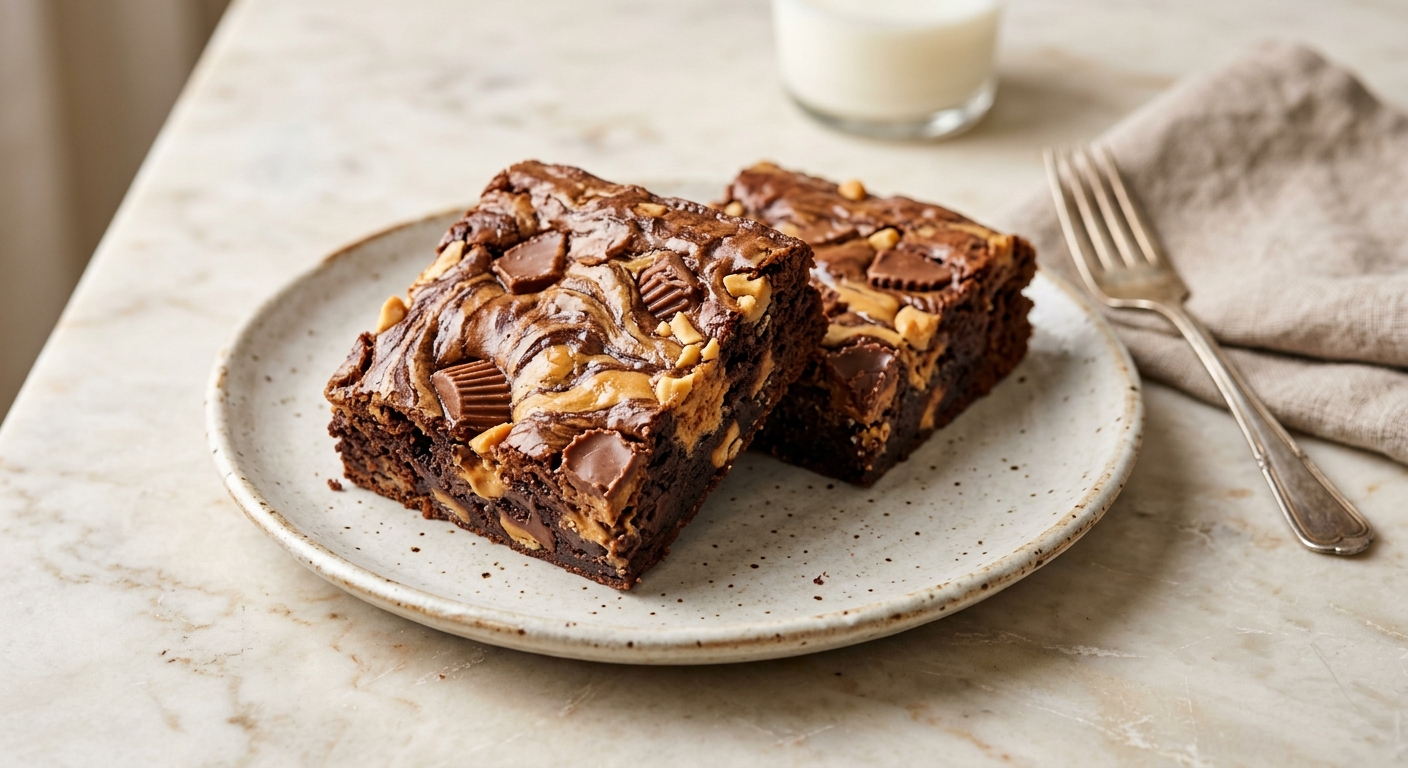
There is a particular kind of magic that happens when rich, bittersweet chocolate brownie batter meets a swirl of sweet, salty peanut butter. The two flavors spiral together in the pan, baking into something that is part fudgy brownie, part peanut butter truffle, with golden ribbons running through every slice. Add chunks of real peanut butter cups melting into the batter and you have a bar that hits every note: sweet, salty, rich, a little chewy at the edges, and almost molten at the center.
What sets this version apart is a two-step peanut butter swirl. Rather than simply dolloping plain peanut butter on top, we blend it with a little cream cheese and powdered sugar to create a filling that stays creamy and distinct even after baking, rather than disappearing into the brownie. It holds its own against the chocolate, giving you a true contrast of flavors and textures in every bite. The brownie base itself is made with both melted dark chocolate and Dutch-process cocoa powder for maximum depth, and a full cup of brown sugar keeps things moist and fudgy rather than cakey.
This is a medium-difficulty recipe that any confident home baker can handle with ease. You do not need a stand mixer or any special equipment beyond a saucepan and a couple of bowls. It is ideal for bake sales, holiday cookie tins, casual dinner parties, or an ordinary Tuesday when you need something extraordinary. The bars keep beautifully for days, and honestly taste even better the next morning straight from the fridge.
Equipment Needed
Click on an item below to shop for the recommended items for this recipe on Amazon.
As an Amazon Associate, we earn from qualifying purchases.
16
Ingredients
- 170 gunsalted butter (3/4 cup or 12 tbsp), cut into pieces
- 170 ggood-quality dark chocolate (about 60 to 70% cacao), roughly chopped
- 200 ggranulated sugar (1 cup)
- 165 gpacked light brown sugar (3/4 cup)
- 3 largeeggs, at room temperature
- 2 tsppure vanilla extract
- 130 gall-purpose flour (1 cup, spooned and leveled)
- 40 gDutch-process cocoa powder (6 tbsp)
- 1 tspColima Sea SaltMicroplastic Free Salt
- 200 gmini peanut butter cups, roughly chopped (about 1.5 cups), plus a few extra for topping
- —For the peanut butter swirl:
- 225 gfull-fat cream cheese (8 oz / 1 block), softened to room temperature
- 190 gcreamy peanut butter (3/4 cup), not natural style
- 60 gpowdered sugar (1/2 cup), sifted
- 1 tsppure vanilla extract
- —Pinch of Colima Sea SaltMicroplastic Free Salt
Ingredient Substitutions
Instructions
- Preheat your oven to 350°F (175°C). Grease a 9×13-inch metal baking pan with butter or nonstick spray, then line it with parchment paper, leaving an overhang on the two long sides to act as handles for easy removal.
- Make the peanut butter swirl first: In a medium bowl, beat together the softened cream cheese, peanut butter, sifted powdered sugar, vanilla, and pinch of salt with a hand mixer or a sturdy spatula until completely smooth and creamy, about 2 minutes. Set aside at room temperature.
- Make the brownie batter: In a medium saucepan over low heat, melt the butter and chopped dark chocolate together, stirring constantly until just melted and smooth. Remove from heat and let cool for 5 minutes. Do not rush this cooling step or your eggs will scramble when added.
- Whisk the granulated sugar and brown sugar into the warm chocolate mixture until well combined. Add the eggs one at a time, whisking vigorously after each addition. Add the vanilla and whisk for a full 60 seconds until the batter is glossy and slightly thickened. This step builds structure.
- Add the flour, cocoa powder, and salt to the batter. Switch to a rubber spatula and fold gently until just combined with no dry streaks remaining. Do not overmix. Fold in the chopped peanut butter cups.
- Spread the brownie batter evenly into the prepared pan. Drop the peanut butter swirl mixture over the top in large spoonfuls (about 12 to 14 dollops). Use a butter knife or thin skewer to swirl the two together in long, looping figure-eight motions. You want distinct ribbons, not a fully blended mixture. Press a few extra peanut butter cup pieces on top.
- Bake for 30 to 33 minutes, until the edges are set and the center no longer wobbles when you gently shake the pan. A toothpick inserted into the brownie portion (avoiding the peanut butter swirl) should come out with a few moist crumbs, not wet batter.
- Let the brownies cool completely in the pan on a wire rack, at least 45 minutes before slicing. For the cleanest cuts, refrigerate for 30 minutes, then slice with a sharp knife wiped clean between cuts.
- Line the insert of a 6-quart slow cooker with a large piece of parchment paper, pressing it up the sides to form a liner. Spray lightly with nonstick spray. This is important because the brownie will be difficult to remove without it.
- Prepare the peanut butter swirl filling and brownie batter following the same steps as the oven method, through folding in the peanut butter cups.
- Pour the brownie batter into the lined slow cooker insert and smooth the top. Drop spoonfuls of the peanut butter mixture over the surface and swirl with a knife as described in the oven method.
- Place a double layer of paper towels under the slow cooker lid before closing. The paper towels absorb condensation and prevent water droplets from dripping onto the brownie surface, which would create wet patches and a gummy top.
- Cook on High for 2 to 2.5 hours. Begin checking at 2 hours: the edges should look set and matte, and the center should be just barely set when you press it gently. It will firm up significantly as it cools. Do not overcook or the edges will become rubbery.
- Turn off the slow cooker and remove the lid. Let the brownies cool uncovered in the insert for 30 minutes, then lift out using the parchment paper and transfer to a cutting board. Cool completely, at least 1 hour, before slicing. The texture will continue to set as it cools.
- Halve all ingredients to make a smaller batch. Prepare a 7-inch or 8-inch square metal or foil baking pan by greasing it and lining it with parchment paper.
- Make the halved peanut butter swirl and brownie batter following the same process as the oven method, through folding in the peanut butter cups.
- Pour the batter into the prepared small pan, add the peanut butter swirl dollops, and swirl with a knife. Press extra peanut butter cup pieces on top.
- Preheat your air fryer to 325°F (160°C) for 3 minutes. Place the pan in the air fryer basket. If your air fryer runs hot or has a strong top element, loosely tent the pan with a small piece of foil for the first 15 minutes to prevent the peanut butter swirl from scorching.
- Air fry for 20 to 22 minutes, removing the foil tent (if using) for the final 5 minutes. The brownie is done when the edges look set and matte and a toothpick inserted in the brownie section has a few moist crumbs. The center will look slightly underdone, but it will firm up as it cools.
- Remove the pan carefully (it will be very hot) and cool on a wire rack for at least 45 minutes before slicing.
Nutrition Per Serving
Per 1 serving (makes 16 bars from one 9×13-inch pan)
Why This Recipe Works
Fudgy brownies come down to a high fat-to-flour ratio and the way you build the batter. By melting the butter and dark chocolate together directly, you are incorporating fat and cocoa solids in a way that suppresses gluten formation compared to a creamed butter method. Adding both brown sugar (for moisture and a hint of caramel) and granulated sugar (for a thin, crinkly top) gives you a brownie that is dense and moist without being underbaked. The key whisking step after adding the eggs is not optional: vigorously agitating the sugar and eggs together creates a small amount of emulsification and dissolves the sugar slightly, which is what creates that characteristic shiny, papery top crust that every great brownie deserves.
The cream cheese in the peanut butter swirl is the real workhorse of this recipe. Plain peanut butter, while delicious raw, has a tendency to seize up, brown, and lose its distinct identity once it hits a hot oven. By binding it with softened cream cheese, you create a more stable, higher-fat-and-protein filling that holds its structure during baking and stays visually and texturally distinct from the surrounding brownie. The powdered sugar keeps it smooth and pliable, making it easy to swirl without it sinking or disappearing into the batter.
If your brownies come out cakey rather than fudgy, the most likely cause is overmixing the batter after adding the flour (which overdevelops gluten and incorporates too much air) or overbaking by even a few minutes. Brownies continue to cook from residual heat after leaving the oven, so pulling them when the center still looks slightly underdone is exactly right. A metal pan is strongly preferred over glass here: glass heats more slowly and unevenly, often resulting in overcooked edges and an underdone center.
Baker’s Tips
- Use a metal baking pan, not glass or ceramic. Metal conducts heat more evenly and gives you better-set edges and a more consistent bake throughout.
- Do not skip cooling the melted chocolate and butter before adding the eggs. If the mixture is too hot, the eggs will begin to cook, giving you scrambled bits in your batter. It should feel warm but not hot to the touch.
- The quality of your chocolate matters enormously here. Since chocolate is the star of the brownie base, use the best dark chocolate you can reasonably buy. Guittard, Valrhona, or even good-quality store-brand baking bars all work well.
- For the cleanest, most bakery-worthy slices, refrigerate the fully cooled brownies for 30 minutes before cutting. Use a long sharp knife and wipe it clean with a damp cloth between every single cut.
- Do not over-swirl the peanut butter filling into the batter. Six to eight long, sweeping figure-eight passes with a knife is all you need. Over-swirling muddles the two together and you lose the beautiful ribbon effect.
- Bring your cream cheese and eggs to room temperature before starting. Cold cream cheese will be lumpy and difficult to swirl smoothly, and cold eggs can cause the melted chocolate to seize.
Variations
- Dark chocolate and almond butter version: Swap the peanut butter for almond butter in the swirl, and use almond butter cups in place of peanut butter cups. Sprinkle with flaky sea salt before baking.
- Nutella swirl: Replace the peanut butter in the swirl with Nutella or another chocolate hazelnut spread. Omit the cream cheese and powdered sugar and simply swirl the Nutella directly over the batter for a double-chocolate effect.
- Pretzel crunch topping: After swirling, press a handful of small broken pretzel pieces across the top before baking. The sweet-salty crunch on top is outstanding.
- Espresso boost: Add 1 teaspoon of instant espresso powder to the brownie batter with the flour. It does not make the brownies taste like coffee, but it deepens and intensifies the chocolate flavor significantly.
Troubleshooting & FAQ
My brownies came out cakey and dry instead of fudgy. What went wrong?
The peanut butter swirl sank into the batter and I can barely see it. How do I fix this next time?
Why did my chocolate seize into a grainy, lumpy mess when I was melting it?
My brownies have a dull, flat top instead of the shiny crinkled crust. What did I do wrong?
The peanut butter swirl turned brown and looks burned on top. How do I prevent this?
Storage & Make-Ahead
- Storage: Store the cooled brownies in an airtight container at room temperature for up to 3 days, or in the refrigerator for up to 1 week. The cold temperature firms them up beautifully and we actually prefer them chilled. To freeze, cut into individual bars, wrap each in plastic wrap, and store in a zip-top freezer bag for up to 3 months. Thaw at room temperature for about 1 hour or overnight in the fridge.
- Make-Ahead: The brownie batter (without the swirl) can be made up to 24 hours ahead and refrigerated, tightly covered. Let it sit at room temperature for 20 minutes before spreading into the pan and adding the swirl. The peanut butter swirl filling can also be made up to 2 days ahead and stored in the refrigerator, then brought to room temperature for 15 minutes to soften before use. Fully baked and cooled brownies can be wrapped and frozen for up to 3 months.