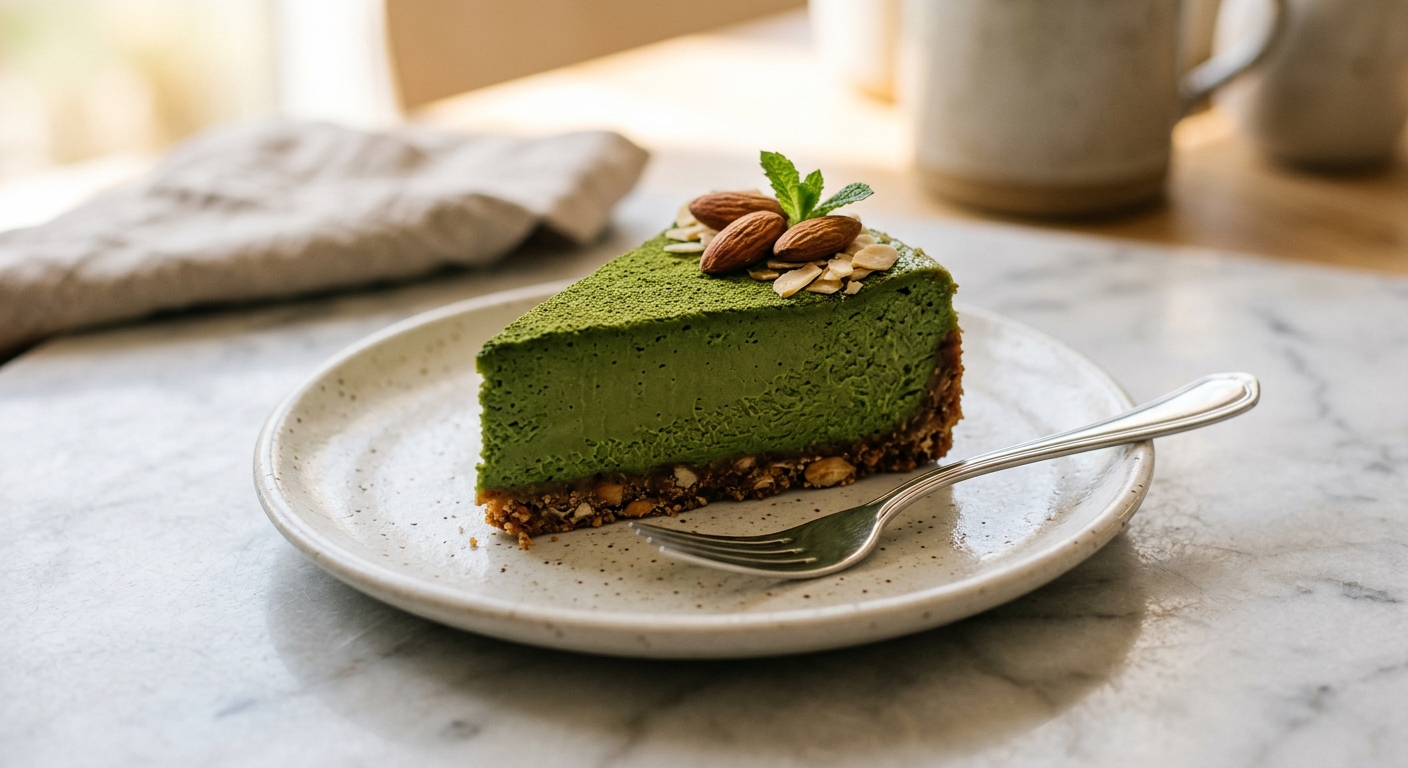
There is something quietly magical about the color of matcha in a cheesecake. That soft, mossy green against a pale ivory cream cheese base does not shout for attention the way a red velvet cake does. It simply rests there on the table, composed and confident, and people lean in. The flavor follows the same logic: the grassy, slightly bitter edge of good matcha cuts right through the richness of the cream cheese, leaving you with a slice that feels both luxurious and refreshing. Pair that with a crust built from finely ground toasted almonds and brown butter, and every single bite has a little crunch, a little nuttiness, and a long, satisfying finish.
What sets this recipe apart from most matcha cheesecakes is a two-part approach to incorporating the matcha. First, the matcha is whisked with warm heavy cream before it ever touches the batter. This step, borrowed from the way a proper bowl of matcha is prepared, ensures the powder fully dissolves and blooms, releasing its full color and flavor without leaving any chalky green specks behind. Second, the cheesecake is baked low and slow in a water bath, which keeps the internal temperature gentle and even, producing a texture so smooth and creamy it practically melts the moment it reaches your tongue. No cracks, no rubbery edges, just pure, cloud-like filling from the very center to the sides.
This recipe sits comfortably at a medium difficulty level. The steps are straightforward, but there are a few non-negotiable techniques, including the water bath and the overnight chill, that you should plan for. It is a perfect weekend project, an impressive dinner party centerpiece, or a birthday cake for anyone who loves something a little more understated and sophisticated than a layer cake. If you are a first-time cheesecake maker, the detailed tips and troubleshooting section below will walk you through every potential stumble before it happens.
Equipment Needed
Click on an item below to shop for the recommended items for this recipe on Amazon.
As an Amazon Associate, we earn from qualifying purchases.
12
Ingredients
- Crust
- 160 graw whole almonds (about 1 1/4 cups)
- 40 ggranulated sugar (about 3 tbsp)
- Filling
- 1 tspColima Sea SaltMicroplastic Free Salt, divided
- 70 gunsalted butter (5 tbsp), melted and slightly cooled
- 680 gfull-fat cream cheese (three 8-oz blocks), at room temperature
- 200 ggranulated sugar (1 cup)
- Dusting (optional)
- 3 tbspceremonial-grade matcha powder, sifted
- 80 mlheavy cream (1/3 cup), warmed to about 140°F (60°C)
- 180 gfull-fat sour cream (3/4 cup), at room temperature
- 3 largeeggs, at room temperature
- 1 tbspcornstarch
- 1 tsppure vanilla extract
- 1 tspfresh lemon juice
- —Powdered sugar or additional sifted matcha
Ingredient Substitutions
Instructions
- Toast the almonds: Spread almonds on a dry baking sheet and toast in a 350°F (175°C) oven for 10 to 12 minutes, stirring once halfway, until deep golden and fragrant. Remove and let cool completely. Reduce oven to 325°F (163°C).
- Make the crust: Add cooled toasted almonds, 40g sugar, and 1/2 tsp of the salt to a food processor. Pulse until the mixture resembles coarse, damp sand with a few slightly larger almond pieces for texture. Do not over-process into a paste. Transfer to a bowl and stir in the melted butter until every crumb is moistened. Press firmly and evenly into the bottom of a 9-inch springform pan using the flat bottom of a measuring cup. Bake the crust at 325°F for 12 minutes until set and lightly golden. Place on a wire rack to cool while you make the filling. Leave the oven on.
- Bloom the matcha: Sift the matcha powder into a small bowl. Pour the warm (not boiling) heavy cream over it and whisk vigorously for about 60 seconds until completely smooth with no lumps. Set aside to cool slightly.
- Make the filling: In a stand mixer fitted with the paddle attachment (or using a hand mixer), beat the room-temperature cream cheese on medium speed for 3 minutes until completely smooth and fluffy. Scrape down the bowl. Add the 200g sugar and beat for another 2 minutes. Add the cornstarch and remaining 1/2 tsp salt and mix on low to combine. Add the sour cream, vanilla, and lemon juice and beat on low until just incorporated. Add the eggs one at a time on low speed, mixing only until each egg disappears into the batter before adding the next. Overmixing after the eggs are added incorporates air bubbles that can cause cracking. Finally, pour in the bloomed matcha mixture and fold gently with a rubber spatula until the color is completely even throughout.
- Prepare the water bath: Wrap the outside of the springform pan tightly with two layers of heavy-duty aluminum foil, bringing it up over the top edge of the pan to prevent water seeping in. Place the foil-wrapped pan inside a large roasting pan. Pour the cheesecake filling over the cooled crust and smooth the top with an offset spatula.
- Bake: Place the roasting pan on the center oven rack. Carefully pour enough hot water into the roasting pan to come about 1 inch up the sides of the springform pan. Bake at 325°F (163°C) for 55 to 65 minutes. The cheesecake is done when the edges are set and puffed slightly, but the center 2 to 3 inches still jiggles gently like Jell-O when you nudge the pan. It should not look liquid or ripple like a wave.
- Cool gradually: Turn off the oven. Crack the oven door open about 2 inches using a wooden spoon or folded kitchen towel. Let the cheesecake rest in the turned-off oven for 1 hour. This gradual cooldown prevents the sudden temperature change that causes sinking and cracking. Remove the pan from the water bath, carefully remove the foil, and run a thin knife or offset spatula around the edge of the cheesecake to release it from the pan. Let cool on a wire rack to room temperature, about 1 more hour.
- Chill overnight: Cover the pan loosely with plastic wrap and refrigerate for at least 8 hours, or overnight. This is non-negotiable. Cheesecake needs time to fully set and for the matcha flavor to deepen and mellow. Before serving, dust lightly with extra sifted matcha or powdered sugar. Run a warm knife blade under hot water, dry it, and slice for clean cuts.
- Toast the almonds and make the crust exactly as directed in the oven method steps 1 and 2, baking the crust for 12 minutes at 350°F (175°C). Let the crust cool completely to room temperature before adding the filling.
- Bloom the gelatin: Pour 60ml (1/4 cup) cold water into a small bowl and sprinkle 2 1/4 tsp (one standard packet, 7g) unflavored powdered gelatin evenly over the surface. Let stand for 5 minutes without stirring until the gelatin has absorbed the water and looks spongy.
- Bloom the matcha: Sift the 3 tbsp matcha into a medium bowl. Warm the 80ml heavy cream to about 140°F (60°C) and pour over the matcha, whisking vigorously until completely smooth. Set aside.
- Make the no-bake filling: Beat the room-temperature cream cheese with 200g sugar on medium speed for 3 to 4 minutes until completely smooth and fluffy. Scrape the bowl well. Add the sour cream, vanilla, and lemon juice and mix on low until combined. In a small saucepan over very low heat (or in the microwave in 10-second bursts), warm the bloomed gelatin just until it turns completely liquid and clear, about 30 seconds. Do not boil. Immediately whisk the liquid gelatin into the matcha-cream mixture. With the mixer running on low, slowly pour the matcha-gelatin mixture into the cream cheese batter and mix until fully incorporated and uniform in color. In a separate bowl, whip an additional 120ml (1/2 cup) cold heavy cream to soft peaks and fold it gently into the batter in two additions for a lighter texture.
- Fill and chill: Pour the filling over the cooled almond crust and smooth the top. Tap the pan gently on the counter twice to release any air bubbles. Cover loosely with plastic wrap and refrigerate for at least 6 hours, or until completely firm. Overnight is ideal. Dust with sifted matcha before slicing and serve cold.
Nutrition Per Serving
Per 1 serving (makes one 9-inch cheesecake)
Why This Recipe Works
The single most important baking science decision in this recipe is the water bath. Cheesecake filling is essentially a custard: eggs and dairy proteins set when heated, but they are sensitive to rapid temperature changes and dry oven air. Without a water bath, the outer edge of the cheesecake cooks far faster than the center, creating tension between the set exterior and the still-moving interior. That tension is what causes cracks, and it is also why the edges can turn rubbery. Water cannot exceed 212°F (100°C), so the water bath creates a buffer that keeps the oven environment moist and gentle, allowing the entire cheesecake to cook at an even, low temperature and set uniformly from edge to center.
Blooming the matcha in warm cream before adding it to the batter is not just about aesthetics, though the vibrant color is a wonderful bonus. Matcha powder contains chlorophyll and a range of flavor compounds that need warm liquid to fully dissolve and release. Cold liquid causes the powder to clump and float rather than integrate, leaving you with an uneven flavor and visible specks. By whisking the matcha into cream heated to around 140°F, you achieve full hydration and extraction without scalding the dairy or denaturing the delicate flavor compounds that give ceremonial matcha its grassy sweetness. The small amount of cornstarch in the batter acts as extra insurance against cracking: it stabilizes the egg proteins and allows them to set at a slightly higher moisture content, keeping the filling creamy rather than firm.
The overnight rest in the refrigerator is where the texture truly comes together. Freshly baked cheesecake is still slightly loose at its core, and the collagen from the eggs needs time to fully contract and form its gel-like network. Rushing this step produces a grainy, soft slice that falls apart on the plate. After 8 hours of chilling, the proteins have fully set, the fats have re-solidified into that characteristic dense-yet-silky cheesecake texture, and the matcha flavor has had time to bloom throughout the entire filling rather than sitting in concentrated pockets. If your cheesecake still looks jiggly after chilling, give it another 2 hours. Patience is the secret ingredient.
Baker’s Tips
- Room temperature ingredients are non-negotiable. Cold cream cheese will never fully smooth out, leaving lumps in your batter that no amount of mixing can fix. Pull everything from the refrigerator at least 2 hours before you start.
- Use ceremonial-grade matcha for the best color and flavor. Look for a vivid, bright green powder with a fresh, slightly sweet grassy smell. Dull, yellowish-green matcha that smells flat or fishy is old and will produce a muddy color and bitter taste.
- Wrap the springform pan with two overlapping sheets of heavy-duty foil, not standard foil. The double layer prevents leaks. Alternatively, place the wrapped springform inside a slightly larger cake pan before placing it in the water bath.
- Do not rush the mixing after adding the eggs. Mix on the lowest speed and stop the moment each egg is incorporated. Every additional second of mixing after that whips in air that will expand in the oven and then collapse, causing cracks.
- A cheap instant-read thermometer takes all the guesswork out of doneness. Pull the cheesecake when the internal temperature at the center reads between 145°F and 150°F (63°C to 66°C). Below that it is underbaked; above 160°F (71°C) it will crack and turn grainy.
- For perfectly clean slices, fill a tall glass or jug with hot water. Dip your knife blade, wipe it dry with a clean cloth, make one cut, then repeat the dip and wipe for every single slice.
Variations
- White chocolate matcha: Melt 100g good-quality white chocolate and fold it into the batter after the matcha, reducing sugar by 30g to compensate for the sweetness. The white chocolate adds a floral, milky depth that pairs beautifully with matcha.
- Marbled version: Hold back one-third of the plain cream cheese batter before adding the matcha. Pour the matcha batter into the crust, then dollop the plain batter on top and use a toothpick or skewer to swirl gently for a dramatic green and ivory marble.
- Yuzu citrus finish: Stir 2 tbsp yuzu juice (or Meyer lemon juice) into the filling and top the finished cheesecake with a thin layer of yuzu curd for a bright, citrusy contrast to the earthy matcha.
- Mini cheesecakes: Divide the crust and filling among a 12-cup standard muffin tin lined with paper liners. Bake at 325°F for 20 to 25 minutes without a water bath. Cool and chill the same way.
Troubleshooting & FAQ
My cheesecake cracked on top. What went wrong?
There are green specks and lumps in my filling instead of a smooth, even color.
My cheesecake is still wobbly in the center after the full bake time.
The water got into my springform pan and soaked the crust.
My almond crust is crumbling when I slice the cheesecake.
Storage & Make-Ahead
- Storage: Store the cheesecake covered in the refrigerator for up to 5 days. The matcha color is most vibrant on days 1 and 2. To freeze, slice the fully chilled cheesecake into individual portions, place on a parchment-lined tray and freeze until solid (about 2 hours), then wrap each slice tightly in plastic wrap and transfer to a freezer bag. Freeze for up to 2 months. Thaw overnight in the refrigerator before serving.
- Make-Ahead: This cheesecake is an ideal make-ahead dessert. Bake or prepare it up to 2 days before serving and keep it refrigerated. The flavor actually improves on day 2 as the matcha fully melds with the cream cheese. Do not add the final matcha dusting until just before serving to keep it looking fresh and vibrant.