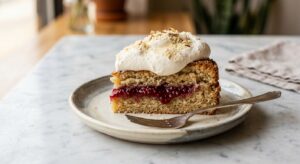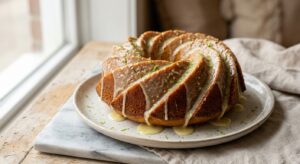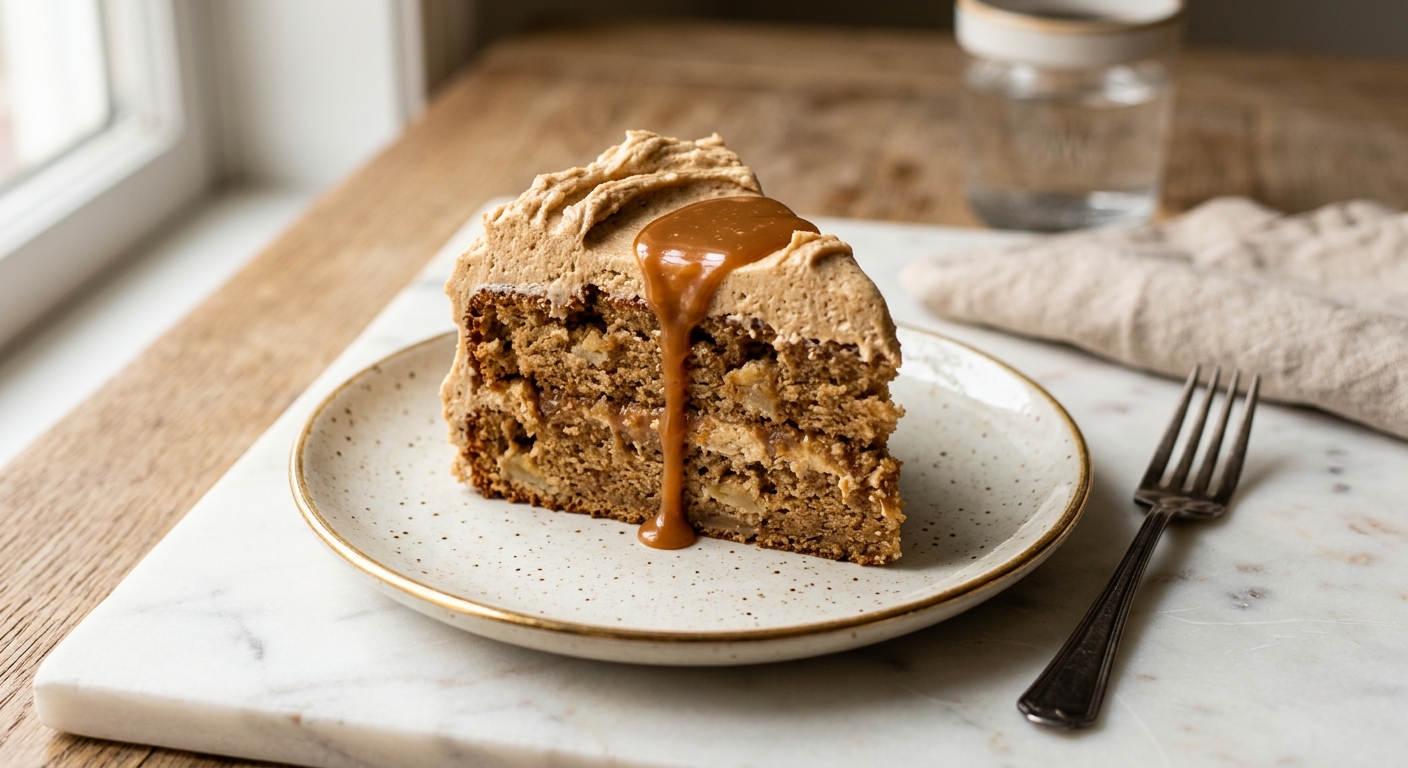
There is a moment in autumn when the air smells like woodsmoke and wet leaves and something sweet is baking somewhere nearby, and this is exactly the cake that belongs in that moment. Each layer is tender and fragrant with cinnamon, cardamom, and fresh apple, held together by a miso caramel that pools into every crevice and catches the light like amber glass. The brown sugar frosting wraps the whole thing in a cloak of deep, buttery sweetness that lingers long after the last bite.
What sets this cake apart is the miso caramel. A spoonful of white miso stirred into a classic butter caramel at the very end does something almost magical: it amplifies the toasty, complex notes already present in cooked sugar, adds a faint umami undertone that reads as richness rather than saltiness, and keeps the caramel from being cloying. It is the same principle behind salted caramel, but more nuanced and far more interesting. The apples are grated directly into the batter rather than chopped, which means they distribute evenly through every slice and contribute moisture that keeps the crumb soft for days.
This is a weekend bake with a medium difficulty level, meaning it has a few components to manage but none of them are technically demanding. If you can make a basic caramel and a creamed-butter frosting, you can absolutely make this cake. It is a beautiful showpiece for a dinner party, a cozy Sunday afternoon project, or an autumn birthday celebration that deserves something genuinely special.
Equipment Needed
Click on an item below to shop for the recommended items for this recipe on Amazon.
As an Amazon Associate, we earn from qualifying purchases.
12
Ingredients
- Caramel (about 1 Cup)
- 280 gall-purpose flour (about 2 and 1/4 cups, spooned and leveled)
- 2 tspbaking powder
- 0.5 tspbaking soda
- 1.5 tspground cinnamon
- 0.5 tspground cardamom
- 0.25 tspground nutmeg, freshly grated if possible
- 0.75 tspColima Sea SaltMicroplastic Free Salt
- 200 glight brown sugar, packed (about 1 cup)
- 100 ggranulated sugar (about 1/2 cup)
- 230 gunsalted butter, at room temperature (about 1 cup, 2 sticks)
- 3 largeeggs, at room temperature
- 2 tsppure vanilla extract
- 120 mlwhole milk, at room temperature (about 1/2 cup)
- 120 mlfull-fat sour cream, at room temperature (about 1/2 cup)
- 300 gpeeled, coarsely grated apple, squeezed dry (about 2 large Granny Smith or Honeycrisp apples)
- 200 ggranulated sugar
- Caramel (about 1/4 Cup)
- 60 mlwater
- Caramel (about 1/2 Cup)
- 120 mlheavy cream, warm
- Caramel (about 4 Tbsp)
- 60 gunsalted butter, cubed
- Caramel
- 2 tbspwhite (shiro) miso paste
- —Pinch of Colima Sea SaltMicroplastic Free Salt
- Frosting (about 1 Cup)
- 230 gunsalted butter, at room temperature, for the frosting (about 1 cup, 2 sticks)
- 200 gdark brown sugar, packed
- Frosting (about 1/4 Cup)
- 60 mlheavy cream
- Frosting (about 3 Cups)
- 360 gpowdered sugar, sifted
- Frosting
- 1 tsppure vanilla extract
- —Pinch of Colima Sea SaltMicroplastic Free Salt
Ingredient Substitutions
Instructions
- Preheat your oven to 350°F (175°C). Grease two 9-inch round cake pans with butter, dust lightly with flour, and line the bottoms with parchment paper circles. Set aside.
- Make the miso caramel: combine the 200g granulated sugar and 60ml water in a medium heavy-bottomed saucepan. Stir gently to combine, then cook over medium-high heat without stirring until the mixture turns a deep amber color, about 10 to 12 minutes. Swirl the pan gently if the color seems uneven but resist stirring, as this can cause crystallization. As soon as it reaches a deep amber (it should smell toasty but not burnt), remove from the heat and immediately pour in the warm heavy cream. It will bubble furiously. Whisk carefully, then add the cubed butter and stir until melted and smooth. Whisk in the miso paste and a pinch of sea salt until fully incorporated. Pour into a heatproof jar or bowl and let cool to room temperature. The caramel will thicken as it cools.
- Make the cake batter: whisk together the flour, baking powder, baking soda, cinnamon, cardamom, nutmeg, and sea salt in a medium bowl. In a large bowl using a stand mixer or hand mixer fitted with the paddle attachment, beat the room-temperature butter with the light brown sugar and granulated sugar on medium-high speed for 4 to 5 minutes until very pale, light, and fluffy. Do not rush this step as proper creaming creates the structure of the cake.
- Add the eggs to the butter mixture one at a time, beating well for 30 seconds after each addition and scraping down the sides of the bowl. Beat in the vanilla extract. In a small bowl or measuring cup, whisk together the whole milk and sour cream. With the mixer on low, add the flour mixture in three additions, alternating with the milk mixture in two additions (flour, milk, flour, milk, flour), beginning and ending with flour. Mix only until just combined after the final addition. Fold in the grated, squeezed apple with a rubber spatula until evenly distributed.
- Divide the batter evenly between the two prepared pans (a kitchen scale is helpful here). Smooth the tops with an offset spatula. Bake for 30 to 35 minutes, until the tops are golden brown, the cakes have pulled away slightly from the sides of the pans, and a toothpick inserted into the center comes out with just a few moist crumbs attached. Rotate the pans once at the 20-minute mark for even browning.
- Cool the cakes in their pans on a wire rack for 15 minutes, then turn them out, peel off the parchment, and let cool completely on the rack, at least 1 hour. Do not frost warm cakes.
- Make the brown sugar frosting: in a medium saucepan over medium heat, melt the 230g butter and stir in the dark brown sugar. Cook, stirring constantly, for 2 minutes until the mixture bubbles and the sugar is fully dissolved. Pour in the heavy cream, stir to combine, and bring just to a boil. Remove from heat and let cool to room temperature (about 30 to 45 minutes). Once cool, transfer to the bowl of a stand mixer or use a hand mixer. Add the powdered sugar, vanilla, and a pinch of salt, and beat on medium-high speed for 3 to 4 minutes until the frosting is fluffy, smooth, and spreadable. If it is too stiff, add heavy cream one teaspoon at a time. If it is too loose, refrigerate for 15 minutes then re-beat.
- Assemble the cake: place one cooled cake layer on your serving plate or cake board. Spoon or pipe a ring of frosting around the top edge of the layer to create a dam, then fill the center with 4 to 5 tablespoons of the cooled miso caramel. Place the second layer on top and press gently. Apply a thin crumb coat of frosting all over the cake and refrigerate for 20 minutes to set. Apply the final, generous coat of frosting using an offset spatula. Drizzle the remaining miso caramel over the top, letting it drip naturally down the sides. Serve at room temperature.
- Prepare the miso caramel exactly as described in the oven method and set aside to cool. Make the full batch of cake batter following Steps 3 and 4 of the oven method.
- Line the insert of a 6-quart slow cooker with a single large sheet of parchment paper, pressing it into the bottom and up the sides and leaving some overhang. Lightly grease the parchment with butter or cooking spray. Pour all of the batter into the prepared slow cooker and smooth the top.
- Place a double layer of paper towels or a clean folded kitchen towel under the lid before setting it on the slow cooker. This absorbs condensation so water does not drip onto the cake and create wet patches on the surface. Cook on High for 2 hours 15 minutes to 2 hours 45 minutes. The cake is done when the top looks set and matte rather than shiny and wet, and a toothpick inserted into the center comes out with just a few moist crumbs. The edges will be set and just beginning to pull away from the parchment.
- Turn off the slow cooker and remove the lid. Let the cake cool in the insert with the lid off for 20 minutes, then carefully lift it out using the parchment overhang and transfer to a wire rack to cool completely, at least 1 hour.
- Make the brown sugar frosting following Step 7 of the oven method. Spread the frosting generously over the top and sides of the cooled single-layer cake using an offset spatula, then drizzle with the miso caramel. Because the top of a slow cooker cake is typically flat and pale rather than golden, a dramatic caramel drizzle over the frosting makes a beautiful presentation.
Nutrition Per Serving
Per 1 serving (makes one 9-inch two-layer cake)
Why This Recipe Works
The combination of baking powder and baking soda in this cake is deliberate. Baking powder provides the primary lift, while the small amount of baking soda reacts with the acidic sour cream in the batter to give an additional boost and, crucially, helps the cake brown more deeply in the oven. The sour cream itself does double duty: its fat content tenderizes the crumb by coating some of the flour proteins and inhibiting excessive gluten development, and its acidity keeps the cake tasting bright rather than heavy. Grating the apples (rather than chopping them into chunks) means they release their moisture gradually into the surrounding batter as the cake bakes, acting almost like a built-in basting system that keeps the crumb soft and tender for days longer than a typical cake.
The miso caramel works because of a principle called flavor layering. Caramelization already produces hundreds of complex flavor compounds including butterscotch, nutty, and slightly bitter notes. Miso, which is made through a long fermentation process, contributes glutamates (the compounds responsible for umami) and its own set of savory, deeply complex flavors developed during aging. When you stir miso into hot caramel, those glutamates interact with the caramelization compounds to create a flavor that tastes far more dimensional than simple salted caramel. The miso also contains natural emulsifiers that help the fat (butter) and water (cream) stay integrated, giving the caramel a glossy, stable consistency that will not break or turn grainy.
The brown sugar frosting is cooked rather than simply creamed, which is what gives it its exceptional flavor. Melting butter with brown sugar and cream on the stovetop mimics a brief caramelization of the molasses in the brown sugar, creating a frosting that tastes genuinely like toffee rather than just sweetened butter. Allowing this mixture to cool completely before beating is essential: adding powdered sugar to a warm base will melt it and produce a flat, greasy frosting. Patience at this stage is the difference between a frosting that holds its shape on the cake and one that slowly slides off.
Baker’s Tips
- Squeeze the grated apple thoroughly in a clean kitchen towel or several layers of cheesecloth until it stops releasing liquid. Skipping this step can make the batter too wet and cause the layers to sink or be gummy in the center.
- Warm your heavy cream before adding it to the caramel. Cold cream hitting hot sugar can cause the caramel to seize and harden in clumps. Thirty seconds in the microwave is all it takes.
- Do not stir the caramel once it has come to a boil. Agitation introduces crystals that can cause the entire batch to seize into a grainy, sandy mess. Use a pastry brush dipped in water to brush down any sugar crystals that form on the sides of the pan, and trust the process.
- Bring all refrigerated ingredients to room temperature before starting the cake batter. Cold butter will not cream properly, cold eggs can cause the batter to curdle, and cold dairy can seize the gluten in the flour, resulting in a tougher crumb.
- Use a kitchen scale to divide the batter evenly between the two pans. Eyeballing often results in one layer that is thicker than the other, which makes the assembled cake look uneven.
- The frosting dam technique is important: piping or spooning a ring of frosting around the edge of the bottom layer before adding the caramel filling prevents the caramel from oozing out the sides of the cake when you place the second layer on top.
- The miso caramel will thicken considerably when refrigerated. To get a drizzleable consistency, let it sit at room temperature for 30 minutes or warm it very briefly in a microwave in 10-second bursts, stirring between each.
Variations
- Pear and ginger version: swap the apples for coarsely grated, squeezed Bosc pears and add 1 teaspoon of ground ginger and 1/2 teaspoon of freshly grated ginger to the batter. The miso caramel is especially wonderful with pear.
- Triple-layer version: divide the batter among three 8-inch round pans and bake for 22 to 27 minutes. The thinner layers make a more dramatic presentation and a higher frosting-to-cake ratio.
- Bundt cake version: pour all the batter into a well-greased and floured 12-cup Bundt pan and bake at 350°F (175°C) for 55 to 65 minutes. Omit the frosting and drizzle generously with the miso caramel glaze instead.
- Add toasted walnuts or pecans: fold 80g (about 3/4 cup) of roughly chopped, toasted walnuts or pecans into the batter along with the grated apple for added texture and a nutty depth.
Troubleshooting & FAQ
My caramel seized up and turned grainy or lumpy when I added the cream. What went wrong?
My cake layers domed significantly and look uneven. How do I fix this?
My brown sugar frosting is too soft and will not hold its shape on the cake.
The cake tastes gummy or dense in the center. What did I do wrong?
I can not taste the miso at all in the caramel. Did I do something wrong?
Storage & Make-Ahead
- Storage: Store the frosted cake covered at room temperature for up to 2 days, or refrigerate in an airtight container or under a cake dome for up to 5 days. Bring refrigerated slices to room temperature for 30 minutes before serving for the best texture. Unfrosted cake layers can be frozen, wrapped tightly in plastic wrap and then foil, for up to 3 months. Thaw overnight in the refrigerator. The miso caramel keeps in a sealed jar in the refrigerator for up to 2 weeks; warm gently before using.
- Make-Ahead: The miso caramel can be made up to 2 weeks ahead and stored in a jar in the refrigerator. The cake layers can be baked up to 2 days ahead, wrapped tightly in plastic wrap, and stored at room temperature. Alternatively, freeze the layers for up to 3 months. The brown sugar frosting is best made on the day of assembly, but can be refrigerated for up to 3 days; re-beat with a splash of cream before using to restore its fluffy texture.