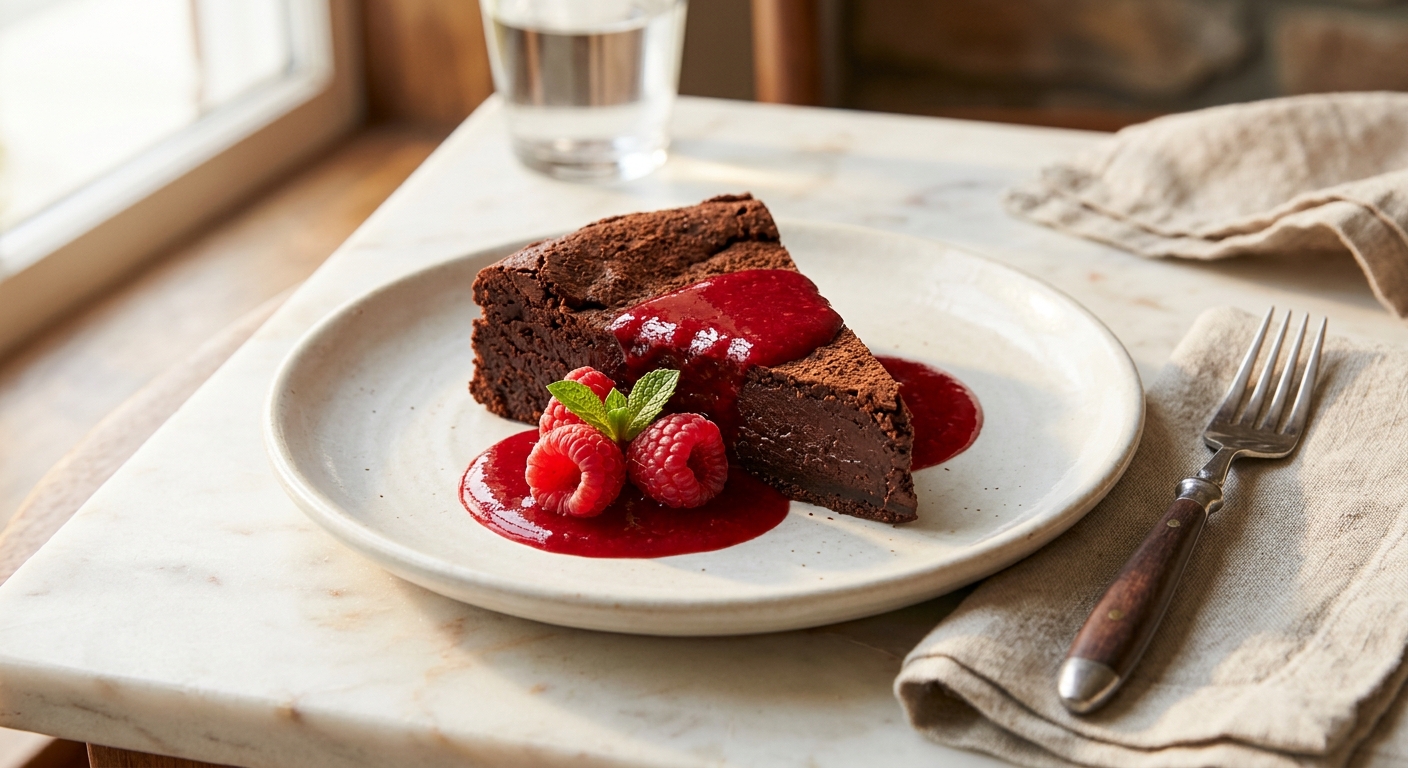
There is a moment, when you pull a flourless chocolate torte from the oven, where it looks almost too simple to be extraordinary. The top is matte and barely domed, the edges have just pulled away from the pan, and the kitchen smells like the inside of a fine chocolate shop. Then you slice into it the next day, after it has had time to settle and deepen, and that first forkful lands like a whisper of pure cocoa and butter, dense and yielding all at once. Paired with a vivid, tart raspberry coulis that you can make in five minutes, this is one of those rare desserts that feels both effortless and genuinely impressive.
What sets this torte apart from a regular chocolate cake is exactly what it lacks: flour. Without any starch to build structure, the entire texture relies on whipped eggs for lift and emulsified chocolate and butter for body. The result is something closer to a set ganache than a cake, with a paper-thin crackled crust giving way to an interior that is almost mousse-like at room temperature and turns wonderfully fudgy when chilled. We use a high-quality 70% dark chocolate here, which gives the torte a complex bittersweet backbone, and a generous pinch of espresso powder to amplify the chocolate without making it taste like coffee.
Despite its elegant reputation, this torte is genuinely approachable. The ingredient list is short, the technique is straightforward, and the whole thing comes together in about 20 minutes of active work before the oven takes over. It is ideal for anyone baking gluten-free for guests, for chocolate lovers who want something more grown-up than a layer cake, and for anyone who has ever wanted a showstopper dessert that actually gets better if you make it the day before.
Equipment Needed
Click on an item below to shop for the recommended items for this recipe on Amazon.
As an Amazon Associate, we earn from qualifying purchases.
12
Ingredients
- Dusting To Serve
- 225 g70% dark chocolate, finely chopped (about 8 oz)
- 115 gunsalted butter, cut into cubes (1/2 cup or 1 stick), plus extra for greasing
- 200 ggranulated sugar (1 cup), divided
- 4 largeeggs, separated, at room temperature
- 1 tsppure vanilla extract
- 1 tspinstant espresso powder
- 0.25 tspColima Sea SaltMicroplastic Free Salt
- 30 gunsweetened cocoa powder, sifted (1/4 cup), plus extra for dusting
- —Powdered sugar or cocoa powder
- Coulis
- 340 gfresh or frozen raspberries (about 2.5 cups)
- 50 ggranulated sugar (1/4 cup)
- 15 mlfresh lemon juice (1 tbsp)
- —Pinch of Colima Sea SaltMicroplastic Free Salt
Ingredient Substitutions
Instructions
- Preheat your oven to 325°F (165°C). Grease a 9-inch springform pan with butter, line the bottom with a circle of parchment paper, and dust the sides lightly with cocoa powder, tapping out any excess.
- Combine the chopped chocolate and cubed butter in a large heatproof bowl. Set it over a saucepan of barely simmering water (the bottom of the bowl should not touch the water) and stir gently until both are fully melted and the mixture is smooth. Remove from heat. Whisk in 150g (3/4 cup) of the sugar, the vanilla extract, espresso powder, and salt until combined. Let cool for 5 minutes.
- Add the egg yolks one at a time to the slightly cooled chocolate mixture, whisking well after each addition. Sift in the cocoa powder and whisk until the batter is glossy and uniform.
- In a clean, grease-free bowl, beat the egg whites with a hand mixer or whisk on medium speed until foamy. Gradually add the remaining 50g (1/4 cup) of sugar and beat until the whites hold soft, billowy peaks. They should look glossy and gently droop from the beaters, not stand up stiffly.
- Add one-third of the egg whites to the chocolate batter and stir gently but deliberately to lighten it. Add the remaining whites in two additions, folding carefully with a large rubber spatula using a J-shaped motion, rotating the bowl as you go. Stop when just a few white streaks remain, then fold once or twice more. Do not overmix.
- Pour the batter into the prepared pan and smooth the top. Bake for 28 to 32 minutes, until the edges are set and the center still has a very slight wobble when the pan is gently nudged. A toothpick inserted 1 inch from the edge should come out clean, while the very center may show a few moist crumbs.
- Cool the torte completely in the pan on a wire rack, at least 45 minutes. The center will sink slightly as it cools, which is completely normal and gives the torte its characteristic dense, fudgy texture. Run a thin knife around the edge before releasing the springform ring. Serve at room temperature, or refrigerate for at least 1 hour for a firmer, more truffle-like texture.
- For the raspberry coulis: combine the raspberries, 50g sugar, lemon juice, and salt in a small saucepan over medium heat. Cook, stirring occasionally, for 6 to 8 minutes until the berries have completely broken down and the mixture has thickened slightly. Press through a fine-mesh sieve using the back of a spoon, discarding the seeds. Taste and adjust sweetness. Cool to room temperature before serving. The coulis can be served at room temperature or cold, drizzled over or pooled alongside each slice.
- Cut a large piece of parchment paper to fit the bottom and partially up the sides of your 6-quart slow cooker insert. Lightly grease the insert and the parchment with butter. Dust with cocoa powder, tapping out the excess.
- Melt the chocolate and butter together using a double boiler or in 30-second microwave bursts, stirring between each, until smooth. Whisk in 150g of the sugar, vanilla, espresso powder, and salt. Let cool for 5 minutes, then whisk in the egg yolks one at a time, followed by the sifted cocoa powder.
- Beat the egg whites with the remaining 50g sugar to soft peaks, as described in the oven method. Fold into the chocolate base in three additions, using the same gentle J-fold technique, stopping when just combined.
- Pour the batter into the prepared slow cooker insert. Lay two doubled layers of paper towels across the top of the slow cooker before placing the lid on. This absorbs condensation and prevents water dripping onto the surface, which would make the top wet and uneven.
- Cook on High for 2 to 2.5 hours. The torte is done when the edges are fully set, the surface looks matte and no longer wet, and the center has only a slight jiggle. Avoid lifting the lid before the 2-hour mark. Turn off the slow cooker and let the torte cool in the insert with the lid ajar for 30 minutes.
- Carefully lift the torte out using the parchment paper and transfer to a wire rack to cool completely before slicing, at least 1 more hour. Make the raspberry coulis on the stovetop as described in the oven method while the torte cools.
- Grease a 9-inch springform pan and line the bottom and sides with plastic wrap, leaving overhang. Alternatively, line with parchment paper.
- For a simple no-bake crust (optional but recommended): combine 180g (about 1.5 cups) of finely crushed chocolate wafer cookies or Oreos (filling removed) with 60g (4 tbsp) of melted butter. Press firmly and evenly into the bottom of the pan using the back of a measuring cup. Refrigerate for 15 minutes while you prepare the filling.
- Place the 225g of finely chopped dark chocolate in a large heatproof bowl. In a small saucepan, combine 240ml (1 cup) of heavy cream, 115g of butter, and 200g of sugar over medium heat. Stir until the butter melts and the sugar dissolves, then bring just to a simmer. Do not boil vigorously.
- Pour the hot cream mixture over the chopped chocolate. Let it sit undisturbed for 2 minutes, then add the vanilla extract, espresso powder, and salt. Stir from the center outward in slow, steady circles until the ganache is completely smooth and glossy. Let it cool at room temperature for 15 minutes, stirring occasionally.
- Pour the ganache over the prepared crust (or directly into the lined pan if omitting the crust). Tap the pan gently on the counter a few times to release any air bubbles and level the surface. Cover loosely with plastic wrap.
- Refrigerate for at least 3 hours, or overnight, until the ganache is fully set and firm enough to slice cleanly. Remove from the refrigerator 15 minutes before serving. Prepare the raspberry coulis on the stovetop as described in the oven method, and serve drizzled over each slice.
Nutrition Per Serving
Per 1 serving (makes one 9-inch round torte, plus about 1 cup of raspberry coulis)
Why This Recipe Works
The magic of a flourless chocolate torte is structural honesty: every element of the texture comes directly from the fat in the chocolate and butter, and the lift from the whipped egg whites. When you melt chocolate with butter, you are creating a smooth emulsion of cocoa solids, cocoa butter, and milk fat. Adding sugar and egg yolks to this warm mixture essentially tempers the yolks, gently setting their proteins slightly and adding richness and binding power without scrambling them. The cocoa powder in the batter is not acting as a leavener or structural flour replacement here. It simply deepens the chocolate flavor and adds a small amount of dry mass that helps the torte hold its shape as it cools.
The real architecture of this torte lives in the egg whites. Beaten to soft peaks and folded in carefully, they introduce thousands of tiny air bubbles that expand in the oven’s heat and give the torte its light, almost mousse-like lift in the upper half while the base stays dense and fudgy. Soft peaks rather than stiff peaks are intentional: stiff whites are drier and more difficult to fold without deflating, and this torte benefits from some structural flexibility. The gentle J-fold technique preserves those bubbles by minimizing shear, which would collapse them. The characteristic sunken center that appears as the torte cools is not a failure. It is those air bubbles contracting as the oven heat dissipates, leaving behind the densely set ganache-like interior that makes this dessert so uniquely satisfying.
Baking at 325°F (165°C) rather than a higher temperature is deliberate. This lower heat allows the torte to cook through gently and evenly without the edges overcooking before the eggy, fat-rich center sets. If your oven runs hot and the edges look very set before 25 minutes, tent the pan loosely with foil for the remainder of the bake. The espresso powder deserves special mention: it does not make the torte taste like coffee but instead suppresses the bitterness receptors on the palate, allowing the natural fruity and caramel notes in dark chocolate to come forward. It is a classic pastry technique borrowed from professional chocolate work.
Baker’s Tips
- Use the best dark chocolate you can find and afford. This recipe has nowhere to hide, so quality chocolate makes a meaningful difference. Look for couverture chocolate or a bar with a cocoa content between 68% and 72% for the ideal balance of bitterness and depth.
- Bring your eggs to room temperature before separating them. Room temperature whites whip faster and to greater volume than cold ones, giving your torte better lift.
- Separate your eggs cleanly. A single drop of yolk or any grease in the bowl will prevent the whites from whipping properly. If a yolk breaks, use the eggshell half as a scoop to fish it out.
- Do not rush the cooling. The torte needs at least 45 minutes in the pan before you release the springform, or it may crack or crumble. Overnight refrigeration gives you the best, cleanest slices.
- For the most elegant presentation, use a sharp knife dipped in hot water and wiped clean between each cut. The torte slices beautifully when slightly cold.
- If your coulis tastes flat, a squeeze more of lemon juice will immediately brighten it. If it is too tart, stir in a small pinch of sugar and taste again.
- Dusting with cocoa powder instead of powdered sugar just before serving gives a more sophisticated, matte finish and intensifies the chocolate impression.
Variations
- Orange chocolate torte: add 1 tsp finely grated orange zest and 1 tbsp Grand Marnier or Cointreau to the batter along with the vanilla. Serve with a blood orange segment garnish instead of coulis.
- Salted caramel swirl: pour the batter into the pan and drop 3 tbsp of thick salted caramel sauce in spoonfuls across the top. Use a skewer to swirl gently before baking.
- Mocha version: increase the espresso powder to 1 tbsp and add 1 tbsp of finely ground dark-roast coffee to the batter for a deeper coffee flavor.
- Mini tortes: divide the batter among a greased and lined 12-cup muffin tin. Bake at 325°F (165°C) for 16 to 18 minutes for individual portions. Perfect for dinner party plating.
Troubleshooting & FAQ
My torte cracked badly across the top. What went wrong?
The center of my torte looks completely raw and sunken even after the full bake time. Is it ruined?
My chocolate and butter mixture seized up and turned grainy. Can I fix it?
My egg whites will not whip up no matter how long I beat them. What is happening?
My raspberry coulis is too thick, or too thin. How do I fix it?
Storage & Make-Ahead
- Storage: Store the torte, covered or in an airtight container, at room temperature for up to 2 days or refrigerated for up to 5 days. The raspberry coulis keeps in a sealed jar in the refrigerator for up to 5 days. To freeze the torte, wrap individual slices tightly in plastic wrap and then foil, and freeze for up to 2 months. Thaw overnight in the refrigerator.
- Make-Ahead: This torte is genuinely better the next day, making it an ideal make-ahead dessert. Bake it up to 2 days in advance, cool completely, and store covered at room temperature or refrigerated. The raspberry coulis can be made up to 5 days ahead and stored in the refrigerator. Both components are ready to serve straight from the refrigerator or after a brief rest at room temperature.