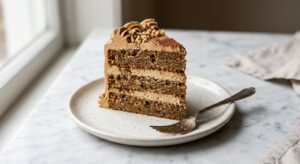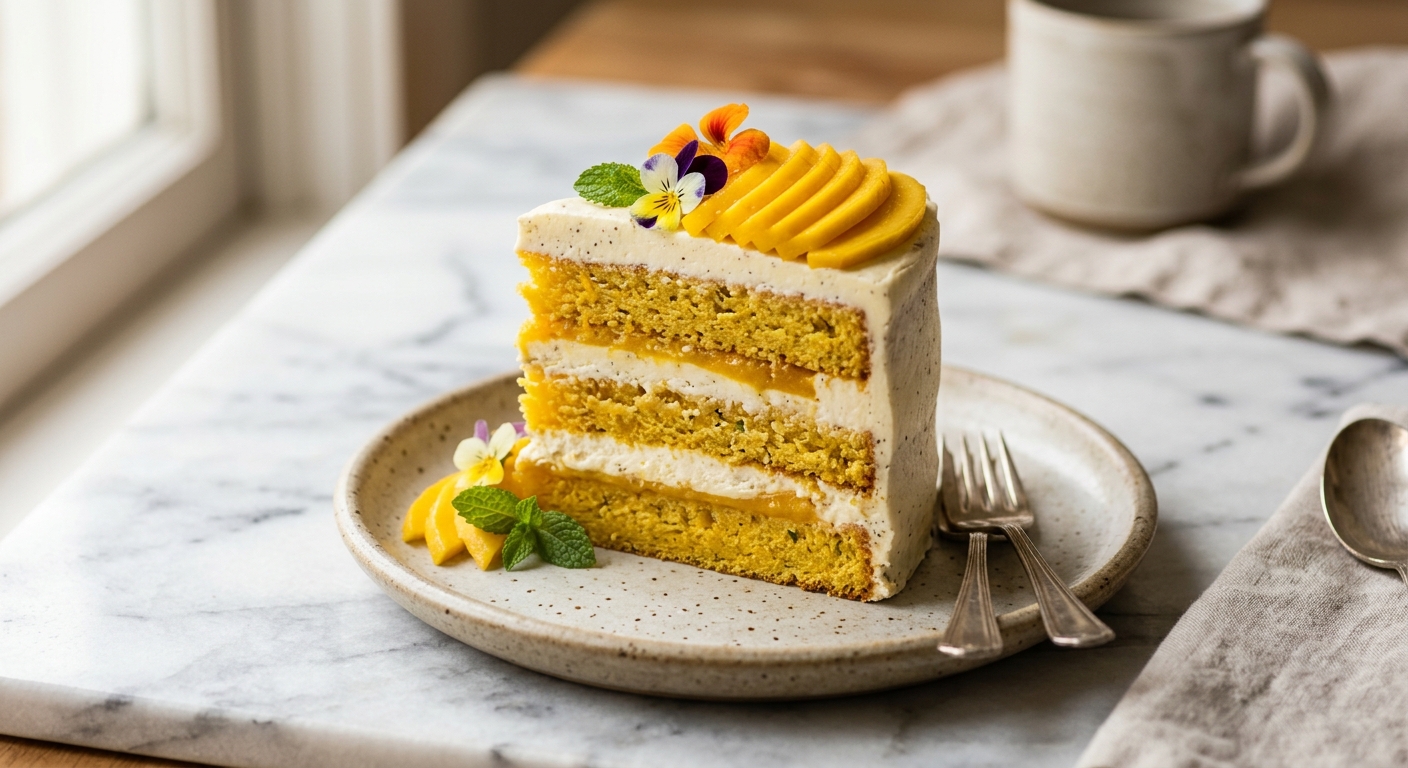
There is something undeniably joyful about a mango. The color alone, that deep saffron-gold, feels like sunshine pressed into fruit. Now imagine that brightness folded into a tender, fragrant cake that smells of warm cardamom the moment it comes out of the oven. This Mango and Cardamom Layer Cake is exactly that: a showstopper that tastes as beautiful as it looks, with a silky mango curd tucked between each layer and a frosting so light and creamy it practically melts on your tongue.
What sets this cake apart is the layering of mango flavor at every stage. A splash of mango puree goes directly into the batter, lending both moisture and a subtle fruity sweetness. Then a luscious stovetop mango curd, sharp with lime and rich with egg yolks, becomes the filling that makes each slice genuinely exciting. The frosting is whipped mascarpone loosened with heavy cream, which stays stable enough to frost and pipe but has none of the heaviness of a classic buttercream. Cardamom threads through every component, tying the whole thing together with its floral, slightly citrusy warmth.
This cake sits at a medium difficulty level. The sponge itself is straightforward, but you will be making the curd separately, which adds a step and a bit of patience. It is ideal for a confident home baker ready to go a little beyond the everyday, and it is absolutely perfect for birthdays, dinner parties, or any occasion where you want to bring something genuinely memorable to the table.
Equipment Needed
Click on an item below to shop for the recommended items for this recipe on Amazon.
As an Amazon Associate, we earn from qualifying purchases.
12
Ingredients
- Mango Curd
- 300 gall-purpose flour (about 2 1/2 cups, spooned and leveled)
- 2.5 tspbaking powder
- 0.5 tspbaking soda
- 1.5 tspground cardamom
- 0.5 tspColima Sea SaltMicroplastic Free Salt
- 225 gunsalted butter, at room temperature (1 cup / 2 sticks)
- 300 ggranulated sugar (1 1/2 cups)
- 3 largeeggs, at room temperature
- 2 tsppure vanilla extract
- 180 mlwhole milk, at room temperature (3/4 cup)
- 120 mlfresh or store-bought mango puree (1/2 cup), divided: 80 ml for batter, 40 ml reserved for frosting
- 4 largeegg yolks
- Mango Curd)
- 150 ggranulated sugar (3/4 cup
- 200 mlfresh or store-bought mango puree (scant 1 cup
- 60 mlfresh lime juice (about 2 limes
- Mango Curd
- 1 tsplime zest
- 0.25 tspground cardamom
- Mango Curd)
- 60 gunsalted butter, cold and cubed (4 tbsp
- Frosting)
- 500 gmascarpone cheese, cold (about 2 1/4 cups
- 360 mlheavy whipping cream, cold (1 1/2 cups
- 80 gpowdered sugar, sifted (about 2/3 cup
- Frosting
- 1 tsppure vanilla extract
- Decorating
- —Fresh mango slices or diced mango
- Garnish (optional)
- —Edible dried rose petals or crushed pistachios
Ingredient Substitutions
Instructions
- Make the mango curd first so it has time to chill. In a medium saucepan, whisk together the 4 egg yolks, 150g sugar, 200ml mango puree, lime juice, lime zest, and 1/4 tsp cardamom over medium-low heat. Cook, whisking constantly, for 8 to 10 minutes until the mixture thickens enough to coat the back of a spoon and registers 170 to 175°F (77 to 79°C) on an instant-read thermometer. Remove from heat and whisk in the cold cubed butter one piece at a time until fully incorporated. Strain through a fine-mesh sieve into a clean bowl, press plastic wrap directly onto the surface, and refrigerate for at least 2 hours until fully set.
- Preheat your oven to 350°F (175°C). Grease three 8-inch round cake pans, line the bottoms with parchment paper circles, then grease the parchment and dust lightly with flour. Tap out any excess.
- In a medium bowl, whisk together the flour, baking powder, baking soda, cardamom, and salt. Set aside. In a small jug, combine the milk and 80ml of the mango puree (reserve the remaining 40ml for the frosting) and stir to combine.
- In the bowl of a stand mixer fitted with the paddle attachment, beat the butter and sugar on medium-high speed for 4 to 5 minutes until the mixture is pale, fluffy, and significantly increased in volume. Scrape down the bowl well. Add the eggs one at a time, beating for 30 seconds after each addition. Add the vanilla and mix to combine. The mixture should look smooth and light.
- With the mixer on low, add the dry ingredients in three additions, alternating with the mango-milk mixture in two additions (beginning and ending with the flour). Mix each addition only until just combined, then finish folding by hand with a spatula. Overmixing at this stage develops gluten and toughens the cake.
- Divide the batter evenly among the three prepared pans (about 400g per pan for accuracy). Smooth the tops with an offset spatula. Bake for 28 to 32 minutes, rotating the pans halfway through, until the tops are golden, the edges pull slightly from the pan, and a toothpick inserted in the center comes out with just a few moist crumbs.
- Cool the layers in the pans on wire racks for 15 minutes, then run a thin knife around the edges and turn out onto the racks to cool completely. Do not frost warm layers.
- Make the frosting: In a cold bowl (chilled in the freezer for 5 minutes), beat the mascarpone, heavy cream, sifted powdered sugar, vanilla, and reserved 40ml mango puree together starting on low speed, then increasing to medium-high. Beat for 2 to 3 minutes until the frosting holds medium-firm peaks. Watch carefully: mascarpone frosting can overwhip and become grainy. Stop as soon as it holds its shape.
- To assemble: Place one cake layer on a serving plate or cake board. Spread a thin layer of frosting over the surface, then pipe or spoon a border of frosting around the edge to act as a dam. Fill the center with about half the mango curd. Repeat with the second layer. Place the final layer on top. Apply a thin crumb coat of frosting all over the cake, then refrigerate for 20 minutes to set. Apply the final layer of frosting, smoothing the sides and top with an offset spatula or bench scraper. Decorate with fresh mango and optional rose petals or pistachios. Refrigerate until ready to serve.
- Make the mango curd as described in the oven method (step 1) and refrigerate until set, at least 2 hours.
- Preheat your oven to 350°F (175°C). Grease a 9×13-inch (23x33cm) baking pan and line with parchment paper, leaving an overhang on the long sides for easy lifting.
- Prepare the batter exactly as in steps 3 through 5 of the oven method. Pour all the batter into the prepared pan and spread evenly to the corners with an offset spatula.
- Bake for 30 to 35 minutes, rotating once at the 20-minute mark, until the top is golden and springs back when lightly touched in the center. A toothpick should come out with just a few moist crumbs. Cool completely in the pan on a wire rack, at least 1 hour.
- Make the mascarpone frosting as in step 8 of the oven method. Spread it evenly over the cooled cake in a generous layer. Spoon the chilled mango curd over the frosting and use the back of a spoon to gently swirl it in, leaving beautiful streaks of gold rather than fully mixing. Top with fresh mango and garnishes. Slice and serve directly from the pan. Store covered in the refrigerator.
- In a large microwave-safe bowl (the curd will bubble up), whisk together the 4 egg yolks, 150g sugar, 200ml mango puree, lime juice, lime zest, and 1/4 tsp cardamom until smooth and fully combined.
- Microwave on HIGH in 60-second bursts, whisking vigorously between each burst. After the first 2 minutes you will see the edges beginning to thicken. After 4 to 5 minutes total the curd should be noticeably thick and coating the whisk. It will continue to thicken as it cools, so remove it when it mounds slightly but is not yet fully set.
- Immediately whisk in the cold cubed butter, one piece at a time, until the curd is smooth and glossy. The cold butter stops the cooking and gives the curd its silky texture.
- Strain through a fine-mesh sieve into a clean container, press plastic wrap directly onto the surface, and refrigerate. Microwave curd sets slightly firmer than stovetop curd and will be ready to use in about 1 hour.
- Proceed with the standard oven method for the cake layers and frosting, using this curd as the filling.
Nutrition Per Serving
Per 1 serving (makes one 8-inch three-layer cake)
Why This Recipe Works
The alternating dry-wet-dry mixing method (called the flour-liquid alternation method) is central to this cake’s tender crumb. Adding flour and liquid alternately prevents the batter from becoming too wet at any one point, which would overdevelop the gluten and lead to a tough, chewy texture. Starting and ending with the dry ingredients means the flour coats the fat early on, providing a brief barrier that limits gluten formation. The result is a cake that is moist and pillowy without being dense.
Mango puree in the batter does double duty: its natural sugars add sweetness and its water content contributes moisture, but crucially, the fruit acids in mango also tenderize the crumb by slightly weakening gluten strands. This is the same principle that makes buttermilk cakes so soft. The baking soda works here not just as a leavener but as a base that reacts with those fruit acids, creating carbon dioxide bubbles for additional lift right from the moment the batter goes into the oven. Cardamom, being an aromatic fat-soluble spice, blooms most effectively when it is in contact with the butter during creaming, which is why it is added to the dry ingredients that meet the fat-sugar mixture early in the mixing process rather than added at the end.
For the mango curd, the key to a smooth, glossy result is temperature control and butter emulsification. Egg yolks begin to coagulate around 160 to 165°F (71 to 74°C), so cooking to 170 to 175°F (77 to 79°C) ensures the yolks are safely set and the curd will hold its structure when chilled. The cold butter whisked in at the end does not just add richness: each small cube cools the curd slightly and the fat molecules coat the protein strands, creating a silky, stable emulsion that resists weeping. Straining removes any trace of cooked egg and any fibrous mango strands, giving you a perfectly smooth filling.
Baker’s Tips
- Bring all refrigerated cake ingredients, especially the butter, eggs, and milk, to room temperature before starting. Cold butter will not cream properly and cold eggs can cause the batter to curdle.
- Weigh your batter into the pans with a digital kitchen scale for perfectly even layers. Uneven layers are the number one cause of a lopsided finished cake.
- Do not skip the crumb coat. That thin first layer of frosting seals in any loose crumbs so your final coat looks pristine and professional.
- Use cold mascarpone and cold heavy cream for the frosting. Warm mascarpone frosting will not whip up properly and is far more likely to become grainy or split.
- If your mango curd is too loose after chilling (it should be a thick, spoonable consistency, similar to lemon curd), it was likely undercooked. You can gently reheat it in the microwave in 20-second bursts, whisking in between, to cook it further, then re-chill.
- For the cleanest mango curd filling, pipe a thick border of mascarpone frosting around the edge of each cake layer before adding the curd. This dam prevents the curd from squeezing out the sides when you stack the layers.
- Freshly ground cardamom from whole pods is noticeably more fragrant than pre-ground. If you want to go the extra mile, crack 12 to 14 green pods, remove the seeds, and grind them in a spice grinder or mortar and pestle.
Variations
- Coconut and mango version: Replace 60ml of the milk with full-fat coconut milk and add 30g toasted shredded coconut to the batter. Frost with a coconut whipped cream instead of mascarpone.
- Mango and saffron: Steep a generous pinch of saffron threads in 2 tbsp warm milk for 10 minutes and add to the wet ingredients. Omit the cardamom or use just 1/2 tsp. The saffron gives the cake a gorgeous golden hue and a floral depth.
- Mini layer cakes for individual servings: Bake the batter in two 9×13-inch sheet pans, then use a 3-inch round cutter to punch out circles and stack three per serving. Beautiful for dinner parties.
- Cardamom and mango cupcakes: Divide the batter among 24 lined muffin cups and bake at 350°F for 18 to 22 minutes. Core each cupcake after cooling, fill with a teaspoon of mango curd, and frost with the mascarpone frosting.
Troubleshooting & FAQ
My cake layers domed and cracked on top. What went wrong?
My mascarpone frosting turned grainy and curdled. Can I fix it?
My mango curd is not setting firm enough to use as a filling. What happened?
The cake layers are sticking to the pans and tearing when I try to unmold them.
My finished cake tastes bland and I cannot really taste the cardamom. What can I do differently next time?
Storage & Make-Ahead
- Storage: Store the assembled cake covered in the refrigerator for up to 4 days. Because of the mascarpone frosting and mango curd, this cake must be kept chilled. Remove from the refrigerator 20 to 30 minutes before serving so the layers come to room temperature and the frosting softens slightly. Unfrosted cake layers can be wrapped tightly in plastic wrap and stored at room temperature for up to 2 days, or frozen for up to 2 months.
- Make-Ahead: The mango curd can be made up to 5 days ahead and stored in an airtight jar in the refrigerator. The cake layers can be baked up to 2 days ahead, wrapped in plastic wrap, and kept at room temperature; or frozen (double-wrapped) for up to 2 months and thawed overnight in the refrigerator. The mascarpone frosting is best made on the day of assembly, as it can weep and lose volume if stored overnight. The fully assembled cake can be refrigerated overnight before serving.