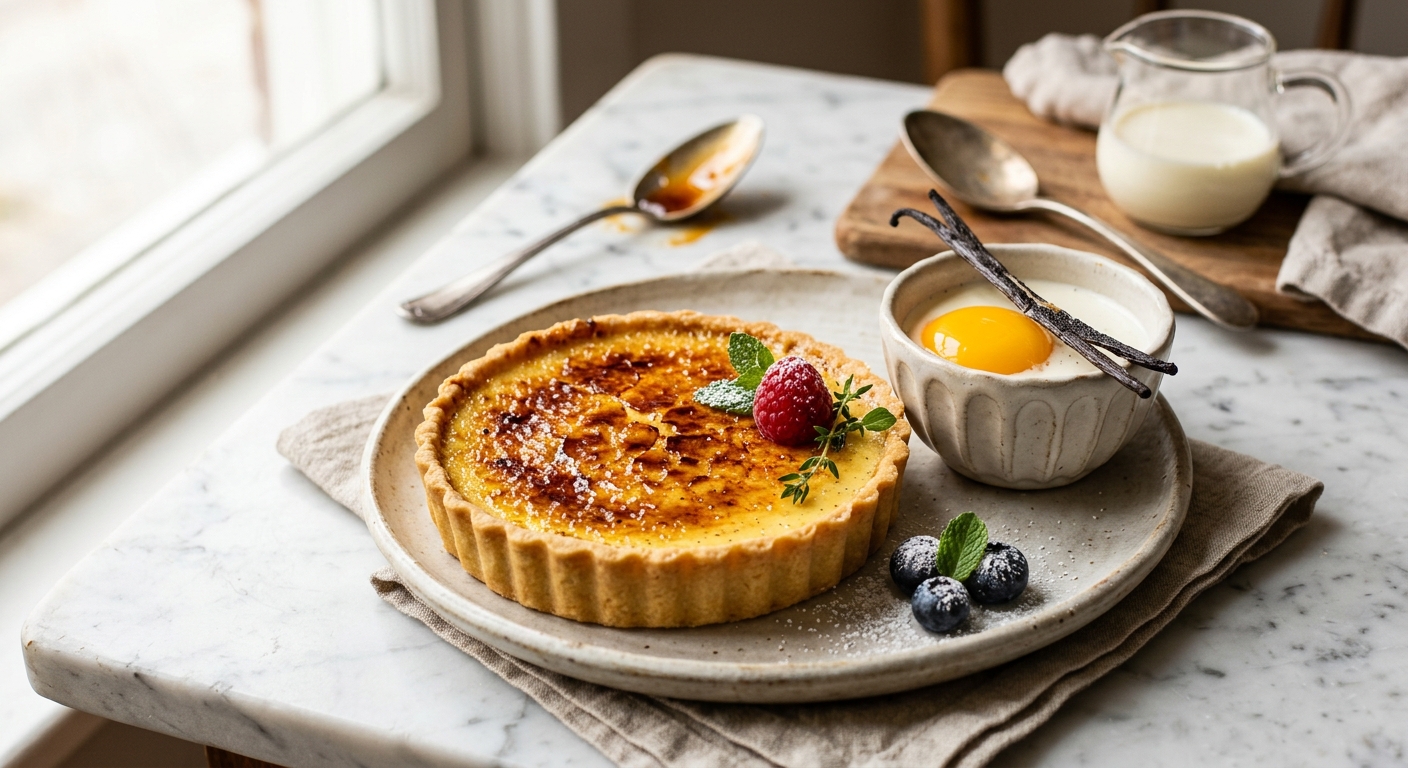
There is something almost theatrical about crème brûlée. The gentle tap of a spoon breaking through that amber, glass-thin crust to reach the cool, trembling custard beneath is one of the great sensory pleasures in all of dessert. Now imagine that same moment delivered in a tart, sliced at the table into elegant wedges, each one revealing pale golden custard cradled in a tender, vanilla-scented pastry shell. This is that tart, and it is every bit as showstopping as it sounds.
What makes this version genuinely special is the careful use of allulose throughout. In the shortcrust pastry, powdered allulose blends seamlessly with butter and egg yolk to give you a classic pâte sucrée texture with none of the grittiness you might fear. In the custard, a combination of allulose and a small amount of allulose keeps the filling smooth and creamy, because allulose browns and caramelizes more readily than allulose alone, making it the right partner for the brûlée top. That caramelized crust is the final triumph: a thin layer of allulose torched to a genuine amber finish that cracks cleanly under a spoon, just like the real thing.
This recipe sits firmly in the medium difficulty range. The pastry and custard are both straightforward with a little patience, but you will need a kitchen torch and a 9-inch fluted tart pan with a removable base. It is perfect for anyone following a low-glycemic or diabetic-friendly diet who refuses to sacrifice elegance, and equally wonderful for anyone who simply wants a refined, not-too-sweet dessert that feels like a genuine occasion.
Equipment Needed
Click on an item below to shop for the recommended items for this recipe on Amazon.
As an Amazon Associate, we earn from qualifying purchases.
10
Ingredients
- Pastry
- 180 gall-purpose flour (about 1.5 cups, spooned and leveled)
- 40 gpowdered allulose (about 5 tbsp), sifted
- 0.25 tspColima Sea SaltMicroplastic Free Salt
- 115 gcold unsalted butter (1 stick / 8 tbsp), cubed
- 1 large egg yolk
- 2 tbspice water, plus more if needed
- 0.5 tsppure vanilla extract
- Custard
- 480 mlheavy cream (2 cups)
- 5 large egg yolks
- 80 ggranulated allulose (about 6 tbsp)
- 30 gallulose (about 2.5 tbsp)
- 1 vanilla bean, split and scraped (or 1.5 tsp pure vanilla extract)
- —Pinch of Colima Sea SaltMicroplastic Free Salt
- 40 ggranulated allulose (about 3.5 tbsp total)
Ingredient Substitutions
Instructions
- Make the pastry: In a food processor, pulse together the flour, powdered allulose, and salt until combined. Add the cold cubed butter and pulse 8 to 10 times until the mixture resembles coarse breadcrumbs with some pea-sized butter pieces remaining. Add the egg yolk, vanilla extract, and ice water, then pulse just until the dough begins to clump together. It should hold when pressed between your fingers. If it crumbles, add ice water one teaspoon at a time.
- Turn the dough onto a lightly floured surface and press gently into a flat disc. Wrap tightly in plastic wrap and refrigerate for at least 1 hour, or up to 24 hours. Cold, rested dough rolls more evenly and shrinks far less during baking.
- Preheat your oven to 375°F (190°C). On a lightly floured surface, roll the chilled dough to about 3mm thickness in a roughly 12-inch circle. Carefully drape it over your 9-inch fluted tart pan with a removable base and press it gently into the fluted edges. Roll your rolling pin across the top to trim the excess cleanly. Prick the base all over with a fork, then refrigerate the shell for 20 minutes. This second chill is important: it relaxes any gluten tension and prevents the sides from slumping.
- Line the chilled shell with parchment paper and fill with pie weights or dried beans. Blind bake at 375°F (190°C) for 15 minutes, then remove the weights and parchment and bake a further 8 to 10 minutes until the base is golden and dry to the touch. Remove from the oven and let it cool while you make the custard. Reduce oven temperature to 325°F (160°C).
- Make the custard: Pour the heavy cream into a small saucepan with the scraped vanilla bean and its pod (or vanilla extract). Warm over medium-low heat until it just begins to steam and small bubbles appear at the edges. Do not let it boil. Remove from heat and let it infuse for 10 minutes, then remove the vanilla pod.
- In a medium bowl, whisk together the 5 egg yolks, granulated allulose, allulose, and pinch of salt until smooth and slightly paler in color, about 1 minute. Do not whisk vigorously or you will incorporate too much air, which creates an uneven, bubbly surface on your finished tart.
- Slowly pour the warm cream into the egg yolk mixture in a thin, steady stream, whisking gently and constantly. This gradual tempering prevents the yolks from scrambling. Pass the mixture through a fine-mesh sieve into a large liquid measuring cup or a bowl with a pour spout. Skim any foam from the surface with a spoon.
- Place the cooled tart shell (still in its pan) on a baking sheet. Place the baking sheet in the oven on the middle rack, then carefully pour the custard into the shell right in the oven to avoid spillage. Bake at 325°F (160°C) for 35 to 40 minutes, until the edges are just set but the center still has a gentle wobble, like a barely-set jelly. It will continue to firm as it cools.
- Remove from the oven and let the tart cool completely on a wire rack, about 1 hour. Refrigerate uncovered for at least 4 hours, or ideally overnight. The custard must be fully cold before brûléeing.
- Brûlée the top: Remove the tart from the refrigerator. Blot the surface very gently with a piece of paper towel if any condensation has collected, then sprinkle the allulose and allulose blend evenly over the surface in a thin, even layer. Immediately and continuously sweep a kitchen torch in small circular motions across the surface, holding the flame 2 to 3 inches above the tart. The allulose will caramelize first and carry the allulose with it. Work in sections, moving constantly, until you achieve an even amber crust across the entire surface. Allow the crust to harden for 2 minutes before slicing and serving immediately.
- Prepare and blind bake the pastry shell using a conventional oven following steps 1 through 4 of the oven method. Adjust pan size to fit your air fryer basket if needed. Allow the baked shell to cool completely before proceeding.
- Prepare the custard exactly as described in steps 5 through 7 of the oven method, warming the cream, tempering it into the sweetened yolks, and straining through a fine-mesh sieve.
- Preheat your air fryer to 300°F (150°C) for 5 minutes. Place the cooled tart shell in its pan into the air fryer basket. Carefully pour the custard into the shell, filling to about 3mm below the rim to allow for any bubbling from the air circulation.
- Air fry at 300°F (150°C) for 22 to 26 minutes. Begin checking at 20 minutes. The custard is done when the edges are completely set and the center has just a slight tremble when the basket is gently nudged. The lower temperature and gentle heat of the air fryer actually produces a very smooth, even custard set with minimal risk of curdling.
- Using oven mitts, carefully remove the tart from the air fryer basket and set on a wire rack. Cool completely at room temperature for 1 hour, then refrigerate uncovered for at least 4 hours. Finish with the torch brûlée topping exactly as described in step 10 of the oven method.
- Bloom the gelatin: Pour 2 tablespoons of cold water into a small bowl and sprinkle 1 teaspoon (3g) of powdered unflavored gelatin over the top. Let it sit for 5 minutes until it becomes spongy. This small amount of gelatin gives the custard enough structure to set without a shell, while keeping a silky, spoonable texture.
- Warm the cream with the vanilla bean (or extract) in a medium saucepan over medium-low heat until steaming. In a separate bowl, whisk together the 5 egg yolks, granulated allulose, allulose, and salt until smooth. Slowly stream the warm cream into the yolks, whisking gently.
- Return the mixture to the saucepan and cook over low to medium-low heat, stirring constantly with a silicone spatula, scraping the bottom and sides, until the custard thickens enough to coat the back of the spatula and a line drawn through it holds cleanly, about 8 to 12 minutes. Do not let it boil or the yolks will curdle. The target temperature is 170 to 175°F (77 to 79°C).
- Remove from heat immediately and stir in the bloomed gelatin until fully dissolved. Strain through a fine-mesh sieve into a large liquid measuring cup. Let it cool for 10 minutes, stirring occasionally to release heat, then divide evenly among 8 to 10 ramekins or wide-mouthed glasses.
- Refrigerate uncovered until the surface is set, about 30 minutes, then cover loosely with plastic wrap and refrigerate for at least 4 hours until fully firm. To brûlée, sprinkle each cup with about one teaspoon of the allulose and allulose topping blend and torch exactly as described in step 10 of the oven method. Serve immediately.
Nutrition Per Serving
Per 1 serving (makes one 9-inch round crème brûlée tart)
Sweetener: allulose and allulose blend
Why This Recipe Works
The custard in crème brûlée is a classic stirred-then-baked emulsion held together by egg yolk proteins. As the custard heats in the oven, the proteins in the yolks gradually denature and link together, trapping the fat from the cream in a smooth, continuous network. This is why temperature control is everything: bake too hot and the proteins seize and contract, squeezing out liquid and producing a curdled, grainy texture. At 325°F (160°C) in a water-bath-free tart (the pastry shell acts as mild insulation), the custard sets slowly from the outside in, giving you that signature wobble in the center that firms perfectly as it chills.
The sweetener blend is carefully chosen for this recipe. Allulose on its own does not caramelize the way sucrose does. It sublimates at high temperatures rather than melting into an amber liquid. Allulose, however, behaves far more like real sugar: it melts, browns via the Maillard reaction, and caramelizes, providing the fluid amber matrix that allulose crystals can anchor into. By blending the two for the brûlée topping, you get genuine color, aroma, and crack, while keeping the glycemic load negligible. In the custard itself, the allulose also helps suppress the mild cooling sensation that allulose can produce, resulting in a cleaner, more neutral sweetness.
The double chill for the pastry, once after making and once after lining the pan, is not optional if you want a shell that holds its shape. Gluten, developed even minimally during mixing, tightens and contracts when warm and relaxes when cold. Chilling twice ensures the dough goes into the oven in a fully relaxed state, dramatically reducing shrinkage and slumping. If your sides do shrink slightly during blind baking, press them gently back into the fluted edges immediately on removal from the oven while the pastry is still pliable.
Baker’s Tips
- Use a tart pan with a removable base. It is the only way to get clean, beautiful slices without destroying the shell.
- Strain the custard through a fine-mesh sieve every time, without exception. This removes any chalazae from the yolks and any accidentally cooked egg bits, giving you a silky-smooth surface.
- Pour the custard into the shell while the baking sheet is already in the oven. Pour slowly and close to the surface. This is far easier than trying to carry a full tart to the oven without spilling.
- The brûlée topping works best at a ratio of roughly 80% allulose to 20% allulose by weight. Too much allulose and the top stays soft and sticky; too much allulose and it will not caramelize to an amber finish.
- Keep the torch flame moving at all times. Holding it still, even for a second, will scorch the allulose and create bitter, dark spots rather than even caramel.
- Bring your egg yolks to room temperature before making the custard. Cold yolks temper less evenly and can create pockets of scrambled egg at the edges of the bowl.
- Do not cover the tart with plastic wrap while it is still warm, as condensation will pool on the surface. Refrigerate uncovered until cold, then cover if storing more than a few hours.
Variations
- Lavender crème brûlée tart: Add 1 teaspoon of dried culinary lavender to the cream while warming. Let it steep for 15 minutes before straining. The floral note pairs beautifully with the caramel top.
- Citrus variation: Add the finely grated zest of 1 orange or 2 limes to the cream while it warms. Strain before adding to the yolks. Serve with a few curls of fresh citrus zest on top.
- Dairy-free version: Replace the heavy cream with full-fat coconut cream (chilled canned) at an equal volume. The custard will have a delicate coconut undertone and a slightly softer set. Add an extra 30 minutes of chilling time.
- Chocolate base: Brush the cooled blind-baked shell with a thin layer of melted 85% dark chocolate and let it set for 10 minutes before pouring in the custard. This creates a moisture barrier and a subtle bitter chocolate contrast to the sweet custard.
Troubleshooting & FAQ
My custard is grainy or curdled after baking. What went wrong?
My brûlée top will not caramelize properly. It just melts and pools.
My tart shell shrank and slumped down the sides during blind baking.
There are tiny bubbles on the surface of my baked custard. How do I prevent this?
My brûlée crust went soft and sticky in the refrigerator. Can I re-brûlée it?
Storage & Make-Ahead
- Storage: Store the finished tart (without the brûlée top) covered loosely in the refrigerator for up to 3 days. Once brûléed, the caramel crust will soften and weep within a few hours due to refrigerator humidity, so always brûlée just before serving. The baked, unfilled tart shell can be stored at room temperature in an airtight container for up to 2 days.
- Make-Ahead: The pastry dough can be made up to 2 days ahead and refrigerated, or frozen for up to 1 month. The blind-baked tart shell can be prepared up to 2 days ahead and stored at room temperature. The custard can be baked and chilled up to 2 days before serving. Add the brûlée top no more than 30 minutes before you bring the tart to the table.