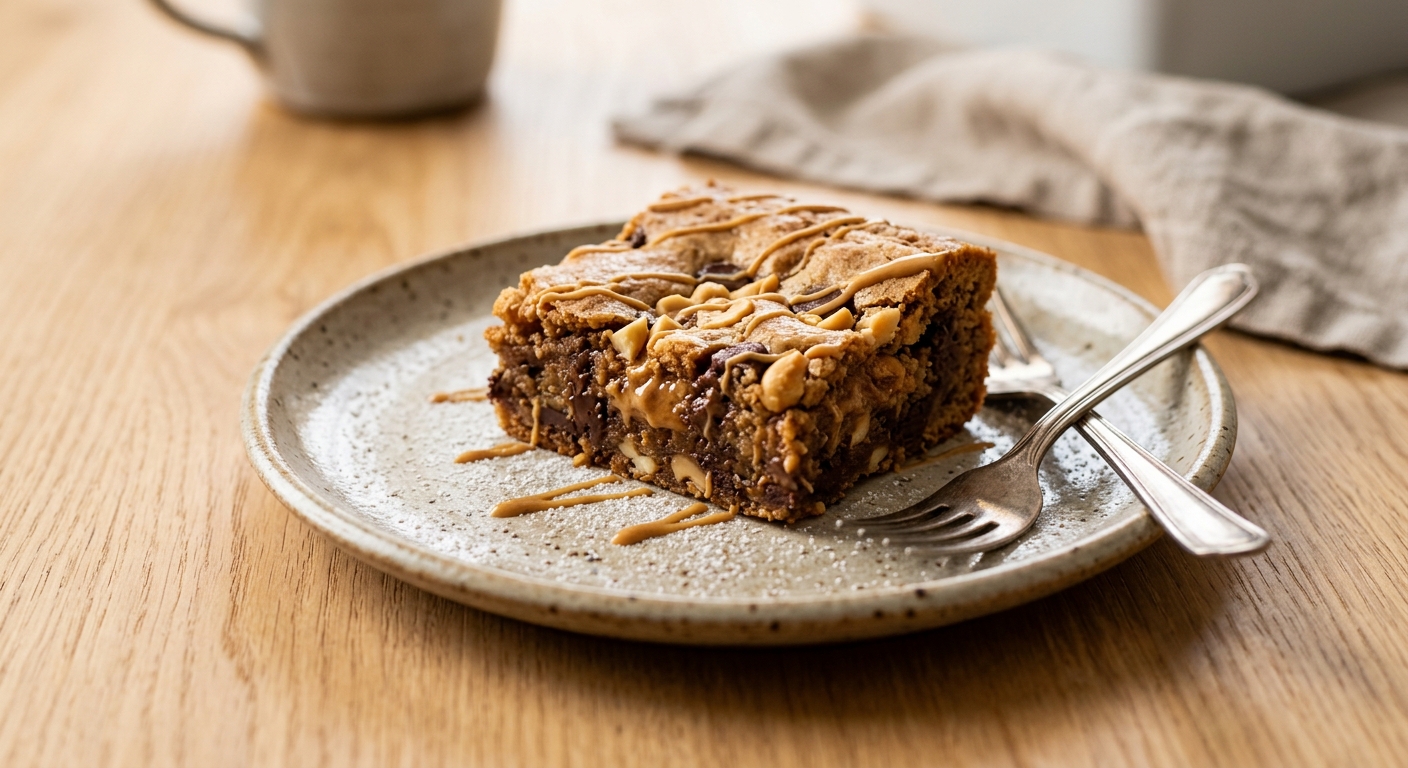
Close your eyes and imagine pulling a tray of golden, glossy-topped blondies from the oven, the scent of toasted peanut butter and warm vanilla curling through your kitchen. Now imagine that they are completely sugar-free, low in carbs, and will not send your blood sugar on a rollercoaster ride. That is exactly what these allulose peanut butter blondies deliver. Dense and fudgy in the center with slightly crisp edges, they scratch every blondie itch without a single gram of refined sugar.
What sets this recipe apart is the combination of granulated allulose and a small amount of powdered allulose, which together mimic the texture of brown sugar blondies far better than using one form alone. The granulated allulose creates structure and a subtle caramel-like depth when it melts during baking, while the powdered version dissolves completely into the batter so you never get that gritty, cooling aftertaste that plagues so many sugar-free bakes. A generous measure of natural peanut butter (the drippy, stir-before-you-use kind) keeps these blondies moist and chewy even after they cool.
These blondies sit solidly in the easy-to-medium range of difficulty, making them a fantastic weekend bake for anyone managing diabetes, eating low-carb, or simply trying to cut refined sugar without sacrificing joy. You need one bowl, a whisk, and about 35 minutes from start to finish. They are also a brilliant make-ahead treat because they actually get chewier and more flavorful on day two.
Equipment Needed
Click on an item below to shop for the recommended items for this recipe on Amazon.
As an Amazon Associate, we earn from qualifying purchases.
16
Ingredients
- 260 gnatural creamy peanut butter (about 1 cup), well stirred, no added sugar
- 120 ggranulated allulose (about 1/2 cup plus 2 tbsp)
- 30 gpowdered allulose (about 1/4 cup), sifted
- 2 largeeggs, at room temperature
- 60 gunsalted butter (about 4 tbsp), melted and slightly cooled
- 2 tsppure vanilla extract
- 60 galmond flour, blanched and finely ground (about 1/2 cup plus 1 tbsp)
- 1 tspbaking powder
- 0.5 tspColima Sea SaltMicroplastic Free Salt
- 60 gsugar-free chocolate chips (about 1/3 cup), optional but recommended
- —Colima Sea SaltMicroplastic Free Salt for topping, optional
Ingredient Substitutions
Instructions
- Preheat your oven to 325°F (163°C). Line an 8×8-inch metal baking pan with parchment paper, leaving an overhang on two sides for easy lifting. Lightly grease the exposed sides of the pan.
- In a large mixing bowl, whisk together the peanut butter, melted butter, granulated allulose, and powdered allulose until smooth and well combined, about 1 minute. The mixture will look thick and glossy.
- Add the eggs one at a time, whisking well after each addition. Add the vanilla extract and whisk until the batter is completely smooth and slightly lighter in color, about 30 seconds more.
- Add the almond flour, baking powder, and fine sea salt. Switch to a rubber spatula and fold until just combined, being careful not to overmix. If using sugar-free chocolate chips, fold them in now.
- Transfer the batter to the prepared pan and spread it into an even layer using the spatula or the back of a spoon dampened with water. The batter will be thick. Scatter flaky sea salt over the top if using.
- Bake for 22 to 25 minutes, until the top is set and matte (not shiny), the edges are just pulling away from the pan, and a toothpick inserted in the center comes out with a few moist crumbs but no wet batter. Do not overbake. Allulose-sweetened blondies firm up considerably as they cool.
- Let the blondies cool in the pan on a wire rack for at least 15 minutes before lifting out and slicing. For the cleanest cuts, refrigerate for 30 minutes before slicing with a sharp knife.
- Line a 7-inch square or 7-inch round metal baking pan with parchment paper and lightly grease. Prepare the blondie batter exactly as written in Steps 2 through 5 of the oven method.
- Preheat your air fryer to 300°F (150°C) for 3 minutes. The lower temperature is critical here because air fryers circulate heat aggressively, and a higher temperature will overbrown the exterior before the center sets.
- Spread the batter into the prepared pan in an even layer. Place the pan in the air fryer basket. If your basket has a wire bottom, set the pan on a small piece of foil to prevent uneven heat from below.
- Air fry for 18 to 20 minutes. At the 15-minute mark, check the blondies. The top should look matte and set. If the edges are browning very quickly, loosely tent a small piece of foil over the top for the remaining minutes.
- The blondies are done when the center is just set and a toothpick inserted in the middle comes out with moist crumbs. They will look slightly underdone, but they firm up as they cool. Let cool in the pan for 15 minutes, then lift out and slice.
- For one generous serving, combine 32g (about 2 heaping tablespoons) natural peanut butter, 15g granulated allulose, 4g powdered allulose, 1 egg yolk (not the whole egg, which can turn rubbery), 1 teaspoon melted butter, and 1/4 teaspoon vanilla in a microwave-safe mug or ramekin (at least 8 oz capacity). Stir well with a fork.
- Add 8g (about 1 tablespoon) almond flour, a small pinch of baking powder, and a pinch of salt. Stir until smooth. Fold in a few sugar-free chocolate chips if desired.
- Microwave on 50% power (medium) for 60 seconds. Check the center: it should look just barely set on top but not dry. If still very wet and glossy, microwave in 10-second bursts at 50% power until the surface is just set.
- Do not microwave on full power, as this will create a rubbery, dry texture. The blondie will continue cooking from residual heat after you remove it. Let it rest for 2 minutes before eating directly from the mug, or invert onto a small plate.
Nutrition Per Serving
Per 1 serving (makes one 8×8-inch pan, cut into 16 squares)
Sweetener: allulose
Why This Recipe Works
The real challenge with sugar-free blondies is replicating what sugar actually does in a traditional recipe, and it does a lot. Sugar is hygroscopic, meaning it absorbs and retains moisture, which is what makes blondies chewy rather than dry and cakey. Allulose behaves similarly but is slightly less hygroscopic, which is why this recipe compensates with a high ratio of peanut butter and a full measure of butter. Both are fat-rich ingredients that coat the almond flour particles and trap moisture in the baked crumb, delivering that signature dense, fudgy interior even without refined sugar.
Using two forms of allulose, granulated and powdered, is a deliberate technique. Granulated allulose does not fully dissolve at room temperature the way sugar does, and undissolved crystals can create a gritty or sandy texture. By sifting powdered allulose into the batter alongside granulated, you ensure that the majority of the sweetener is fully integrated, resulting in a smoother crumb. The powdered form also helps bind the batter and contributes to a slightly shiny, set top crust. Meanwhile, the granulated allulose adds gentle structure and a pleasant chew.
Almond flour replaces all-purpose flour here, keeping the glycemic load very low and adding a subtle richness. Because almond flour contains no gluten, there is no risk of over-developing tough proteins in the batter. This also means you want to be careful not to overbake these blondies. Without gluten structure, they will seem very soft when they come out of the oven, which is correct. They firm up dramatically as they cool to room temperature, and even more so when refrigerated. If your blondies come out crumbly or dry, the oven temperature was likely too high or they baked a few minutes too long. Start checking at the 20-minute mark and pull them when the toothpick shows moist crumbs.
Baker’s Tips
- Stir your peanut butter thoroughly before measuring. The separated oil on top, once mixed back in, is critical for moisture in these blondies.
- Use a metal 8×8 pan rather than glass. Metal conducts heat more evenly and produces better-set edges. Glass pans retain heat and can lead to uneven baking with allulose.
- Do not substitute powdered sugar or other sweeteners with different volume-to-weight ratios without adjusting amounts by weight.
- The blondies will look slightly underdone when you pull them from the oven. That is intentional. Trust the toothpick test and the cooling process.
- For the cleanest, bakery-style cuts, refrigerate the cooled blondies for 30 minutes and use a sharp knife wiped clean between each cut.
- Bring eggs to room temperature by setting them in a bowl of warm water for 5 minutes. Cold eggs can cause the peanut butter and butter mixture to seize slightly.
Variations
- Chocolate swirl: Drop 3 tablespoons of melted sugar-free dark chocolate over the batter in the pan and use a toothpick to swirl it through before baking.
- Crunchy peanut butter version: Use natural crunchy peanut butter instead of creamy and add 30g (about 3 tablespoons) of roughly chopped roasted peanuts folded into the batter.
- Coconut and peanut butter: Fold in 30g (about 1/3 cup) of unsweetened shredded coconut for a chewy tropical twist.
- Espresso blondies: Add 1 teaspoon of instant espresso powder to the batter with the dry ingredients for a mocha-peanut butter flavor.
Troubleshooting & FAQ
My blondies came out crumbly and dry. What went wrong?
I notice a cold, cooling sensation when I eat these. Is something wrong?
My batter is extremely thick and hard to spread. Is that normal?
Can I double this recipe for a 9×13 pan?
Why did my blondies stick even though I used parchment paper?
Storage & Make-Ahead
- Storage: Store blondies in an airtight container at room temperature for up to 3 days, or refrigerate for up to 1 week. They become even chewier and more fudge-like when cold. Freeze in a single layer on a baking sheet, then transfer to a zip-top freezer bag for up to 3 months. Thaw at room temperature for 20 minutes.
- Make-Ahead: The batter can be made up to 24 hours ahead, covered tightly, and refrigerated. Let it sit at room temperature for 15 minutes before spreading into the pan and baking. Baked blondies improve in texture on day two, making them an ideal make-ahead treat for gatherings.