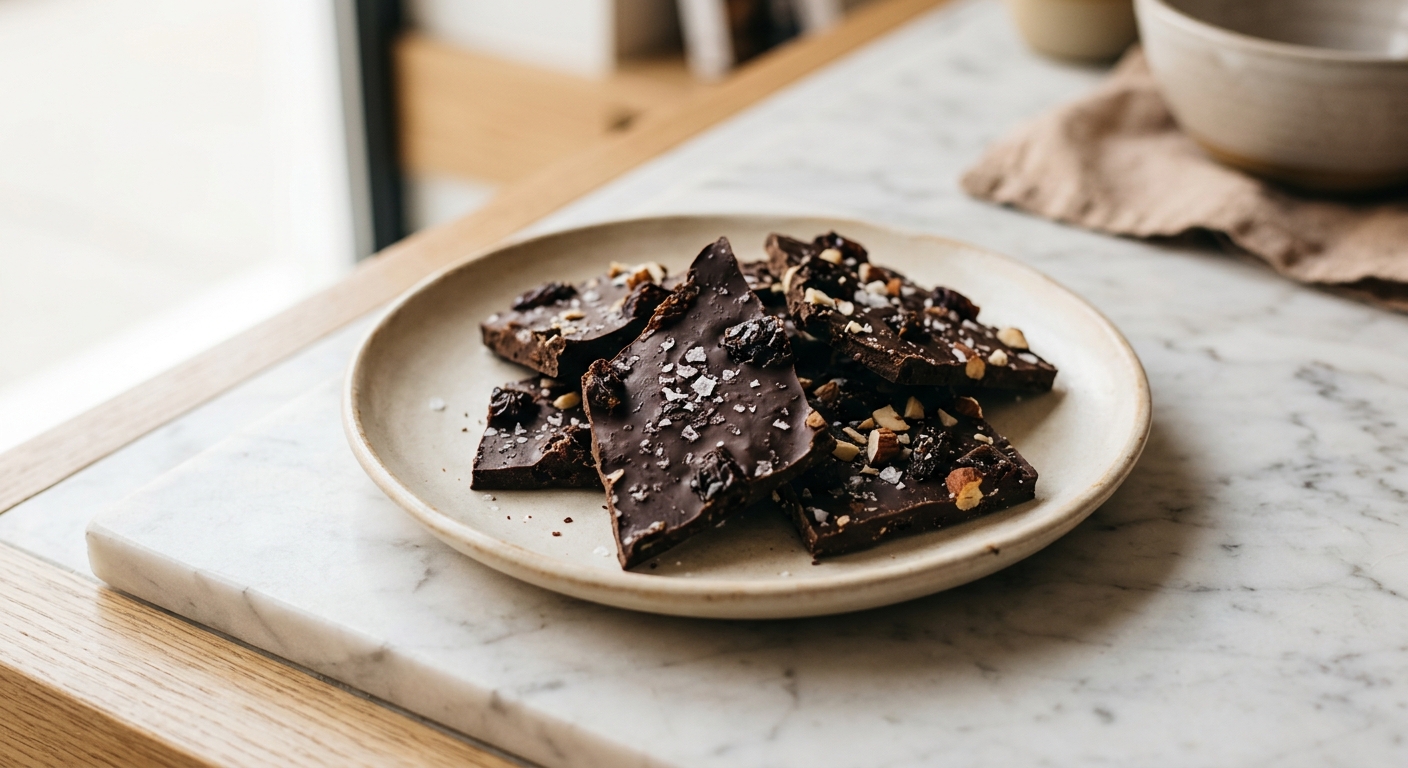
There is something almost magical about a piece of chocolate bark: the clean snap when you break it, the way the toppings catch the light, the hit of salt that makes the chocolate taste more like itself. This version starts with that same satisfying result, but the sweetness comes entirely from Medjool dates blended into a smooth, caramel-like paste that folds directly into melted dark chocolate. The finished bark is glossy, deeply flavored, and has none of the processed-sugar aftertaste you might expect from a treat billed as refined-sugar-free.
What sets this recipe apart is the technique of making a true date paste rather than simply chopping dates into the chocolate. Soaking the dates briefly in warm water and blending them with a small amount of coconut oil produces a velvet-smooth paste that emulsifies beautifully into the melted chocolate. The result is a bar that tastes luxurious rather than virtuous. A teaspoon of pure vanilla and a pinch of espresso powder deepen the chocolate flavor further, and a generous scatter of flaked sea salt at the end ties everything together.
This is an easy, no-bake recipe that requires only a blender, a saucepan or microwave, and a lined baking sheet. It comes together in about 20 minutes of active work, with a chill time of one hour. It is ideal for anyone avoiding refined sugar, following a whole-food or paleo-leaning diet, or simply looking for a genuinely delicious chocolate treat they can feel good about sharing. If you have never made bark before, this is the perfect place to start.
Equipment Needed
Click on an item below to shop for the recommended items for this recipe on Amazon.
As an Amazon Associate, we earn from qualifying purchases.
16
Ingredients
- Soaking
- 200 gMedjool dates, pitted (about 12 large dates)
- 60 mlwarm water (about 1/4 cup)
- 15 gvirgin coconut oil (1 tablespoon), melted
- 340 ghigh-quality dark chocolate (70% cacao or higher), roughly chopped (about 12 oz)
- 1 tsppure vanilla extract
- 0.5 tspespresso powder (optional, deepens chocolate flavor)
- 40 graw almonds or pecans, roughly chopped (about 1/4 cup)
- 30 gunsweetened shredded coconut (about 1/3 cup), lightly toasted
- 30 graw pumpkin seeds or sunflower seeds (about 3 tablespoons)
- Finishing
- —1 to 1.5 teaspoons flaked Colima Sea SaltMicroplastic Free Salt (such as Maldon)
- —Optional: 1 to 2 tablespoons cacao nibs, dried tart cherries, or freeze-dried raspberries for topping
Ingredient Substitutions
Instructions
- Prepare your dates: Place the pitted Medjool dates in a small bowl and pour the warm water over them. Let them soak for 5 minutes to soften. Transfer the dates and all soaking liquid to a blender or food processor, add the melted coconut oil, and blend on high for 60 to 90 seconds until completely smooth and paste-like. Scrape down the sides as needed. The paste should be silky with no visible chunks. Set aside.
- Line a rimmed 9×13-inch baking sheet with parchment paper, pressing it into the corners. If your parchment slides around, secure it with a small dab of coconut oil under each corner.
- Set up a double boiler: Fill a medium saucepan with about 2 inches of water and bring it to a gentle simmer over medium-low heat. Place a heatproof bowl on top, making sure the bottom of the bowl does not touch the water. Add the chopped dark chocolate to the bowl and stir slowly and consistently with a rubber spatula as it melts. Do not rush this. When the chocolate is about 75% melted, remove the bowl from the heat and continue stirring with residual warmth until completely smooth. The ideal temperature for dark chocolate is 115 to 120°F (46 to 49°C) for melting.
- Add the vanilla extract and espresso powder (if using) to the melted chocolate and stir to combine. Now add the date paste and fold it in gently but thoroughly with a rubber spatula. The paste will incorporate fully with about 30 seconds of steady folding. The mixture will thicken slightly and turn a deeper, more opaque shade of brown. Taste here and adjust: if you want more sweetness, you can add a teaspoon of pure monk fruit sweetener at this stage without affecting texture.
- Pour the chocolate mixture onto the prepared baking sheet and use an offset spatula or the back of a spoon to spread it into an even layer, roughly 1/4 inch thick. Work fairly quickly as the chocolate will begin to set.
- Immediately scatter the chopped nuts, toasted coconut, and pumpkin seeds evenly over the surface. Finish with a generous, even pinch of flaked sea salt across the entire surface. Press the toppings very lightly with your fingertips to help them adhere.
- Transfer the baking sheet to the refrigerator and chill for at least 1 hour, or until the bark is completely firm and set. Once set, lift the bark from the pan using the parchment paper and transfer to a cutting board. Break into irregular pieces by hand, or use a sharp chef’s knife to cut into neat rectangles. Serve immediately or store as directed.
- Prepare the date paste exactly as in the primary method: soak dates in warm water for 5 minutes, then blend with coconut oil until completely smooth. Set aside.
- Line a rimmed 9×13-inch baking sheet with parchment paper.
- Place the chopped dark chocolate in a large microwave-safe bowl. Microwave on 50% power for 30 seconds. Remove and stir well, even if the chocolate does not look melted yet. Repeat in 30-second intervals at 50% power, stirring between each interval, until the chocolate is about 80% melted. This will take 3 to 5 intervals depending on your microwave. Remove the bowl and stir steadily until the residual heat melts the remaining pieces completely. Do not continue microwaving once you reach 80% melted, as carryover heat will finish the job and prevent overheating.
- Add the vanilla extract, espresso powder (if using), and date paste to the melted chocolate. Fold everything together with a rubber spatula until the paste is fully incorporated and the mixture is uniform in color and texture.
- Pour the mixture onto the prepared baking sheet and spread to an even layer about 1/4 inch thick using an offset spatula. Scatter the chopped nuts, toasted coconut, seeds, and flaked sea salt over the top. Press gently to adhere.
- Refrigerate for at least 1 hour until fully set, then break or cut into pieces and serve.
- Clear a flat shelf in your freezer before you begin. Line your baking sheet with parchment.
- Prepare the date paste: soak pitted dates in warm water for 5 minutes, then blend with melted coconut oil until completely smooth.
- Melt the dark chocolate using either the double boiler or microwave method described above. Stir in vanilla, espresso powder, and date paste until fully combined and smooth.
- Pour onto the lined baking sheet and spread evenly to about 1/4 inch thickness. Add all toppings and sea salt, pressing lightly.
- Place the baking sheet on the flat freezer shelf and freeze for 15 to 20 minutes until completely firm. Do not leave it in the freezer beyond 30 minutes or condensation may form when you remove it, which can affect the surface texture.
- Remove from the freezer and let the bark rest at room temperature for 3 to 4 minutes before breaking it into pieces. This brief rest prevents the cold bark from shattering too aggressively and makes cleaner breaks. Store refrigerated.
Nutrition Per Serving
Per 1 serving (makes approximately 16 pieces of bark from one rimmed 9×13-inch baking sheet)
Sweetener: Medjool dates
Why This Recipe Works
Dates are one of nature’s most effective natural sweeteners because they contain not only fructose and glucose but also fiber, which slows the absorption of those sugars significantly. Medjool dates in particular have a naturally caramel-like flavor thanks to their high concentration of natural sugars that have partially crystallized and developed complex flavor compounds. When blended with a small amount of fat (the coconut oil), the date solids emulsify smoothly, creating a paste that disperses evenly throughout the chocolate rather than clumping. This is the same principle behind ganache: fat helps bind water-containing ingredients into a stable, smooth chocolate mixture.
Dark chocolate at 70% cacao contains relatively little added sugar to begin with, and the cocoa butter in the chocolate is what gives the bark its satisfying snap. Cocoa butter sets in a crystalline structure at room temperature, and the key to a glossy, crisp bark is keeping the chocolate in what bakers call its correct tempered state. By melting gently (never above 120°F/49°C) and avoiding steam or moisture, we encourage the formation of stable Form V beta crystals. Adding the date paste, which contains a small amount of water from the soaking liquid, risks breaking this temper slightly, which is why we recommend refrigerating the bark: the cold sets everything quickly before the fat crystals have a chance to reorganize into less stable forms.
The flaked sea salt is not just aesthetic. Salt suppresses bitterness receptors on the palate, which makes the chocolate taste sweeter and more rounded without any additional sweetener. It also creates a burst of salinity contrast that keeps each bite interesting. If your bark ever tastes slightly flat or one-dimensional, more salt is almost always the answer. The espresso powder works by the same principle: it amplifies chocolate flavor without making the bark taste like coffee, because the quantity is far below the threshold of detection as a distinct flavor.
Baker’s Tips
- Use the best quality dark chocolate you can find and afford. Since this recipe has very few ingredients, the chocolate is the star and its quality will be obvious in the finished bark. Look for chocolate with cacao butter listed, not palm oil or other fats.
- Make sure your dates are truly soft and fresh. If they feel hard or crystallized on the outside, soak them for 10 minutes instead of 5. Dry or old dates will leave tiny fibrous bits in the paste even after blending.
- Toast the shredded coconut before using it. Spread it on a dry skillet over medium heat and stir constantly for 2 to 3 minutes until golden. This takes only a few minutes and dramatically improves the flavor and crunch.
- Spread the chocolate relatively quickly after mixing in the date paste. Once the chocolate starts to cool, it becomes harder to spread smoothly. If you are adding multiple toppings, have everything measured and ready to go before you begin melting.
- Do not skip pressing the toppings gently into the chocolate before chilling. Just a light touch with your fingertips ensures the nuts and seeds adhere and do not fall off when you break the bark.
- For the cleanest gift presentation, use a sharp chef’s knife warmed under hot water (and dried thoroughly) to score the bark into neat rectangles rather than breaking it by hand.
- If your kitchen is warm (above 72°F/22°C), work quickly and refrigerate the bark rather than using the freezer method for the most consistent results.
Variations
- Tahini Swirl: Before chilling, drizzle 2 tablespoons of runny tahini over the surface in thin lines and use a toothpick to swirl it lightly into the chocolate for a nutty, sesame flavor that pairs beautifully with the dates.
- Spiced Bark: Add 1/2 teaspoon ground cinnamon, 1/4 teaspoon ground cardamom, and a tiny pinch of cayenne to the melted chocolate along with the date paste for a warmly spiced, Moroccan-inspired version.
- Berry and Pistachio: Replace the almonds and coconut with 30g of chopped raw pistachios and 20g of freeze-dried raspberries or strawberries. The tartness of the freeze-dried fruit against the date-sweetened chocolate is stunning.
- Mint Chocolate: Add 1/4 teaspoon pure peppermint extract (not mint extract, which can taste medicinal) to the melted chocolate. Top with cacao nibs and skip the coconut for a classic combination.
- White Chocolate Version: Use high-quality unsweetened cacao butter-based white chocolate or make your own by combining 60g melted cacao butter with 40g of the date paste and 1/2 tsp vanilla. Spread as above and top with dried fruit and rose petals.
Troubleshooting & FAQ
My chocolate seized up and turned thick and grainy when I added the date paste. What happened?
The bark came out with a white or grey dusty coating on the surface. Is it still safe to eat?
My bark is not snapping cleanly. It is soft and bendy even after an hour in the refrigerator.
The date paste is not blending smooth. There are still fibrous bits in it.
My toppings keep falling off when I break the bark into pieces.
Storage & Make-Ahead
- Storage: Store bark pieces in an airtight container in the refrigerator for up to 2 weeks, with layers separated by parchment paper to prevent sticking. For room-temperature storage, keep in a cool, dry place (below 70°F/21°C) for up to 5 days. Bark can be frozen for up to 3 months in a freezer-safe container.
- Make-Ahead: This bark is an excellent make-ahead treat. The date paste can be blended up to 5 days ahead and stored in the refrigerator in a sealed jar. The finished bark keeps beautifully in the refrigerator for 2 weeks, making it ideal for gifting or weekly meal prep. Simply layer pieces in a box or tin between sheets of parchment paper.