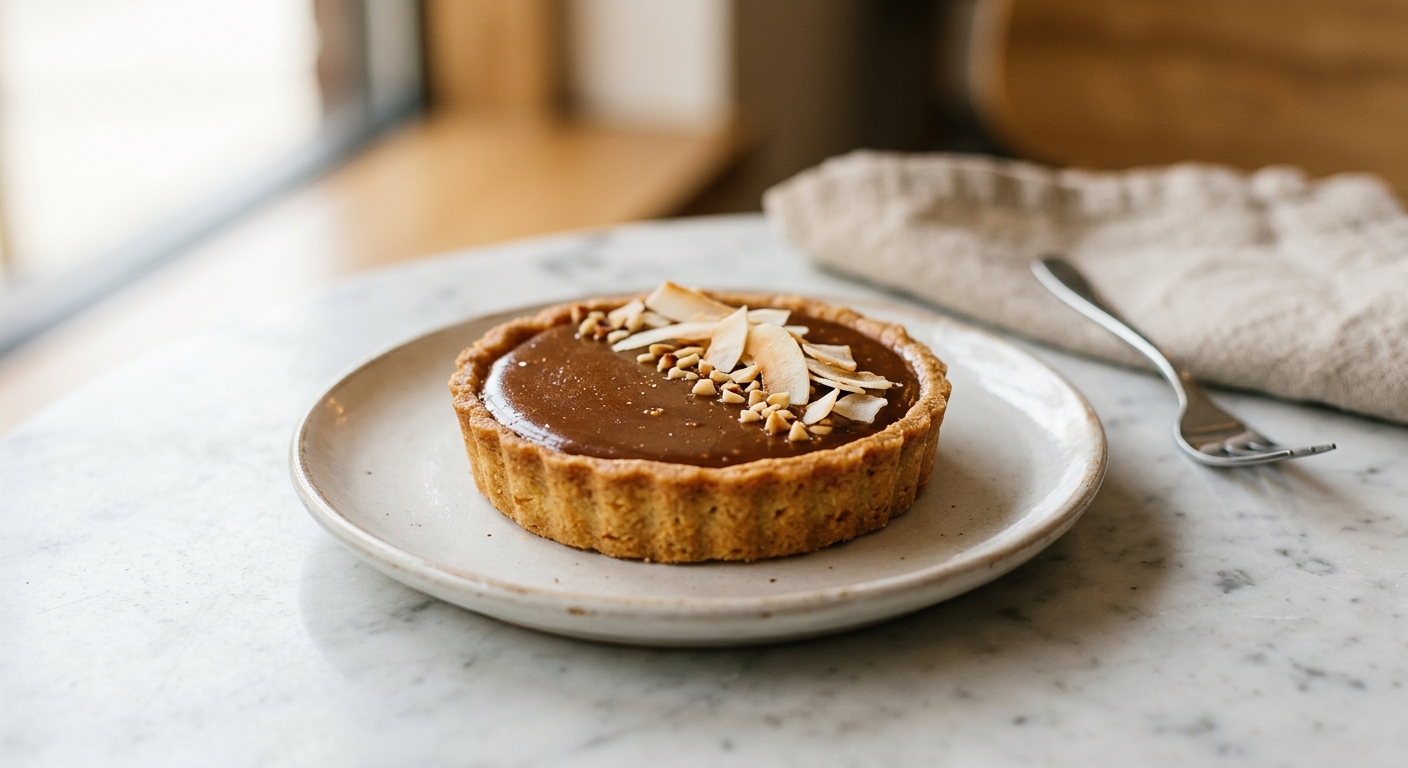
There is something almost magical about the moment caramel comes together: the way pale syrup deepens to a burnished amber, the way the kitchen fills with a toasty, almost smoky sweetness that makes everyone wander in to ask what you’re making. This tart captures that moment and holds it in a silky, set filling nestled inside a golden almond pastry shell that shatters just slightly when you press a fork through it. It is the kind of dessert that looks like it came from a patisserie window, but it begins with a single saucepan and a handful of wholesome ingredients.
What makes this version genuinely different is the use of coconut sugar throughout, both in the pastry and the caramel filling. Coconut sugar is minimally processed from the sap of coconut palm blossoms, and it carries with it a natural butterscotch warmth that refined sugar simply cannot mimic. It also has a significantly lower glycemic index (around 35, compared to table sugar’s 65), meaning it causes a slower, gentler rise in blood sugar. The almond flour crust adds another layer of benefit: high in healthy fats and protein, low in carbohydrates, and naturally gluten-free. Together, they create a tart that satisfies deeply without the sugar crash that follows most caramel desserts.
In terms of difficulty, this recipe sits comfortably at medium. The pastry comes together quickly and is very forgiving because almond flour dough does not toughen from overworking the way wheat dough does. The caramel requires your full attention for about ten minutes, but if you follow the temperature cues and keep a thermometer nearby, it is entirely approachable for a confident home baker. This tart is perfect for anyone managing their sugar intake without wanting to sacrifice the kind of dessert that earns a quiet gasp at the table.
Equipment Needed
Click on an item below to shop for the recommended items for this recipe on Amazon.
As an Amazon Associate, we earn from qualifying purchases.
10
Ingredients
- Pastry
- 240 gblanched almond flour (about 2 and 1/3 cups, spooned lightly)
- 30 gcoconut sugar (about 3 tbsp)
- 0.25 tspColima Sea SaltMicroplastic Free Salt
- 85 gcold unsalted butter, cut into 1/2-inch cubes (about 6 tbsp)
- 1 largeegg yolk, cold
- 1 tsppure vanilla extract
- Caramel
- 200 gcoconut sugar (about 1 cup, packed)
- 60 mlwater (about 1/4 cup)
- 240 mlheavy cream, at room temperature (about 1 cup)
- 56 gunsalted butter, cut into cubes (about 4 tbsp)
- Filling
- 2 largeeggs, at room temperature
- 1 largeegg yolk, at room temperature
- Caramel Filling
- 0.5 tspColima Sea SaltMicroplastic Free Salt
- 1 tsppure vanilla extract
- Finishing
- —Colima Sea SaltMicroplastic Free Salt (such as Maldon)
- —Lightly toasted almond slices or coconut flakes, optional garnish
Ingredient Substitutions
Instructions
- Make the almond pastry: In a food processor, combine the almond flour, coconut sugar, and 1/4 tsp fine sea salt. Pulse 3 to 4 times to combine. Add the cold butter cubes and pulse 8 to 10 times until the mixture resembles coarse, damp sand with no large butter chunks visible. Add the egg yolk and vanilla extract and pulse just until the dough clumps together and pulls away from the sides, about 5 to 6 more pulses. Do not overprocess.
- Press the pastry into a 9-inch fluted tart pan with a removable bottom. Use the flat bottom of a measuring cup to press the dough evenly across the base, then use your fingertips to press it up the sides to an even thickness of about 1/4 inch. The edges should come just to the top of the pan’s fluting. Refrigerate the unbaked shell for 20 minutes. Meanwhile, preheat your oven to 350°F (175°C).
- Blind bake the shell: Line the chilled pastry shell with a sheet of parchment paper and fill it with pie weights or dried beans. Bake for 12 minutes, then carefully lift out the parchment and weights. Return the shell to the oven and bake for a further 3 minutes until the base looks dry and just faintly golden. Set aside to cool slightly while you make the caramel. Keep the oven on.
- Make the coconut sugar caramel: Combine the 200g coconut sugar and 60ml water in a medium heavy-bottomed saucepan over medium heat. Stir gently just until the sugar dissolves, then stop stirring entirely. Bring to a boil and cook, swirling the pan occasionally (do not stir), until the mixture reaches 230°F (110°C) on an instant-read thermometer and smells deeply toasty, about 6 to 9 minutes. Because coconut sugar is already deeply colored, watch the temperature and aroma rather than color alone.
- Remove the pan from the heat and carefully pour in the heavy cream in a slow, steady stream, standing back as the mixture will bubble vigorously. Whisk to combine. Add the 56g butter cubes, the 1/2 tsp salt, and 1 tsp vanilla, whisking until the butter is fully melted and the caramel is smooth and glossy. Let the caramel cool for 10 minutes, stirring occasionally.
- Finish the filling: In a medium bowl, lightly whisk the 2 whole eggs and 1 egg yolk together. Slowly pour the warm (not hot) caramel into the eggs in a thin stream, whisking constantly to temper them. If the caramel is too hot when it meets the eggs, it will scramble them. Aim for around 140°F (60°C) or lower before adding.
- Pour the caramel filling through a fine-mesh strainer into the par-baked tart shell. This catches any accidentally scrambled egg bits and ensures a silky result. Bake at 350°F (175°C) for 10 to 12 minutes, until the edges are set but the center still has a gentle wobble, like a just-set jello. It will firm up as it cools.
- Remove from the oven and cool on a wire rack for 30 minutes, then transfer to the refrigerator and chill for at least 2 hours before slicing. Finish with a pinch of flaky sea salt and toasted almonds or coconut flakes just before serving. Remove the tart ring carefully before bringing to the table.
- Make the no-bake crust: In a food processor, combine 200g blanched almond flour, 100g soft Medjool dates (pitted, about 6 large), 2 tbsp coconut sugar, 1/4 tsp fine sea salt, and 1 tsp vanilla extract. Process until the mixture comes together into a sticky, uniform dough that holds its shape when pressed between your fingers, about 45 to 60 seconds. If it seems dry, add one additional date.
- Press the crust evenly into the base and up the sides of a 9-inch fluted tart pan with a removable bottom. Use the back of a spoon dipped in water to smooth it out. Place the pan in the freezer for 20 minutes to firm up while you prepare the filling.
- Make the no-bake caramel filling: In a medium saucepan, whisk together 240ml full-fat coconut cream, 180g coconut sugar, 1/2 tsp fine sea salt, and 1 tsp agar-agar powder (not flakes). Bring to a simmer over medium heat, whisking constantly, and cook for 2 full minutes once simmering to fully activate the agar. Remove from heat, add 2 tbsp refined coconut oil and 1 tsp vanilla extract, and whisk until smooth.
- Let the caramel filling cool for 5 minutes, whisking occasionally to prevent a skin from forming. Pour it through a fine-mesh strainer into the chilled tart shell. It will look quite liquid at this stage, which is normal.
- Gently tap the tart pan on the counter twice to release any air bubbles. Let it cool at room temperature for 20 minutes, then transfer carefully to the refrigerator. Chill for at least 4 hours, or overnight, until the filling is completely firm and set. Finish with flaky sea salt and optional garnishes just before serving.
- Prepare the almond pastry dough exactly as in the oven method (steps 1 and 2), pressing it into a 7-inch fluted tart pan with a removable bottom (a 9-inch pan will not fit most air fryer baskets). Refrigerate the shell for 20 minutes.
- Preheat your air fryer to 320°F (160°C) for 3 minutes. Line the chilled pastry shell with a sheet of parchment paper cut to fit and fill with pie weights or dried beans.
- Air fry the weighted shell for 8 minutes. Carefully remove the weights and parchment and air fry for a further 3 to 4 minutes, watching closely, until the base is dry and the edges are golden. Almond flour can go from golden to over-browned quickly in an air fryer. Remove and cool completely on a wire rack.
- Make the stovetop caramel: Follow the caramel steps from the oven method (steps 4 and 5), using the same ingredients and technique. Because this filling will not be baked again, cook the caramel to 240°F (115°C) for a slightly firmer set. Whisk in the butter, salt, and vanilla. Since there are no eggs in this version, simply pour the warm caramel directly through a fine-mesh strainer into the cooled tart shell.
- Allow the tart to cool at room temperature for 30 minutes, then refrigerate for at least 2 hours until fully set. The filling will be slightly denser and more toffee-like than the baked egg version. Finish with flaky sea salt before serving. Note that the yield is slightly smaller due to the smaller pan size, approximately 8 servings.
Nutrition Per Serving
Per 1 serving (makes one 9-inch tart, 10 slices)
Sweetener: coconut sugar
Why This Recipe Works
Almond flour pastry behaves very differently from traditional wheat-based shortcrust, and understanding why makes it much easier to work with. Because almond flour contains no gluten, there is no network of proteins to toughen if you overwork the dough. What holds almond pastry together instead is fat (from both the almonds and the added butter) and the egg yolk, which acts as an emulsifier and binder. This is why the dough is pressed rather than rolled: it is too fragile and moist to behave like a rolled dough, but pressing it gives you excellent, even coverage and a tender, slightly crumbly shell that holds its shape beautifully once baked.
The coconut sugar caramel works on the same principle as any caramel: heat drives off moisture, concentrating the sugars and triggering Maillard reactions and caramelization that produce hundreds of complex flavor compounds. Because coconut sugar is already naturally darker and contains trace minerals and inulin (a prebiotic fiber), it reaches a deep, complex flavor at a lower visual threshold than white sugar. This is why temperature is your most reliable guide here rather than color. Cooking to 230°F (110°C) before adding the cream produces a fluid caramel that, when combined with eggs and baked, sets to a smooth, sliceable consistency. The eggs are tempered slowly into the warm caramel to cook them gently and evenly without curdling, creating a custard-like structure that firms up in the oven.
If your caramel seizes or becomes grainy as it cooks, it is likely due to crystallization triggered by stirring after the sugar has dissolved, or by sugar crystals on the sides of the pan. To rescue a seized caramel, add 2 tablespoons of warm water, return to medium heat, and stir gently until the crystals dissolve again. To prevent it in the first place, resist stirring after the sugar dissolves, and use a wet pastry brush to brush down any crystals that form on the sides of the pan during cooking.
Baker’s Tips
- Bring the eggs and heavy cream to room temperature before making the filling. Cold dairy added to hot caramel can cause it to seize, and cold eggs are more likely to scramble when the warm caramel hits them.
- Use an instant-read thermometer for the caramel. Because coconut sugar is already dark, you cannot rely on the color change that guides traditional caramel making. Temperature is your most accurate and reliable cue.
- When pressing the almond pastry into the pan, use a flat-bottomed measuring cup or small glass to get an even base, then switch to your fingertips for the sides. Aim for a consistent 1/4-inch thickness so the crust bakes evenly.
- Strain the caramel filling before pouring it into the tart shell. Even a careful cook can accidentally introduce tiny cooked egg bits, and straining takes five seconds but guarantees a perfectly silky result.
- The tart is done baking when the outer inch or so is set but the very center still jiggles gently when you nudge the pan. It will look worryingly underdone, but carryover heat and refrigerator chilling will set it completely.
- Add the flaky sea salt just before serving, not before chilling. Salt draws out moisture over time and can cause the surface to weep slightly if added too early.
- If the tart shell shrinks during blind baking, it means the dough was pressed too thin up the sides, or it was not chilled long enough before baking. A full 20-minute refrigerator rest is important for the fat to resolidify and help the shell hold its shape.
Variations
- Espresso caramel: Add 1 teaspoon of instant espresso powder to the cream before adding it to the hot caramel. The coffee deepens the toffee notes of the coconut sugar dramatically.
- Dark chocolate ganache layer: Once the tart has chilled and set, pour a thin layer of warm ganache (60g 85% dark chocolate melted with 60ml warm cream) over the top and chill for 30 more minutes for a chocolate-caramel tart.
- Orange blossom: Add 1 teaspoon of orange blossom water and the finely grated zest of one orange to the caramel filling before pouring. Garnish with candied orange peel.
- Tahini swirl: Drop 3 teaspoons of runny tahini onto the surface of the filled (unbaked) tart and use a toothpick to swirl it through. It adds a nutty, slightly bitter contrast to the sweet caramel.
Troubleshooting & FAQ
My caramel seized up and turned grainy and crumbly in the pan. What happened?
The filling looks completely liquid after 12 minutes of baking. Is it done?
I accidentally scrambled the eggs when adding the caramel. Can I fix it?
My almond pastry crust crumbled and fell apart when I removed the tart ring. What went wrong?
The caramel filling tastes slightly bitter. Did I burn it?
Storage & Make-Ahead
- Storage: Store the tart loosely covered in the refrigerator for up to 5 days. The crust may soften slightly after day 2, but the flavor actually deepens. Do not store at room temperature for more than 2 hours due to the egg-based filling. The baked shell (unfilled) can be frozen for up to 1 month, well-wrapped.
- Make-Ahead: The almond pastry shell can be baked up to 2 days ahead, cooled completely, and stored at room temperature loosely covered. The full assembled tart is best made the day before serving, as the 2-hour chill requirement means it fits perfectly into a next-day plan. The caramel filling can be made up to 24 hours ahead and gently rewarmed over low heat, whisked smooth, then tempered with the eggs before baking.