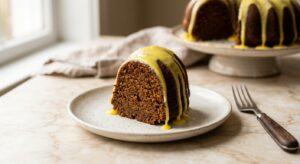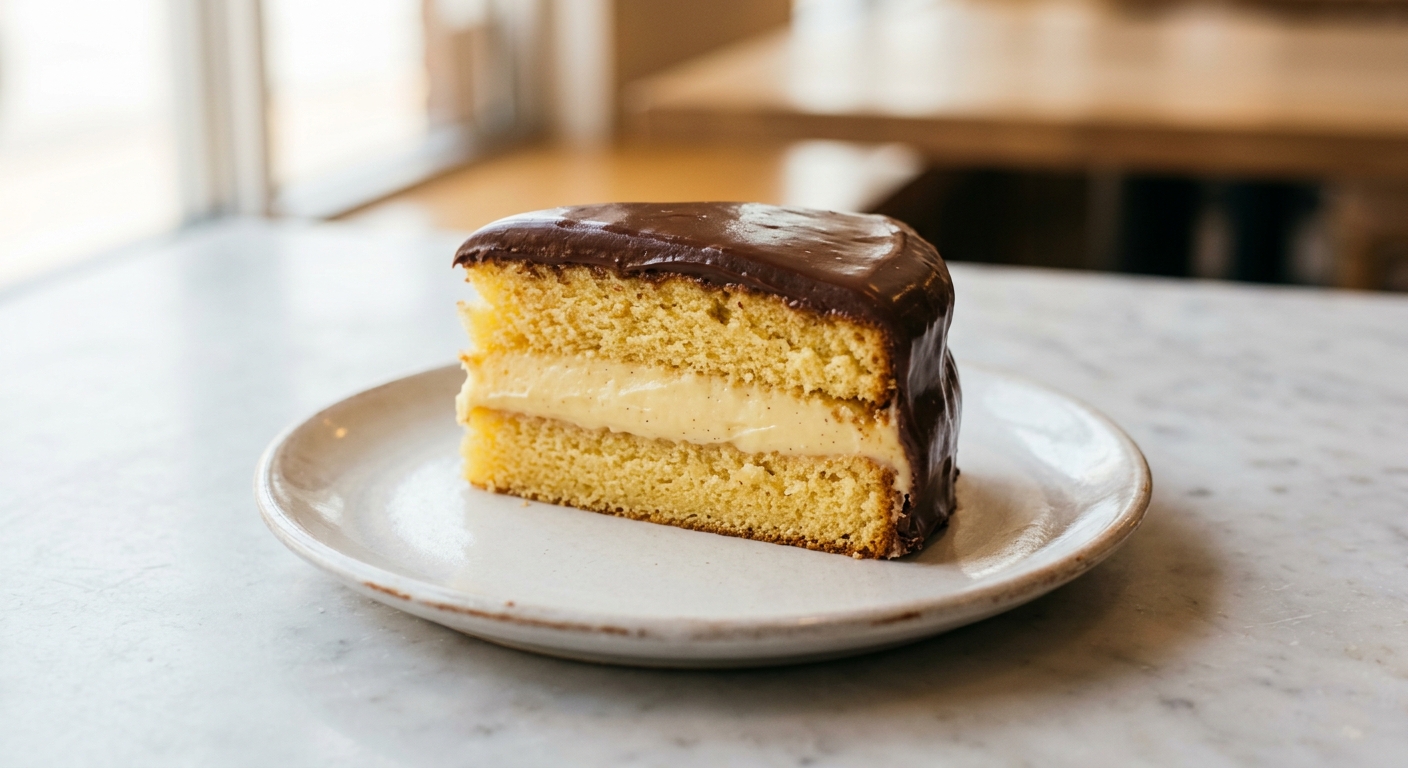
There is something quietly spectacular about a Boston Cream Pie. It arrives at the table looking almost restrained, dressed in nothing but dark chocolate and a few stray drips, and then you cut into it and that pale, cloud-soft pastry cream comes spilling forward and suddenly the whole room leans in. It is a cake that has been charming people since the 1850s, when it was first served at Boston’s Parker House Hotel, and nearly 175 years later it still has the power to make a dinner table go completely silent after the first bite.
What sets this version apart is the pastry cream, which is made the proper French way with egg yolks, whole milk, a generous amount of real vanilla, and just enough cornstarch to give it body without turning it gluey or stiff. It is cooked low and slow, strained for absolute smoothness, and then chilled with plastic wrap pressed directly against the surface so it stays perfectly silky. The cake layers themselves are a classic American butter cake made with both butter and a touch of sour cream for tenderness, and the chocolate glaze is a simple ganache-style pour made with heavy cream and good-quality dark chocolate. Every component is achievable on its own, and together they are genuinely extraordinary.
This recipe sits comfortably at a medium difficulty level. None of the techniques are advanced, but there are three components to prepare, so a little planning goes a long way. It is ideal for a home baker who is comfortable with basic cake baking and wants to try their first pastry cream, or anyone who loves a classic American dessert and wants to make the best possible version of it from scratch.
Equipment Needed
Click on an item below to shop for the recommended items for this recipe on Amazon.
As an Amazon Associate, we earn from qualifying purchases.
12
Ingredients
- —PASTRY CREAM (make first, needs 2 to 3 hours to chill)
- 480 mlwhole milk (2 cups)
- 100 ggranulated sugar, divided (1/2 cup), split into two portions
- 5 Nonelarge egg yolks
- 35 gcornstarch (1/4 cup)
- 28 gunsalted butter, cut into cubes (2 tablespoons)
- 2 tsppure vanilla extract
- —VANILLA BUTTER CAKE LAYERS
- 280 gall-purpose flour (2 1/4 cups, spooned and leveled)
- 2 tspbaking powder
- 0.5 tspColima Sea SaltMicroplastic Free Salt
- 170 gunsalted butter, at room temperature (3/4 cup, 1.5 sticks)
- 250 ggranulated sugar (1 1/4 cups)
- 3 Nonelarge eggs, at room temperature
- 2 tsppure vanilla extract
- 120 gfull-fat sour cream, at room temperature (1/2 cup)
- 120 mlwhole milk, at room temperature (1/2 cup)
- —DARK CHOCOLATE GLAZE
- 170 ggood-quality dark chocolate, 60 to 70% cacao, finely chopped (6 oz)
- 180 mlheavy cream (3/4 cup)
- 14 gunsalted butter (1 tablespoon)
- 1 tbsplight corn syrup (for shine and flexibility, optional but recommended)
Ingredient Substitutions
Instructions
- MAKE THE PASTRY CREAM FIRST: In a medium heavy-bottomed saucepan, combine the milk and half the sugar (50g). Heat over medium heat, stirring occasionally, until steaming and just beginning to simmer around the edges. Do not boil.
- Meanwhile, whisk the egg yolks, remaining 50g of sugar, and cornstarch together in a medium heatproof bowl until pale and smooth, about 1 minute. This mixture should have no lumps.
- Temper the yolks by slowly pouring about one-third of the hot milk into the yolk mixture while whisking constantly. Pour this tempered mixture back into the saucepan with the remaining milk. Cook over medium heat, whisking constantly and making sure to reach into the corners of the pan, until the cream thickens, large bubbles begin to pop on the surface, and it holds a visible trail from the whisk. This takes about 3 to 4 minutes. Cook for 1 full minute after the first large bubble appears to cook out the raw cornstarch flavor.
- Remove from heat and immediately whisk in the butter and vanilla extract until completely melted and incorporated. Strain through a fine-mesh sieve into a clean bowl to remove any lumps or overcooked egg bits. Press plastic wrap directly onto the surface of the pastry cream (this prevents a skin from forming) and refrigerate for at least 2 to 3 hours, or until fully cold and set. The cream will firm up considerably as it chills.
- MAKE THE CAKE LAYERS: Preheat your oven to 350°F (175°C). Grease two 9-inch round cake pans, line the bottoms with parchment paper circles, then grease and flour the parchment and sides.
- Whisk together the flour, baking powder, and salt in a medium bowl. Set aside.
- In the bowl of a stand mixer fitted with the paddle attachment (or using a hand mixer), beat the room-temperature butter on medium-high speed for 2 minutes until pale and creamy. Add the granulated sugar and beat for a further 3 to 4 minutes until the mixture is very light, fluffy, and almost white in color. Scrape down the sides of the bowl.
- Add the eggs one at a time, beating for 30 seconds after each addition and scraping down the bowl. Add the vanilla extract with the last egg. If the mixture looks slightly curdled, do not worry; it will come together when the flour is added.
- Combine the sour cream and milk in a small measuring jug and stir briefly. With the mixer on low speed, add the flour mixture in three additions, alternating with the sour cream and milk mixture in two additions (flour, liquid, flour, liquid, flour). Begin and end with the flour. Mix each addition only until just combined. Do not overmix once the flour is added or the cake will be tough.
- Divide the batter evenly between the two prepared pans (about 520g per pan if you have a scale, which gives level layers). Smooth the tops gently. Bake for 28 to 32 minutes, until the tops are golden, the edges have pulled away slightly from the pan, and a toothpick inserted in the center comes out with just a few moist crumbs. Rotate the pans once at the halfway point.
- Cool the layers in the pans for 15 minutes, then turn out onto wire racks, peel off the parchment, and cool completely. The layers must be completely cool before filling.
- MAKE THE CHOCOLATE GLAZE: Once the layers are cool and you are ready to assemble, heat the heavy cream in a small saucepan over medium heat until it just begins to simmer. Pour it over the finely chopped chocolate and butter in a heatproof bowl. Let sit undisturbed for 2 minutes, then whisk gently from the center outward until completely smooth and glossy. Stir in the corn syrup if using. Let the glaze cool at room temperature, stirring occasionally, until it thickens to a pourable but not runny consistency, about 20 to 30 minutes. It should coat the back of a spoon and flow slowly when you tilt the bowl.
- ASSEMBLE: Place the first cake layer on a cake board or serving plate. If the pastry cream has become very firm in the fridge, whisk it briefly until smooth and spreadable. Spoon all of the pastry cream onto the center of the first layer and spread it evenly to within about 1/2 inch of the edge (the weight of the top layer will push it slightly outward). Place the second cake layer on top, pressing down very gently and evenly.
- Pour the chocolate glaze into the center of the top layer. Use an offset spatula or the back of a spoon to gently nudge it toward the edges, encouraging a few dramatic drips to fall down the sides. Do not frost the sides fully; the exposed layers and cream are part of the classic look. Let the glaze set for at least 20 minutes before slicing. For the cleanest slices, refrigerate the assembled cake for 30 minutes before cutting with a warm, sharp knife.
- Make the pastry cream and refrigerate it as described in steps 1 through 4 of the oven method. This must be done ahead and the cream must be fully chilled before assembly.
- Grease the insert of a 6-quart slow cooker generously with butter or non-stick spray. Line the bottom with a circle of parchment paper cut to fit, then grease the parchment. This step is important: the full batter will go into the single insert as one thick layer.
- Make the cake batter exactly as described in steps 6 through 9 of the oven method. Pour the entire batter into the prepared slow cooker insert and smooth the top. Place a double layer of paper towels across the top of the slow cooker insert before putting on the lid. This absorbs condensation and prevents water from dripping onto the cake, which would leave wet, gummy patches on the surface.
- Cook on High for 2 to 2.5 hours. Do not lift the lid for the first 2 hours. The cake is done when the edges are set and pulling away from the sides, the top looks matte and dry (not shiny or wet), and a toothpick inserted in the center comes out with just a few moist crumbs. The center will remain lighter in color than the edges, which is normal.
- Turn off the slow cooker and let the cake rest with the lid slightly ajar for 15 minutes. Then carefully lift the insert out (use oven mitts as it will be very hot), run a thin spatula around the edges, and invert the cake onto a wire rack. Peel off the parchment and let cool completely, at least 1.5 hours. The cake will not have a browned crust but will be tender and moist throughout.
- Once completely cool, use a long serrated bread knife to split the cake horizontally into two even layers. Make a small notch on the side with a toothpick first so you can realign the layers after filling. Fill with all of the chilled pastry cream, replace the top layer, and finish with the chocolate glaze exactly as described in the oven method steps 12 and 13.
- SMALL-BATCH PASTRY CREAM: In a small saucepan, whisk together 80ml (1/3 cup) whole milk, 1 egg yolk, 2 teaspoons sugar, and 1 teaspoon cornstarch until smooth. Cook over medium-low heat, whisking constantly, until the mixture thickens and begins to bubble, about 3 to 4 minutes. Remove from heat, whisk in 1/2 teaspoon vanilla extract and a small knob of butter (about 5g). Transfer to a small bowl, press plastic wrap to the surface, and refrigerate while you make the mug cake. It will be ready in about 15 minutes.
- MUG CAKE: Grease a large microwave-safe mug (at least 350ml capacity) lightly with butter. In a small bowl, whisk together 3 tablespoons (25g) all-purpose flour, 2 tablespoons (25g) granulated sugar, 1/4 teaspoon baking powder, and a tiny pinch of salt. Add 2 tablespoons (30ml) whole milk, 2 tablespoons (28g) melted butter, 1 small egg, and 1/4 teaspoon vanilla extract. Whisk until smooth. Pour into the greased mug.
- Microwave on full power (1000W) for 85 to 90 seconds. The cake is done when it looks set on top, slightly moist at the very center is acceptable, and a toothpick comes out with just a few moist crumbs. Every microwave is different, so check at 75 seconds. Let the mug rest for 2 minutes as it will continue cooking slightly from residual heat.
- MICROWAVE GLAZE: Place 2 tablespoons (28g) finely chopped dark chocolate and 1.5 tablespoons (22ml) heavy cream in a small microwave-safe bowl. Microwave on 50% power for 30 seconds, then stir until completely smooth and glossy. If not fully melted, microwave in further 10-second bursts at 50% power, stirring between each.
- ASSEMBLE: Let the mug cake cool for 5 minutes. If you prefer, run a knife around the edges and invert the cake onto a small plate. Spoon the chilled pastry cream over the top, then pour the chocolate glaze over the cream. Serve immediately. Alternatively, leave the cake in the mug, spoon pastry cream into the center, and pour the glaze directly in for a more casual, rustic presentation.
Nutrition Per Serving
Per 1 serving (makes one 9-inch two-layer cake)
Why This Recipe Works
The sour cream in the cake batter does two important things: it adds fat, which coats gluten strands and keeps the crumb tender, and its acidity reacts with the baking powder to give a slightly more vigorous rise. Creaming the butter and sugar for a full 4 minutes is not just convention. It physically incorporates millions of tiny air bubbles into the fat, and those bubbles expand in the oven heat to give the cake its light, even crumb. Cutting that step short means a denser, flatter cake. The alternating addition of flour and liquid prevents gluten from developing too aggressively: adding all the flour at once would cause the gluten to tighten up under the strain of mixing, resulting in a tough, chewy texture rather than a tender one.
Pastry cream is a starch-thickened custard, and the science of making it well comes down to two key moments. First, tempering: pouring hot milk into cold egg yolks gradually raises their temperature slowly enough that they do not scramble. Pouring hot milk directly onto cold yolks without tempering would cook them into sweet scrambled eggs. Second, the full minute of boiling after the cream thickens is essential. Cornstarch contains an enzyme called amylase that, if left active, will break down the starch and cause the pastry cream to thin out and weep liquid within hours. Boiling deactivates this enzyme and ensures the cream stays thick and stable even after 3 days in the refrigerator. Pressing plastic wrap directly onto the surface prevents oxidation and the formation of a leathery skin that would create lumps.
The chocolate glaze works on the principle of a simple ganache. Pouring hot cream over finely chopped chocolate melts the chocolate gently and evenly, and the fat from the cream emulsifies with the cocoa butter in the chocolate to form a smooth, glossy, pourable sauce. Butter adds additional richness and a satin sheen. Corn syrup interferes with sugar crystallization in the chocolate, keeping the set glaze flexible and glossy rather than dull and crackly. Allowing the glaze to cool and thicken before pouring is critical: too hot and it will run straight off the cake and pool on the plate; at the right consistency it will flow slowly and stay put at the edges, creating those signature drips.
Baker’s Tips
- Bring all refrigerated ingredients for the cake layers (butter, eggs, sour cream, milk) to room temperature at least 45 minutes before starting. Cold butter will not cream properly and cold eggs can cause the batter to break and curdle.
- Make the pastry cream first, even the night before. It must be completely cold and set before you can fill the cake. A warm or runny pastry cream will soak into the cake layers and cause the top layer to slide.
- Weigh your flour rather than scooping it from the bag. Scooping compacts flour and can add 20 to 30% more than intended, leading to a dry, dense cake. If you do not have a scale, spoon flour into the measuring cup and level it off with a straight edge.
- Chop the chocolate for the glaze finely and evenly so it all melts at the same rate from the heat of the cream. Large chunks may remain unmelted and can leave a lumpy, streaky glaze.
- For the cleanest, most dramatic slices, refrigerate the assembled cake for at least 30 minutes before cutting. Run your knife under hot water, wipe it dry, and make each cut in a single downward motion without sawing. Wipe the blade clean between each slice.
- If your pastry cream has lumps or looks slightly curdled after chilling, whisk it vigorously for 30 to 60 seconds before spreading. It will smooth out. If it remains very lumpy, pass it through a fine-mesh sieve while pressing with a flexible spatula.
Variations
- Espresso Pastry Cream: Whisk 1.5 teaspoons of instant espresso powder into the hot milk before tempering the yolks. The coffee flavor amplifies the dark chocolate glaze beautifully.
- Lemon Boston Cream: Replace the vanilla extract in the pastry cream with 2 teaspoons of finely grated lemon zest and 1 teaspoon of lemon juice. Use white chocolate in place of dark chocolate for the glaze for a bright, summery version.
- Brown Butter Cake Layers: Brown the butter before using it in the cake. Cook the butter in a light-colored saucepan over medium heat until the milk solids turn golden and nutty-smelling, then cool to room temperature until solid again before creaming. This adds a remarkable depth of flavor to the cake.
- Mini Boston Cream Cupcakes: Pour the cake batter into 24 lined cupcake wells and bake at 350°F (175°C) for 18 to 20 minutes. Once cool, use a small melon baller or apple corer to hollow out the center of each cupcake, fill with pastry cream, replace the plug, and spoon chocolate glaze over each top.
Troubleshooting & FAQ
My pastry cream turned out lumpy, with what looks like scrambled egg bits in it. What went wrong?
My pastry cream was thick when I made it but turned watery and thin overnight. Why?
My cake layers domed significantly in the center. How do I get flat layers?
My chocolate glaze looks dull and grainy instead of glossy. What happened?
The top layer of my cake slid off when I tried to serve it. How do I prevent this?
Storage & Make-Ahead
- Storage: Store the assembled cake covered in the refrigerator for up to 4 days. Because of the pastry cream filling, this cake must be refrigerated and should not be left at room temperature for more than 2 hours. The unassembled cake layers can be stored at room temperature, well wrapped, for up to 2 days. Freeze unfilled cake layers wrapped in plastic wrap and then foil for up to 2 months; thaw overnight in the refrigerator. Pastry cream does not freeze well as it separates when thawed.
- Make-Ahead: The pastry cream can be made up to 3 days in advance and stored in the refrigerator with plastic wrap pressed to its surface. The cake layers can be baked up to 2 days ahead and stored tightly wrapped at room temperature, or frozen for up to 2 months. The chocolate glaze can be made up to 1 week ahead and refrigerated in a jar; reheat gently in a bowl set over hot water or in 15-second microwave bursts at 50% power until pourable. Assemble the cake on the day of serving, or no more than 24 hours ahead.