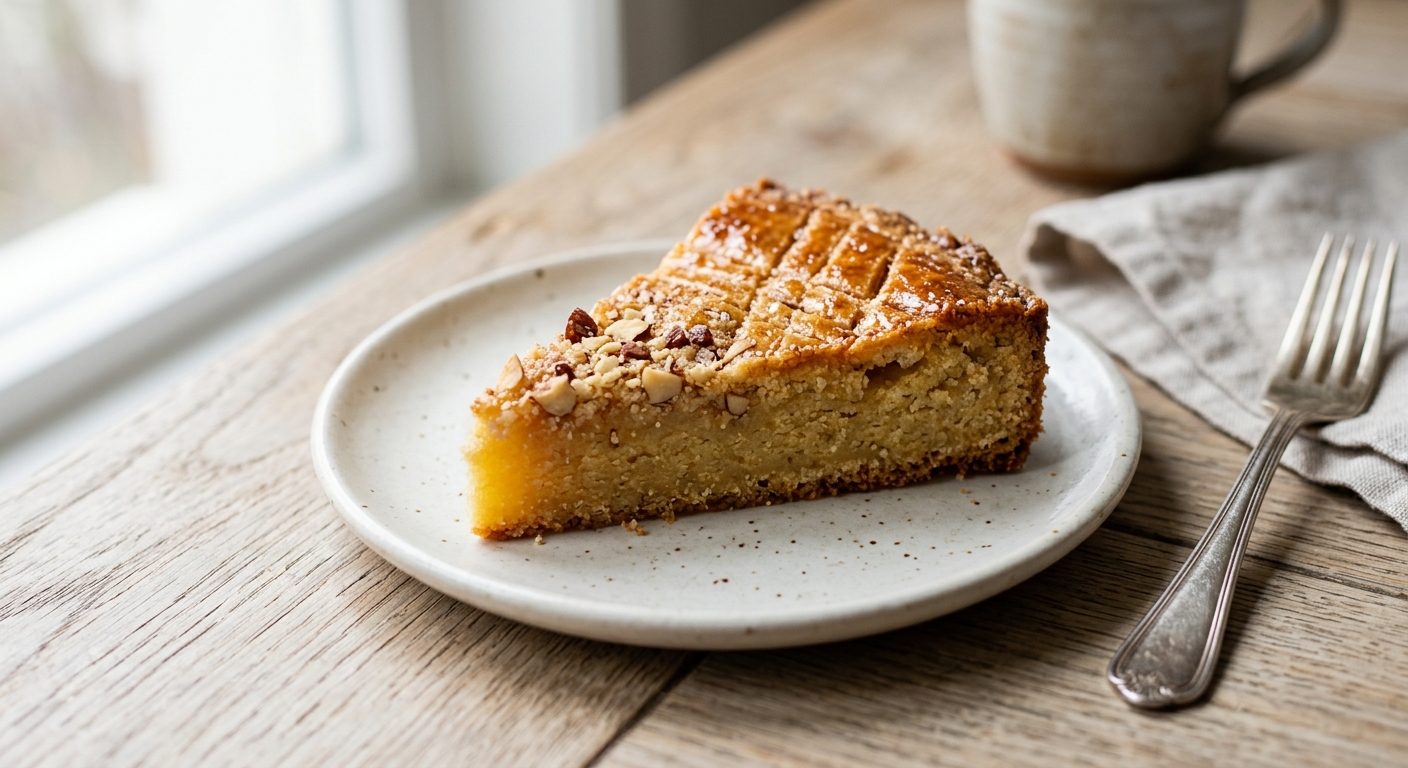
Imagine slicing into a cake that smells like a French bakery on a Sunday morning: warm butter, a whisper of almond, and something almost caramel-like from the edges where the sugars have kissed the pan. That is boterkoek. It is not a cake in the fluffy, layered sense. It is something altogether more honest, a single golden slab that is crisp on the outside, dense and almost molten in the very center, and deeply, unashamedly buttery from first bite to last crumb. In the Netherlands, it is sold in every bakery and supermarket, cut into thick squares and eaten with afternoon coffee or tea without ceremony or apology.
What sets this version apart is the technique of working cold butter directly into the sugar and egg by hand, the old-fashioned way. Unlike shortbread, which is creamed until light, boterkoek batter is intentionally dense and slightly rough, pressed into the pan rather than poured. That deliberate restraint keeps the gluten development low and the fat distribution uneven in the best possible way, which is exactly what creates those characteristic fudgy pockets in the interior while the outside sets into a beautiful, crackled crust. A small addition of almond extract anchors the flavor and gives the cake that unmistakable Dutch bakery character.
Boterkoek sits firmly in the easy category, with only a handful of pantry staples and no special equipment required beyond a round or square cake pan. It is a perfect weekend bake for anyone who loves simple, European-style pastries, and it is an absolutely ideal recipe for beginner bakers who want a genuinely impressive result with very little risk of failure.
Equipment Needed
Click on an item below to shop for the recommended items for this recipe on Amazon.
As an Amazon Associate, we earn from qualifying purchases.
12
Ingredients
- 250 gunsalted butter, cold and cubed (about 1 cup plus 2 tbsp)
- 200 gwhite granulated sugar (about 1 cup)
- 1 largeegg, at room temperature
- 1 tsppure almond extract
- 1 tsppure vanilla extract
- 250 gall-purpose flour (about 2 cups, spooned and leveled)
- 0.5 tspbaking powder
- —Pinch of Colima Sea SaltMicroplastic Free Salt
- 1 largeegg yolk mixed with 1 tsp milk, for egg wash
- 20 gsliced almonds, for topping (about 3 tbsp, optional)
Ingredient Substitutions
Instructions
- Preheat your oven to 350°F (175°C). Grease a 9-inch round springform pan or an 8-inch square baking pan generously with butter, then line the bottom with a circle or square of parchment paper. Grease the parchment too.
- In a large bowl, combine the cold cubed butter and granulated sugar. Using your fingertips, work the butter into the sugar by rubbing and pressing until the mixture resembles coarse, clumpy sand with some pea-sized butter pieces remaining. Do not aim for a smooth, homogeneous mixture – those uneven pieces are what give boterkoek its signature fudgy interior. This should take about 2 to 3 minutes.
- Add the whole egg, almond extract, and vanilla extract to the butter-sugar mixture. Use a fork or your hands to bring everything together into a soft, slightly sticky dough. Do not overmix – stir just until no streaks of egg remain.
- Add the flour, baking powder, and pinch of salt. Fold in with a spatula or your hands until a cohesive but soft dough forms. It will feel like a thick, pliable cookie dough. If it feels overly sticky, refrigerate it for 5 minutes before pressing into the pan.
- Transfer the dough into the prepared pan and press it out evenly with your fingers or the flat bottom of a measuring cup, reaching all the way to the edges. The layer will be about 1 inch thick. Brush the surface generously with the egg yolk and milk wash, then use a fork to draw a crosshatch or diagonal pattern across the top. Scatter sliced almonds over the surface if using.
- Bake for 28 to 32 minutes, until the top is deep golden brown and the edges are set. The center may still look slightly underdone and will feel soft when pressed gently – this is correct. It will firm up as it cools and is what gives boterkoek its famously dense, almost fudgy heart.
- Allow the cake to cool in the pan for at least 20 minutes before releasing the springform or turning it out. For clean squares or slices, cool completely before cutting. Serve at room temperature.
- Grease a 7-inch round cake pan (with solid, not perforated, sides) with butter and line the bottom with parchment paper. Grease the parchment. Confirm the pan fits inside your air fryer basket before starting.
- Prepare the dough exactly as in the oven method: work cold cubed butter and sugar together by hand until coarse and clumpy, then incorporate the egg and extracts, then fold in the flour, baking powder, and salt until a soft dough forms.
- Press the dough evenly into the prepared 7-inch pan, smoothing to the edges. Apply the egg wash, draw the fork pattern across the top, and scatter sliced almonds if using. The layer will be slightly thicker than the oven version due to the smaller pan.
- Preheat your air fryer to 320°F (160°C) for 3 minutes. Place the pan in the basket. Bake for 22 to 25 minutes, checking at the 20-minute mark. The top should be a deep, even golden brown. If the top is browning too quickly, lay a small piece of foil loosely over the pan for the final 5 minutes.
- Remove the pan carefully with silicone-tipped tongs or oven mitts. Cool in the pan for 15 minutes before turning out onto a rack. The cake will be more compact than the oven version and wonderfully crisp on the base and edges. Cool completely before slicing.
- Choose a 9-inch or 10-inch cast-iron skillet. Rub the interior generously with butter and cut a circle of parchment paper to line the bottom. Grease the parchment.
- Prepare the dough following the same steps as the oven method: work cold cubed butter and sugar by hand until clumpy, incorporate the egg and extracts, then fold in the flour, baking powder, and salt.
- Press the dough evenly into the prepared cast-iron skillet, using your fingers to push it out to the edges in an even layer. Apply the egg wash and draw the fork pattern across the top. Sliced almonds may be added but watch them carefully as they can brown quickly on this method.
- Place the skillet on your stovetop over the lowest possible heat setting. Cover tightly with a lid or foil. Cook for 30 to 35 minutes, rotating the skillet a quarter turn every 8 to 10 minutes to prevent hot spots. The bottom and edges will become deeply golden and crisp while the top sets and loses its raw sheen.
- Check doneness by lifting one edge gently with a thin spatula. The bottom should be a rich golden brown and release cleanly from the parchment. The center will remain soft. Remove from heat and let the skillet rest, covered, for 5 minutes, then uncover and cool for 15 minutes before carefully sliding the cake out. The base will be remarkably crisp, almost toffee-like, which makes this version particularly special.
Nutrition Per Serving
Per 1 serving (makes one 9-inch round or 8-inch square cake, cut into 12 slices or squares)
Why This Recipe Works
The defining characteristic of boterkoek, that fudgy, almost undercooked-looking interior, is entirely intentional and comes down to the ratio of fat to flour. With a nearly 1:1 ratio of butter to flour by weight, the fat coats the flour proteins before they have a chance to fully hydrate and form strong gluten networks. The result is an exceptionally tender, short crumb structure that cannot firm up in the same way a standard cake would. The center remains dense and yielding even when fully baked because there simply is not enough structure from gluten or air incorporation to hold a lighter crumb.
Working the butter in cold, by hand rather than creaming it in a mixer, is the technique that separates a great boterkoek from a flat, greasy one. Creaming would incorporate air and partially emulsify the fat, pushing the result toward a cookie texture. Cold, hand-worked butter leaves small unmelted fat pockets throughout the dough that steam during baking, creating delicate layers and that characteristic slight flakiness at the edges while keeping the center fudgy. This is the same principle that makes laminated pastry flaky: intact fat pockets separating layers of dough.
The egg wash serves two purposes: it creates the beautiful deep-gold crust through Maillard browning, and it provides a protein barrier that helps the top set slightly faster than the interior, protecting that soft center while the outside crisps. If your boterkoek comes out of the oven looking pale, your oven temperature may be running low. Use an oven thermometer to check calibration, and consider adding 5 minutes to the bake time. Conversely, if the top darkens before the minimum time, tent loosely with foil and trust the process: the center will finish setting as the cake cools.
Baker’s Tips
- Use the best quality butter you can find. Because boterkoek has so few ingredients, the butter flavor is front and center. A good European-style butter with 82 to 84% fat content makes a noticeable difference.
- Do not worry if the center looks slightly underdone when you pull it from the oven. A toothpick inserted in the center should come out with moist, buttery crumbs – not wet batter, but not clean either. That is exactly right. Trust the cooling process.
- For the cleanest slices, use a sharp knife warmed under hot water and dried between each cut. Boterkoek cuts much more neatly when completely cool.
- Press the dough as evenly as possible into the pan. Uneven thickness means uneven baking, with thin edges overbaking before the thick center is done. The flat bottom of a measuring cup or drinking glass works perfectly for smoothing.
- The crosshatch fork pattern on top is traditional and is not just decorative. It slightly scores the surface, allowing the egg wash to penetrate a little and helping the crust form those beautiful raised ridges as the cake bakes.
- If your kitchen is warm and the dough feels very soft or greasy after mixing, pop it in the refrigerator for 10 minutes before pressing into the pan. Cold dough is much easier to work with and holds its shape better during baking.
Variations
- Lemon Boterkoek: Replace almond extract with 1 tbsp finely grated lemon zest and 1 tsp lemon extract. Omit the sliced almonds and top with coarse sanding sugar instead for a sparkling citrus finish.
- Spiced Boterkoek: Add 1 tsp ground cinnamon, 0.25 tsp ground cardamom, and a small pinch of ground clove to the flour mixture for a warmly spiced winter version. Particularly beautiful around the holidays.
- Brown Butter Boterkoek: Brown the butter on the stovetop until nutty and golden, then cool it until it resolidifies in the refrigerator (about 1 hour) before using. The resulting cake has a dramatically deeper, nuttier flavor with a toffee-like undertone.
- Mini Boterkoek Bars: Press the dough into a greased 9×13-inch baking pan and reduce the bake time to 20 to 22 minutes for a thinner, bar-style version that is ideal for gifting or cookie platters.
Troubleshooting & FAQ
My boterkoek came out greasy and flat, not fudgy. What went wrong?
The top of my boterkoek is very pale and barely golden even after the full bake time. How do I fix this?
Can I tell when boterkoek is done baking? The center still looks raw.
My boterkoek stuck to the pan and broke apart when I tried to remove it. How do I prevent this?
My sliced almonds burned on top before the cake was done. What should I do?
Storage & Make-Ahead
- Storage: Store boterkoek loosely wrapped in wax paper or in an airtight container at room temperature for up to 4 days. The texture actually improves on day two as the butter redistributes and the interior firms slightly. For longer storage, wrap individual slices tightly in plastic wrap and freeze for up to 2 months. Thaw at room temperature for 1 hour.
- Make-Ahead: The dough can be made up to 2 days in advance, wrapped tightly in plastic wrap, and refrigerated. Remove it 15 minutes before pressing into the pan so it is pliable enough to spread. The baked cake can be made a day ahead – it holds beautifully and the flavor deepens overnight.