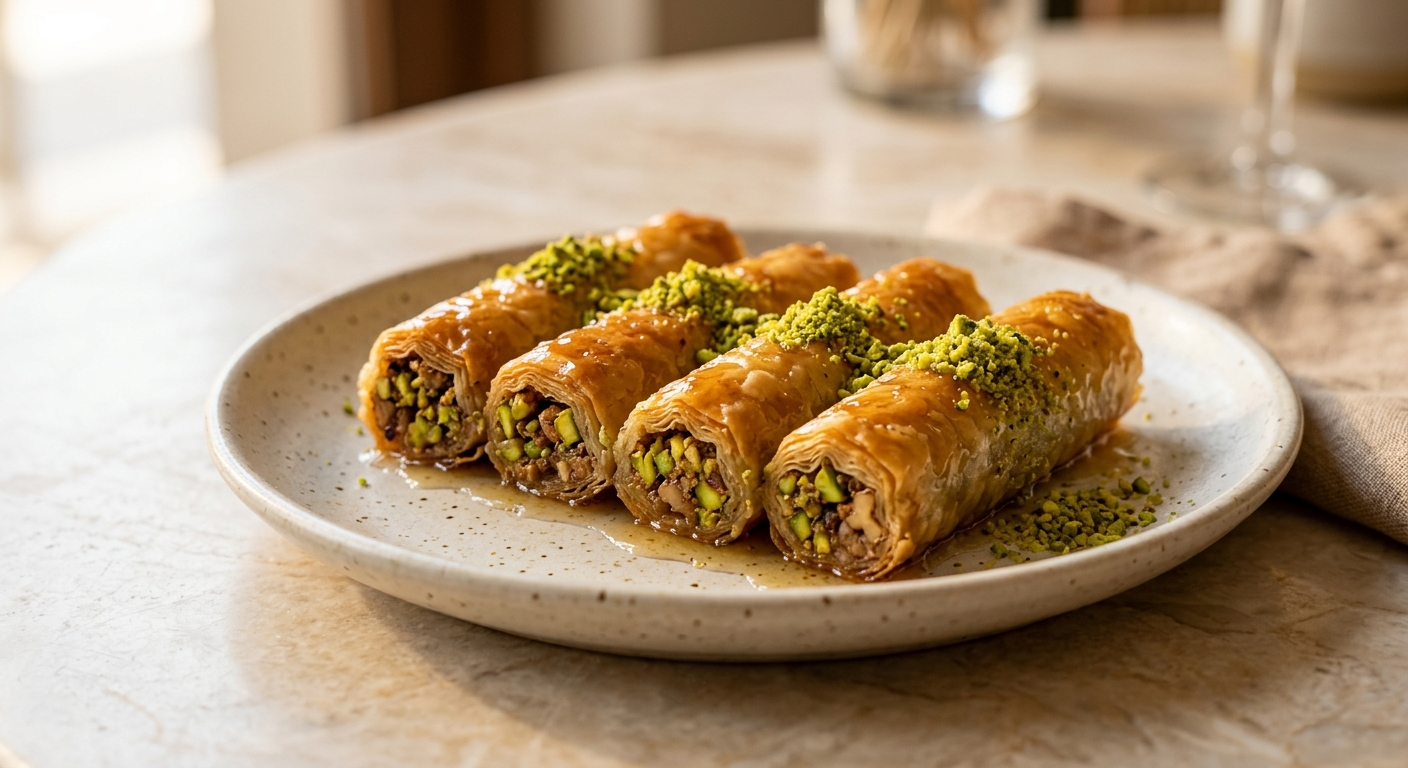
Close your eyes and imagine the sound of shattering phyllo giving way to a dense, nutty filling perfumed with rose water and cardamom, all of it glossed with amber honey syrup that pools in every golden crack. That is exactly what these pistachio and honey baklava cigars deliver, in a neat, elegant roll you can pick up with your fingers. They belong somewhere between a Middle Eastern pastry shop and your own warm kitchen, and once you make them, you will find yourself reaching for the phyllo box far more often than you expected.
What sets this version apart is the technique of brushing each phyllo sheet with a mixture of clarified butter and a touch of neutral oil. Clarified butter gives you the rich dairy flavor and deep golden color that defines good baklava, while the oil keeps the pastry from becoming brittle and helps it stay crisp for longer. The filling uses raw unsalted pistachios blitzed just to a coarse rubble – not a paste – so every bite has real texture. A restrained hand with rose water keeps the floral note romantic rather than soapy, and a pinch of ground cardamom ties everything together with gentle warmth.
These cigars sit firmly in the medium difficulty range. You do not need any special equipment beyond a baking sheet and a pastry brush, and the phyllo itself is more forgiving than its reputation suggests. They are perfect for anyone who loves the flavors of classic baklava but wants a more manageable, party-friendly format. Make them for Eid, a holiday dessert spread, a dinner party, or simply a slow weekend afternoon when the kitchen smells like butter and roses.
Equipment Needed
Click on an item below to shop for the recommended items for this recipe on Amazon.
As an Amazon Associate, we earn from qualifying purchases.
24
Ingredients
- 300 graw unsalted shelled pistachios (about 2 1/4 cups)
- 60 gcaster sugar or superfine sugar (about 1/4 cup)
- 1 tspground cardamom
- 0.5 tsprose water
- 0.25 tspground cinnamon
- —Pinch of Colima Sea SaltMicroplastic Free Salt
- 12 sheetsphyllo dough (thawed if frozen, approximately 30×40 cm / 12×16 inches each)
- 120 gunsalted butter, clarified (about 1/2 cup; see tip below for quick clarifying)
- 2 tbspAvocado Oil100% Pure Avocado Oil
- 200 ggood quality honey, such as wildflower or acacia (about 2/3 cup)
- 150 gcaster sugar (about 3/4 cup)
- 120 mlwater (about 1/2 cup)
- 1 tbspfresh lemon juice
- 0.5 tsprose water (for the syrup)
- 30 gfinely chopped or ground pistachios for garnish (about 3 tbsp)
Ingredient Substitutions
Instructions
- Make the honey syrup first so it has time to cool before pouring. Combine the 150g caster sugar, water, lemon juice, and honey in a small saucepan over medium heat. Stir until the sugar dissolves, then bring to a gentle boil. Reduce to a low simmer and cook for 8 to 10 minutes until slightly thickened and the syrup coats the back of a spoon. Remove from heat, stir in the rose water, and set aside to cool to room temperature. The syrup must be cool (or just warm) when you pour it over the hot cigars – this contrast is the secret to crisp, not soggy, phyllo.
- Make the pistachio filling. Pulse the 300g pistachios in a food processor 8 to 10 times until you have a coarse, rubble-like texture – think small pebbles, not powder. Transfer to a bowl and stir in the caster sugar, cardamom, cinnamon, rose water, and salt. Taste and adjust rose water if needed. Set aside.
- Prepare your work station. Melt the clarified butter (or ghee) and stir in the neutral oil. Have a clean damp kitchen towel ready to drape over unused phyllo sheets to prevent them from drying out – dried phyllo cracks and tears, so speed and coverage are your best friends here.
- Preheat your oven to 375°F (190°C). Line two large baking sheets with parchment paper.
- Assemble the cigars. Unroll the phyllo onto a clean surface and cut the stack in half lengthwise so you have sheets roughly 15×40 cm (6×16 inches). Keep all unused sheets covered. Working with one half-sheet at a time, lay it flat and brush lightly but thoroughly with the butter and oil mixture. Place a second half-sheet directly on top and brush again. Spoon about 2 level tablespoons of pistachio filling in a thin line along the short edge of the phyllo, leaving a 2 cm (3/4-inch) border at each side. Fold the side borders in over the filling, then roll the phyllo tightly away from you into a compact cigar shape, roughly 10 to 12 cm (4 to 5 inches) long. Place seam-side down on the prepared baking sheet. Repeat with remaining phyllo and filling to make 24 cigars total.
- Brush the tops of all assembled cigars generously with the remaining butter mixture. Bake for 22 to 25 minutes, rotating the pans halfway through, until the cigars are deep golden brown and crisp. Do not pull them out when they look pale gold – they need to be genuinely dark golden to achieve the right texture and flavor.
- Remove from the oven and immediately pour the cooled syrup evenly over the hot cigars directly on the baking sheet. You will hear a wonderful sizzle. Allow them to soak and absorb the syrup for at least 30 minutes before serving. Sprinkle with finely chopped pistachios just before serving.
- Prepare the honey syrup and pistachio filling exactly as described in the oven method steps 1 and 2. Allow the syrup to cool fully before using.
- Assemble the cigars exactly as described in oven method step 5. Because air fryer baskets vary in size, prepare only as many cigars as will fit your basket in a single layer without touching – typically 6 to 8.
- Preheat your air fryer to 350°F (175°C) for 3 minutes. Lightly brush the air fryer basket with a little of the butter and oil mixture to prevent sticking. Arrange the cigars seam-side down in the basket, leaving a small gap between each one for air circulation. Brush the tops generously with the butter mixture.
- Air fry for 10 to 12 minutes, flipping carefully with tongs at the 6-minute mark and brushing the newly exposed sides with more butter. They are done when deeply golden brown on all sides. Watch them closely in the final 2 minutes as browning can accelerate quickly.
- Transfer the hot cigars immediately to a shallow dish or lipped baking tray. Spoon the cooled syrup generously over them – about 1 to 1.5 teaspoons per cigar – and let them soak for at least 30 minutes. Continue assembling and air frying remaining batches, adding syrup to each batch while still hot. Garnish with chopped pistachios before serving.
Nutrition Per Serving
Per 1 serving (makes 24 baklava cigars)
Why This Recipe Works
The two-sheet layering method is not just for structural integrity – it creates multiple thin layers of fat-coated dough that steam and separate from each other in the oven, producing that distinctive shattering crunch. Brushing with a mixture of clarified butter and oil matters because clarified butter has had its milk solids removed, which means it can withstand higher temperatures without burning and delivers a cleaner, more golden color. The added oil lowers the overall smoke point slightly but more importantly reduces the saturated fat content of the coating, which keeps the pastry more pliable as it bakes and slows the rate at which it turns brittle after cooling.
The syrup temperature trick – hot cigars, cool syrup – is the heart of good baklava texture. When the piping hot pastry hits the cool syrup, rapid condensation occurs on the surface of the phyllo layers, which the syrup immediately fills. If you pour hot syrup over hot pastry, both are already saturated with steam and the liquid does not absorb cleanly, leaving you with greasy, waterlogged baklava. Cool syrup on hot pastry is absorbed efficiently, coating each layer without overwhelming the crunch. The lemon juice in the syrup serves a chemical purpose too: it inverts a small portion of the sucrose into glucose and fructose, which prevents the syrup from recrystallizing into a grainy, sandy coating as it cools.
If your phyllo is tearing as you roll, the dough has likely dried out – the moisture in the sheets evaporated faster than you were working. Lay a damp (not wet) kitchen towel over the unused stack at all times and work briskly. If a sheet does tear, simply patch it with a small piece of another sheet and continue; once baked and soaked, the joins are completely invisible. If your finished cigars feel soft and lack crunch, they either need more oven time or the syrup was too hot when applied. Both are easy fixes to note for your next batch.
Baker’s Tips
- Thaw frozen phyllo overnight in the refrigerator and then let it sit at room temperature for 1 hour before opening. Opening a cold package causes condensation on the sheets, making them stick and tear.
- To clarify butter quickly: melt unsalted butter in a small saucepan over low heat without stirring. The white foam on top is the milk solids – skim it off with a spoon, then carefully pour the clear golden liquid into a bowl, leaving the milky sediment at the bottom. That clear liquid is your clarified butter.
- Pulse the pistachios in short bursts and check often. Over-processing releases the oils in the nuts and turns the filling into a greasy paste that leaks out during baking.
- Roll the cigars as tightly as you can without tearing the phyllo. A loose roll will unravel in the oven and the filling will spill out.
- Use a ruler or simply eyeball equal spacing when portioning the filling to keep all your cigars the same size so they bake evenly in the same time.
- If you want to serve these warm, reheat them uncovered in a 325°F (160°C) oven for 5 to 6 minutes. Do not microwave them or the phyllo will turn chewy.
Variations
- Walnut and cinnamon: Replace the pistachios with finely chopped walnuts, increase the cinnamon to 1 tsp, omit the rose water, and add 1/4 tsp vanilla extract to the filling for a more warmly spiced, deeply traditional flavor.
- Chocolate and pistachio: Add 30g of very finely chopped dark chocolate (70% cacao) to the pistachio filling. The chocolate melts during baking and creates a rich, fudgy interior that contrasts beautifully with the crisp phyllo.
- Orange and almond: Replace the pistachios with blanched almonds, substitute the rose water for orange blossom water, and add 1 tsp of finely grated orange zest to both the filling and the syrup for a bright, citrusy variation.
- Mini cocktail size: Cut each phyllo half-sheet in half again before rolling to make 48 smaller bite-size cigars. Reduce filling per cigar to 1 teaspoon and bake for 16 to 18 minutes, watching closely.
Troubleshooting & FAQ
My phyllo keeps tearing when I try to roll the cigars. What am I doing wrong?
My baklava cigars turned out soggy instead of crisp. What happened?
Why did the filling leak out of my cigars during baking?
My syrup crystallized and turned grainy after it cooled. How do I fix it?
Can I make these ahead and will they stay crisp?
Storage & Make-Ahead
- Storage: Store cigars in a single layer in an airtight container at room temperature for up to 4 days. Do not refrigerate – the cold air turns the phyllo chewy and soft. If you need to stack them, place a sheet of parchment between layers. They are best within the first 48 hours when the phyllo is at its crispest.
- Make-Ahead: The honey syrup can be made up to 1 week ahead and stored in a sealed jar at room temperature. The pistachio filling can be made up to 3 days ahead and stored in an airtight container at room temperature. The cigars themselves can be assembled (unbaked) up to 8 hours ahead, covered loosely with plastic wrap on the baking sheet, and refrigerated until ready to bake. Baked and syrup-soaked cigars are also excellent made the day before serving.