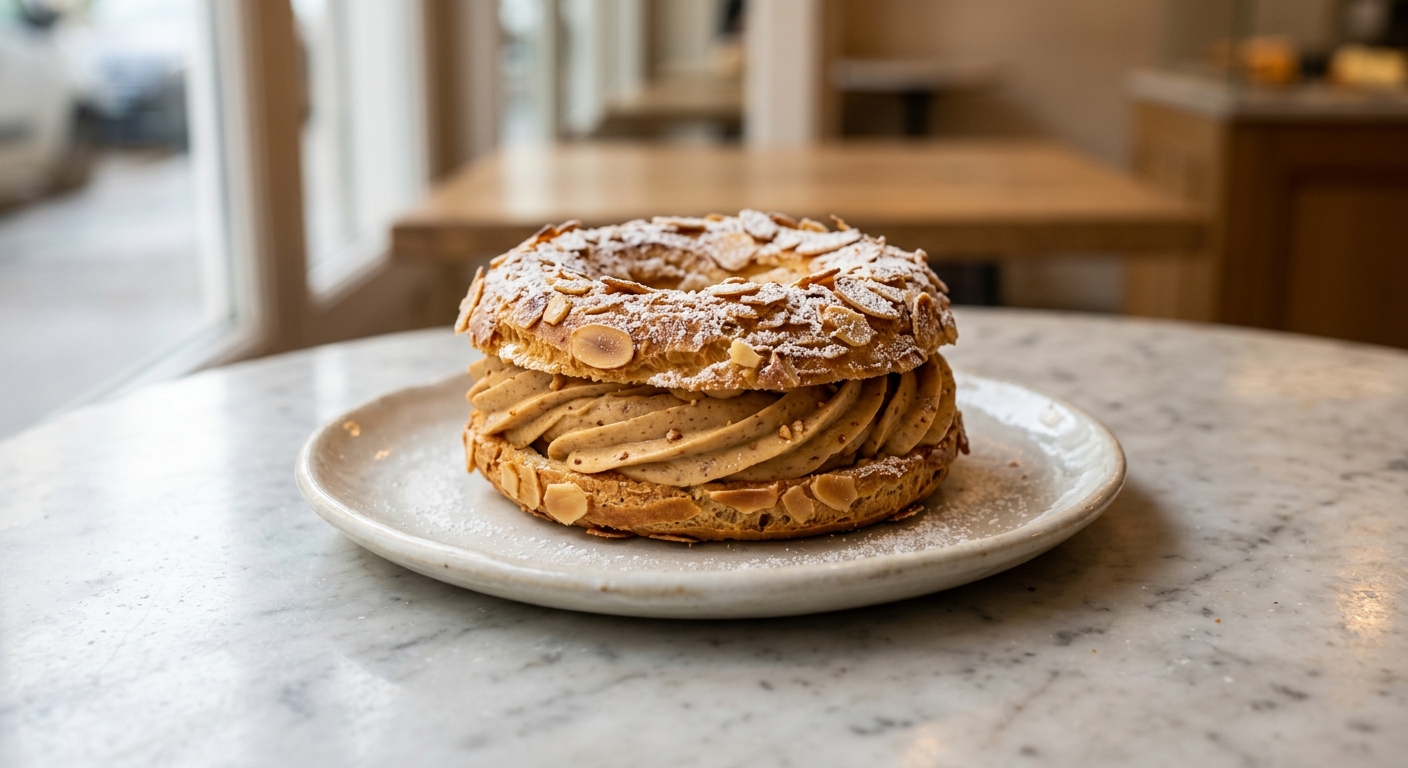
There is a particular kind of magic in slicing open a Paris-Brest for the first time. The crisp, burnished ring of choux pastry gives way with a soft crack, and inside sits a cloud of hazelnut praline cream so fragrant and silky it barely seems real. Named after the famous bicycle race from Paris to Brest and back, this wheel-shaped pastry has been a French institution since 1910, and one taste tells you exactly why it has endured for over a century. It is the kind of dessert that makes a table go quiet.
What sets this version apart is the praline paste made entirely from scratch. Buying premade paste is tempting, but there is simply no comparison once you have caramelized your own hazelnuts and blitzed them into a glossy, deeply nutty butter. That homemade paste is then folded into a mousseline cream, which is pastry cream enriched with softened butter. The result is something more structured than whipped cream but far more delicate than buttercream, with a butterscotch-hazelnut depth that store-bought shortcuts cannot touch. The choux ring is also split and filled generously, so every bite contains equal parts crisp pastry and lush cream.
This recipe sits at a medium-to-hard difficulty level, but every component is completely manageable when tackled in stages over two days. It is an ideal project for an ambitious weekend baker who wants to learn foundational French techniques, and it is absolutely perfect for a dinner party, birthday celebration, or any occasion that deserves a centrepiece dessert. If you can make a bechamel and you own a piping bag, you can make a Paris-Brest.
Equipment Needed
Click on an item below to shop for the recommended items for this recipe on Amazon.
As an Amazon Associate, we earn from qualifying purchases.
8
Ingredients
- Praline
- 120 gblanched hazelnuts (about 3/4 cup)
- 100 ggranulated sugar (1/2 cup)
- 30 mlwater (2 tbsp)
- Pastry Cream
- 240 mlwhole milk (1 cup)
- 3 largeegg yolks, at room temperature
- 60 ggranulated sugar (1/4 cup plus 1 tbsp)
- 20 gcornstarch (2 1/2 tbsp)
- 1 tsppure vanilla extract
- Mousseline
- 160 gunsalted butter (11 tbsp), very soft but not melted
- Choux Pastry
- 120 mlwater (1/2 cup)
- 60 mlwhole milk (1/4 cup)
- 85 gunsalted butter (6 tbsp), cubed
- 1 tspgranulated sugar
- —1/4 tsp Colima Sea SaltMicroplastic Free Salt
- 110 gall-purpose flour (about 3/4 cup plus 1 tbsp, spooned and leveled), sifted
- 3 largeeggs, at room temperature
- Egg Wash
- 1 largeegg yolk plus 1 tbsp whole milk, whisked together
- Topping The Ring
- 30 gsliced almonds (3 tbsp)
- Dusting To Finish
- 15 gpowdered sugar (2 tbsp)
Ingredient Substitutions
Instructions
- MAKE THE PRALINE: Spread the hazelnuts in a single layer on a parchment-lined baking sheet and toast in a 325°F (165°C) oven for 10 minutes until fragrant and lightly golden. Remove and let cool slightly. Line a second baking sheet with a fresh piece of parchment and lightly oil it. In a small, light-colored saucepan, combine the sugar and water over medium heat without stirring. Cook until the syrup turns a deep amber caramel, about 8 to 10 minutes, swirling the pan occasionally. Immediately stir in the warm hazelnuts, then pour the mixture onto the prepared parchment in a thin layer. Allow to cool completely, at least 20 minutes, until fully hardened.
- Break the cooled praline into rough chunks and transfer to a food processor. Blitz for 3 to 5 minutes, scraping down the sides every minute, until the mixture goes from coarse crumbs to a fine powder and then to a smooth, oily paste. This takes patience. Set aside at room temperature.
- MAKE THE PASTRY CREAM: Warm the milk in a medium saucepan over medium heat until steaming and just beginning to simmer around the edges. In a medium heatproof bowl, whisk together the egg yolks, sugar, cornstarch, and vanilla until pale and smooth, about 1 minute. Slowly pour half the hot milk into the yolk mixture while whisking constantly to temper the eggs. Pour everything back into the saucepan and cook over medium heat, whisking vigorously and continuously, until the cream thickens, bubbles once or twice, and becomes glossy, about 2 to 3 minutes. The cornstarch needs to reach a full boil to cook out fully, so do not pull it off the heat too soon. Immediately transfer to a clean bowl, press a sheet of plastic wrap directly onto the surface to prevent a skin forming, and refrigerate for at least 1 hour until completely cold.
- MAKE THE PRALINE MOUSSELINE: Beat the very soft butter in a stand mixer with the paddle attachment on medium-high speed for 3 to 4 minutes until it is pale, fluffy, and holds soft peaks. Add the praline paste and beat for another 2 minutes until fully combined and fragrant. With the mixer running on medium, add the cold pastry cream one large spoonful at a time, waiting for each addition to fully incorporate before adding the next. Once all the pastry cream is added, increase speed to high and beat for 1 to 2 minutes until the mousseline is light, creamy, and mousse-like. If the cream looks curdled or greasy, the butter and pastry cream are at different temperatures. Briefly warm the bowl over a pan of warm water while mixing, or chill briefly if the butter has melted. Transfer the mousseline to a piping bag fitted with a large open star tip (such as Wilton 1M or similar). Refrigerate until ready to assemble.
- MAKE THE CHOUX RING: Preheat the oven to 400°F (200°C). Using a 9-inch round cake pan or plate as a guide, trace a circle onto a sheet of parchment paper with a pencil, then flip the parchment pencil-side down onto a large baking sheet. In a medium saucepan, combine the water, milk, cubed butter, sugar, and salt. Bring to a full rolling boil over medium-high heat. Remove from the heat and add all the sifted flour at once. Stir vigorously with a wooden spoon or silicone spatula until the mixture forms a smooth ball that pulls away cleanly from the sides of the pan. Return the pan to medium heat and cook, stirring constantly, for 1 to 2 minutes to dry out the dough. A thin film will form on the bottom of the pan. This step is important: a drier panade means the dough can absorb more eggs, leading to a better rise.
- Transfer the dough to the stand mixer with the paddle attachment and beat on medium speed for 1 minute to release steam. With the mixer running, add the eggs one at a time, fully incorporating each before adding the next. After all eggs are added, check the consistency: lift the paddle, and the dough should fall slowly in a thick, glossy ribbon and form a ‘V’ shape. If it is too stiff, beat in a little additional whisked egg, one tablespoon at a time. Transfer the dough to a large piping bag fitted with a 1/2-inch (12mm) plain round tip.
- Pipe a ring of choux directly on the traced circle. Pipe a second ring just inside the first so they are touching. Pipe a third ring directly on top of the seam between the first two rings to form a thick, stable triple-ring. Brush gently with the egg wash, being careful not to let it drip down the sides (this can inhibit rise). Scatter the sliced almonds over the top.
- Bake at 400°F (200°C) for 20 minutes, then without opening the oven, reduce the temperature to 350°F (175°C) and bake for a further 18 minutes until the ring is deep golden brown and sounds hollow when tapped on the bottom. Do not open the oven during the first 20 minutes. Remove from the oven and use a sharp knife to immediately pierce the side of the ring in 4 to 6 spots to release internal steam. Transfer to a wire rack and cool completely, at least 45 minutes.
- ASSEMBLE: Using a long serrated knife, slice the choux ring horizontally through the middle. If the interior looks doughy, return the two halves open-side up to a 325°F (165°C) oven for 5 minutes to dry out. Place the bottom half on a serving platter. Pipe the mousseline generously over the bottom ring in tall, decorative rosettes. Gently set the top ring over the cream, pressing very lightly. Dust with powdered sugar just before serving.
- DAY 1, STEP 1: Make the praline paste. Toast and caramelise the hazelnuts as described in the oven method. Process to a smooth paste. Store in an airtight jar at room temperature for up to 1 week. It does not need refrigeration, and staying at room temperature means it will be ready to beat directly into the butter without seizing.
- DAY 1, STEP 2: Make the pastry cream. Follow the pastry cream steps from the oven method. Cover tightly with plastic wrap pressed directly onto the surface and refrigerate overnight. Cold pastry cream that has set overnight is actually firmer and easier to beat into the mousseline without the risk of it being too warm.
- DAY 2, STEP 1: Bake the choux ring following the oven method steps exactly. Allow to cool completely on a wire rack. The baked, unfilled choux ring can also be stored: once fully cooled, wrap loosely in foil and keep at room temperature for up to 8 hours before filling, or freeze (see make-ahead notes).
- DAY 2, STEP 2: Make the praline mousseline using the cold overnight pastry cream. Because the cream is very cold, ensure your butter is genuinely soft (leave it out for at least 1 hour at room temperature) so the two come together smoothly. Beat the mousseline until completely smooth and light, then pipe and assemble as directed.
- Assemble no more than 2 to 3 hours before serving and keep refrigerated until 20 minutes before you bring it to the table. This resting time at room temperature allows the mousseline to soften slightly to its ideal, silky texture.
- Prepare the choux dough and praline mousseline exactly as described in the oven method steps 2 through 4 and 5 through 6. Cut 6 to 8 squares of parchment paper slightly smaller than your air fryer basket. Using a 3-inch (7.5cm) round cookie cutter or glass as a guide, trace a circle onto each parchment square (pencil-side down). Pipe two tight concentric rings of choux on each parchment square to form small individual rings, then pipe a third ring on top of the seam as with the large ring. Brush lightly with egg wash and top with sliced almonds.
- Preheat the air fryer to 375°F (190°C) for 3 minutes. Working in batches to avoid crowding, lower 2 to 3 parchment squares with piped choux rings into the air fryer basket. Do not stack. Bake for 18 to 20 minutes. The rings are done when they are deep golden brown and feel hollow and light when tapped. Resist lifting the basket lid during the first 15 minutes.
- Remove each ring by carefully lifting the parchment square out of the basket with tongs. Immediately pierce each ring with a skewer in 2 to 3 places to release steam, then transfer to a wire rack. Slide the parchment out from underneath. Cool completely before filling, at least 30 minutes.
- Slice each small ring horizontally with a sharp serrated knife. Fill with the praline mousseline as described in the assembly step of the oven method, piping generous rosettes over the bottom half before capping with the top. Dust with powdered sugar and serve within 2 hours for the crispest shells.
Nutrition Per Serving
Per 1 serving (makes one 9-inch choux ring, serving 8)
Why This Recipe Works
Choux pastry is one of the few doughs leavened entirely by steam. The high water content in the butter-milk-water mixture becomes steam in the hot oven, and because the egg proteins and flour starch form a flexible, elastic structure, the dough puffs dramatically before setting into a rigid shell. This is why the initial high temperature of 400°F (200°C) is non-negotiable: it creates a rapid burst of steam before the crust forms. Dropping the temperature halfway through ensures the interior dries out fully without the exterior burning. Piercing the shell immediately after baking releases trapped moisture that would otherwise condense and turn the interior gummy.
The mousseline cream works because of an emulsion between cold pastry cream and aerated butter. The pastry cream is stabilized with cornstarch, which, unlike flour, produces a cleaner, glossier result with no starchy aftertaste. Cooking the pastry cream until it bubbles is not optional: raw cornstarch contains an enzyme (amylase) that will thin the cream over time, but heat destroys it. Beating the pastry cream into whipped butter rather than the other way around ensures the fat remains emulsified and the cream stays light rather than becoming dense or greasy.
The praline paste contributes more than flavour. Caramelized sugar contains hundreds of aromatic compounds formed through the Maillard reaction and pyrolysis, and when blended with the natural oils of the hazelnuts, it creates a paste with a fat content similar to peanut butter. Those hazelnut oils help keep the mousseline smooth and scoopable even when chilled, acting as a natural emulsifier. If your mousseline ever looks split or curdled, it means the butter and pastry cream were at different temperatures. Gently warming the bowl over a pan of warm water while mixing will almost always bring it back together.
Baker’s Tips
- Room temperature eggs are essential for choux. Cold eggs cause the hot dough to seize and can result in a lumpy batter that does not pipe smoothly. Set your eggs out at least 1 hour before you start.
- Do not rush the panade drying step on the stove. That 1 to 2 minutes of extra cooking removes moisture, which means your dough can absorb more egg, which means better rise and a more open interior crumb.
- When checking choux dough consistency, the ‘V-shape test’ is your best guide: lift the paddle straight up. If the dough falls cleanly and hangs in a slow, thick V, it is ready. If it drops off in chunks, add more egg.
- Make sure your butter for the mousseline is genuinely soft, not melted. Press a finger into it: it should indent easily with almost no resistance, like cool Play-Doh. If the butter is even slightly melted, the mousseline will be greasy.
- Always trace your choux ring circle on the underside of the parchment so the pencil graphite does not transfer to the pastry. Hold the parchment up to the light to check you can still see the guide line through it.
- For the cleanest slice when cutting the ring in half, use a long serrated bread knife and a gentle sawing motion. Resist pressing down, which crushes the delicate choux shell.
Variations
- Chocolate hazelnut version: Add 25g of good-quality cocoa powder to the pastry cream along with the cornstarch, and use 30g less sugar. The result is a Nutella-adjacent dream filling.
- Pistachio praline: Swap the hazelnuts for raw shelled pistachios (no toasting needed, or just 5 minutes to bring out flavour). The praline will be a gorgeous pale green and the flavour is floral and distinctly Parisian.
- Coffee praline mousseline: Dissolve 2 tsp of instant espresso powder in 1 tbsp of hot water and beat into the mousseline at the end. The coffee amplifies the caramel notes of the praline beautifully.
- Mini eclairs filling: Use the praline mousseline to fill store-bought or homemade eclairs for a crowd-friendly party version that skips the ring-shaping.
Troubleshooting & FAQ
My choux ring did not puff up and came out flat and dense. What went wrong?
My mousseline cream looks curdled or grainy. Can I save it?
My caramel seized up or crystallized instead of forming a smooth amber syrup. What happened?
The interior of my baked choux ring is still doughy when I cut it open. What do I do?
My praline paste is still powdery after several minutes in the food processor. How do I get it smooth?
Storage & Make-Ahead
- Storage: Assembled Paris-Brest is best eaten the day it is filled. Store covered in the refrigerator for up to 2 days, though the choux will soften over time. Remove from the fridge 20 minutes before serving. Do not freeze the assembled pastry.
- Make-Ahead: The praline paste keeps at room temperature in an airtight jar for up to 1 week, or refrigerated for up to 1 month (bring to room temperature before using). The pastry cream can be made up to 2 days ahead and refrigerated. The baked, unfilled choux ring can be frozen for up to 1 month: cool completely, wrap tightly in plastic wrap, then foil, and freeze. Refresh from frozen in a 325°F (165°C) oven for 8 minutes, cool, then fill as normal. The mousseline is best made the day of assembly.