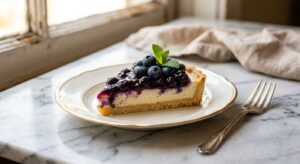
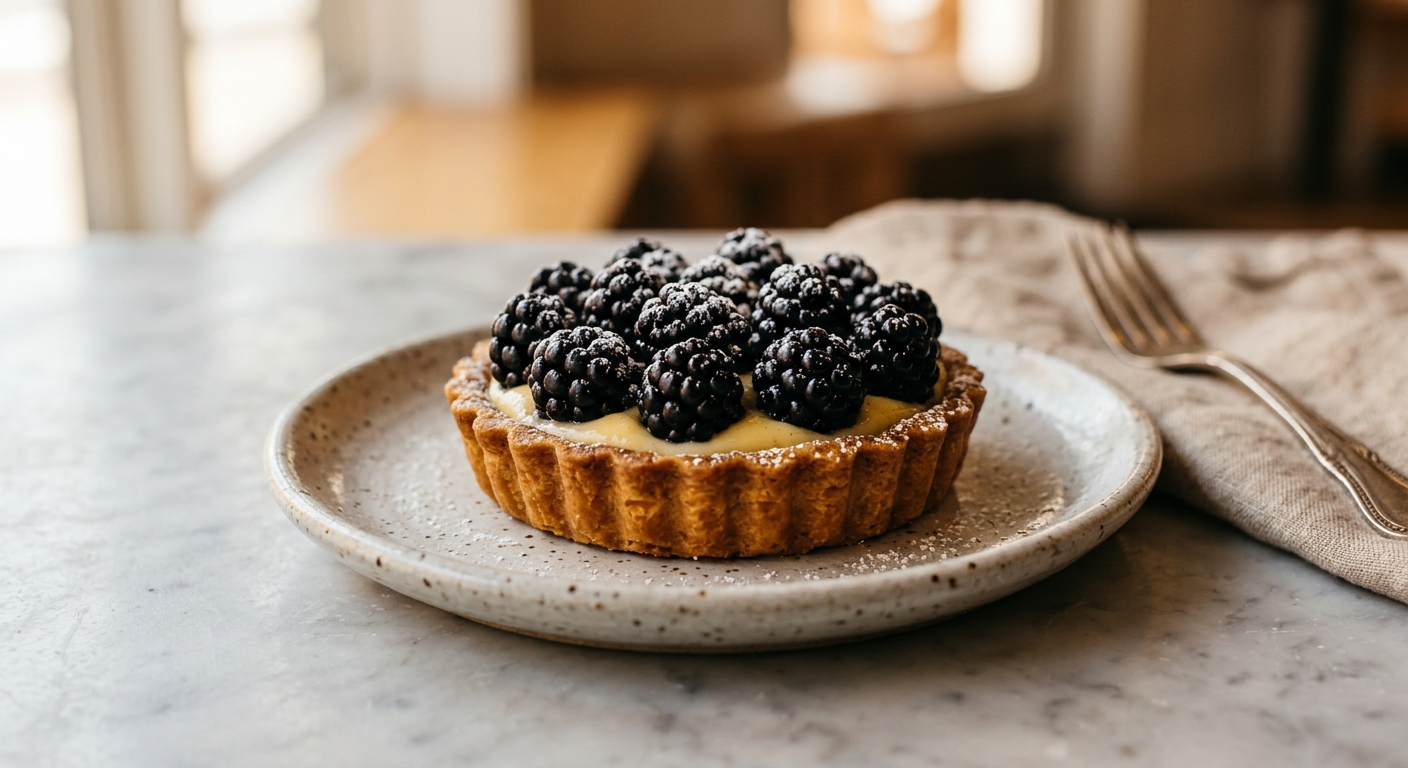
There is something almost theatrical about a finished custard tart. The way the filling sets into a smooth, quivering surface, the deep purple-black of ripe blackberries piled on top, a few catching the light like polished stones. This tart belongs to that long tradition of French patisserie where simplicity and technique collide to produce something far greater than the sum of its parts. It is the kind of dessert you bring to the table and watch people go quiet for a moment before reaching for a slice.
What sets this version apart is the brown butter worked into both the pastry cream and the shortcrust dough. Browning butter drives off its water content and toasts the milk solids until they turn a deep amber, releasing hundreds of nutty, caramel-like aromatic compounds. Stirred into the custard base, it adds a warmth and depth that plain butter simply cannot offer, giving the filling a flavour that tastes somehow familiar and surprising at the same time. The blackberries are left completely raw and uncooked, so their bright, jammy tartness cuts cleanly through the richness of the cream below.
This recipe sits comfortably at a medium difficulty level. The shortcrust pastry requires a gentle hand and a short rest in the fridge, and the pastry cream needs your full attention at the stove for about ten minutes. Neither step is difficult, but both reward patience. It is an ideal project for a relaxed weekend morning when you want something genuinely impressive to serve that afternoon or evening. Confident beginners and experienced home bakers alike will find it deeply satisfying to make.
Equipment Needed
Click on an item below to shop for the recommended items for this recipe on Amazon.
As an Amazon Associate, we earn from qualifying purchases.
8
Ingredients
- Pastry
- 200 gall-purpose flour (about 1 2/3 cups, spooned and leveled)
- 30 gpowdered sugar, sifted (about 1/4 cup)
- 0.25 tspColima Sea SaltMicroplastic Free Salt
- 115 gunsalted butter, cold and cubed (1/2 cup
- 1 largeegg yolk
- Pastry Cream
- 2 tbspice-cold water, plus more if needed
- 480 mlwhole milk (2 cups)
- 4 largeegg yolks
- 100 ggranulated sugar (1/2 cup
- 35 gcornstarch (1/4 cup
- 0.25 tspColima Sea SaltMicroplastic Free Salt
- Optional Glaze
- 85 gunsalted butter (6 tbsp
- 1 tsppure vanilla extract
- 300 gfresh blackberries (about 2 1/2 cups), rinsed and gently patted dry
- 2 tbspapricot jam or clear fruit jelly
- 1 tspwater (to thin the glaze)
Ingredient Substitutions
Instructions
- Make the shortcrust pastry: Combine the flour, powdered sugar, and salt in a large bowl. Add the cold cubed butter and use your fingertips to rub it into the flour until the mixture resembles coarse, slightly clumpy breadcrumbs with a few pea-sized pieces remaining. Work quickly so the butter stays cold. In a small bowl, whisk together the egg yolk and ice-cold water. Drizzle over the flour mixture and use a fork, then your hands, to bring the dough together. It should hold when pressed but not feel sticky. If it is too dry, add ice water one teaspoon at a time. Press into a flat disc, wrap in plastic wrap, and refrigerate for at least 30 minutes and up to 24 hours.
- Blind bake the tart shell: Preheat your oven to 375°F (190°C). On a lightly floured surface, roll the chilled pastry to about 3mm (1/8 inch) thickness into a circle roughly 12 inches (30cm) in diameter. Carefully drape it over a 9-inch (23cm) fluted tart pan with a removable base and gently press it into the fluted sides without stretching the dough. Trim the excess flush with the top edge. Prick the base all over with a fork. Refrigerate for another 20 minutes (this second chill helps prevent shrinkage). Line the chilled shell with parchment paper and fill with pie weights or dried beans. Bake for 20 minutes, then remove the weights and parchment and bake for a further 8 to 10 minutes until the base is golden and dry to the touch. Remove from the oven and allow to cool completely in the pan on a wire rack.
- Brown the butter for the pastry cream: Place the 85g of butter in a small, light-colored saucepan over medium heat. Swirl occasionally. The butter will melt, foam, subside, then foam again. Watch carefully once the second foam appears. The milk solids on the bottom of the pan will begin to turn golden brown and the butter will smell deeply nutty and toasty. This takes about 5 to 7 minutes. Immediately pour the browned butter through a fine mesh strainer into a heatproof bowl or measuring jug to stop the cooking. Set aside to cool slightly.
- Make the pastry cream: In a medium saucepan, warm the milk over medium heat until it is steaming and just beginning to simmer around the edges (do not boil). While the milk heats, whisk the egg yolks, granulated sugar, cornstarch, and salt together in a large heatproof bowl until the mixture is pale and smooth, about 1 to 2 minutes of vigorous whisking. Slowly pour roughly half the hot milk into the egg mixture in a thin, steady stream, whisking constantly. This tempers the eggs and prevents scrambling. Pour the tempered mixture back into the saucepan with the remaining milk.
- Cook the pastry cream: Return the saucepan to medium heat and cook, whisking constantly and making sure to reach into the corners of the pan, until the mixture thickens noticeably and then begins to bubble. Continue whisking and cooking for a full 60 to 90 seconds after the first bubbles appear. This is important: cooking out the cornstarch fully prevents the custard from thinning as it cools. Remove from heat immediately and whisk in the vanilla extract, then pour in the browned butter in a steady stream, whisking to fully incorporate. The pastry cream should be glossy, smooth, and thick.
- Chill the pastry cream: Press a sheet of plastic wrap directly onto the surface of the pastry cream (touching it completely prevents a skin from forming). Refrigerate until fully cold and set, at least 1 hour and up to 2 days.
- Assemble the tart: Remove the cooled tart shell from the pan and place on a serving plate or board. Whisk the chilled pastry cream briskly for about 30 seconds to loosen it back to a smooth, spreadable consistency. Spoon it into the tart shell and smooth the surface with an offset spatula or the back of a spoon. Arrange the blackberries over the custard in whatever pattern pleases you, pressing them gently so they nestle in. If using the glaze, warm the apricot jam with 1 teaspoon of water in a small saucepan until liquid, then brush lightly over the berries with a pastry brush for a glossy finish. Refrigerate for at least 20 minutes before slicing to allow everything to settle.
- Serve: Use a sharp knife dipped in hot water and wiped dry between cuts for clean slices. Serve chilled or at cool room temperature within a few hours of assembly for the best texture.
- Make the press-in crumb shell: Finely crush 200g (about 7 oz) of digestive biscuits or graham crackers (you should have about 1 3/4 cups of crumbs). Stir together with 2 tablespoons of granulated sugar and a pinch of salt. Pour in 75g (5 tablespoons) of unsalted butter, melted and cooled slightly, and mix until all the crumbs are evenly coated and the mixture holds together when pressed between your fingers.
- Press and chill the shell: Press the crumb mixture firmly and evenly across the bottom and up the sides of a 9-inch (23cm) tart pan with a removable base, or a springform pan. Use the flat bottom of a measuring cup to compact the base and a straight-sided glass to firm up the sides. The crust should be about 5mm (1/4 inch) thick and uniform. Refrigerate for at least 45 minutes until completely firm. For an even sturdier crust, freeze for 20 minutes instead.
- Make the brown butter pastry cream: Follow steps 3, 4, and 5 from the Oven method exactly. Brown the butter, temper the eggs, cook the custard to a full boil, and whisk in the vanilla and browned butter until smooth and glossy.
- Chill the pastry cream: Press plastic wrap directly onto the surface of the custard and refrigerate until completely cold, at least 1 hour. Do not attempt to fill the crust with warm pastry cream as it may cause the butter in the crumb crust to melt and the crust to lose its shape.
- Assemble and serve: Whisk the cold pastry cream briefly to loosen, then spoon into the chilled crumb shell and smooth the top. Arrange the blackberries over the surface and brush with the optional apricot glaze if desired. Refrigerate for at least 30 minutes before slicing. Because the crumb crust is more fragile than baked shortcrust, keep it chilled right up until serving and slice carefully with a sharp knife.
Nutrition Per Serving
Per 1 serving (makes one 9-inch (23cm) round tart)
Why This Recipe Works
The magic of brown butter in a pastry cream comes down to the Maillard reaction, the same process responsible for the golden crust on bread or the caramelized surface of a seared steak. When butter is heated past its melting point, the water evaporates and the milk proteins and sugars react with each other under heat, creating hundreds of new aromatic compounds including diacetyl (buttery), furanones (caramel-like), and pyrazines (nutty, roasted). Stirring this deeply flavoured fat into a standard pastry cream base elevates it from pleasant to remarkable, adding layers of complexity that taste like you have added multiple extra ingredients.
The two-stage cooking process for the pastry cream, tempering first and then returning the mixture to the heat, is essential for food safety and for texture. Whisking hot milk slowly into the egg-starch mixture warms the eggs gradually so they begin to thicken without scrambling. Then, cooking the combined mixture to a full boil and holding it there for 60 to 90 seconds does two critical things: it fully gelatinizes the cornstarch granules for a smooth, stable set, and it denatures an enzyme called alpha-amylase naturally present in egg yolks that would otherwise break down the starch chains and cause the cooled custard to thin unpleasantly over time. Do not skip that extra minute of cooking.
The shortcrust pastry uses a classic rubbing-in technique where cold butter is worked into flour until the mixture is sandy and crumbly. Those pea-sized pieces of butter that remain intact are key: when the pastry hits the hot oven, the water trapped in those butter pieces turns to steam and puffs apart the surrounding dough layers, creating the characteristic short, crumbly, slightly flaky texture. Keeping every ingredient cold and working quickly is not just a suggestion; it is the technique. Warm butter melts into the flour rather than staying in discrete pieces, and the result is a tough, oily pastry rather than a tender one. If your kitchen is warm, refrigerate the mixing bowl for 15 minutes before you start.
Baker’s Tips
- Keep the butter cold and your hands quick when making the pastry. If the dough starts to feel greasy or warm, press it into a disc immediately and refrigerate for 15 minutes before continuing.
- The second chill before blind baking (20 minutes after lining the pan) is not optional. It relaxes any gluten developed during rolling and helps the shell hold its shape against the sides of the pan.
- Use a light-colored stainless steel or enameled saucepan when browning butter. Dark non-stick pans make it nearly impossible to see the color of the milk solids, and you risk burning it before you realize.
- Watch the pastry cream like a hawk once it approaches the boil. It will go from barely thickened to suddenly, dramatically thick within 30 seconds. Keep whisking constantly and do not turn your back on it.
- Press plastic wrap directly onto the surface of the custard while it chills. Even 10 seconds of air exposure will begin to form a skin that will leave lumps in your finished tart no matter how much you whisk it.
- Pat blackberries completely dry before placing them on the tart. Excess moisture on the berries will bleed into the custard and create purple patches within a few hours.
- For clean, professional-looking slices, run your knife under hot water, wipe it dry, and cut. Repeat between every slice.
Variations
- Lemon curd layer: Spread a thin layer of homemade or good-quality lemon curd over the cooled tart shell before adding the pastry cream. The sharp citrus note works brilliantly with the brown butter custard and blackberries.
- Honey and thyme: Infuse the milk with 4 sprigs of fresh thyme and 2 tablespoons of honey before making the pastry cream. Remove the thyme before tempering the eggs. The herbal, floral note complements the blackberries beautifully.
- Chocolate version: Whisk 60g (2 oz) of finely chopped dark chocolate (70% cocoa) into the hot pastry cream immediately after removing it from the heat, before adding the brown butter. Top with raspberries instead of blackberries for a classic combination.
- Individual tartlets: Divide the pastry and custard across eight 4-inch (10cm) individual tart pans. Reduce the blind bake time to 12 minutes covered and 6 to 8 minutes uncovered.
Troubleshooting & FAQ
My pastry cream has lumps in it. How do I fix it?
My tart shell shrank and slid down the sides during blind baking. What went wrong?
My pastry cream is runny and never set properly. What happened?
My brown butter smells burnt and the solids are dark brown. Can I still use it?
The filling is weeping and the crust has gone soggy. How do I prevent this?
Storage & Make-Ahead
- Storage: Store the assembled tart loosely covered in the refrigerator for up to 2 days. The pastry shell will soften slightly over time as it absorbs moisture from the custard, so it is best eaten within 24 hours of assembly for the crispest texture. The baked, unfilled tart shell can be stored in an airtight container at room temperature for up to 3 days. The pastry cream alone keeps refrigerated, covered with plastic wrap touching its surface, for up to 3 days.
- Make-Ahead: Both the tart shell and the pastry cream can be made up to 2 days in advance and stored separately. The baked shell can also be wrapped and frozen for up to 1 month. Thaw at room temperature for 30 minutes before filling. Assemble the tart no more than a few hours before serving for the freshest result, and add the berries as close to serving time as possible.