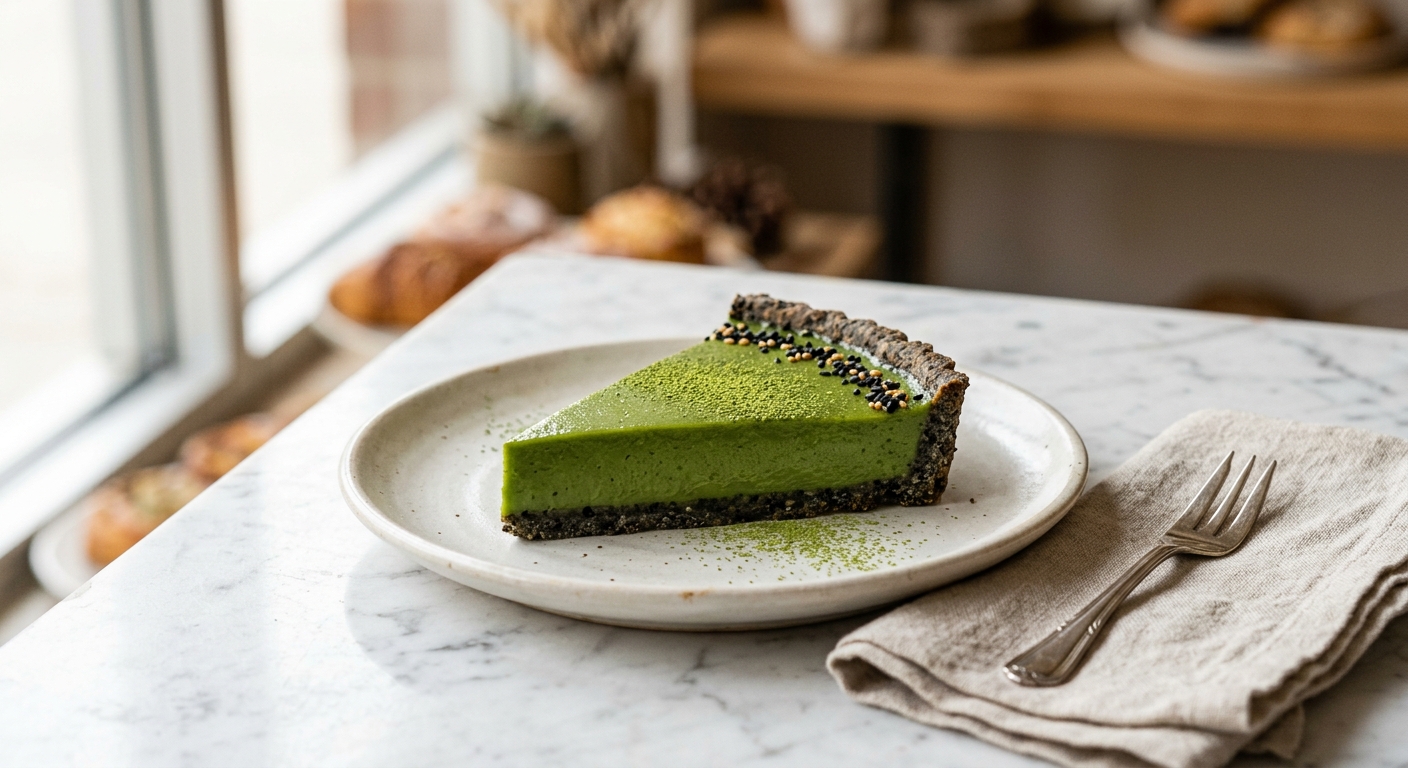
There is something quietly dramatic about this tart. The shell is the color of midnight – a deeply savory, toasty black sesame shortcrust that shatters at the press of a fork. The filling is the softest, creamiest jade-green custard, trembling just slightly when the pan is nudged, set just enough to slice cleanly but still lush on the tongue. Together, they look like something from a high-end patisserie window, but they come together in your own kitchen with patience, a good whisk, and a little trust in the process.
What makes this version stand out is the double-layered approach to both components. For the crust, whole black sesame seeds are first toasted and then ground into the pastry dough alongside a touch of toasted sesame oil, amplifying that roasted, almost smoky character far beyond what seeds alone could achieve. For the custard, a classic French crème pâtissière base is enriched with both cream and egg yolks for body, while the matcha is first bloomed in a small amount of warm milk before being incorporated – a step that prevents clumping and coaxes out every bit of the tea’s grassy, umami-laced flavor. The result is a custard with a vivid, even color and a flavor that tastes genuinely of matcha, not just vaguely green.
This recipe sits at a medium difficulty level. The crust requires a little care when blind baking, and the custard needs gentle, attentive stirring on the stove. But neither step is beyond any baker who has made pastry cream or shortcrust before, and detailed guidance is woven through every step. It is a showstopper for a weekend afternoon, a dinner party dessert that will prompt questions, or simply a treat for anyone who loves Japanese flavors in an elegant European format.
Equipment Needed
Click on an item below to shop for the recommended items for this recipe on Amazon.
As an Amazon Associate, we earn from qualifying purchases.
8
Ingredients
- 180 gall-purpose flour (about 1.5 cups, spooned and leveled)
- 40 gblack sesame seeds, toasted (about 3 tbsp), plus extra for garnish
- 30 gpowdered sugar (about 1/4 cup)
- 0.25 tspColima Sea SaltMicroplastic Free Salt
- 115 gunsalted butter, cold and cubed (about 8 tbsp / 1 stick)
- 1 tsptoasted sesame oil
- 1 largeegg yolk, cold
- 2 tbspice water, plus more if needed
- 480 mlwhole milk (about 2 cups)
- 120 mlheavy cream (about 1/2 cup)
- 18 gceremonial-grade matcha powder (about 3 tbsp, sifted)
- 5 largeegg yolks
- 100 ggranulated sugar (about 1/2 cup)
- 35 gcornstarch (about 1/4 cup)
- 0.25 tspColima Sea SaltMicroplastic Free Salt
- 30 gunsalted butter, room temperature and cubed (about 2 tbsp)
- —Lightly sweetened whipped cream, for serving (optional)
Ingredient Substitutions
Instructions
- Make the black sesame crust: Toast the black sesame seeds in a dry skillet over medium heat for 2 to 3 minutes until fragrant, then let cool completely. Transfer to a food processor and pulse 15 to 20 times until coarsely ground – you want some texture remaining, not a paste. Add the flour, powdered sugar, and salt and pulse 5 times to combine. Add the cold cubed butter and sesame oil and pulse in short bursts, 10 to 12 pulses, until the mixture resembles coarse, pea-sized crumbs. Add the egg yolk and ice water and pulse just until the dough begins to clump. Tip onto a lightly floured surface and press together into a flat disc without kneading. Wrap in plastic wrap and refrigerate for at least 1 hour.
- Preheat your oven to 375°F (190°C). On a lightly floured surface, roll the chilled dough into a circle about 11 to 12 inches in diameter and 3mm thick. Work quickly – this dough softens fast. Drape over your rolling pin and transfer to a 9-inch fluted tart pan with a removable base. Press gently into the fluted edges without stretching the dough, then trim any overhang flush with the top of the pan. Patch any cracks with scraps. Refrigerate the lined pan for 20 minutes to prevent shrinkage during baking.
- Line the chilled tart shell with parchment paper and fill with pie weights or dried beans, pressing them up the sides. Blind bake for 20 minutes, until the edges are set and dry. Remove the weights and parchment, prick the base a few times with a fork, and return to the oven for another 10 to 13 minutes until the base looks dry and feels firm. The crust will darken only slightly – its dark color makes it hard to judge by sight, so rely on touch. Let cool completely on a wire rack before filling.
- Make the matcha custard: In a small bowl, whisk the sifted matcha powder with 60ml (1/4 cup) of the whole milk until completely smooth with no lumps. Set aside. In a medium heavy-bottomed saucepan, combine the remaining milk and heavy cream and warm over medium heat until steaming and just beginning to bubble at the edges. Do not boil.
- While the milk heats, whisk the egg yolks, granulated sugar, cornstarch, and salt together in a large heatproof bowl until pale and thick, about 1 to 2 minutes. Whisk the matcha-milk mixture into the egg yolk mixture until uniform. Now temper: slowly pour the hot milk mixture into the bowl in a thin, steady stream while whisking constantly. This raises the temperature of the eggs gradually so they do not scramble.
- Pour the entire mixture back into the saucepan and cook over medium heat, whisking constantly and reaching into all corners of the pan, until the custard thickens and large bubbles begin to plop at the surface, about 4 to 6 minutes. Continue to cook and whisk for a full 60 seconds after the first bubble appears – this cooks out the cornstarch and removes any starchy taste. Remove from heat immediately.
- Add the room-temperature butter cubes to the hot custard and whisk until fully melted and incorporated. For an ultra-smooth custard, strain through a fine-mesh sieve into a clean bowl. Pour the custard immediately into the cooled tart shell, smoothing the surface with an offset spatula. Press a sheet of plastic wrap directly onto the surface of the custard to prevent a skin from forming. Refrigerate for at least 2 hours, or until fully set.
- To serve, remove the tart from the pan and place on a serving board. Garnish with a light dusting of sifted matcha, a scatter of black sesame seeds, and dollops of lightly sweetened whipped cream if desired. Slice with a sharp knife wiped clean between cuts.
- Make the no-bake black sesame crust: Toast 40g (about 3 tbsp) black sesame seeds until fragrant and let cool. In a food processor, combine the toasted sesame seeds, 200g (about 14) digestive biscuits or graham crackers (roughly broken), 20g (about 2 tbsp) powdered sugar, and 0.25 tsp fine sea salt. Process until fine crumbs form. Add 85g (6 tbsp) melted unsalted butter and 1 tsp toasted sesame oil and pulse until the mixture clumps when pressed together between your fingers.
- Press the crumb mixture firmly and evenly into the base and up the sides of a 9-inch tart pan with a removable base or a 9-inch springform pan. Use the flat bottom of a measuring cup to compact the base tightly. Refrigerate for at least 30 minutes until firm, or freeze for 15 minutes if you are short on time. A firm, well-chilled crust is essential since it will not be baked.
- Make the matcha custard following steps 4 through 6 of the oven method exactly – the stovetop custard process is identical. The custard must be cooked fully on the stovetop since this crust is not going into the oven.
- Add the butter to the finished custard and whisk to combine. Strain through a fine-mesh sieve if desired. Let the custard cool for 10 minutes at room temperature, stirring occasionally to release steam, before pouring into the chilled crust. A very hot custard poured directly into a no-bake crust can cause it to crumble. Smooth the surface and press plastic wrap directly onto the custard.
- Refrigerate for at least 2 hours until fully set and cold. Garnish and serve directly from the fridge for the cleanest slices.
Nutrition Per Serving
Per 1 serving (makes one 9-inch round tart)
Why This Recipe Works
The black sesame shortcrust relies on cold fat and minimal gluten development for its signature snap. By keeping the butter cold and handling the dough as little as possible, we ensure the fat coats the flour particles without fully hydrating them, producing a tender, crumbly crust rather than a tough one. The addition of powdered sugar (instead of granulated) gives us a finer, more compact crumb, which is important for a tart shell that needs to hold its shape when sliced. The sesame oil and ground sesame seeds both contain natural oils that further shorten the gluten strands, contributing to that delicate, almost sandy texture known in French pastry as pâte sablée. The one hour chill after mixing is not optional: it allows the gluten to relax and the butter to re-solidify, both of which dramatically reduce shrinkage during blind baking.
Blooming the matcha in a small amount of warm milk before adding it to the custard base is the key technique that elevates this recipe. Matcha powder is hydrophobic when added directly to fat or a rich mixture, meaning it tends to clump and sit unevenly rather than disperse. By whisking it into a small amount of warm (not boiling) liquid first, we break up the fine particles and create a smooth slurry that integrates evenly into the custard. Boiling water or milk would degrade the chlorophyll in the matcha, dulling that vivid green color, so we keep the milk just warm. The cornstarch in the custard serves two roles: it thickens the mixture into a sliceable gel, and it stabilizes the egg yolks against curdling, giving you a wider temperature window to work in before the eggs scramble. The full minute of continued cooking after the custard bubbles is essential to fully gelatinize the starch and eliminate any chalky, undercooked flavor.
If your custard is lumpy, it almost certainly seized before the starch could do its stabilizing work, usually because the hot milk was added too quickly during tempering. Strain the custard through a fine-mesh sieve and you may rescue most of it. If the crust shrinks dramatically during blind baking, the dough was either stretched when lining the pan, insufficiently chilled, or rolled too thin. For future batches, always ease the dough into the pan rather than pulling it, chill again after lining, and aim for a consistent 3mm thickness throughout.
Baker’s Tips
- Use ceremonial-grade matcha if at all possible. The difference in color, sweetness, and depth of flavor compared to culinary grade is significant in a recipe where matcha is the star.
- Ground the sesame seeds in short pulses – you want a coarse, sandy grind, not sesame butter. Stop well before the mixture starts to clump or release its oils.
- When rolling the sesame shortcrust, work on a lightly floured surface and move quickly. If the dough becomes too soft and sticky at any point, slide it onto a baking sheet and refrigerate for 10 minutes before continuing.
- The 60-second boil after the custard thickens is crucial. Undercooking the cornstarch leaves a starchy, gluey taste. Set a timer and keep whisking.
- Press plastic wrap directly onto the surface of the custard both while it cools and while it chills in the tart shell. Any air contact will form a skin that creates lumps when you slice.
- Sift the matcha powder before blooming it – matcha clumps on contact with any moisture, and starting with sifted powder gives you a much smoother slurry.
Variations
- Hojicha Custard: Replace the matcha with 20g finely ground hojicha powder for a warm, roasted-tea custard with caramel undertones. The same blooming technique applies.
- Yuzu Matcha Tart: Add 2 tsp yuzu juice and 0.5 tsp yuzu zest to the finished custard off the heat for a bright, citrusy lift that plays beautifully against the earthy matcha.
- White Chocolate Matcha: Whisk 60g finely chopped white chocolate into the hot custard along with the butter for an extra-lush, sweeter filling. Reduce the sugar in the custard by 20g to compensate.
- Individual Tartlets: Divide the dough among eight 3.5-inch tartlet pans. Reduce the blind bake time to 12 minutes, then 8 minutes uncovered. Fill as directed. Elegant for dinner parties.
Troubleshooting & FAQ
My custard is lumpy. What went wrong?
My tart crust shrank badly and slid down the sides during blind baking. How do I prevent this?
My matcha custard is brownish-green or olive colored rather than bright green. What happened?
The custard is not setting firmly enough and runs when I slice the tart. What did I do wrong?
My tart crust cracked when I tried to roll it out. Can I fix it?
Storage & Make-Ahead
- Storage: Store the finished tart loosely covered in the refrigerator for up to 3 days. The crust will soften slightly after day one, which is still delicious. The baked tart shell (unfilled) can be wrapped tightly at room temperature for up to 2 days. Do not freeze the assembled tart as the custard will weep upon thawing.
- Make-Ahead: The tart shell can be blind-baked up to 2 days in advance and stored wrapped at room temperature. The matcha custard can be made up to 24 hours ahead, stored with plastic wrap pressed to the surface in the refrigerator, and then spooned into the shell a few hours before serving. For best results, fill the shell no more than 4 hours before serving to keep the crust at its crispest.