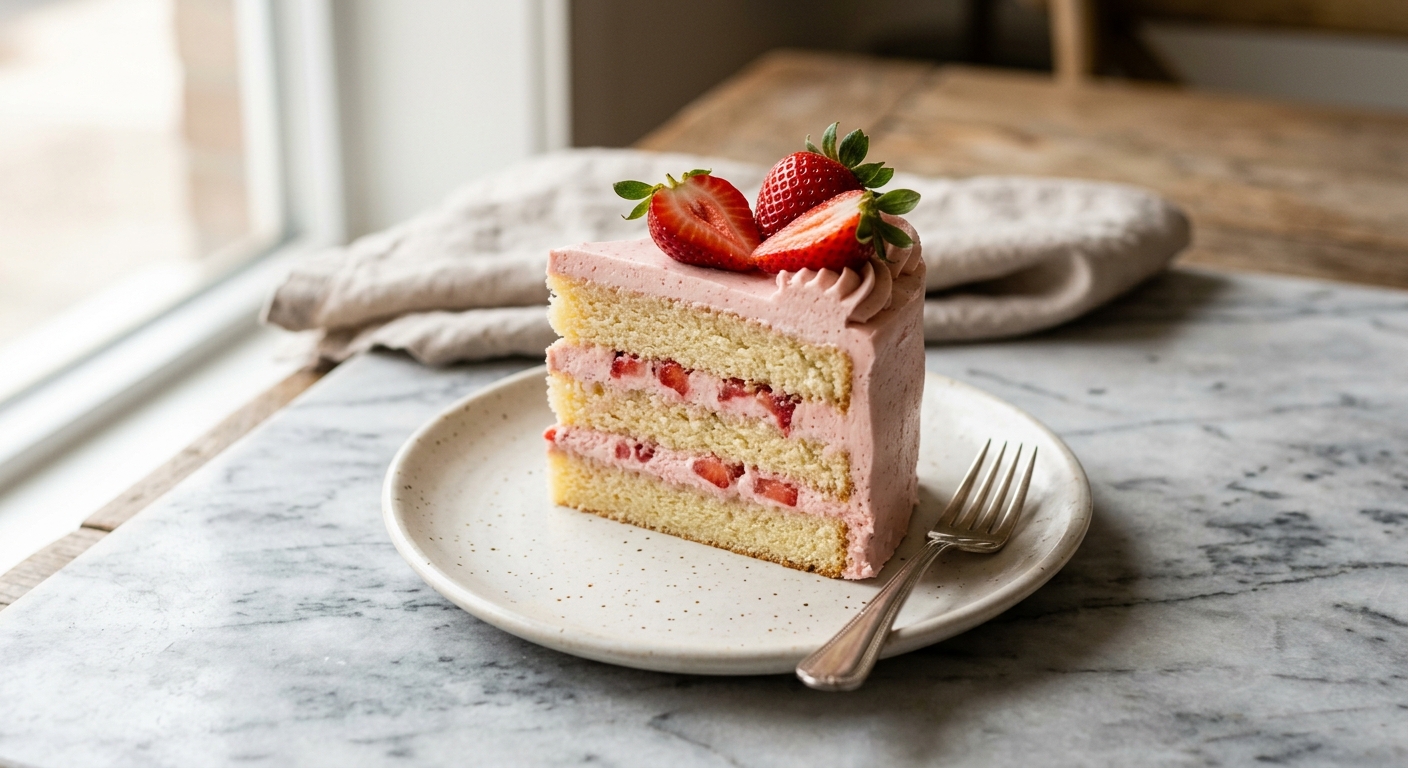
There is a certain kind of cake that stops conversation the moment it is set on the table. This is that cake. Picture layers of pale pink, strawberry-kissed crumb, stacked high and frosted in a cloud of blush buttercream that smells, genuinely, like a bowl of ripe strawberries. It is the kind of showstopper that looks like it came from a professional bakery window, but was made in your own kitchen on a Saturday afternoon with a punnet of berries and a little bit of patience.
What sets this recipe apart from every other strawberry cake out there is simple: we use real strawberries, twice. A reduced strawberry puree is folded directly into the cake batter, concentrating the fruit flavor without adding excess moisture that would make the crumb dense or gummy. Then that same puree, reduced even further to an intensely jammy consistency, is whisked into a Swiss meringue buttercream base. Cooking the egg whites over a double boiler before whipping them gives you a frosting that is incredibly stable, silky smooth, and never too sweet, the perfect canvas for that bright berry flavor to shine.
This is a medium-difficulty bake, honest and approachable if you have made a layer cake before. The Swiss meringue buttercream has one or two steps that can seem fussy the first time, but the detailed tips below will walk you through every stage. This cake is perfect for birthdays, summer celebrations, or any occasion that deserves something truly special. If strawberries are in season and you want to make the most of them, this is the recipe to reach for.
Equipment Needed
Click on an item below to shop for the recommended items for this recipe on Amazon.
As an Amazon Associate, we earn from qualifying purchases.
12
Ingredients
- 600 gfresh strawberries (about 4 cups), hulled and halved, divided use
- 1 tbspfresh lemon juice
- 300 gall-purpose flour (about 2.5 cups, spooned and leveled)
- 2 tspbaking powder
- 0.5 tspbaking soda
- 0.75 tspColima Sea SaltMicroplastic Free Salt
- 225 gunsalted butter (1 cup / 2 sticks), softened to room temperature
- 300 ggranulated sugar (about 1.5 cups)
- 3 largeeggs, at room temperature
- 2 tsppure vanilla extract
- 120 mlwhole milk (about 0.5 cup), at room temperature
- 120 mlfull-fat sour cream (about 0.5 cup), at room temperature
- —FOR THE STRAWBERRY SWISS MERINGUE BUTTERCREAM
- 350 gfresh strawberries (about 2.5 cups), hulled and halved
- 1 tbspgranulated sugar (for the reduction)
- 200 gegg whites (from about 6 large eggs)
- 400 ggranulated sugar (about 2 cups)
- 450 gunsalted butter (2 cups / 4 sticks), cut into 1-inch cubes, at room temperature
- 1 tsppure vanilla extract
- 0.25 tspColima Sea SaltMicroplastic Free Salt
Ingredient Substitutions
Instructions
- Make the strawberry puree for the cake batter: Blend 600g hulled strawberries with 1 tbsp lemon juice in a blender until completely smooth. Pour into a medium saucepan over medium heat and cook, stirring frequently, for 20 to 25 minutes until reduced to exactly 200ml (about 0.75 cup). It should be thick, jammy, and deeply colored. Remove from heat and cool to room temperature. Divide the cooled puree: set aside 150ml for the cake batter and reserve 50ml for the buttercream (cover and refrigerate until needed).
- Make the buttercream reduction separately: Blend 350g hulled strawberries with 1 tbsp sugar until smooth. Pour into a small saucepan over medium heat and reduce for 25 to 30 minutes, stirring often, until you have roughly 80ml of a thick, intensely concentrated paste. Cool completely. This can be done alongside the cake puree or up to 3 days ahead.
- Preheat your oven to 350°F (175°C). Grease three 8-inch round cake pans, line the bottoms with parchment paper circles, and grease the parchment. Dust lightly with flour and tap out the excess.
- Whisk together the flour, baking powder, baking soda, and salt in a medium bowl. Set aside. In a small bowl or measuring jug, combine the 150ml strawberry puree, whole milk, sour cream, and vanilla extract. Whisk until smooth.
- In the bowl of a stand mixer fitted with the paddle attachment (or using a hand mixer), beat the softened butter and 300g granulated sugar on medium-high speed for 4 to 5 minutes until very pale, fluffy, and almost white in appearance. Scrape down the sides of the bowl well. Add the eggs one at a time, beating for 30 seconds after each addition and scraping down the bowl. The mixture may look slightly curdled at this point, which is normal.
- With the mixer on low speed, add the flour mixture in three additions, alternating with the strawberry-milk mixture in two additions (flour, milk, flour, milk, flour). Begin and end with flour. Mix only until just combined after each addition. Do not overmix. Finish folding with a spatula to ensure no dry streaks remain at the bottom.
- Divide the batter evenly between the three prepared pans (a kitchen scale makes this easy, about 420g per pan). Smooth the tops gently with an offset spatula. Bake for 28 to 32 minutes, until a toothpick inserted into the center comes out with just a few moist crumbs attached and the edges have pulled slightly away from the sides of the pan. Rotate the pans front-to-back at the 20-minute mark for even baking.
- Cool the cakes in the pans on a wire rack for 15 minutes, then carefully run an offset spatula around the edges and invert onto the rack. Peel off the parchment and allow to cool completely, at least 1 hour, before frosting. Do not rush this step.
- Make the Swiss meringue buttercream: Combine 200g egg whites and 400g granulated sugar in the clean, grease-free bowl of a stand mixer. Set the bowl over a saucepan of barely simmering water (do not let the bowl touch the water). Whisk constantly by hand until the mixture reaches 160°F (71°C) on an instant-read thermometer and the sugar is fully dissolved (rub a small amount between your fingers – it should feel completely smooth with no graininess). This takes about 5 to 7 minutes.
- Transfer the bowl to the stand mixer fitted with the whisk attachment. Whip on medium-high speed for 10 to 12 minutes until the meringue is thick, very glossy, forms stiff peaks, and the outside of the bowl feels completely cool to the touch. This cooling step is critical: adding butter to warm meringue will melt it.
- With the mixer running on medium speed, add the room-temperature butter cubes one or two at a time, waiting about 5 seconds between additions. Once all the butter is incorporated, increase to medium-high and beat for 3 to 5 more minutes. The buttercream may look curdled and soupy at some point during this process – keep going, it will come together into a smooth, silky frosting. Add the vanilla extract, salt, and the reserved strawberry reduction. Beat for another 2 minutes until fully incorporated and evenly colored. If the buttercream is too soft to spread, refrigerate for 20 minutes and re-beat.
- Assemble the cake: Place one cooled cake layer on a cake board or serving plate. Spread a generous layer of buttercream (about 150g) evenly over the top using an offset spatula. Place the second layer on top and repeat. Add the third layer. Apply a thin crumb coat of buttercream all over the top and sides, then refrigerate for 20 minutes to set. Apply the final coat of frosting, smoothing with a bench scraper for clean sides. Decorate with fresh halved strawberries if desired. Slice and serve.
- Prepare the strawberry puree and buttercream reduction exactly as described in the oven method steps 1 and 2. Cool completely before using.
- Preheat your oven to 350°F (175°C). Grease a 9×13-inch baking pan generously with butter and line with parchment paper, leaving an overhang on the long sides to act as handles for lifting the cake out. Grease the parchment.
- Prepare the batter exactly as described in oven method steps 4 through 6. Pour the entire batter into the prepared pan and spread into an even layer with an offset spatula.
- Bake for 35 to 40 minutes, rotating the pan at the 25-minute mark, until a toothpick inserted into the thickest part of the center comes out with just a few moist crumbs. The top should spring back lightly when gently pressed. Cool in the pan on a wire rack for 20 minutes, then lift out using the parchment handles and cool completely on the rack.
- Prepare the Swiss meringue buttercream exactly as described in oven method steps 9 through 11. Because this is a single-layer cake with a more casual presentation, you will have more frosting than you strictly need. Spread about half to two-thirds of the buttercream generously over the cooled cake in a thick, swoopy layer. Store leftover frosting in the fridge for up to 5 days or freeze for up to 2 months. Garnish with sliced fresh strawberries before serving.
- Prepare the strawberry puree and buttercream reduction exactly as described in the oven method steps 1 and 2. Cool completely.
- Preheat your oven to 350°F (175°C). Line two standard 12-cup muffin tins with paper liners. This recipe yields about 22 to 24 cupcakes.
- Prepare the batter exactly as described in oven method steps 4 through 6. Fill each paper liner about two-thirds full using an ice cream scoop or large cookie scoop for even, neat portions. Do not overfill or the cupcakes will overflow and bake into muffin tops.
- Bake for 18 to 22 minutes, until a toothpick inserted in the center comes out with just a few moist crumbs and the tops spring back lightly when pressed. Cool in the tin for 5 minutes, then transfer to a wire rack to cool completely. Never frost warm cupcakes.
- Prepare the Swiss meringue buttercream as described in oven method steps 9 through 11. Transfer to a large piping bag fitted with a large round or open star tip. Pipe generous swirls onto each cooled cupcake. Top each one with a small fresh strawberry. The frosted cupcakes can sit at room temperature for up to 4 hours before serving.
Nutrition Per Serving
Per 1 serving (makes one 8-inch three-layer cake)
Why This Recipe Works
The most important technique in this recipe is reducing the strawberry puree before it goes into the batter. Fresh strawberries are roughly 90% water, which means adding uncooked puree to a cake batter introduces a significant amount of liquid that would dilute the structure and produce a dense, wet crumb. By cooking the puree down to a fraction of its original volume, we drive off that excess water and concentrate the sugars and flavor compounds, so we get intensely strawberry-flavored cake layers with a tender, even crumb that holds its structure when sliced. The same logic applies to the buttercream reduction, where we cook the berries down to an almost jammy paste that folds into the frosting without destabilizing it.
The creaming of butter and sugar for a full 4 to 5 minutes is not a step to rush. As the fat and sugar are beaten together, millions of tiny air bubbles are incorporated into the fat. When the batter hits the heat of the oven, those trapped air pockets expand and help the cake rise to a light, fine-crumbed texture. The alternating flour and liquid method (often called the muffin method in reverse) is used here to protect the gluten structure: adding all the liquid at once to already-beaten butter can cause the emulsion to break, leading to a tough or greasy crumb. Alternating keeps the batter smooth and emulsified throughout.
Swiss meringue buttercream is the gold standard for layer cake frosting because of its stability and texture. Heating the egg whites with the sugar to 160°F pasteurizes the whites (making them safe to eat) and fully dissolves the sugar crystals, which is why the finished frosting is so impossibly smooth. The meringue must be completely cool before the butter is added, because butter melts above 90°F and warm meringue will simply melt it into a greasy soup. If this happens, do not panic: refrigerate the bowl for 15 to 20 minutes and then beat again. It almost always rescues itself.
Baker’s Tips
- Bring all refrigerated ingredients (butter, eggs, milk, sour cream) to room temperature at least 1 hour before starting. Cold ingredients do not emulsify properly and can cause a lumpy or broken batter.
- Weigh your strawberry reductions as they cook. Pulling them off the heat at the right point is the single most important factor in ensuring the right moisture level in both the cake and buttercream.
- Use a kitchen scale to divide the batter evenly between the three pans. Equal layers stack and look more professional, and they bake in the same amount of time.
- Wrap and freeze your cake layers for 30 minutes before frosting for an easier crumb coat. A slightly firm, chilled layer is much easier to handle than a delicate room-temperature one.
- If your buttercream looks curdled and soupy after adding the butter, keep beating. This is the most common point of panic and it almost always resolves within 3 to 4 more minutes of mixing as the emulsion comes together.
- For the cleanest cake slices, dip a long sharp knife in hot water, wipe it dry, and slice in one clean downward motion. Repeat between each slice.
- Fresh strawberry garnish added too far in advance can weep juice onto the frosting. Add decorative berries no more than 2 hours before serving.
Variations
- Strawberry and lemon: Add 2 tsp of finely grated lemon zest to the butter and sugar at the creaming stage for a bright, citrusy lift that pairs beautifully with the strawberry.
- Strawberry and rose: Stir 1 tsp of rose water into the buttercream along with the strawberry reduction for a delicate floral note. Use sparingly as rose water is potent.
- Chocolate base: Replace 40g of flour with good-quality Dutch-process cocoa powder. The chocolate and strawberry combination in the frosting is exceptional.
- Strawberry jam filling: Spread a thin layer of good-quality strawberry jam on each cake layer before the buttercream for an extra punch of berry flavor and a beautiful cross-section.
Troubleshooting & FAQ
My cake layers have very little strawberry color or flavor. What went wrong?
My Swiss meringue buttercream looks soupy and broken after I added the butter. Is it ruined?
My cake layers domed and cracked on top. How do I fix this for next time?
The cake layers stuck to the pans and broke when I tried to remove them. How do I prevent this?
My sugar is not dissolving in the egg whites over the double boiler. What should I do?
Storage & Make-Ahead
- Storage: Store the frosted cake under a cake dome or in an airtight container at room temperature for up to 2 days. For longer storage, refrigerate for up to 5 days – bring individual slices to room temperature for 30 minutes before serving for the best texture. The unfrosted cake layers can be wrapped tightly in plastic wrap and stored at room temperature for up to 2 days, or frozen for up to 3 months. The buttercream can be refrigerated in an airtight container for up to 1 week, or frozen for up to 2 months; re-whip at room temperature before using.
- Make-Ahead: The strawberry reductions for both the cake and buttercream can be made up to 3 days ahead and refrigerated. The cake layers can be baked, cooled, wrapped tightly, and stored at room temperature up to 2 days ahead, or frozen up to 3 months. The Swiss meringue buttercream can be made up to 1 week ahead and refrigerated; bring it to room temperature and re-whip with the paddle attachment until smooth and creamy before using. The fully assembled and frosted cake can be refrigerated overnight and brought to room temperature before serving.