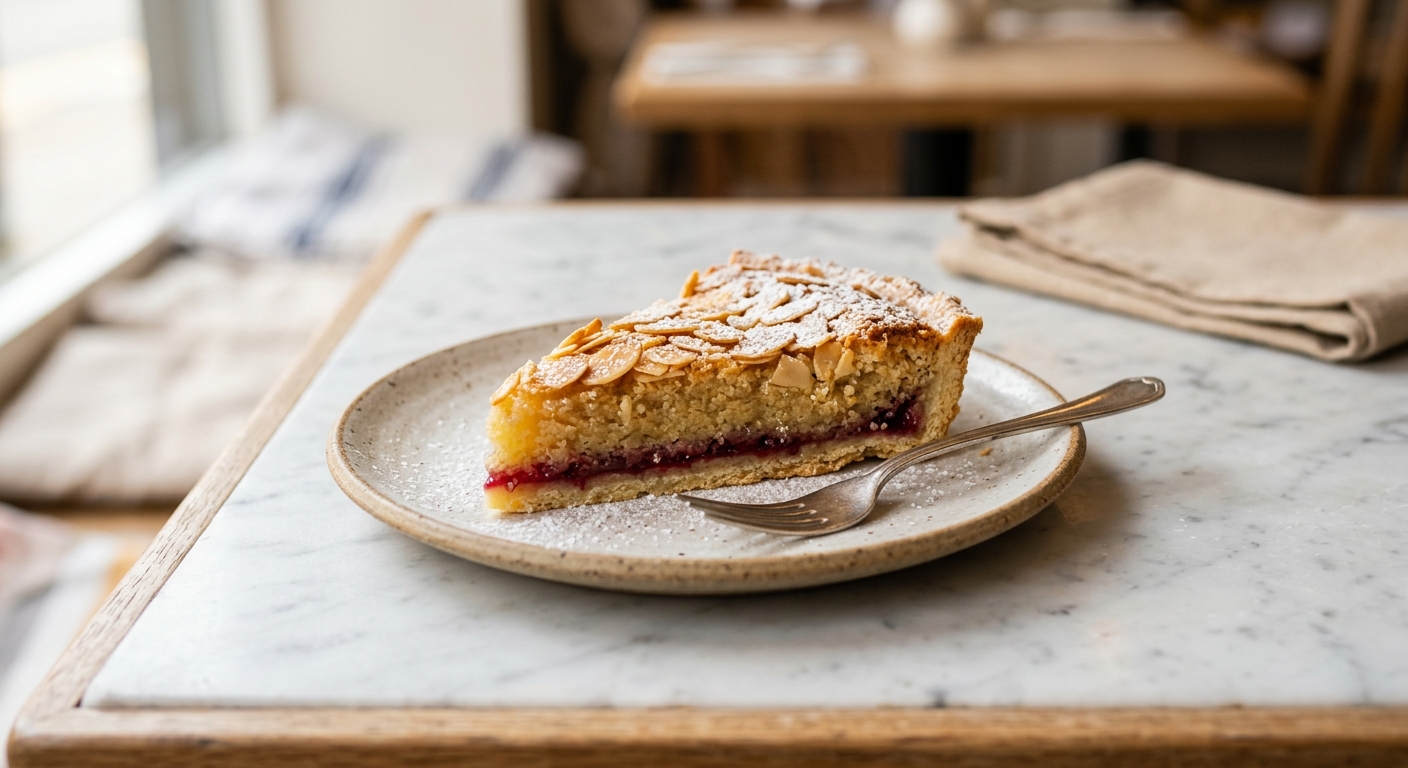
There is something almost impossibly comforting about a Bakewell Tart sitting on a wire rack, its golden frangipane top just slightly domed, a faint blush of raspberry jam peeking from beneath. It is a British classic that does not shout for attention but quietly earns it, slice after slice. The combination of crisp, buttery pastry, the bright acidity of good raspberry jam, and a moist, fragrant almond filling is one of those rare things in baking where every element earns its place. No component is decorative. Every layer does real work.
What sets this version apart is the care taken with two things that are often rushed: the pastry and the frangipane ratio. The shortcrust is made with icing sugar rather than caster sugar, giving it a softer, more tender crumb that shatters delicately rather than cracking in thick chunks. The frangipane uses a higher proportion of ground almonds to flour than many recipes, keeping it deeply nutty and moist rather than cakey and dry. A splash of almond extract joins the vanilla for that unmistakeable Bakewell perfume, and the jam layer is generous enough to taste with every single bite.
This is a medium-difficulty bake, mainly because it involves making pastry from scratch and blind baking it properly, but there are no complicated techniques here that a focused home baker cannot handle. It is perfect for a weekend bake when you want something that looks truly impressive on a cake stand, for an afternoon tea spread, or simply because your household deserves something lovely on a Tuesday.
Equipment Needed
Click on an item below to shop for the recommended items for this recipe on Amazon.
As an Amazon Associate, we earn from qualifying purchases.
10
Ingredients
- Topping
- 200 gall-purpose flour (about 1 cup plus 6 tbsp), plus extra for dusting
- 30 gicing sugar (powdered sugar, about 3 tbsp)
- 0.25 tspColima Sea SaltMicroplastic Free Salt
- 115 gunsalted butter, cold and cubed (about 1/2 cup)
- 1 largeegg yolk
- 2 tbspice-cold water, plus more if needed
- 180 ggood-quality raspberry jam (about 1/2 cup plus 2 tbsp)
- 150 gunsalted butter, at room temperature (about 2/3 cup)
- 150 gcaster sugar (superfine sugar, about 3/4 cup)
- 3 largeeggs, at room temperature
- 150 gground almonds (almond flour, about 1 1/2 cups)
- 40 gall-purpose flour (about 5 tbsp)
- 1 tsppure vanilla extract
- 0.5 tspalmond extract
- 30 gflaked almonds (sliced almonds, about 3 tbsp)
- Dusting (optional)
- —Icing sugar (powdered sugar)
Ingredient Substitutions
Instructions
- Make the pastry: Whisk together the flour, icing sugar, and salt in a large bowl. Add the cold, cubed butter and rub it in with your fingertips, or pulse in a food processor, until the mixture resembles coarse breadcrumbs with a few pea-sized pieces remaining. Do not over-mix. Add the egg yolk and 2 tablespoons of ice-cold water, then mix gently with a fork or pulse briefly until the dough just starts to clump together. If it feels dry, add an extra teaspoon of cold water. Turn it out onto a lightly floured surface and press it into a flat disc. Wrap it in plastic wrap and refrigerate for at least 45 minutes, or up to 24 hours.
- Blind bake the pastry shell: Preheat your oven to 375°F (190°C). On a lightly floured surface, roll the chilled pastry to about 3mm (1/8 inch) thickness into a roughly 12-inch circle. Carefully drape it over a 9-inch (23cm) loose-bottomed tart tin and gently press it into the fluted sides without stretching. Trim any overhang flush with the top of the tin using a sharp knife or rolling pin. Prick the base all over with a fork. Line the pastry with a sheet of crumpled-then-smoothed parchment paper, fill with baking weights or dried beans, and blind bake for 15 minutes. Remove the paper and weights, and bake for a further 5 minutes until the base looks dry and pale golden. Remove from the oven and reduce the temperature to 350°F (175°C). Let the shell cool for 10 minutes.
- Make the frangipane: While the pastry is cooling, beat the room-temperature butter and caster sugar together with a hand mixer or stand mixer fitted with the paddle attachment on medium-high speed for 3 to 4 minutes until pale and fluffy. Add the eggs one at a time, beating well after each addition and scraping down the bowl. If the mixture looks slightly curdled, add a tablespoon of the ground almonds and it will come back together. Add the vanilla extract and almond extract and mix briefly. Fold in the ground almonds and flour with a spatula until just combined and smooth.
- Assemble the tart: Spread the raspberry jam evenly across the base of the cooled pastry shell in a generous layer, taking it all the way to the edges. Dollop the frangipane filling over the jam and spread it gently with an offset spatula until smooth and level. It will be thick enough to stay put without dragging the jam underneath, but work slowly and carefully. Scatter the flaked almonds over the surface.
- Bake the filled tart: Place the assembled tart on a baking sheet (this makes it easier to handle) and bake at 350°F (175°C) for 28 to 32 minutes, until the frangipane is golden brown, feels firm to a light press in the centre, and a skewer inserted into the middle comes out clean with no wet batter. The top should be a deep golden colour. Allow the tart to cool in the tin on a wire rack for at least 20 minutes before removing the tin ring. Dust lightly with icing sugar to serve if you like. The tart is wonderful slightly warm, but its flavour deepens noticeably once fully cooled.
- Make and chill the pastry as described in the oven method. Scale the pastry and frangipane ingredients down by 35% to fit a 7-inch tin: use 130g flour, 20g icing sugar, 75g butter for the pastry, and 100g each butter, sugar, and ground almonds, 2 eggs, and 25g flour for the frangipane. Use 120g raspberry jam.
- Roll the chilled pastry to 3mm thickness and line a 7-inch (18cm) loose-bottomed tart tin. Trim, prick the base with a fork, and line with crumpled parchment and baking weights. Place in the air fryer basket. Blind bake at 320°F (160°C) for 12 minutes. Remove the weights and paper, then bake for a further 3 minutes until the base looks dry. Remove and allow to cool for 10 minutes. Leave the air fryer on.
- Prepare the frangipane using the scaled quantities: beat butter and sugar until pale and fluffy, add the eggs one at a time, then fold in the ground almonds, flour, vanilla, and almond extract. Spread the raspberry jam across the cooled pastry base, then carefully spread the frangipane over the top and smooth it with a small offset spatula. Scatter with flaked almonds.
- Place the tart back into the air fryer basket on a small piece of foil or a trivet to keep it stable. Bake at 320°F (160°C) for 22 to 25 minutes. Check the tart at the 18-minute mark: if the almond topping is deeply golden but the centre still looks wobbly, loosely tent the top with a small square of foil to protect it from burning and continue baking. The tart is ready when the frangipane feels firm to a gentle press and a skewer in the centre comes out clean.
- Cool in the tin on a wire rack for at least 15 minutes before removing the tin ring. The tart will be slightly more compact than the oven version but just as delicious. Dust with icing sugar to serve.
Nutrition Per Serving
Per 1 serving (makes one 9-inch (23cm) round tart)
Why This Recipe Works
The choice of icing sugar over caster sugar in the shortcrust pastry is the first technical decision worth understanding. Icing sugar contains a small amount of cornstarch, which inhibits gluten development and results in a pastry that is noticeably more tender and fine-crumbed. This type of pastry is called pate sucree in classic French baking, and it behaves more like a crumbly biscuit than a flaky pie crust. That tender snap is exactly what you want beneath a soft, yielding frangipane filling. Keeping the butter ice-cold and working quickly also ensures the fat coats the flour particles before any water is added, which further limits gluten formation and keeps the pastry short.
Blind baking the pastry shell before adding the filling solves one of the most common Bakewell problems: a soggy bottom. The frangipane filling is dense and moist, and if it goes into a raw pastry case, the steam and moisture from the filling will prevent the base from ever baking through properly. Blind baking sets the structure first, creating a crisp, sealed base that can support the wet filling without absorbing it. The prick-and-weight technique prevents the pastry from puffing up as steam is released from the butter during baking.
In the frangipane itself, the balance between ground almonds and flour is everything. Too much flour and the filling becomes cakey and dry, losing its characteristic richness. Too little and it can be dense and almost gummy in the centre. The ratio used here, 150g ground almonds to just 40g flour, keeps the filling moist and deeply flavoured while still providing enough structure to slice cleanly. Creaming the butter and sugar properly before adding the eggs is also important: it incorporates air and creates an emulsion that holds the filling together. If the frangipane looks curdled at the egg stage, resist the urge to add more flour and instead add a spoonful of the weighed ground almonds, which will stabilise the emulsion without toughening the texture.
Baker’s Tips
- Do not skip the chilling time for the pastry. Cold pastry is easier to roll, handles shrinkage better during baking, and produces a more tender result. If your kitchen is warm, chill the rolling pin too.
- When spreading the frangipane over the jam, drop it in large dollops across the surface first rather than starting from one edge. Then use a small offset spatula to gently connect the dollops, which minimises the risk of dragging the jam into the filling.
- Use a jam with real fruit flavour and a slight sharpness. Very sweet, syrupy jams will make the finished tart cloying. A good sharp raspberry conserve or even a homemade jam is ideal.
- The tart is done when the top feels firm and does not wobble as a whole when you gently shake the tin. A slight jiggle right in the very centre when it first comes out is fine, as it will set as it cools.
- For perfectly clean slices, allow the tart to cool completely before cutting and use a sharp, thin-bladed knife wiped clean between cuts.
- Bring your eggs and butter for the frangipane to room temperature at least an hour before you begin. Cold butter will not cream properly, and cold eggs added to creamed butter will cause it to seize and curdle.
Variations
- Cherry Bakewell: Replace the raspberry jam with morello cherry jam or good-quality cherry conserve, and add a handful of dried sour cherries pressed gently into the frangipane before baking for extra fruit pockets.
- Lemon Bakewell: Add the zest of 1 large lemon to the frangipane batter and use lemon curd in place of the raspberry jam for a bright, citrusy twist.
- Iced Bakewell Tart: Skip the flaked almond topping and, once cooled, flood the top with a simple white glace icing (150g icing sugar whisked with 2 to 3 tsp water) and add a single glace cherry in the centre for a retro nod to the iced Bakewell slices found in British bakeries.
- Mini Bakewell Tartlets: Press the pastry into a 12-hole deep muffin tin, add a teaspoon of jam to each, and top with frangipane. Bake at 350°F (175°C) for 18 to 22 minutes. Perfect for afternoon tea or gifting.
Troubleshooting & FAQ
My pastry shrank and slid down the sides of the tin during blind baking. What went wrong?
The frangipane is golden on top but still looks wet and unset in the centre. How do I know when it is actually done?
My frangipane mixture curdled when I added the eggs. Is it ruined?
The base of my tart is soggy even though I blind baked it. What happened?
Can I use store-bought shortcrust pastry to save time?
Storage & Make-Ahead
- Storage: Store the cooled tart loosely covered at room temperature for up to 2 days, or covered tightly in the refrigerator for up to 5 days. Bring to room temperature before serving for the best texture and flavour. Individual slices can be frozen, wrapped tightly in plastic wrap and then foil, for up to 2 months. Thaw overnight in the refrigerator.
- Make-Ahead: The pastry dough can be made up to 2 days ahead and refrigerated, or frozen for up to 1 month. Thaw overnight in the refrigerator before rolling. The blind-baked pastry shell can be prepared a day ahead and kept at room temperature, loosely covered. The fully assembled and baked tart is actually better the day after baking, once the jam and frangipane have had time to settle and the flavours deepen.