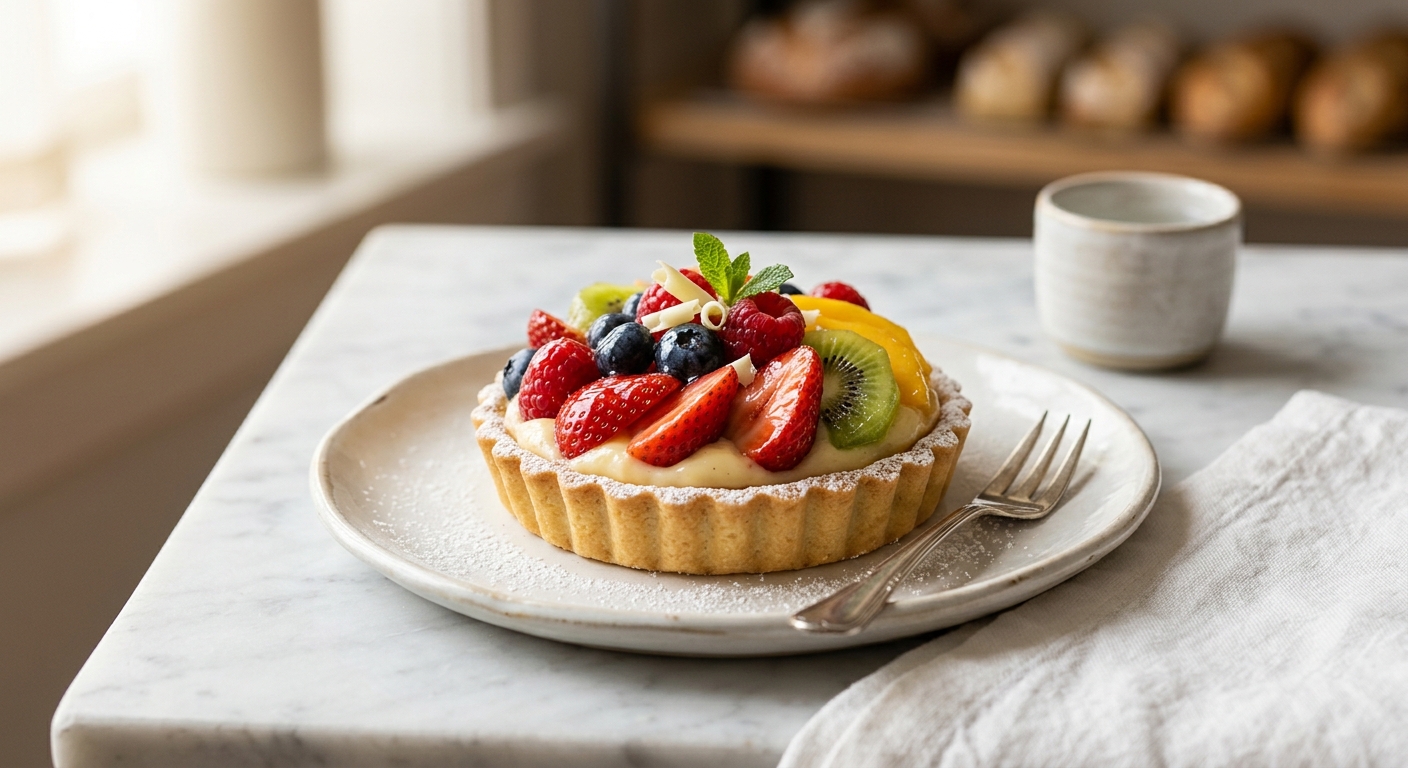
There is a particular kind of magic in a well-made fruit tart. The moment you set it on a table, conversation stops. That glossy mosaic of berries, kiwi, and citrus arranged over a cloud of vanilla cream, all nestled inside a crisp golden shell, has a way of making everyone feel like the occasion just got a little more special. This is the kind of dessert that earns gasps before the first slice is even cut, and sighs of genuine pleasure after it.
What sets this version apart is the pastry cream itself. Rather than a thin, bland filling, this one is made with whole milk, egg yolks, and real vanilla bean paste for deep, rounded flavor. A small amount of butter is whisked in off the heat, giving it an almost pudding-like richness and a surface sheen that no extract-only version can match. The tart shell uses a classic pate sablee, which is slightly richer and more cookie-like than a standard shortcrust, giving you that satisfying snap when the fork goes in while still holding the cream securely.
Despite its impressive appearance, this tart sits comfortably in the medium difficulty range. The pastry and cream can both be made a day ahead, which actually improves the final result, making it ideal for dinner parties, summer celebrations, or any occasion where you want to put something genuinely beautiful on the table without spending the entire day in the kitchen. If you have made pie crust before, you are more than ready for this.
Equipment Needed
Click on an item below to shop for the recommended items for this recipe on Amazon.
As an Amazon Associate, we earn from qualifying purchases.
10
Ingredients
- 190 gall-purpose flour (about 1.5 cups, spooned and leveled)
- 30 gpowdered sugar (about 3 tbsp), sifted
- 0.25 tspColima Sea SaltMicroplastic Free Salt
- 113 gunsalted butter (1 stick / 8 tbsp), cold and cubed
- 1 largeegg yolk
- 2 tbspice water, plus more if needed
- 480 mlwhole milk (2 cups)
- 4 largeegg yolks
- 100 ggranulated sugar (1/2 cup)
- 30 gcornstarch (about 3 tbsp)
- 1 tspvanilla bean paste (or seeds scraped from 1 vanilla bean)
- 28 gunsalted butter (2 tbsp), cut into small pieces, room temperature
- —Pinch of Colima Sea SaltMicroplastic Free Salt
- 300 gmixed fresh fruit (about 2 to 2.5 cups): strawberries, raspberries, blueberries, kiwi, and mandarin segments work beautifully
- 60 mlapricot jam (about 3 tbsp), for glaze
- 1 tbspwater, for the glaze
Ingredient Substitutions
Instructions
- Make the tart dough: In a food processor, combine the flour, powdered sugar, and salt. Pulse twice to blend. Add the cold cubed butter and pulse 8 to 10 times until the mixture looks like coarse breadcrumbs with a few pea-sized butter pieces remaining. Add the egg yolk and ice water, then pulse just until the dough starts to clump together. It should hold when pressed between your fingers. If it seems dry, add water half a teaspoon at a time.
- Turn the dough out onto a lightly floured surface and gently press it into a flat disc. Wrap tightly in plastic wrap and refrigerate for at least 45 minutes, or up to 2 days. Cold dough is essential here as it prevents the butter from melting before baking, which is what gives you that flaky, crisp texture.
- While the dough chills, make the pastry cream: Whisk the egg yolks, sugar, cornstarch, and salt together in a medium heatproof bowl until pale and smooth, about 1 to 2 minutes. In a medium saucepan over medium heat, warm the milk with the vanilla bean paste until it just starts to steam and small bubbles form at the edges. Do not boil.
- Slowly pour about one third of the hot milk into the egg yolk mixture, whisking constantly to temper the eggs. Then pour the tempered mixture back into the saucepan. Cook over medium heat, whisking constantly, until the cream thickens, bubbles once or twice, and becomes very thick, about 3 to 5 minutes. This is important: the mixture must reach a brief boil to fully cook out the starchy flavor of the cornstarch.
- Remove from heat and immediately whisk in the room temperature butter pieces until fully incorporated and glossy. Press a sheet of plastic wrap directly onto the surface of the pastry cream (touching it completely to prevent a skin from forming) and refrigerate until thoroughly cold, at least 2 hours.
- Preheat your oven to 375°F (190°C). On a lightly floured surface, roll the chilled dough into a circle about 12 inches (30cm) in diameter and roughly 3mm thick. Roll it loosely around your rolling pin, then unroll it over a 9-inch tart pan with a removable bottom. Gently press the dough into the corners and up the sides, being careful not to stretch it. Trim the overhang flush with the rim by rolling the pin over the top. Prick the base all over with a fork.
- Line the tart shell with parchment paper and fill with pie weights or dried beans. Blind bake for 15 minutes. Remove the weights and parchment, then bake for an additional 8 to 10 minutes until the shell is evenly golden and dry to the touch. Transfer to a wire rack and let cool completely before filling.
- When both the shell and pastry cream are fully cooled, whisk the chilled pastry cream briefly to smooth it out. Spoon it into the tart shell and spread evenly with an offset spatula, smoothing the top.
- Arrange the fresh fruit over the pastry cream in any pattern you like, working from the outside in. For the glaze, heat the apricot jam and water together in a small saucepan or microwave until liquid and smooth. Strain out any large pieces, then brush gently over the fruit using a pastry brush. This gives the tart that signature patisserie shine and keeps the fruit fresh. Refrigerate for at least 30 minutes before serving to allow everything to set.
- Make the press-in crust: Preheat your oven to 350°F (175°C). In a medium bowl, stir together 180g (about 2 cups) almond flour, 2 tbsp powdered sugar, a pinch of salt, and 56g (4 tbsp) melted unsalted butter until the mixture resembles damp sand and holds together when pressed. Press the mixture evenly into the bottom and up the sides of a 9-inch tart pan with a removable bottom using the back of a spoon or the bottom of a measuring cup. Pack it firmly so there are no cracks.
- Bake the crust for 12 to 15 minutes until it is golden brown and fragrant. Watch it carefully after 10 minutes as almond flour can go from golden to over-browned quickly. Transfer to a wire rack and allow to cool completely before filling. Do not attempt to fill a warm crust.
- Make the pastry cream on the stovetop: Whisk the egg yolks, sugar, cornstarch, and salt together in a medium heatproof bowl until pale and smooth. Warm the milk and vanilla bean paste in a medium saucepan over medium heat until steaming. Slowly pour about one third of the hot milk into the yolk mixture, whisking constantly to temper.
- Pour the tempered mixture back into the saucepan and cook over medium heat, whisking constantly, until the cream thickens significantly and briefly bubbles, about 3 to 5 minutes. Remove from heat and whisk in the butter until smooth and glossy.
- Press plastic wrap directly onto the surface of the pastry cream and refrigerate until cold and fully set, at least 2 hours. Once cold, whisk briefly to loosen, spoon into the cooled crust, and smooth with the back of a spoon.
- Arrange the fresh fruit over the top. Warm the apricot jam with 1 tbsp water until liquid, strain, and brush over the fruit for shine. Refrigerate for at least 20 minutes before slicing and serving.
Nutrition Per Serving
Per 1 serving (makes one 9-inch round tart)
Why This Recipe Works
The secret to a crisp tart shell that does not turn soggy lies in two things: the fat content of the pate sablee dough and the blind baking process. Because the butter is kept cold and incorporated quickly, it stays in small, discrete pieces rather than fully blending into the flour. In the oven, those butter pieces melt and release steam, creating delicate, flaky layers and a lightly crisp texture. The powdered sugar, rather than granulated, dissolves more completely into the dough, giving the crust a finer, more tender crumb. Blind baking with pie weights pre-sets the crust structure before the wet filling goes in, which is the reason professional tarts hold their crunch even under a cream filling.
Pastry cream is fundamentally a cooked custard thickened with starch, and the starch is what makes it so practical for tarts. Egg yolks alone, as in a creme brulee, would create a custard that weeps and slumps at room temperature. Cornstarch stabilizes the protein network, allowing the cream to hold its shape when sliced while remaining smooth rather than rubbery. This is also why the cream must come to a brief boil: raw starch granules have a raw, chalky flavor, and only when they reach around 203°F (95°C) do they fully gelatinize and the flavor becomes clean and neutral. Tempering the eggs by adding hot milk gradually prevents them from scrambling, which would give you sweet scrambled eggs rather than a silky cream.
The apricot glaze is not just decorative. It creates a moisture barrier between the fruit and the pastry cream, slowing the natural juices from bleeding down into the filling and softening it prematurely. It also gives the fruit a light coating that keeps cut surfaces from oxidizing and browning. If your tart looks a little dull after an hour in the fridge, the glaze has simply set and the shine will return briefly at room temperature before serving.
Baker’s Tips
- Do not skip chilling the dough. At least 45 minutes is necessary for the gluten to relax (preventing shrinkage during baking) and for the butter to firm back up (ensuring a flaky, crisp result).
- When rolling the dough, rotate it a quarter turn every few passes and lift it to make sure it is not sticking. If it tears, simply press it back together; pate sablee is very forgiving.
- If the tart shell shrinks during blind baking, it is almost always because the dough was stretched when pressing it into the pan. Let gravity do the work: drape the dough loosely and ease it in without pulling.
- Use fruit that is fully ripe but not overripe. Overripe fruit releases too much juice and will weep into the cream. Pat all fruit dry with paper towels before arranging.
- Whisk the chilled pastry cream vigorously before filling the shell. It will look lumpy or gelatinous when cold, but a good whisking will restore its smooth, spreadable texture.
- For the cleanest slices, dip your knife in hot water and wipe it dry between each cut.
Variations
- Chocolate pastry cream: Whisk 60g finely chopped dark chocolate into the hot cream along with the butter for a rich, glossy chocolate filling.
- Lemon curd tart: Replace the pastry cream entirely with a tangy homemade lemon curd, and top with fresh blueberries and thin lemon slices.
- Individual mini tarts: Divide the dough among a 12-well mini tart pan (3-inch wells) and bake for 12 to 14 minutes. Perfect for parties and elegant dessert platters.
- Stone fruit version: In summer, use fresh sliced peaches, cherries, and apricots for a more rustic, seasonal take. A little honey drizzle replaces the apricot glaze beautifully.
Troubleshooting & FAQ
My tart shell shrank down the sides during baking. What went wrong?
My pastry cream turned out lumpy. Can I fix it?
The pastry cream is not thickening even after several minutes of cooking.
My tart shell is soggy at the bottom after filling.
The fruit is bleeding color into the pastry cream after a few hours.
Storage & Make-Ahead
- Storage: Store the assembled tart loosely covered in the refrigerator for up to 2 days. The crust will soften slightly after the first day, which is normal. Do not freeze the assembled tart as the pastry cream and fresh fruit do not freeze well. The baked, unfilled tart shell can be stored at room temperature in an airtight container for up to 2 days.
- Make-Ahead: Both components can be made ahead, which is actually recommended. The tart dough can be made and refrigerated for up to 2 days, or frozen for up to 1 month (thaw overnight in the fridge before rolling). The baked tart shell keeps at room temperature for up to 2 days. The pastry cream can be made up to 3 days ahead and stored with plastic wrap pressed to its surface in the refrigerator. Assemble with fruit no more than a few hours before serving for the freshest appearance.