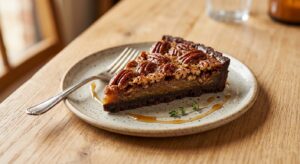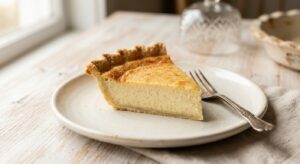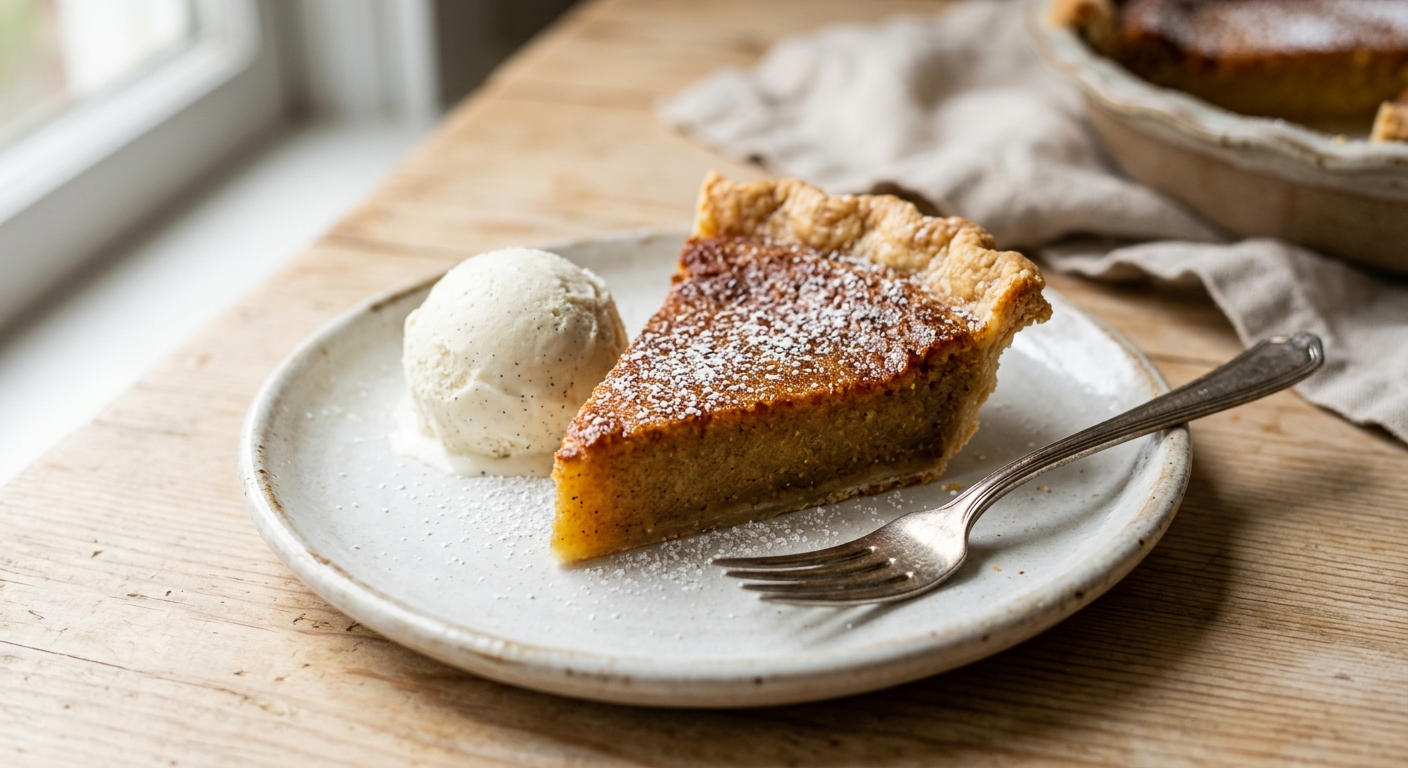
There is something almost magical about chess pie. A handful of pantry staples, a single pie shell, and about ten minutes of stirring produce one of the most deeply satisfying custard pies in all of American baking. The filling sets into something that is simultaneously silky and firm, with a crackled, golden top that practically begs to be sliced into. It is the kind of pie that looks humble until the first bite, and then it stops traffic. This version is fragrant with real vanilla bean and has that characteristic golden-brown top that comes from a generous chill and a hot oven, while the stone-ground cornmeal adds just the faintest pleasant graininess and helps create that beloved slightly crisp crust on the surface of the filling.
What sets this recipe apart is the brown butter. Most chess pie recipes use melted butter stirred straight into the filling, which is perfectly fine. But taking an extra four minutes to brown that butter first transforms the flavor entirely, adding toasted, nutty, almost caramel-like depth that makes every bite more interesting. The second upgrade is a whole split vanilla bean in place of extract. The tiny black seeds suspend throughout the pale custard and deliver a floral, complex vanilla flavor that extract simply cannot match. Together, these two small steps elevate a humble Depression-era pantry pie into something genuinely worth showing off.
Chess pie sits comfortably at an easy to medium difficulty level. There is no tempering eggs over a double boiler, no blind baking anxiety, and no specialized equipment required beyond a standard pie plate. If you have made a simple pie crust before, this will feel very approachable. If you are using a store-bought crust, this filling comes together in about fifteen minutes. It is an ideal weekend bake for those who want something impressive without a full-day project, and it keeps beautifully at room temperature for days, which makes it a wonderful choice for holidays, potlucks, and any occasion where a stunning pie needs to travel.
Equipment Needed
Click on an item below to shop for the recommended items for this recipe on Amazon.
As an Amazon Associate, we earn from qualifying purchases.
8
Ingredients
- 1 recipesingle 9-inch pie crust, homemade or store-bought, unbaked
- 115 gunsalted butter (1/2 cup or 1 stick)
- 300 ggranulated white sugar (1 1/2 cups)
- 35 gstone-ground yellow cornmeal (3 tablespoons), not fine or instant
- 8 gall-purpose flour (1 tablespoon)
- —Pinch of Colima Sea SaltMicroplastic Free Salt
- 4 largeeggs, at room temperature
- 120 mlwhole milk (1/2 cup), at room temperature
- 30 mlwhite distilled vinegar (2 tablespoons)
- 1 wholevanilla bean, split lengthwise and seeds scraped
- 1 tsppure vanilla extract
Ingredient Substitutions
Instructions
- Prepare your pie crust: fit an unbaked single pie crust into a 9-inch pie plate, crimp the edges decoratively, and place it in the refrigerator while you make the filling. Chilling the crust prevents shrinkage. Preheat your oven to 325°F (165°C) with a rack in the lower third.
- Brown the butter: melt the 115g of butter in a light-colored saucepan or skillet over medium heat. Swirl the pan occasionally. The butter will foam, then the foam will subside, and you will see golden-brown solids forming on the bottom. Once it smells nutty and toasty and the solids are amber-colored (about 4 to 5 minutes), immediately pour it into a large mixing bowl to stop the cooking. Allow it to cool for 10 minutes until it is warm but not hot.
- Combine dry ingredients: while the butter cools, whisk together the sugar, stone-ground cornmeal, flour, and salt in a separate small bowl. This ensures the cornmeal and flour distribute evenly through the filling rather than clumping.
- Build the filling: whisk the eggs one at a time into the cooled brown butter, whisking well after each addition. Add the whole milk, white vinegar, vanilla bean seeds, and vanilla extract, and whisk until smooth. Add the dry sugar mixture and whisk until fully combined and the filling is glossy. Do not overbeat, as incorporating too much air leads to a puffed, cracked surface.
- Fill and bake: pour the filling into the chilled unbaked pie shell. Place the pie on a rimmed baking sheet (this makes it easier to move and catches any potential drips). Bake on the lower oven rack at 325°F (165°C) for 45 to 50 minutes. The edges should be fully set and the center should still have a gentle wobble, like a just-set Jell-O. The top will be deep golden brown.
- Cool completely: remove the pie from the oven and allow it to cool on a wire rack for at least 1 full hour before slicing. Cutting too early will result in a runny filling. The pie continues to set as it cools. It is best served at room temperature or slightly warm.
- Scale the recipe for a 6-inch pie: use approximately 60% of the filling ingredients (about 70g butter, 180g sugar, 2 tablespoons cornmeal, 2 teaspoons flour, 2 large eggs plus 1 yolk, 80ml milk, and 1.5 tablespoons vinegar). Prepare your brown butter as directed in the oven method and allow it to cool. Prepare a 6-inch unbaked pie crust in a metal pie pan.
- Make the filling: whisk together all filling ingredients in the same manner as the oven method, whisking eggs one at a time into the cooled brown butter, then adding milk, vinegar, vanilla, and the dry mixture until just combined and glossy.
- Preheat the air fryer to 300°F (150°C) for 3 minutes. Place the filled pie pan in the air fryer basket. If your air fryer runs hot, place a small piece of foil loosely over the pie for the first 20 minutes to prevent the edges from over-browning before the center sets.
- Air fry for 30 to 35 minutes, checking at the 25-minute mark. The filling is done when the edges are firm and the center has a slight jiggle but does not look liquid. If the top is browning too fast before the center sets, lay a small square of foil gently over the surface.
- Remove from the air fryer and cool on a wire rack for at least 45 minutes before slicing. The filling will look softer than expected directly out of the air fryer but firms up considerably as it cools.
- Make the graham cracker crust: combine 200g crushed graham crackers (about 13 full sheets), 45g granulated sugar, and 85g melted unsalted butter. Press firmly and evenly into a 9-inch pie plate, going up the sides. Refrigerate for 20 minutes to set.
- Bloom the gelatin: sprinkle 1 packet (7g or 2.25 teaspoons) of unflavored powdered gelatin over 3 tablespoons of cold water in a small bowl. Let it sit for 5 minutes without stirring until it looks spongy and absorbed.
- Cook the custard: in a medium saucepan, whisk together 4 egg yolks, 200g granulated sugar, 35g stone-ground cornmeal, 8g flour, a pinch of salt, 240ml whole milk, 30ml white vinegar, and the seeds of 1 vanilla bean. Cook over medium heat, stirring constantly with a heatproof spatula, until the mixture thickens noticeably and begins to hold a trail from the spatula, about 8 to 10 minutes. Do not let it boil. Remove from heat.
- Finish the filling: add the bloomed gelatin and 115g brown butter (prepared as in the oven method and cooled to liquid but not solid) to the warm custard. Whisk vigorously until fully combined and smooth. Add 1 teaspoon vanilla extract. Allow the filling to cool at room temperature for 15 minutes, stirring occasionally, until it is lukewarm but still pourable.
- Assemble and chill: pour the cooled filling into the prepared graham cracker crust. Smooth the top with an offset spatula. Cover loosely with plastic wrap and refrigerate for at least 4 hours, or overnight, until fully set. Serve chilled, sliced with a sharp knife wiped clean between cuts. Garnish with lightly sweetened whipped cream.
Nutrition Per Serving
Per 1 serving (makes one 9-inch single-crust pie)
Why This Recipe Works
Chess pie is a pure custard pie, meaning it sets entirely through the coagulation of egg proteins. When you bake the pie low and slow at 325°F (165°C), the egg proteins heat gently and evenly, firming into a silky, cohesive custard rather than scrambling or curdling at the edges before the center has a chance to catch up. The small amount of flour and stone-ground cornmeal act as stabilizers, giving those egg proteins something to cling to and slowing the process just enough to produce a forgiving, even texture. The cornmeal also absorbs some of the surface moisture during baking, creating that characteristic slightly crisp, crackled top that distinguishes a well-made chess pie from a simple egg custard.
The vinegar serves a clever dual purpose. Chemically, the acid tenderizes the egg proteins slightly, contributing to that clean-slicing, smooth texture. Flavor-wise, it provides a faint brightness that keeps the pie from tasting overly sweet or cloying, which is essential when you are working with 300 grams of sugar. You genuinely cannot taste the vinegar in the finished pie, but you would notice its absence. The brown butter adds depth because the browning process (the Maillard reaction between milk proteins and naturally occurring sugars in the butter) creates hundreds of new flavor compounds, including nutty pyrazines and buttery lactones, that plain melted butter simply does not contain.
If your filling puffs dramatically during baking and then sinks into a crater on cooling, the most likely cause is overbeating, which incorporates too much air into the eggs. Whisk gently and only until combined. If your top is very dark before the center sets, your oven is running hot: verify with an oven thermometer and tent the pie loosely with foil for the last 15 minutes. If the filling is still liquid after the stated bake time, the oven temperature is too low or the pie is underbaked. Trust the wobble test: set edges with a jiggling, not sloshing, center means it is ready.
Baker’s Tips
- Use a light-colored stainless or enameled saucepan when browning the butter so you can clearly see the color of the milk solids. Dark pans make it easy to overshoot and burn the butter.
- Allow the brown butter to cool for at least 10 minutes before adding the eggs. Too-hot butter will begin to cook the eggs and produce scrambled bits in your filling.
- Scrape every last bit of the browned milk solids from the pan into the bowl. Those caramelized bits carry the most flavor.
- Place the filled pie on a rimmed baking sheet before putting it in the oven. This not only makes transporting the pie safer, it also provides a buffer of gentle heat beneath the pie plate, which helps the bottom crust bake through.
- The pie is done when the outer 3 inches are fully set and the very center, roughly the size of a golf ball, still has a slow, even jiggle when you nudge the pan. It will continue to set as it cools.
- For the cleanest slices, refrigerate the fully cooled pie for 1 hour before cutting. Use a sharp knife dipped in hot water and wiped dry between each cut.
- Bring all refrigerated ingredients (eggs, milk) to room temperature before starting. Cold eggs mixed into warm brown butter can cause the fat to seize slightly, producing an uneven emulsion.
Variations
- Lemon Chess Pie: replace the vinegar with fresh lemon juice and add 1 tablespoon of finely grated lemon zest to the filling along with the vanilla. Omit the vanilla bean for a cleaner citrus flavor.
- Chocolate Chess Pie: whisk 30g (1/4 cup) of Dutch-process cocoa powder into the dry sugar mixture. The brown butter and chocolate create an intensely fudgy, brownie-like filling.
- Bourbon Chess Pie: add 2 tablespoons of good bourbon to the filling along with the milk. The caramel notes in the bourbon complement the brown butter beautifully.
- Coconut Chess Pie: replace the whole milk with full-fat coconut milk and add 50g of lightly toasted shredded coconut to the filling before pouring into the crust.
Troubleshooting & FAQ
My filling is still very jiggly and liquid after 50 minutes of baking. What is wrong?
The top of my pie cracked and sank in the center after it came out of the oven.
My bottom crust is soggy. How do I prevent this?
I can taste the vinegar in my finished pie. Did I add too much?
My brown butter went from golden to burnt before I could stop it. How do I control it?
Storage & Make-Ahead
- Storage: Store the baked pie loosely covered at room temperature for up to 3 days. For longer storage, cover and refrigerate for up to 5 days. Bring slices to room temperature for about 30 minutes before serving for the best texture. The baked pie can be frozen whole or in slices, well wrapped, for up to 2 months. Thaw overnight in the refrigerator.
- Make-Ahead: This pie is an excellent make-ahead dessert. The filling actually improves in flavor after a full day of resting. Bake the pie up to 2 days ahead and store loosely covered at room temperature. The unbaked pie crust can be fitted into the pan and refrigerated for up to 2 days, or frozen for up to 1 month, ready to fill and bake.